Violent Arrest Of Woman For Hijab In Tehran Sparks Outrage
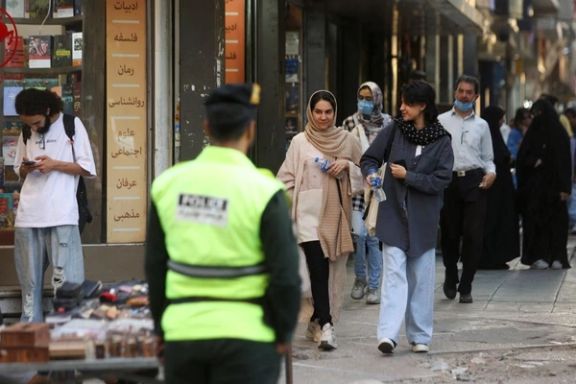
Iranian women walk on a street during the revival of morality police in Tehran, Iran, July 16, 2023.
Iranian police officers violently detained a woman in Tehran on Saturday for non-compliance with mandatory hijab regulations.
The officers singled out the woman, physically assaulted her, and forced her into a police van.
According to videos released on social media, police forces in Shahrak-e Gharb, northwest of the capital Tehran, took the woman out of her vehicle because she was not covering herself in the car.
In recent years, security forces of the regime have detained numerous women and girls across the country for failing to adhere to compulsory hijab, subjecting them to physical abuse and harassment.
Despite restrictive legislation and the Islamic Republic's efforts to suppress opponents of mandatory hijab, the struggle for women in Iran to secure the right to choose their attire continues.
Since the killing of 22-year-old Mahsa Amini in police custody in September 2022, which ignited the Women, Life, Freedom protests, the act of civil disobedience has become increasingly difficult for the regime to control. Daily images of women without compulsory hijab continue to circulate online.
According to the annual report by HRANA, a human rights organization, in 2023, 44 women were detained for women's rights activism. At least 20 activists have been sentenced to 182 months of imprisonment in addition to fines. Two individuals have also received a sentence of 222 lashes.
Dollar and euro banknotes at a money exchange in Tehran
Iran’s rial has fallen around 5 percent since early January, with a notable decline in the past three days, following US and UK strikes on Tehran’s Houthi allies.
The rial fell from 505,00 On January 2 to 530,000 against the US dollar and to 581,000 against the euro on Saturday, as uncertainty grew about a military escalation in the region.
Yemen’s Houthis have been attacking international commercial vessels in the strategically important Red Sea region since mid-November. They began firing missiles and drones and engaged in ship hijacking after Iran’s Supreme Leader Ali Khamenei called for blockading Israel in early November.
The United States and several allied countries formed a naval coalition and warned the Houthis to stop the attacks. After the Houthis dismissed the warnings, US and UK warplanes and warships launched attacks this week against dozens of military targets in Yemen.
The Iranian currency has fallen more than 12-fold since 2018 when the United States withdrew from the JCPOA nuclear deal and imposed oil export and banking sanctions on Tehran. Although illicit oil shipments to China have risen since 2021, the Iranian government still faces severe financial pressures. Annual inflation hovers around 50 percent and rial’s depreciation will push consumer prices higher.
The Biden administration has said that it does not want to engage in military escalation, but the continued Iranian proxy attacks in the region pushed Washington to respond to the Houthis.
An aircraft takes off to join the US-led coalition to conduct air strikes against military targets in Yemen, aimed at the Iran-backed Houthi militia that has been targeting international shipping in the Red Sea, January 12, 2024.
The limited responses from Iranian officials to the US and UK's attacks on Houthi targets in Yemen have largely consisted of typical rhetoric from the regime.
So far, Iran's Foreign Ministry Spokesman Nasser Kanaani has provided the most "critical" response to the Western air strikes. He strongly condemned the military action and claimed that they only divert attention from the "crimes" in Gaza and "have no result other than fueling insecurity and instability in the region."
In a reaction that can be evaluated as relatively mild, Iran’s Foreign Minister Hossein Amir-Abdollahian wrote on X that Houthis are committed to maritime and shipping security in the region.
Since mid-November Iran’s Yemeni proxies have launched dozens of missile and drone attacks against international commercial vessels in the Red Sea, after the Supreme Leader in Tehran called for a blockade of goods to Israel.
“Instead of a military strike on Yemen, the White House should immediately end all military and security cooperations with Tel Aviv against the people of Gaza and the West Bank,” stated Amir-Abdollahian, adding that only then, security will be restored across the region.
Iran’s Supreme Leader Ali Khamenei and top IRGC commanders have not yet made any comments on the strikes.
Newly recruited fighters who joined a Houthi military force intended to be sent to fight in support of the Palestinians in the Gaza Strip, march during a parade in Sanaa, Yemen December 2, 2023.
Likewise, state-sponsored media in Iran have also provided limited reporting on the events in Yemen, mostly repeating stereotypical statements made by the Islamic Republic, Houthi officials, and Tehran’s allies in the region.
IRNA, the Iranian state news agency, covered the condemnation of the attacks by Syria, Oman and Iraq’s Hezbollah, a Tehran-backed militant group.
In an article released on Friday, IRNA called the US and UK airstrikes against Houthi targets “the escalation of tensions by cowboys,” warning that the offensives “can further complicate the spiral of instability in the region and increase the risk of expanding the war.”
Other state-sponsored and military-affiliated news agencies in Iran such as Fars, Mehr, and Tasnim, have adopted a similar stance by reiterating the familiar “the enemy will be conquered” rhetoric while avoiding any straightforward pledge regarding the Islamic Republic’s direct interference in support of Houthis.
Tabnak news website, reportedly owned by Mohsen Rezaei, a former IRGC commander, conducted an interview with Heshmatollah Falahatpisheh, a former lawmaker. Falahatpisheh, who once served as the head of the National Security and Foreign Policy Committee of the Iranian parliament, claimed that Saudi Arabia greenlit the recent attacks on Yemeni Houthis.
Citing Saudi Crown Prince Mohammed Bin Salman, Falahatpisheh stressed that Riyadh is still willing to normalize relations with Israel despite the war in Gaza.
Relatively independent media in Iran, nonetheless, can be said to adopt a more analytical approach toward the escalation of the tensions in the region. KhabarOnline news website predicted on Saturday that the Islamic Republic will not enter the war as it is “mired in complex internal issues” that it has yet to resolve.
The tension and conflict in the Red Sea will continue “on a normal, and not very heavy, scale,” added the report by Khabaronline, further noting that the US, Britain, and NATO will avoid a full-scale, long-term, ground war against Houthis as they believe it will benefit Russia and China.
Meanwhile, Fereydoun Majlesi, a former Iranian diplomat, said that the recent strikes in Yemen were predictable because targeting commercial vessels in the Red Sea affected a large variety of players across the region and the whole world.
“The Red Sea is not just a cargo route for Israel’s port of Eilat, but a transit route for oil and other commodities to go through the Suez Canal,” Majlesi told Rouydad24 news website, adding that US President Joe Biden has been under the pressure of the Republicans to respond to the Houthis.
The most controversial stance among Iran’s relatively independent media belonged to Donya-e-Eqtesad daily which covered the attacks against the Houthis under the headline, “The US Sealed Yemen’s Fate.” Kayhan daily, the regime's most uncompromising media outlet, severely criticized Donya-e-Eqtesad's title, saying it shows that some newspapers that serve the US and NATO's interests are still active in Iran.
Biden issued a veiled threat to the Islamic Republic following the strikes. Asked by a reporter if he had a message for Tehran in the light of the attack, Biden said “I’ve already delivered the message to Iran. They know not to do anything.”
We will continue “to fulfil our duties with regard to Palestine” despite the efforts by Washington and London to protect Israeli and Israel-related ships in the region, Abdul-Malik al-Houthi stressed, adding that Houthis will do “what is necessary” in the case of a “direct confrontation” with the US.
People stuck in snow on Chalus Road, linking the capital Tehran to the Caspian Sea coasts (January 2024)
Heavy snowfall and rainfall are causing significant disruptions in 11 provinces across Iran, intensifying concerns about potential road closures and transportation challenges.
The weather development is critical as it comes amid heightened anxieties over a prolonged drought in the country.
Ahmad Shirani, Chief of Information and Traffic Control Center of the Police, confirmed on Saturday that snowfall and rainfall have affected highways in East Azarbaijan, West Azarbaijan, Kordestan, Ardabil, Mazandaran, Alborz, Zanjan, Tehran, Lorestan, Kermanshah, and Hamedan provinces. He urged citizens to avoid unnecessary travel to ensure safety during adverse weather conditions.
The Meteorological Organization issued a red-level warning for heavy snowfall, signaling the potential for blocked transportation routes in four provinces. Hamedan province, in particular, reported significant snowfall in some areas, compounding challenges for residents and authorities.
Prior to the recent weather events, the spokesperson for the water industry, Isa Bozorgzadeh, stated in a press conference on Monday that Iran is experiencing its fourth consecutive dry year, with the country's precipitation in the current water year measured at 48.2 millimeters showing a 40% shortfall from the required 80 millimeters for normal conditions.
The usually wetter northern provinces are also experiencing inadequate rainfall.
Between mid-March and April 2018, extensive flash flooding wreaked havoc in numerous regions of Iran. Over a span of two weeks, Iran faced three significant waves of rain and flooding, causing inundation in at least 26 out of the country's 31 provinces killing at least 70.
It is crucial to note that the floods experienced in 2018 provided only temporary respite, emphasizing the need for a sustained period of precipitation extending over several months to bring substantial relief this year.
Iran's ruler Ali Khamenei kissing Qasem Soleimani, the slain commander of IRGC's extraterritorial Quds (Qods) force
Mohammad Shirazi, the head of the military office of Iran’s Supreme Leader, has praised the “achievements” of Qasem Soleimani, the slain head of IRGC Quds Force.
Only a fraction of Soleimani’s activities have been revealed, said Shirazi on Saturday, further stressing that “nobody” knows what the slain IRGC commander did except for Supreme Leader Ali Khamenei.
It is not unprecedented for those in the inner circle of power in the Islamic Republic to employ a magniloquent and sycophantic rhetoric to praise Khamenei and Soleimani to guarantee their upward mobility on political and economic ladders within the theocratic establishment.
Soleimani, the Iranian regime’s top military and intelligence operative in the Middle East, was killed in a US drone strike in January 2020 in Iraq.
Via a costly and extensive propaganda campaign, the Islamic Republic has tried to promote the image of Soleimani as a national hero.
However, many Iranians view the slain IRGC commander as a destructive figure, labeling him a master terrorist, echoing the terminology used by the United States. Some critics argue that his primary focus was on developing Iran’s regional militant proxy networks rather than addressing domestic concerns.
Earlier in the month, Markus Rosch, the Istanbul-based correspondent for the German public TV station ARD, sparked anger over his report that claimed all Iranians worship Soleimani.
“Every Iranian, whether opposition or not, worships him as a hero,” he had told millions of viewers watching the popular ARD Tagesschau news program. Rosch’s comment about a man accused of fomenting bloodshed in the Middle East triggered widespread outrage on social media, prompting Rosch to apologize.
Regime-sponsored demonstrators burn US, British and Israeli flags during a gathering in support of Yemen in front of the British embassy in Tehran on January 12, 2024.
Iranian Foreign Minister Hossein Amir-Abdollahian has praised the actions of the Houthi rebels in Yemen, describing their attacks as "commendable."
In a statement on X, he asserted that the Houthi group is "fully committed to maritime security and shipping," despite their repeated attacks on commercial vessels.
Amir-Abdollahian went further to call on the White House to halt its "comprehensive military and security support" for Israel in its conflict with Hamas, suggesting that redirecting the support would contribute to "restoring security across the entire region."
Earlier, Naser Kanaani, spokesperson for the Ministry of Foreign Affairs of the Islamic Republic, condemned the US and British attacks on the Houthis, denouncing them as "a self-serving act, a clear violation of Yemen's sovereignty and territorial integrity, and a breach of international laws and rights."
On Friday evening, supporters of the Islamic Republic gathered outside the British Embassy in Tehran, vocalizing their discontent with the United States and Britain.
Citing financial and arms support from the Islamic Republic to the Houthi rebels, the United States and its allies hold Tehran responsible for the recent attacks on vessels in the Red Sea.
UK Defense Secretary Grant Shapps, in a message to Iran, demanded an immediate cessation of support for the Yemeni Houthi militants, amid the ongoing conflict involving Israel and Gaza. The call coincides with coordinated airstrikes targeting over 60 Houthi sites in Yemen, indicating an intensified international response to the escalating tensions in the region.
In a related context, Linda Thomas-Greenfield, the United States Ambassador to the United Nations, asserted on Friday that without Iran's support, the Houthi militants lack the capability to carry out attacks on commercial ships.