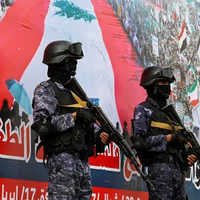
UN Chief 'Strongly Condemns' Attack On Soleimani Ceremony
United Nations Secretary-General Antonio Guterres "strongly condemned" the bombing of the ceremony in Iran to honor former Iranian top commander Qassem Soleimani.
"The Secretary-General strongly condemns the attack today on a memorial ceremony in Kerman City in the Islamic Republic of Iran, which reportedly killed more than 100 people and injured many more," said Florencia Soto Nino, associate spokesperson for the Secretary-General.
"The Secretary-General calls for those responsible to be held accountable," added Soto Nino.
According to reports from the US-based Human Rights Activists News Agency (HRANA), government officials stepped in to ban the gathering.
Arak is one of eight major Iranian cities grappling with severe air pollution. Despite this, the authorities in the central province recently approved the re-use of mazut in the Shazand power plant, sparking concerns among the populace.
In response to the decision, several professors from Arak University issued a call to cease the use of the highly polluting fuel. In a statement, they emphasized that the burning of mazut in the Shazand power plant "poses a serious threat to the health of over a million residents of Arak and Shazand."
It was the second protest against air quality in events days. Last Tuesday, hundreds of residents in Ardakan, Yazd province, took to the streets to express their discontent with the air quality in their city.
The longstanding practice of using mazut in industries and power plants during the second half of each year, attributed to a gas shortage, has raised environmental and health concerns among the Iranian populace.
Hamas deputy leader Saleh al-Arouri during a reconciliation deal signing ceremony in Cairo, Egypt, October 12, 2017
The Islamic Revolutionary Guard Corps (IRGC) issued a condemnation regarding the killing of Saleh al-Arouri, a senior Hamas official.
Al-Arouri, serving as Hamas's deputy leader abroad, was targeted in an alleged Israeli strike in Dahiyeh, a Hezbollah stronghold in Beirut on Tuesday, part of the Jewish state's mission to destroy the UK designated terror group after the October 7 invasion.
The IRGC's statement claimed that attempts to “rectify the defeat on [October 7] through acts of assassination and crime are futile. The Zionist regime, currently facing challenges, is deemed incapable of distorting the resistance's strategic calculations through such actions,” disregarding the fact that since the attacks, Gaza has been devastated by Israel's relentless retaliation and dozens of its top commanders assassinated.
Naser Kanaani, Iran's Foreign Ministry spokesman, also condemned Israel's "despicable" actions, labeling them as killings that will serve to further motivate the region to resist Israel. Despite the condemnation, Iranian government websites provided minimal coverage of the event on Wednesday as the regime marked the fourth anniversary of the death of former IRGC Quds Force Commander Qasem Soleimani, killed in a US drone strike on January 3, 2020.
Al-Arouri, a founding member of Hamas's military wing, had overseen the group's operations in the West Bank and spent nearly 18 years in Israeli prisons since the early 1990s. Residing in Lebanon since 2018, he was known for his close ties to both Hezbollah and Iran. His West Bank home was also flattened in the wake of the October 7 attacks.
Since the October 7 invasion led by Iran-backed Hamas into Israel, resulting in the loss of 1,200 lives, predominantly civilians, and the abduction of over 240 more, Iran's proxies have been activated across the region.
Attacks on both Israel and US facilities across the region have intensified, Iranian proxies in Yemen, Lebanon, Iraq, and Syria claiming to stand in support of Hamas, culminating in the worst crisis witnessed in recent years.
Iran's Yemeni proxy, the Houthis, have implemented a blockade of the Red Sea and surrounding area, leading to a more than 20-nation coalition being formed by the US to counter the threat to global trade routes.
Ahmad Vahidi, the Minister of Interior in the Islamic Republic, addressed the public following the death of scores of people and the injury of over 250 in the blasts near the burial site of Qasem Soleimani.
Vahidi stated, "The situation in Kerman is normal, and everything is under control. People should not worry because our security and military forces are vigilant and prepared."
According to him, the majority of the casualties from the incident occurred during the second explosion.
He warned that the military and security forces of the Islamic Republic would retaliate.
People at Kerman's cemetery to honor IRGC-Quds Force commander Qasem Soleimani, who was killed in 2020
Ninety-five people were killed and 211 injured after two explosions occurred near the grave of IRGC commander Qasem Soleimani on his fourth death anniversary.
Iranian state television reported a first and then a second explosion at the cemetery in the southern city of Kerman during the ceremony held to mark the 2020 killing of the top IRGC commander in a US drone attack at Baghdad airport.
Iranian officials have made conflicting statements since the incident. The mayor of Kerman and some government-controlled media claimed that the explosions were due to gas blasts, while others said it was a suicide attack, and yet other officials said bombs were placed on the road to the cemetery.
Local media reported that the condition of some of those injured was critical, while one emergency medical staff member, who was rushing to the scene after the first explosion, was killed by the second blast.
The number of casualties, first reported as 20 dead climbed quickly, as local media put the latest number at 103 people killed and more than 170 injured in the incident. However, it remains unclear if all the casualties were due to the explosions or a stampede that reportedly followed the incidents.
The semi-official Nournews said soon after the incident that "several gas canisters exploded on the road leading to the cemetery and relevant authorities are monitoring the situation".
However, later reports spoke of four explosions and a hardliner member of parliament blamed Israel for what he said was a terror attack conducted with suicide belts. Semi-official media reported that two bombs were placed in separate bags.
In more than two decades at the head of the IRGC’s Quds forces, Soleimani managed to create a loose but effective coalition of forces spanning from Yemen to Lebanon, all with domestic interest but united in their enmity towards Israel and the US.
Follow our Live Blog for latest related developments