• العربية
  • فارسی
Brand
  • Iran Insight
  • Politics
  • Economy
  • Analysis
  • Special Report
  • Opinion
  • Podcast
  • Iran Insight
  • Politics
  • Economy
  • Analysis
  • Special Report
  • Opinion
  • Podcast
  • Theme
  • Language
    • العربية
    • فارسی
  • Iran Insight
  • Politics
  • Economy
  • Analysis
  • Special Report
  • Opinion
  • Podcast
All rights reserved for Volant Media UK Limited
volant media logo

New tool helps Iranian fans display Lion and Sun flag at World Cup

Jun 8, 2026, 10:08 GMT+1

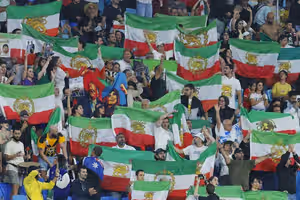
A group of Iranian activists has launched a digital platform designed to display the Lion and Sun flag and political messages inside 2026 World Cup stadiums after FIFA restricted the symbol’s entry, according to comments by a former national boxing team captain.

The platform, called IranSync, synchronizes the screens of mobile phones held by spectators to create large coordinated images and messages across sections of a stadium, Salar Gholami told Iran International.

“We created a system that allows people to display unified images and messages without bringing physical banners or flags into the stadium,” Gholami said.

According to Gholami, users do not need to install an application and can access the service through the IranSync website. After participants register, the system generates a design based on the number of people taking part, allowing neighboring phone screens to form a larger image.

Gholami said the platform can be used to display the Lion and Sun flag as well as slogans including “Free Iran,” “Reza Pahlavi,” and “Regime Change for Iran.”

Alternatives after FIFA restrictions

The launch follows efforts by some members of the Iranian diaspora, particularly in the United States, to challenge FIFA’s decision to bar the Lion and Sun flag from World Cup venues and to find alternative ways of displaying the symbol during matches.

Gholami said the project aims to attract international media attention to developments in Iran and prevent the issue from being overshadowed by coverage of the World Cup.

“The presence of international media at the World Cup creates an opportunity to amplify the demands of protesters and bring the voice of the Iranian people to a global audience,” he said.

The 2026 World Cup will be hosted by the United States, Canada and Mexico, with Iran’s matches scheduled to take place in the United States.

Gholami argued that supporters of the Islamic Republic could seek to use the tournament to improve the regime’s international image, adding that Iranian communities abroad should organize their own visibility campaigns.

During the 2022 World Cup in Qatar, the Islamic Republic sought to prevent the voices of protesters in the Woman, Life, Freedom uprising from being heard in stadiums by sending large numbers of its supporters to the country.

The United States has issued visas to Iran's national football team players and coaching staff, but some members of the delegation have not been granted entry permits.

Most Viewed

Delayed burial, absent successor: Questions over post-Khamenei Iran
1

Delayed burial, absent successor: Questions over post-Khamenei Iran

2

Student protests over university entrance exam rules continue across Iran

3
ANALYSIS

From banks to blockchains: US opens new front in Iran sanctions

4

Iran student protests widen over final exams and university entrance rules

5
INSIGHT

Iran turns to LA-based singer for state-backed religious event

Banner
Banner

Spotlight

  • Delayed burial, absent successor: Questions over post-Khamenei Iran

    Delayed burial, absent successor: Questions over post-Khamenei Iran

  • Iran turns to LA-based singer for state-backed religious event
    INSIGHT

    Iran turns to LA-based singer for state-backed religious event

  • From banks to blockchains: US opens new front in Iran sanctions
    ANALYSIS

    From banks to blockchains: US opens new front in Iran sanctions

  • Can Trump crack Iran's negotiating playbook?
    PODCAST

    Can Trump crack Iran's negotiating playbook?

  • Explained: Iran's frozen assets around the world

    Explained: Iran's frozen assets around the world

  • Iran’s lion-and-sun flag at center of FIFA row before 2026 World Cup

    Iran’s lion-and-sun flag at center of FIFA row before 2026 World Cup

•
•
•

More Stories

Student protests over university entrance exam rules continue across Iran

Jun 7, 2026, 15:11 GMT+1
Student protests over university entrance exam rules continue across Iran
100%
Students in Kermanshah, western Iran, gather outside the Kermanshah provincial directorate of education.

Student protests over Iran’s university entrance exam system continued on Sunday, spreading across at least 20 provinces as pupils demanded changes to rules that give school grades a decisive role in university admissions.

Videos received by Iran International showed students in the northeastern city of Mashhad chanting: “We have heard many promises, but seen no result,” and “If our problem is not solved, there will be protests every day.”

Other videos from the central city of Isfahan showed students chanting: “Student, shout, cry out for your rights.”

The protests, which began in late May in western and central Iran, initially focused on how final exams were being held. They later grew into a broader demand to cancel the fixed impact of 11th-grade GPA scores on the national university entrance exam, or at least change it to a positive-only effect.

Iran’s national university entrance exam, known as the konkur, is a highly competitive test that plays a major role in determining access to higher education and future career prospects.

Students say repeated changes to exam rules, the role of school grades in admissions and the way final exams are being held have placed heavy psychological and academic pressure on them.

Abdolvahed Fayyazi, a member of parliament’s Education and Research Committee, told the semi-official ILNA news agency that responsibility for the entrance exam decision lies with the Supreme Council of the Cultural Revolution, a powerful state body that sets major education and cultural policies in Iran.

He said the council continued to insist on including school grades in the entrance exam process.

Fayyazi urged protesting students to “give up the protests and go study,” saying “there is no other choice and protests are useless.”

The protests have reached at least 20 provinces, including Tehran, Isfahan, Khuzestan, Fars, Razavi Khorasan, Sistan and Baluchestan, Gilan, Lorestan, Mazandaran and Yazd.

They have also spread to cities including Tehran, Isfahan, Mashhad, Shahrekord, Khorramabad, Arak, Qom, Yazd and Saveh.

Reports from some cities said security forces confronted protesters, injuring several students and arresting at least one person.

Students had previously gathered outside the Education Department in Mashhad, demanding the resignation of Abdolhossein Khosropanah, secretary of the Supreme Council of the Cultural Revolution.

Khosropanah defended the policy in an interview with Iranian state television on Sunday, saying members of the council had reached a consensus on keeping the decisive role of 11th- and 12th-grade academic records in the 2026 entrance exam.

He also accused “most” of the protesters of being linked to the “konkur mafia,” a term Iranian officials use to refer to private tutoring and exam-preparation businesses that profit from the university entrance system.

The remarks drew criticism from students, who said the accusation ignored the real concerns of pupils facing repeated policy changes, exam pressure and uncertainty over their educational future.

Khosropanah acknowledged that some demands, including those of repeat entrance exam candidates and students seeking to improve their grades, could not be dismissed.

He said proposals including more opportunities to improve grades, single-subject grade improvement and changes to exam scheduling would be reviewed.

Students say their generation has already faced school closures, online learning, social crises and repeated changes to education rules, and should not have to pay the price for sudden and contradictory decisions by officials.

They have said the protests will continue until their demands are addressed.

Inside Rasht's bloody crackdown: witnesses detail secret removals of bodies

Jun 6, 2026, 17:16 GMT+1
•
Farnoosh Faraji
Inside Rasht's bloody crackdown: witnesses detail secret removals of bodies
100%

Security forces opened fire on protesters, blocked medical aid and secretly removed bodies as they crushed demonstrations in Rasht, northern Iran, during January’s nationwide uprising, eyewitness accounts and documents sent to Iran International show.

Witnesses described security forces shooting at protesters, blocking aid to the wounded, demanding money from families before returning bodies, and pressuring relatives to hold secret burials and avoid public ceremonies.

The new accounts add to an Iran International public documentation campaign that has gathered testimony saying protesters in Rasht were driven into narrow market passages, trapped as fire spread and fired upon by security forces during January’s unrest.

The morning of Jan 9: a city in smoke, blood and fire

One eyewitness told Iran International that around 5 a.m. on January 9, heavy smoke and fire were still rising in the municipality area of Rasht.

The witness said streets leading to the municipality, including Namjoo Street, Imam Street, Shahrdari Street and the route from the bazaar toward Saqlan Square, were badly damaged and parts of the city had burned.

“On the morning of January 9, the city smelled of smoke. Traces of blood were clearly visible on Shahrdari and Saadi streets. The bloody handprints of protesters were on the city walls. Basijis in Sabzeh Meydan Square were busy erasing slogans with spray paint, and large parts of the bazaar had completely burned,” the witness said.

Bodies moved in pickup trucks and garbage trucks

An eyewitness told Iran International that on the morning of January 9, several municipal pickup trucks left Shahrdari Street, and the bodies of some of those killed were in the back of one vehicle, covered with cloth.

Iran International has also received multiple reports indicating that the bodies of some of those killed in Rasht were collected with garbage trucks and secretly transferred.

Witnesses said some wounded people were also among the bodies transferred to Bagh-e Rezvan cemetery in Rasht.

A source said one wounded person who had been transferred to Bagh-e Rezvan along with the bodies managed to escape and hid for a while in a nearby forest.

Transfer of bodies to an unmarked warehouse

New information received by Iran International shows that on January 8 and 9, the bodies of some of those killed in Rasht were transferred to a warehouse on Tehran Road, between Bagh-e Rezvan and Saravan.

The warehouse was painted red, white and green and had no specific sign or official marking.

The bodies were kept there temporarily before burial or transfer to other locations.

Witnesses describe DShK machine gun fire on protesters

Witnesses told Iran International that security forces used heavy weapons including DShK machine guns against people who had entered parts of the city’s military areas.

According to the accounts, the area around the Rasht governor’s office was one of the main sites where protesters were killed on January 8 and 9.

One eyewitness said Basij and Revolutionary Guards forces directed the crowd toward the governor’s office, placing protesters on a route where their ability to leave or retreat was limited.

The witnesses said armed forces shot at people after the gates of the governor’s office were opened.

The accounts indicated that the crackdown in Rasht was not limited to streets around the municipality, the bazaar, Namjoo Street and Sajjad Clinic, and that the area around the governor’s office was also a key site of shootings and killings.

Families told to pay for slain protesters’ bodies

Sources told Iran International that slain protesters' families faced severe security pressure.

Some families were asked to pay money to receive the bodies of their children, with the amount depending on the family’s financial situation, according to the accounts.

Some families were asked for several billion rials, equivalent to several thousand dollars, and in some cases more than 10 billion rials, or over $5,700 at the open-market rate, the sources said.

An eyewitness said one family was told to bring a box of sweets along with the payment before they could receive their loved one’s body.

The witness said the request was part of a humiliating process of dealing with the survivors.

Families forced into secret night burials

Witnesses told Iran International that the families of some slain protesters were not allowed to wash their loved ones’ bodies, a standard Islamic burial rite performed before burial.

One eyewitness said security agents told a family the victims were “ritually impure” and had to be buried as they were, bloodied and still in their clothes.

According to witness accounts, burials were often carried out late at night or near dawn, with a limited number of family members present and under pressure from security forces.

The burial place of many of the victims is in the far sections of Bagh-e Rezvan in Rasht.

Families said they were repeatedly humiliated and threatened while receiving and burying the bodies.

Iran student protests widen over final exams and university entrance rules

Jun 6, 2026, 12:33 GMT+1
Iran student protests widen over final exams and university entrance rules
100%
A scene of student protests in Iran

High school students in about 20 Iranian provinces have held protests against education policies, final exam rules and changes affecting the national university entrance exam, with some gatherings met by violence and arrests.

The protests, which began in late May in western and central Iran, initially focused on how final exams were being held. They later grew into a broader demand to cancel the fixed impact of 11th-grade GPA scores on the national university entrance exam, or at least change it to a positive-only effect.

Students have protested in West Azarbaijan, Isfahan, Tehran, Chaharmahal and Bakhtiari, Razavi Khorasan, North Khorasan, Khuzestan, Zanjan, Sistan and Baluchestan, Fars, Qazvin, Qom, Kohgiluyeh and Boyer-Ahmad, Gilan, Lorestan, Mazandaran, Markazi and Yazd provinces.

In Yazd, several students were injured during clashes at a protest. In Qom, at least one person was arrested. In Saveh, education department staff clashed with protesters.

Students in Shahrekord, Chaharmahal and Bakhtiari province, gathered on Saturday alongside students in other provinces and chanted against education policies, including: “Student, cry out! demand your rights” and “Incompetent official we don’t want you.”

A video sent to Iran International showed students in Tehran gathering outside the Supreme Council of the Cultural Revolution to protest its decisions on the university entrance exam. They chanted: “Justice, education, our undeniable right.”

Earlier in June, students in Khorramabad gathered outside Lorestan’s education department and demanded transparency over the holding of exams. Similar gatherings were reported in Arak and Isfahan, where students protested in-person exams and poor educational conditions.

The protests reached a peak this week in Tehran, when a group of 11th- and 12th-grade students gathered outside the Ministry of Education to oppose the fixed impact of 11th-grade GPA scores on university entrance results.

Students held banners reading “Hear the voice of Iran’s students” and demanded that the policy be scrapped or changed to a positive-only effect.

Dozens of students have sent messages to Iran International criticizing uncertainty in education policy, saying repeated changes to exam and entrance rules have placed heavy psychological pressure on them.

They say the current generation of university applicants has already faced school closures, online education, social crises and repeated changes to education rules, and should not be harmed again by another shift in entrance exam policy.

Can Trump crack Iran's negotiating playbook?

Jun 5, 2026, 21:20 GMT+1
•
Negar Mojtahedi
Can Trump crack Iran's negotiating playbook?
100%
US President Donald Trump points his finger during a cabinet meeting in the Cabinet Room at the White House, in Washington, D.C., US, May 27, 2026.

As US-Iran talks stall over Tehran's demand for billions of dollars in frozen assets, the Trump administration faces a familiar challenge: whether it can force a deal before Iran's long-standing strategy of delay reshapes the terms of negotiation.

A senior Iranian official told CNN on Friday that a potential agreement hinges on Washington releasing $24 billion in frozen Iranian funds, warning the United States would enter a "dark corridor" if it resumes military action.

The comments came as Iran also tied the future of a broader peace arrangement to developments in Lebanon, Hezbollah and the reopening of the Strait of Hormuz.

For President Donald Trump, the standoff is testing whether his mix of pressure, unpredictability and military force can break a negotiating playbook that has frustrated successive US administrations.

"The Islamic Republic gets a vote here too," Jason Brodsky, policy director at United Against Nuclear Iran, told Eye for Iran. "The Iranian regime plays a much longer game than the United States does in terms of its strategic patience and strategy."

Brodsky said Iran has historically used prolonged negotiations to wear down international demands, pointing to how the original US position of zero enrichment eventually gave way to the 2015 nuclear deal's limited enrichment framework.

But he argued Trump has changed the baseline by demonstrating a willingness to use force.

"For the first time in decades, the Islamic Republic is not enriching uranium," Brodsky said, crediting US and Israeli military action with changing the facts on the ground.

Can Trump outlast Tehran's long game?

Former US diplomat Alberto Fernandez said Trump may possess an advantage previous administrations lacked: the ability to walk away from a deal while maintaining pressure.

"No deal is better than a bad deal," Fernandez said, arguing that Trump could refuse sanctions relief, maintain the blockade and preserve the threat of future strikes if Tehran refuses to compromise.

Still, there are concerns that Iran's strategy may be working in more subtle ways. Tehran has long relied on protracted negotiations to buy time, lower demands and secure concessions incrementally.

Daily Mail special correspondent David Patrikarakos warned that if Iran secures a limited nuclear agreement without restrictions on missiles or regional activity, it could still claim victory.

"If what Iran gets is a ring-fenced nuclear deal, then honestly, it's a defeat and it is a win for the Iranians," he said.

The question is whether Trump can sustain pressure long enough to force a broader agreement—or whether domestic politics, oil prices and regional tensions ultimately push Washington toward a narrower deal.

Is Iran's leverage shrinking?

That question extends beyond the nuclear file.

In Lebanon, President Joseph Aoun delivered a rare public rebuke to Tehran this week, accusing Iran of using his country as a "bargaining chip" in its confrontation with Washington and Israel.

"You are not trying to help us," Aoun told CNN. "The people of Lebanon are paying the price for the sake of your own interest."

He also directed a message to Iran's Islamic Revolutionary Guard Corps: "It's not your country, it's our country."

The comments reflect growing frustration among Lebanese officials who argue their country has paid the price for regional conflicts driven by outside powers.

May Farhat, Iran International's correspondent in Beirut, said Hezbollah is facing one of the weakest periods in its history after major military and political setbacks.

"There is little doubt that Hezbollah is going through one of the most difficult periods in its history," Farhat told Eye for Iran.

She pointed to the killing of senior commanders, the loss of Hassan Nasrallah, tighter border controls and new Lebanese restrictions on Iranian access as evidence that the balance of power inside Lebanon is shifting.

For the first time in years, Lebanese authorities have suspended direct Iranian flights, tightened visa requirements for Iranian citizens and moved to limit Tehran's influence over strategic infrastructure and border crossings.

The weakening of Hezbollah matters because it potentially reduces one of Tehran's most important sources of regional leverage at a moment when Iran is attempting to negotiate from a position of strength.

The Strait of Hormuz represents another test of Iran's leverage.

For decades, the Islamic Republic has used the threat of disruption in the waterway as one of its most powerful strategic tools. But according to Homayoun Falakshahi, who leads Kpler's crude oil analysis team, that leverage may already be eroding.

Falakshahi said oil tanker traffic through the Strait of Hormuz has fallen dramatically since the war and the US blockade on Iranian ports. Before the conflict, roughly 30 oil tankers transited the waterway daily. Today, the average is closer to one or two.

More importantly, he argues that the crisis is accelerating efforts by Gulf states to reduce their dependence on the strait altogether.

Abu Dhabi is already expanding export capacity through Fujairah on the Gulf of Oman, while other producers are exploring alternative routes.

"Five years from now, that leverage that the Islamic Republic currently has probably will not exist anymore," Falakshahi said.

He believes Iran may be overestimating the long-term value of its position.

"They always overplay their hand," he said.

While the disruption of the Strait of Hormuz has demonstrated Tehran's ability to shake global energy markets, Falakshahi argues that the strategy ultimately hurts Iran's own interests by damaging China, its most important oil customer and strategic partner.

"I don't think they have the upper hand," he said. "Even though they want everyone to believe that they have."

For now, Iran is testing the limits: in Lebanon, in the Persian Gulf, at sea and at the negotiating table.

Trump may have disrupted Tehran's playbook. But whether he has cracked it will depend on whether pressure produces a durable agreement—or simply another pause in a decades-long confrontation.

Lebanon becomes a test of Trump's Iran diplomacy

Jun 2, 2026, 01:19 GMT+1
•
Negar Mojtahedi
Lebanon becomes a test of Trump's Iran diplomacy
100%
People, including children, walk along a road, as they make their way while fleeing the southern suburbs of Beirut, after Israeli Prime Minister Benjamin Netanyahu ordered the military to attack targets in the suburbs, Lebanon, June 1, 2026.

By suspending talks with Washington over Israel's campaign in Lebanon, Tehran has raised the stakes of postwar diplomacy and posed a critical question: is it successfully increasing its leverage, or overplaying its hand?

President Donald Trump announced Monday that Israel and Hezbollah had agreed to halt attacks following a flurry of calls with Israeli Prime Minister Benjamin Netanyahu and intermediaries linked to the Iranian-backed group.

Hours earlier, however, Iran suspended talks with Washington, citing Israel's military operations in Lebanon and threatening to open new fronts in the conflict.

The diplomatic turmoil comes as Israel carries out its deepest military operations in Lebanon in more than two decades.

Tehran argues the operations violate the broader ceasefire framework established after the US-Iran war, while critics counter that Iran helped create the crisis by insisting Lebanon be included in ceasefire discussions and then backing Hezbollah attacks that prompted Israel's response.

Turning Lebanon into leverage

For some analysts, Iran's actions suggest a regime that believes it emerged from the war with more leverage than many expected.

"I fear that the Iranians are doing what they're doing because they feel that they have the upper hand," Yaakov Katz, an Israeli-American journalist and author of While Israel Slept, told Iran International.

Katz said Tehran may see itself as having weathered the conflict relatively well. The regime survived, its military remains intact despite significant losses, its nuclear program remains unresolved and Washington is still negotiating with it.

From that perspective, Iran may believe it can broaden the scope of diplomacy beyond its nuclear program and force the United States to account for developments in Lebanon.

That is precisely what concerns Katz.

"It's a disaster to connect the two," he said.

If Washington accepts Lebanon as part of the negotiating framework, Katz argues, Tehran could repeatedly use Hezbollah's confrontation with Israel as leverage whenever future diplomatic disputes arise.

The concern comes as Trump balances two competing objectives: preventing a wider regional war while preserving a diplomatic path with Tehran.

On Monday, Iranian-linked media warned that Tehran could expand pressure to the Bab el-Mandeb Strait, another vital global shipping route, while tensions remain elevated in the Strait of Hormuz. The threats renewed concerns about global energy supplies and the economic fallout from a broader regional confrontation.

The price of Tehran's red lines

Eric Mandel, founder of the Middle East Political and Information Network, believes the Lebanon crisis, threats to maritime shipping and suspension of talks are all part of a broader Iranian strategy.

"This is a coordinated strategy that they are using," he told Iran International. "The biggest part of it is that they are looking to delay."

Mandel argues Tehran is attempting to stretch out negotiations while increasing economic and geopolitical pressure on Washington.

The goal, he says, is to test whether the Trump administration is willing to sustain a prolonged confrontation or whether concerns over oil prices, shipping disruptions and economic instability will eventually force concessions.

He believes Iran benefits from uncertainty.

"I think what Iran wants overall is to create a global recession," Mandel said.

Danny Citrinowicz of Israel's Institute for National Security Studies and former head of the Iran branch in Israeli military intelligence sees the situation somewhat differently.

While Katz and Mandel largely view Tehran's behavior through the lens of leverage and strategy, Citrinowicz argues that ideology remains a central factor.

He says Iran does not view Hezbollah, its missile arsenal and its enrichment program as bargaining chips that can simply be traded away. Rather, they are core pillars of the Islamic Republic.

"They cannot sit aside and not retaliate. That is their mentality," Citrinowicz told Iran International.

From Tehran's perspective, he argues, failing to respond to Israeli operations in Lebanon would amount to abandoning a strategic commitment to Hezbollah and undermining principles the regime considers fundamental to its survival.

That distinction may prove critical as Washington weighs its next move.

For Katz, Iran is attempting to exploit Trump's desire for a deal by transforming Lebanon into a bargaining chip. For Mandel, Tehran is deliberately prolonging the crisis to increase pressure on the United States. For Citrinowicz, Iran's actions are driven less by tactical calculations than by ideological red lines it believes it cannot abandon.

What all three agree on is that Lebanon is no longer a side issue. It has become a central test of the fragile diplomacy between Washington and Tehran.

If Trump pressures Israel to halt operations, Tehran may claim it forced Washington's hand. If he does not, Iran appears prepared to use Lebanon, Hormuz and potentially other fronts to argue that the ceasefire framework has already collapsed.

Either way, Tehran appears willing to increase the costs associated with both diplomacy and confrontation as it seeks to shape the next phase of negotiations.