Canadian PM Stops Short Of Designating Iran's IRGC

Canadian Prime Minister Justin Trudeau addressed concerns about the impact of Iran's Revolutionary Guard Corps (IRGC) during a speech on Wednesday.

Canadian Prime Minister Justin Trudeau addressed concerns about the impact of Iran's Revolutionary Guard Corps (IRGC) during a speech on Wednesday.

Contradicting a statement from the IRGC spokesman, its top commander, Hossein Salami, denied Iran's involvement in Hamas's October 7 invasion of Israel.
“The al-Aqsa Flood operation was completely a Palestinian operation. It was designed and implemented by Palestinians and no decision was made outside of Palestine,” stressed IRGC Commander, Salami, speaking during the funeral service for Razi Mousavi, the IRGC's man in Syria, killed in an alleged Israeli airstrike this week.
“Resistance in Iraq is part of the resistance front [in the region], but acts independently. In Lebanon, Hezbollah acts independently,” Salami went on to say.
However, his comments came a day after Ramezan Sharif, the spokesperson for the IRGC, said the October 7 attack by Hamas on Israel was a retaliatory action for the assassination of Qasem Soleimani, the Iranian regime’s top military and intelligence operator in the Middle East, who was killed in a US drone strike in January 2020 in Iraq.
“The Al-Aqsa Storm was one of the retaliations of the Axis of Resistance against the Zionists for the martyrdom of Qasem Soleimani,” Sharif stated on Wednesday as the contradictions from within the IRGC ranks continued, suggesting Tehran's ongoing denials may be losing traction. Iran has long supported Hamas, with financial and military aid. Last month, Hamas political leader Ismail Haniyeh was in Tehran meeting the Supreme Leader.
The Hamas militant group immediately rejected Sharif’s claim, insisting that the attack on Israel was carried out in response to “Israeli occupation and enduring hostilities against our people and holy sites,” in spite of the fact its top leaders had been in top level meetings with Tehran in the weeks and months leading up to the atrocity.
Trying to unravel the contradictions, on Thursday, Salami openly undermined the IRGC spokesperson’s remarks and said, “We have not yet avenged the assassination of Martyr Qasem Soleimani. We will do this in due time. We sincerely declare what we do and we are not scared.”
Since the beginning of the Israel-Hamas war, the Islamic Republic officials have time and again made contradictory remarks about the conflict. On October 7, the Iranian government immediately praised the invasion and ordered street celebrations, with large banners erected within hours, suggesting Tehran had known in advance of the attacks which killed 1,200 mostly civilians and saw 240 or more taken hostage to Gaza.
However, following the escalation of the conflict and the US move to dispatch its warships to the region, Tehran officials toned down their public rhetoric, with many of them, including Supreme Leader Ali Khamenei, repeatedly denying the Islamic Republic’s role in Hamas’s attack.
Meanwhile, Iran's proxy groups in Lebanon, Iraq, Syria, and Yemen continue to attack Israeli and American targets in the region. Iran's most powerful proxy, Hezbollah, has engaged in the heaviest clashes with Israel for almost 20 years, but has avoided a full-fledged war.
Experts view Hezbollah’s unwillingness to wage an all-encompassing war against Israel as Tehran’s conservative approach to the conflict. Though the Iranian officials vow “great blows” to Israel and the country’s imminent destruction, Tehran has so far refrained from launching any direct attack against Israel and its allies. However, just days ago, the US blamed Iran directly for an attack on a vessel caught up in the maritime front of the war in Gaza.
As recently as Tuesday, an explosion occurred near the Israeli embassy in New Delhi, India. The staff members sustained no injuries in the attack. Though no group has claimed responsibility for the attack, eyes turned once again to Iran and Revolutionary Guard extraterritorial Qods force (IRGC-QF) in the wake of other foiled plots such as one to attack the Israeli embassy in Baku, just a few months ago.

The Commander of Iran's Islamic Revolutionary Guard Corps (IRGC) has vowed revenge for the killing of IRGC commander Razi Mousavi in Syria.
Mousavi was targeted in an alleged Israeli airstrike earlier this week amid the shadow war between the two countries, with his body subsequently brought to Tehran for burial.
Amidst the Gaza war, which commenced on October 7 with Hamas leading the conflict against Israel, Iran-backed militias in Syria, Iraq, Yemen, and Lebanon have also become involved.
In a televised speech, Hossein Salami declared that the retaliation for Mousavi's death would extend beyond conventional measures.
"Our revenge for the martyrdom of Sayyed Razi will be nothing less than the removal of the Zionist regime," Salami said, claiming that he had defended the Muslim nation for almost 33 years.
Mousavi played a pivotal role within the IRGC, known as the IRGC's man in Syria. Thousands of mourners gathered in Tehran's central Imam Hossein Square for Mousavi's funeral, passionately chanting anti-Israel and anti-American slogans. The crowd waved yellow flags bearing the message "I am your opponent," directly targeting Israel.
During the funeral on Thursday, Iran's Supreme Leader, Ali Khamenei, led prayers and paid tribute to Mousavi.

Officials in New Delhi have pledged to hold accountable those responsible for the recent attacks on two merchant vessels predominantly crewed by Indians.
The commitment comes in the midst of ongoing missile and drone strikes in the Red Sea, attributed to Houthi rebels and Iran.
India's response to the incidents in the Red and Arabian Seas, particularly the attacks on MV Sai Baba and MV Chem Pluto follows the incident on the MV Chem Pluto which was targeted by a one-way attack drone a mere 200 nautical miles off the Indian coast. While the Pentagon attributes the attack to Iran, deviating from the majority of strikes originating in Yemen, India has refrained from officially naming the perpetrator.
During the commissioning ceremony of INS Imphal (D68), the third destroyer in the Indian Navy's Visakhapatnam class, Raksha Mantri Shri Rajnath Singh, India's Defense Minister, declared a commitment to retaliatory measures. "Those who have carried out these attacks, we will find them from the bottom of the sea, and strict action will be taken against them," stated Shri Rajnath Singh.
The defense minister emphasized India's role as the "Net Security Provider in the entire Indian Ocean Region" and its commitment to keeping sea lanes open to facilitate expanded regional trade in collaboration with international partners. Singh also attributed the attacks to India's "growing economic and strategic power," suggesting that it has fueled "jealousy and animosity" in certain quarters.

Amid Mideast tensions, Senator Lindsey Graham called on Wednesday for a much harsher approach towards Tehran, suggesting that the US should bomb the IRGC inside Iran.
“I've been saying [this] for six months now,” Graham said on Fox News, “hit Iran. They have oil fields out in the open. They have a Revolutionary Guard headquarters you can see from space. Blow it off the map.”
The Republican Senator's tough position regarding Iran is nothing new. It is serious, however, since it follows a few days of unmistakable escalation in the face off between Israel and the US on one side and Hamas, Iran and its regional allies on the other.
Since Monday, Israel has killed Iran’s top man in Syria; Iran-backed militias have targeted US bases in Iraq, wounding three soldiers, one critically; Yemen Houthis have launched multiple attacks in the Red Sea, forcing the American fleet to shoot down at least 17 drones and missiles; and the US has struck Iran-affiliated positions in Iraq.
On Wednesday, President Joe Biden sent a letter to top Congressional leaders explaining his decision to strike back in Iraq, immediately after it was confirmed that a US serviceman had been critically injured.
"The strikes were intended to degrade and disrupt the ongoing series of attacks against the United States and our partners,” Biden said, “and to deter Iran and Iran-backed militia groups from conducting or supporting further attacks on United States personnel and facilities."
But this is not a response that would satisfy Biden’s Republican critics in the Congress.
“The Biden administration is failing our troops in the field,” said Senator Graham, who is a member of the influential Senate Armed Services Committee. “If you really want to protect American soldiers, make it real to the Ayatollah, you attack a soldier through proxy, we're coming after you.”
Iran-backed groups in Iraq and Syria have targeted US forces more than a hundred times since mid-October. So far, no American soldier has been killed. With every attack, however, criticism of Biden’s policy on Iran has become more extensive and harsher.
Republican presidential candidate Nikki Haley pilloried Biden in a TV interview Wednesday.
“Getting out of Obama's Iran deal sent a message to Iran that America meant business,” she said, hailing Trump’s decision to withdraw from the nuclear agreement with Iran. “Joe Biden falling all over himself to get back into the deal sent a message to Iran that it could walk all over America.”
Haley is one of the more vocal critics of Biden’s Iran policy, not surprising as she aims to be the Republican running against him next year. The current crisis in the Middle East will likely be a central theme in the 2024 campaign, especially since no end is in sight for the war in Gaza or attacks by Iran's proxies.
On Wednesday, Benny Gantz, a member of Israel’s emergency war cabinet, hinted at another war with Hezbollah in Lebanon.
“If the world and the Lebanese government don’t act in order to prevent the firing on Israel’s northern residents, and to distance Hezbollah from the border, the IDF will do it,” Ganz said in a press conference.
Hezbollah is widely believed to be the strongest non-state actor in the region, with an estimated arsenal of more than a hundred thousand missiles. A full-blown war with the group would see thousands added to the more than 20,000 Palestinians killed by Israel since early October.

Iran’s Supreme Leader Ali Khamenei performed funeral prayers on Thursday for Razi Mousavi, a top IRGC commander who was killed in an Israeli airstrike in Syria.
This gesture underscores the high regard Khamenei held for the slain commander, as he typically reserves funeral prayers for those in his inner circle, such as Qassem Suleimani, another key IRGC operative, who was killed in a targeted US air strike in Iraq in 2020.
On Thursday, Khamenei also met with the family of Razi Mousavi and hailed his years of “indefatigable jihad”.
Razi Mousavi (aka Seyyed Razi) was killed by a direct airstrike Monday, believed to have been launched by Israel. He headed IRGC’s ‘logistics’ and military coordination in Syria, getting weapons for and coordinating Iran-backed forces in Syria and Lebanon.
He had been active in Syria for more than 25 years, and had escaped multiple Israeli attempts on his life, according to reports in IRGC-affiliated media.
Iranian regime officials have vowed retaliation against Israel, with one general suggesting that October 7 Hamas attack was already an act of revenge for Soleimani’s killing.
President Ebrahim Raisi pleged that “Israel will face the consequences for Mousavi's death.” Foreign Minister Hossein Amir-Abdollahian stressed that Tel Aviv “must brace for a formidable countdown.”
Following the death of the commander, Iran's proxies in the region have intensified their attacks against Israeli and American targets. The US fleet in the Red Sea intercepted 17 drones and missiles on Tuesday.
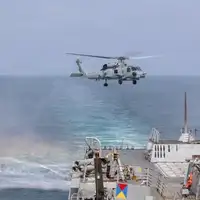
Destroyers and fighter jets from the USS Eisenhower were forced to shoot down “twelve one-way attack drones, three anti-ship ballistic missiles, and two land attack cruise missiles” in the Red Sea –all fired by Iran-backed Houthis in 10 hours, according to the US Central Command.
While he refrained from directly answering Iranian journalist Negar Mojtahedi's questions whether Canada would consider listing the IRGC as a terrorist entity, Trudeau emphasized the government's commitment to monitoring and taking responsible measures against the IRGC's influence.
In response to questions regarding the more than 700 Iranian regime-linked individuals reportedly living freely in Canada, Trudeau stated, "We continue to watch and make sure that we're able to do everything we can that is responsible against the impact of the IRGC." However, he did not explicitly commit to designating the IRGC as a terrorist organization.
Trudeau asserted that Canada would persist in holding the Iranian regime accountable, limiting its global impact, and protecting Canadians. He highlighted the ongoing efforts of security services and police agencies to ensure the safety of Canadians.
The Prime Minister's remarks come against the backdrop of increased scrutiny on the IRGC following the downing of the PS752 Ukrainian passenger airliner in January 2020, resulting in the loss of Canadian lives. Despite calls from the Iranian Canadian community, Trudeau has not committed to labeling the IRGC as a terrorist group, citing factors such as mandatory military service that compel some Iranians to join the organization.
Critics argue that existing measures, including expanded sanctions and amendments to the Magnitsky legislation, are insufficient to address the issue of regime-connected officials residing in Canada. The debate surrounding the designation of the IRGC continues, with members of the diaspora expressing concerns about accountability for crimes committed abroad by those holding Canadian citizenship.