Iran, Saudi Arabia Mulling Direct Scheduled Flights

Iran and Saudi Arabia will start formal talks next week to resume direct scheduled flights between Tehran and Riyadh and other cities, an Iranian official said.
Iran and Saudi Arabia will start formal talks next week to resume direct scheduled flights between Tehran and Riyadh and other cities, an Iranian official said.
"There are no restrictions regarding the launch of direct flights from Tehran to Riyadh, or other cities," Deputy Minister of Roads and Urban Development Mohammad Mohammadibakhsh told the state-affiliated news agency ILNA on Sunday.
Regular flights would be another step towards restoring ties between the two Middle Eastern rivals. A Chinese-mediated agreement in March restored diplomatic relations after years of tension that threatened the security of the entire region and fueled conflicts in Iraq, Syria and Yemen.
"A bilateral working group will start final negotiations next week to have non-haj flights between the two countries," he said, referring to the annual Muslim pilgrimage to the holy city of Mecca in Saudi Arabia.
There have been no regular direct flights between the two countries for years. Currently, only occasional direct flights take off from Iran carrying haj pilgrims.
Mohammadibakhsh said a resumption of flights would include travel for pilgrims of the year-round Umrah -- which can be undertaken at any time year -- and also non-religious travel.
Iran had already presented a list of airline companies which might operate flights, he said, but did not specify any.
Shiite-dominated Iran and Sunni Persian Gulf monarchy Saudi Arabia cut ties in 2016 over Saudi Arabia's execution of a Shiite Muslim cleric and the subsequent storming of Riyadh's embassy in Tehran.



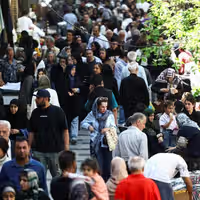


Controversy has erupted in Iran after hardliners demanded specifically designed gowns conforming to hijab rules to be made compulsory in hospitals and operating rooms.
Twelve versions of Islamic surgical gowns have been designed for female patients in the operating room to comply with Sharia rules, announced Mohammad-Hossein Taheri-Akerdi, the secretary of a state body responsible for promotion of Islamic standards, whose main concern has always been promotion of hijab.
Taheri-Akerdi said Tuesday that the standard clothing currently worn by patients in hospitals violates women’s “dignity” and responsible government bodies have been instructed to identify the standards of religiously required and forbidden aspects in respect to “hijab and chastity” in hospital environments.
The entity that Taheri-Akerdi represents is a state-funded organization with a budget of 1.25 trillion rials (around $2.5m) in the current fiscal year, with an increase of 125 percent compared to the previous year. An even higher budget is expected to be allocated to the organization for the next year.
Not only those who oppose the compulsory hijab, but also many religious people are against the various measures that religious fundamentalists are employing to enforce the hijab rules.
“One feels like standing in front of a hidden camera and waiting for someone to say that this [situation] is just a joke, but no, these are Taheri-Akerdi’s exact words,” a commentary by Mostafa Danandeh a regular contributor to the conservative Asr-e Iran news website said.
“I don't know how upsetting the reading of these news must be for patients and their families who are dealing with the problems of finding their medication, hospital admission and its costs these days. They see that there are people in this country who are looking for Islamic surgical clothes instead of worrying about availability of medicine and the conditions of hospitals,” he wrote.
He added that he thinks the entity that seriously needs reform is the same organization that needlessly tries to impose obscure religious standards and trying to anger people with its decisions.
Some clerics and Islamic scholars such as Ayatollah Seyed Mohammad-Ali Ayazi, a member of a reformist clerical association in Qom, have also criticized the demand for Islamification of hospital gowns.
In an interview with Salamat News (Health News) Thursday, Ayazi criticized fundamentalists and said from the religious point of view demanding Islamic hospital gowns to be designed is a matter of minimal importance when both doctors and patients must deal with such serious problems as shortages of medicine and equipment.
Some media and social media users have pointed out that there may be a hidden agenda in the official’s declaration about unsuitability of current hospital gowns and need for designing Islamic ones.
“But the point that has not been paid much attention to is this story’s economic aspect like the open and hidden financial dimensions of government measures in regard to hijab clothing … and in whose pockets the profits find their way?” a commentary in Faraz Daily, a news website, wrote Saturday.
Faraz Daily mentioned in its article that there are no official data on the market turnover of hijab clothing such as fabric for making the long black veils, called chador in Persian, that is largely imported.
The article also pointed out that the secretary of the Cultural Council said in September 2022 that the black veil was “an essential commodity” and said the government must encourage importing fabrics for the veils by lowering import tariffs. In addition, when a commodity is listed as essential, importers can receive foreign currency from the government at preferential lower rates. This practice has been a major source of corruption in recent years.
A black veil made with imported fabric can cost as high as 20m rials ($400), with the cheapest ones made with domestically produced fabric costing around one-third of that.
The trial of Johan Floderus, a Swedish national employed by the European Union, has commenced in Tehran, as confirmed by Sweden's Foreign Minister Tobias Billstrom on Saturday.
Floderus, detained in April 2022 during a vacation in Iran on charges of espionage, is now navigating a legal process marked by little transparency.
Foreign Minister Billstrom informed the Swedish news agency TT, stating, "I have been informed that the trial of Johan Floderus has begun in Tehran." Notably, the Swedish charge d'affaires was denied participation in the trial, prompting Sweden to seek permission for future involvement in the proceedings.
The specific charges against Floderus remain undisclosed, but his family asserts that the detention lacks justifiable cause or due process. The situation amplifies concerns voiced by rights groups and Western governments, accusing Iran of exploiting arrests on security charges for political ends. Tehran, however, maintains that such detentions adhere to its criminal code and are devoid of political motivations.
Diplomatic tensions between Sweden and Iran have heightened since 2019, following Sweden's arrest of former Iranian official Hamid Nouri, involved in the mass execution and torture of political prisoners in the 1980s. Nouri was sentenced to life imprisonment last year, leading Iran to recall its envoy to Sweden in protest.
In a related incident, in May, Iran executed a Swedish-Iranian dissident accused of leading an Arab separatist group, implicated in various attacks, including a 2018 military parade incident resulting in 25 fatalities.
The first-ever national Iranian state-controlled insurance company has faced a significant loss of net profits in 2022, a decrease of 300% from the previous year.
Established in 1935, the company with offices around the world, including in the UK, has suffered substantial losses over the past few years, under the management of political appointees.
The government-owned Iran Insurance Company held a market share of nearly 50% back in 2014 which is now estimated to be 27%.
The company's accumulated losses since 2021 have increased by more than 4 trillion rials (nearly $95 million), in addition to accumulated debts.
Aftabnews in Tehran has reported that the downward spiral of the organization has accelerated much more rapidly during the past two years, which could point to the beginning of Ebrahim Raisi's presidency, who appointed his political allies to run the company.
A series of promises were made to justify the changes when Ehsan Khandouzi, Minister of Economic Affairs and Finance, reshuffled key players in the company. In the industry, these moves caused outrage and backfired.
In light of recent scandals such as the $3.5 billion embezzlement case of Debsh Tea Company and the missing $336 million of Tehran Municipality's collected revenues, it is not unthinkable to ascribe losses at Iran Insurance company to mismanagement and even possible corruption.
In January 2022, Raisi's Economy Minister appointed Hassan Sharifi as CEO after removing Majid Bakhtiari from this position. Various Iranian media outlets described Sharifi as a “security agent” with experience working for the Iran Insurance Company.
Aftabnews reported in April that the appointment was made in what appeared to be a “political agreement behind the scenes”. In just a few months the weaknesses of the new management team fueled infighting and disunity in the company.
A second change involved the removal of Dariush Mohammadi and the election of Alireza Moghadesi as a member of the Iran Insurance Board of Directors in December 2022. Previously, Moghadasi was the head of the Islamic Republic of Iran Customs Administration (IRICA). It is not clear why Mohammadi was removed from this position.
Bimeyedigital, a website covering insurance news in Iran, characterized Moghadasi's appointment as "controversial" and wrote the following in December 2022, "Ehsan Khandozi has sent a clear message to the insurance industry by this appointment: There will be no room for meritocrats and elitists, but only a select few will be allowed to operate based upon criteria established by the Minister of Economy.
Another publication also criticized the move and wrote: Mohammadi should be regarded as the most qualified former member of Iran's insurance board who has given his place to the least qualified person in the industry, with no experience in the area of insurance.
The latest change took place in September and involved the Director-General of the Central Insurance Company of Iran (CIC). A regulatory body for the Iranian insurance industry.
The Economy Minister dismissed Majid Behzadpour, the head of Iran’s Central Insurance Company after nearly 20 insurance companies were targeted by hackers. The government denied this claim, but it sparked another set of changes, and some have even contended that the hacking was a pretext to legitimize changing management.
The Paydari ultraconservative party, enjoying a majority in parliament, also has unparalleled influence in presidential administration and controls most of the appointments to government-controlled companies. Numerous government corruption cases in the past two decades have shown that state companies are a lucrative target for regime insiders in Iran.
Iran's Foreign Minister claims that the US sent a message to Iran, urging Tehran to instruct "resistance groups" to cease attacks on American bases in the region.
"In response, we stated that the groups are independent, make their own decisions, and we respect their decisions. We will continue our actions in support of Palestine," Hossein Amir-Abdollahian stated without providing any further details.
Since the start of the Gaza war, militant groups backed by Iran have attacked US bases in the region more than 80 times.
Iran supports Hamas but says it did not play any role in the Islamist militants' October 7 terror attack that triggered the current crisis. Iran also backs the Hezbollah, a Lebanese militant group that has deep ties with Hamas and Islamic Jihad, another Palestinian faction in Gaza that is also backed by Iran.
He further asserted, "The assessment of the resistance after seven days of ceasefire is that the Zionist regime continues attacks because they have not achieved anything so far."
Amir-Abdollahian's comments coincide with the circulation of several clips and photos on social media showing Palestinians being rounded up by the Israel Defense Forces in Gaza. The individuals, suspected of involvement with Hamas and other terror groups, were seen blindfolded and with their hands tied behind their backs, held by Israeli troops in northern Gaza's Jabaliya.
"At the beginning of the conflict, the Zionist regime sought to destroy Hamas but failed. Meanwhile, Western supporters sent arms to Israel regularly, hoping to destroy Hamas within 15 to 20 days, but they couldn't," claimed the Iranian foreign minister.
This comes as the Israeli military announced on Thursday that it had apprehended hundreds of people suspected of terrorism, including wanted Hamas operatives, across the Gaza Strip in a single day.
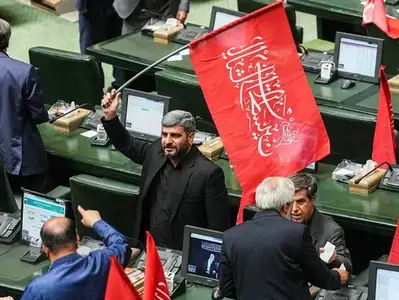
President Ebrahim Raisi and Parliamentary Speaker Mohamad Bagher Ghalibaf denied their differences during a meeting at the Iranian parliament earlier this week.
Nonetheless, despite the denials, disputes between the media outlets affiliated with the two sides appear to be escalating.
But power struggles is not limited to the executive and legislative leaders. There were indications in the latest news conference of Iranian Judiciary Chief Gholamhossein Mohseni Ejei on Thursday about possible differences between him and Raisi.
Speaking about a major financial corruption case, Ejei revealed that Raisi's statement about handing over nearly 60 government officials to the Judiciary for their involvement in the case was not true. Ejei made it clear that "The government has named no one for involvement in the case."
In another development, according to Khabar Online, while Raisi has spoken about coordination of efforts between the parliament and the government, Ghalibaf has expressed concern that a difference of tastes between the two are likely to turn into disputes."
The website wrote that when Ghalibaf and Raisi met on Tuesday morning, pro-Ghalibaf newspaper Sobh-e No's editorial against Raisi's performance had already been published. The editorial called Raisi's supporters "super revolutionaries" and pointed out that Raja News, a website maintained by a close relative of Raisi has been attacking Ghalibaf for a few days.
The pro-Ghalibaf daily further added that he and Ejei agree that the country's most important problems are about the economy. Consequently, the country needs legislations to prevent financial corruption cases in which government officials are regularly involved.
Nearly all fingers point at Raisi as the man responsible for the latest corruption case. Many have said that if the affair took place during the last two years of the Rouhani administration (2019-2021), Raisi should have prevented it as Judiciary Chief at the time. And if it took place during the past two years, then Raisi as president will be in a worse position as his share of the responsibility will be even bigger.
Government media outlets including Iran newspaper, the only mention Ejei and Ghalibaf in connection with the corruption case. They never say anything about Raisi, Khabar Online observed.
Media close to Ghalibaf, on the other hand, attack Raisi’s supporters in the ultraconservative Paydari party who constitute a powerful bloc in parliament, trying to increase their seats in the March elections.
However, rivalry between Ghalibaf and Raisi goes beyond the upcoming parliamentary election as both men know very well that Ghalibaf's main objective is to win the Presidential election in 2025. Ghalibaf is also aware that in any election in Iran he will have far more votes than Raisi. His calculation is based on the precedence left after the 2013 Presidential election when he was forced, by Khamenei’s men, to drop out of the race, to give Raisi a chance to win that election. Raisi, however, lost to relatively moderate Hassan Rouhani.
Meanwhile, Ghalibaf's supporters have accused the Raisi Administration of trying to intervene in the March election. To take revenge on Raisi, Ghalibaf’s men in parliament changed the Development Plan submitted by Raisi’s administration beyond recognition. Subsequently the president complained to Khamenei that what the parliament has approved cannot be implemented.
Despite all their differences, both Ghalibaf and Raisi told the press after their meeting that "We will not let others to take advantage of the difference in the two branches of the state. This will never happen!" As Khabar Online noted, regardless of what they say, it is difficult to believe pleasant words from any side. The two men's body language during the meeting, and the continuation and rather escalation of the war of words in their media outlets tell another story.