• العربية
  • فارسی
Brand
  • Iran Insight
  • Politics
  • Economy
  • Analysis
  • Special Report
  • Opinion
  • Podcast
  • Iran Insight
  • Politics
  • Economy
  • Analysis
  • Special Report
  • Opinion
  • Podcast
  • Theme
  • Language
    • العربية
    • فارسی
  • Iran Insight
  • Politics
  • Economy
  • Analysis
  • Special Report
  • Opinion
  • Podcast
All rights reserved for Volant Media UK Limited
volant media logo

Despite Some Rhetoric, Khamenei Remains Subdued In Gaza War
Iran International Newsroom
Nov 20, 2023, 18:49 GMT+0Updated: 11:29 GMT+0
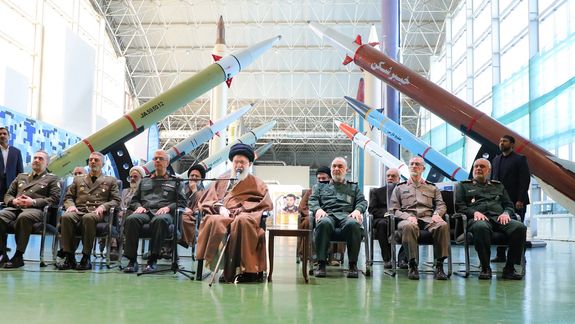
Iran’s Supreme Leader Ali Khamenei and top brass during an exhibition showcasing latest drones and missiles made by the Revolutionary Guard’s Aerospace Force on November 19, 2023

As Iran’s ruler Ali Khamenei has remained cautious over direct involvement in the Gaza war, lower ranking officials continue to speak with bluster about defeating Israel.

Mohsen Rezaei, a former Revolutionary Guard commander and a power insider in Tehran, threatened on Sunday that “New fronts will be opened in the Gaza war, and if the situation in remains grave, it would be impossible to prevent reactions by Muslim youth.”

Rezaei, who was speaking to Iran-affiliated Al Mayadeen television, hinted at other groups of the “Resistance Front” getting involved in the war and insisted that Israel will be defeated. Other Iranian officials have made similar claims since Israel launched its attacks on Gaza after Hamas’ October 7 terror attack. However, so far, the Iranian regime has not used its own military forces to respond to Israel.

Khamenei appealed to Muslim states with political ties with Israel on Sunday to at least cut them for "a limited time", state media reported on Sunday, weeks after he called for an Islamic oil and food embargo on Israel.

Iranian politician Mohsen Rezaee (undated)
100%
Iranian politician Mohsen Rezaee

"Some Islamic governments have condemned Israeli crimes in assemblies while some have not. This is unacceptable," Khamenei said before reiterating that the main task of Islamic governments should be to cut off Israel from energy and goods.

"Islamic governments should at least cut off political ties to Israel for a limited time," Khamenei added.

This was a substantial climb-down for a man who has made Israel’s destruction the main ideological linchpin of his 34-year rule. The fact that Iran’s most powerful proxy military group, the Lebanese Hezbollah, has refrained from starting an all-out war against Israel, as Hamas faces a dire situation in Gaza, is another clear sign that Tehran is unwilling to risk everything at this stage.

In the meantime, Iran’s rulers have succeeded in securing the release of as much as $17 billion dollars that was blocked in South Korea and Iraq because of US sanctions. The Biden administration began approving the release of the funds from June, despite domestic opposition, and approved another big chunk this month, as the war raged in Gaza. The most astonishing aspect of Washington’s decision is that it came amid almost daily attacks by Iranian proxy militias on US military bases in Iraq and Syria.

It is not clear if this concession by the Biden administration is what keeps Tehran hesitant to expand the conflict, or it simply feels unease given its precarious situation at home. Since the United States imposed sanction in 2018, Iran faces an intractable economic crisis, which in turn has led to public anger and rounds of protests. The Islamic Republic faces political instability, with the ever-present specter of more popular protests.

After decades of calling for Israel’s destruction, the Islamic Republic seems to have shied away from military assistance to Hamas and is calling for a ceasefire. On Monday, President Ebrahim Raisi wrote to leaders of 50 countries asking them to use their influence to end the fighting. These included, the leaders of China, Russia, Turkey, Kazakhstan, South Africa, Kenya and Jordan. Once again Raisi asked these countries to impose economic sanctions on Israel.

However, during a joint summit between members of the Organisation for Islamic Cooperation and the Arab League in Saudi Arabia's capital on Nov. 11, Muslim states did not agree to impose wide-ranging sanctions on Israel, and Raisi had to put his name to a joint statement that actually endorsed a two-state solution – or Israel’s right to exist.


Most Viewed

Iran negotiators ordered to return after internal rift over Islamabad talks
1
EXCLUSIVE

Iran negotiators ordered to return after internal rift over Islamabad talks

2
ANALYSIS

US blockade enters murky phase as tankers spoof signals and buyers hesitate

3
ANALYSIS

Why the $100 billion Hormuz toll revenue is a myth

4

US tightens financial squeeze on Iran, warns banks over oil money flows

5
ANALYSIS

US blockade targets Iran oil boom amid regional disruption

Banner
Banner

Spotlight

  • Hardliners push Hormuz ‘red line’ as US blockade tests Iran’s leverage
    INSIGHT

    Hardliners push Hormuz ‘red line’ as US blockade tests Iran’s leverage

  • Ideology may be fading in Iran, but not in Kashmir's ‘Mini Iran'
    INSIGHT

    Ideology may be fading in Iran, but not in Kashmir's ‘Mini Iran'

  • War damage amounts to $3,000 per Iranian, with blockade set to add to losses
    INSIGHT

    War damage amounts to $3,000 per Iranian, with blockade set to add to losses

  • Why the $100 billion Hormuz toll revenue is a myth
    ANALYSIS

    Why the $100 billion Hormuz toll revenue is a myth

  • US blockade targets Iran oil boom amid regional disruption
    ANALYSIS

    US blockade targets Iran oil boom amid regional disruption

  • Iran's digital economy battered by prolonged blackout
    INSIGHT

    Iran's digital economy battered by prolonged blackout

•
•
•

More Stories

Internet Bans Cost Iranians $400 Million Annually

Nov 20, 2023, 17:57 GMT+0

An Iranian MP has estimated that the annual financial turnover of Virtual Private Networks (VPNs) in Iran is approximately $900 million amid widespread internet bans.

The revelation stems from a survey conducted by MP Jalal Rashidi Kouchi who calculated that if the minimum monthly price of a VPN in Iran is $2, citizens would be compelled to spend around $480 million annually on these tools to circumvent regime bans on the likes of Instagram and Whatsapp.

He also estimated that the shutdowns on popular apps used for social networking and e-commerce cost the public an additional $400 million.

In September, Yekta Net Advertising Company published a report estimating the market volume of circumvention tools in 2022 to be between $500 million to $600 million. According to the report, 80% of Iranians use VPNs to access social networks, while the Islamic Republic currently restricts access to major international social networks and messaging platforms.

Estimations of VPN sales in Iran in recent years have been approximations due to a lack of transparent data. The estimates typically focus on the direct costs citizens pay to bypass censorship, overlooking government expenses in equipping and maintaining the online censorship system.

Despite the controversies, officials from the Ministry of Communications and Information Technology, including Minister Isa Zarepour, have consistently rejected published statistics on the matter, avoiding responsibility.

According to Freedom House, Iran was the Middle East's worst country for internet freedom in 2023, its rating worsening in the wake of the Women, Life, Freedom uprising. 

US Defense Chiefs Demand Tougher Action On Iran

Nov 20, 2023, 15:23 GMT+0
•
Iran International Newsroom

US Department of Defense chiefs are frustrated by their government’s lack of action in dealing with Iran-backed attacks on US facilities across the region.

Iran-backed militias have been targeting American forces almost daily for over a month, totalling 61 attacks in which at least 59 staff have been wounded. They say their operations are in support of Palestinians and will continue as long as the United States backs the Israeli onslaught on Gaza.

In response, the Biden administration has so far approved three airstrikes on IRGC-affiliated facilities in Syria, the last of which on 12 November killed “seven militants”, according to US officials.

“Are we trying to deter future Iranian attacks like this,” a Pentagon official told the Washington Post on the condition of anonymity. “There’s no clear definition of what we are trying to deter.”

As Iran uses the war in Gaza to fuel its proxies' actions against its archenemies Israel and the US, regime rhetoric is relishing the opportunity posed by the Hamas invasion of Israel on October 7. Thousands of terrorists invaded Israel killing at least 1,200 mostly civilians in the single most deadly day for Jews since the Holocaust. While Iran denies involvement, it funds the group tens of millions each year and supports it militarily.

Handout photo dated July 2, 2013 shows F/A-18C Hornets assigned to the Wildcats of Strike Fighter Squadron (VFA) 131 fly over the aircraft carrier USS Dwight D. Eisenhower (CVN 69) during Carrier Air Wing (CVW) 7’s fly-off in the Atlantic Ocean.
100%
Handout photo dated July 2, 2013 shows F/A-18C Hornets assigned to the Wildcats of Strike Fighter Squadron (VFA) 131 fly over the aircraft carrier USS Dwight D. Eisenhower (CVN 69) during Carrier Air Wing (CVW) 7’s fly-off in the Atlantic Ocean.

“We have seen the first stage of expansion of the scope of the war by the resistance groups who make their own decisions,” said Iranian Foreign Minister Hossein Amir-Abdollahian Monday, distancing himself from the proxy attacks on Israel and the US which have come from Yemen, Iraq, Lebanon and Syria.

“And if the possible scenarios to stop the crimes of the Zionists do not come to fruition, we will probably witness a new situation in the region,” he warned. On Sunday, Iran's Yemeni proxy, the Houthis, admitted hijacking what it had believed to be an Israeli-owned ship while on Monday, the situation on Israel's northern border had escalated under its proxy Hezbollah.

The Biden administration is mindful of not escalating the conflict and turning it into a full-scale regional war that would inexorably drag in American troops. They have warned Iran and its proxies many times that the United States will not tolerate attacks on its forces and would retaliate. Warships and troops have also been brought to the region to deter further aggression, yet the attacks are continuing unabated.

However, if the attacks on US bases carry on at the current rate, it is only a matter of time before US military personnel get killed, forcing the administration to react.

Some in Washington say Biden's softly-softly approach has emboldened the regime, not least since the recent hostage deal which saw five unlawfully detained US-Iranians released in exchange for the freeing up of $6bn of frozen Iranian funds in south Korea and a possible $10bn more in the offing.

Many attacks on US troops are carried out by one-way drones, which Iran manufactures on a large scale, even giving them to Russia to be used in its war against Ukraine.

“They keep shooting, waiting for us to respond. We don’t, so they keep shooting,” said Senator Kevin Cramer of the Armed Services Committee. “Our posture has to be a little more aggressive than just strictly defensive, because one of these days, we’re going to miss one of those drones.”

Taliban Calls On Iran For Help Amid Challenges Faced By Immigrants

Nov 20, 2023, 13:51 GMT+0

In the midst of challenges posed by millions of Afghan immigrants residing in Iran, the Afghan embassy has sought assistance from Iran to improve their living conditions.

During a recent meeting with Abdul Basit Emami, the Acting Head of Migrant Affairs at the Afghan Embassy in Tehran, Taliban officials expressed concerns about Iranian policies. They raised issues regarding restrictions imposed on Afghan citizens in certain provinces, highlighting the prohibition of employment opportunities, such as roles as sellers or apprentices.

Mohammad Hosseini, the representative of Bushehr in the Supreme Council of Provinces, quoting Solat Mortazavi, the Minister of Labor, emphasized that “five million jobs in Iran are currently monopolized by Afghan citizens,” a point of contention for those who argue Iranians should be employed amidst a national depression.

The figure is particularly significant considering the reported 8.4 million Afghan nationals residing in various provinces. Despite the high unemployment rate in Iran, experts argue that there is no imperative need for foreign labor at the present rate.meanwhile professions such as nursing and teaching remain in dire short supply as Iranians migrant in unprecedented numbers.

In the meeting, Taliban officials underscored the importance of facilitating the issuance of driver's licenses for migrants and establishing a suitable mechanism for legal matters related to property ownership. They urged Iran to prevent the forced expulsion of migrants possessing legal documents and residence permits. However, reports suggest that the number of migrants with legal residence permits in Iran is relatively low.

The Iranian government is currently facing criticism for what some perceive as a lenient approach towards Afghan refugees. Political opponents of the government have repeatedly warned against its "open borders" policy, raising concerns about potential hidden agendas such as rallying more pro-regime support. In response, the government has accused critics of promoting "Afghan-phobia".

Japan In Direct Talks With Iran-Backed Houthis After Ship Hijacking

Nov 20, 2023, 12:30 GMT+0
•
Iran International Newsroom

Japan’s government said it was “directly approaching” Yemen’s Iran-backed Houthis after they hijacked a Japanese-operated cargo ship in the Red Sea.

The hijack on Sunday saw dozens of crew on board taken hostage on the Galaxy Leader, a Bahamian flagged vessel.

The car carrier, Galaxy Leader, was taken to a Yemeni port and according to The Telegraph, the proxy group believed it was owned by an Israeli businessman, but on Monday, Japanese officials confirmed the vessel was operated by Tokyo-based firm Nippon Yusen.

Japan’s foreign minister, Yoko Kamikawa, said Japan “strongly condemns” the ship’s hijacking as it worked on its release. “We are also urging Saudi Arabia, Oman, Iran and other countries concerned to strongly urge the Houthis for the early release of the vessel and crew members,” he said.

 Japanese Foreign Minister Yoko Kamikawa arrives to a meeting with Secretary of State Antony Blinken, September 18, 2023, in New York.
100%
Japanese Foreign Minister Yoko Kamikawa arrives to a meeting with Secretary of State Antony Blinken, September 18, 2023, in New York.

More than 20 crew members are believed to be on the ship including Ukrainian, Bulgarian, Filipino, Mexican and Romanian nationals. The vessel had been heading toward India from Europe with no cargo, Nippon Yusen said. The company said it had set up a crisis management centre at its offices in Tokyo.

Benjamin Netanyahu, the Israeli prime minister, was quick to blame Iran for the hijacking. There were no Israelis aboard the ship and Israel was not involved in its ownership or operation, his office said on Sunday.

“This is another Iranian act of terrorism that represents an escalation in Iran’s belligerence against the citizens of the free world, with concomitant international ramifications vis-a-vis the security of global shipping routes,” his office said.

The link to Israel is believed to have come from its Isle of Man-headquartered parent company, Ray Car Carriers Ltd, which is reportedly a unit of Tel Aviv-incorporated Ray Shipping.

Ray Car Carriers, which operates a fleet of 65 vehicle carriers, was founded by Abraham “Rami” Ungar, one of the wealthiest businessmen in Israel.

On Sunday, amidst the war in Gaza following Iran-backed Hamas’s attacks on Israel on October 7, the Houthis had warned that all ships owned or operated by Israeli companies, or carrying the Israeli flag, could be targeted in the Red Sea and the Bab el-Mandeb Strait.

The Houthis are one of several Iranian proxies to have joined the war on Israel across its borders, attacks having been launched from Lebanon, Syria and Iraq, in addition to the ongoing barrage from Hamas.

While the people in the Gaza Strip are entering a devastating humanitarian crisis following Israel’s relentless retaliation for an attack which was the single most deadly day for Jews since the Holocaust, the proxy militia has had no let-up in its rocket salvos to Israel.

The Houthis have been launching long-range missile and drone salvoes at Israel since the war broke out, leaders in Iran hailing what they say is the imminent downfall of ‘the Zionist entity’.

Mohammed Abdul-Salam, the Houthis’ spokesman, said Israel only understands “the language of force”, adding, “The detention of the Israeli ship is a practical step that proves the seriousness of the Yemeni armed forces in waging the sea battle, regardless of its costs”, he said. “This is the beginning.”

Meanwhile, the US national security council called the attack a “flagrant violation of international law", demanding the release of the ship and its crew, warning it will take appropriate next steps with its allies and UN partners.

The US was unequivocal in its support for Israel’s right to defend itself after October 7 saw at least 1,200 mostly civilians murdered and 240 taken hostage to Gaza.

It has since sent battleships to the region in a bid to prevent escalation but as a result of its support for Israel, has had over 40 attacks on its facilities in Syria and Iraq amidst a worsening regional crisis.


Activist Condemns Hijab Crackdown in Tehran Metro

Nov 20, 2023, 09:26 GMT+0

Political activist Abbas Abdi has slammed the recent deployment of police and hijab patrols in Tehran's metro stations, aiming to enforce mandatory hijab regulations.

In a Monday editorial for Etemad newspaper, the reputable reformist commentator and journalist expressed deep concern over the situation, asserting that “the increased police presence in the metro only serves to heighten public discontent.”

In recent months the regime has hardened its stance over the hijab as the strength of rebellion fails to weaken.

Abdi emphasized that the onus is on the government to align itself with the expectations of the people and work towards a more harmonious coexistence. Images circulating on social media depict numerous hijab officers creating congestion in a subway passageway at Tehran's Enghelab station, now colloquially referred to as the "horror tunnel" for women.

Reports also highlight the use of cameras by the Security Police (FARAJA) to identify women without headscarves. Abdi reposted an image of the hijab enforcers on the X social network on Friday, cautioning that the regime would likely face regrettable consequences for its decisions.

The stringent enforcement of hijab rules gained momentum following the tragic death of Iranian-Kurdish woman Mahsa Amini in hijab police custody in September 2022, igniting the Women, Life, Freedom protests. In May, Tehran Mayor Alireza Zakani announced the implementation of a uniformed security unit to prevent women from accessing metro ticket gates.

Reports in August suggested that Tehran municipality was planning to deploy 400 personnel to enforce hijab laws at subway stations in the capital. The heightened presence of hijab police also led to the death of Armita Geravand, 16, who lost her life in October following an encounter with Tehran's hijab police in the subway, in echoes of the Mahsa Amini tragedy one year earlier.