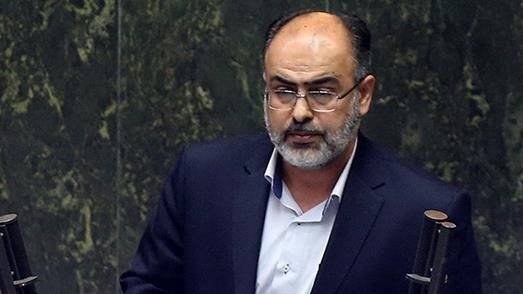
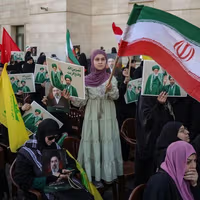
In defense of Iran's secretive government, a fundamentalist member of Iranian parliament said transparency is not necessary and petty.
Mehrdad Veis-Karami said in a video published on social networks that "God, the Prophet, and the Qur'an were not after transparency, because people do not have the capacity."
The professor of Islamic studies said: “Many MPs entered the parliament with the promise of transparency, and now they have regretted their promises."
His statements come as the majority of government institutions have refused to publicly announce vital figures of the country's economy over recent years, including the state of debts and budget deficit, the amount of consumption of polluting fuels such as diesel fuel, oil export revenues, the details of long-term strategic partnership with China and the fate of embezzlement of billions of dollars.
In its annual report published in February last year, Transparency International said Iran ranks 147th among 180 countries in terms of the extent of financial corruption.
Lack of transparency is not only limited to economic and financial issues in Iran. A wide range of issues from the downing of the Ukrainian airliner by IRGC missiles to arbitrary arrests, and the number of victims in mass killings of popular protests were not announced transparently.
Iran’s Ministry of Intelligence sent a blast text message across the country warning citizens against being recruited by Israeli Intelligence Agency Mossad.
“One of the most important tactics of Mossad in carrying out terrorist and criminal operations in Iran is to abuse the public awareness and people’s ignorance,” read the message.
“If someone asks you to buy a vehicle and leave it in a certain place by paying money, think that you might be abused in a Mossad terrorist act,” added the warning text.
Last year, Israel’s Mossad captured a senior IRGC official on Iranian soil and interrogated him about weapons shipments to Iran's proxies.
Iran International obtained video footage of the interrogation in which a man introducing himself as Yadollah Khedmati, deputy commander of the Revolutionary Guards (IRGC) Logistics, said he regrets his involvement in shipping weapons to Iran’s proxy groups in Syria, Iraq, Lebanon, and Yemen and urges other IRGC officials to avoid engagement in such activities.
Israel has allegedly carried out dozens of operations and assassinations inside Iran, including the assassination of Iran's top nuclear man and senior IRGC member Mohsen Fakhrizadeh in November 2020 for which it has never officially taken responsibility. Ex Mossad Chief Yossi Cohen in June 2021 strongly suggested Israel was behind attacks on Iranian nuclear facilities.
Referring to the theft of thousands of Iranian secret nuclear documents in February 2018 from a warehouse near Tehran, Cohen said more than 20 Mossad agents were involved in the operation. He said the agents were not Israelis, adding that all of them are alive and some of them have already left Iran.
Jihad Azour, Director of the Middle East and Central Asia Department at the IMF, in an interview with Reuters in Dubai, May 2, 2023
Lebanon slid deeper into crisis on Wednesday when Hezbollah and its allies thwarted a bid by their rivals to elect a top IMF official as president.
The failure by the parliament to vote sharpened sectarian tensions and underlined the dim hopes for reviving the crumbling state.
Four years since Lebanon slid into a financial meltdown that marks its worst crisis since the 1975-90 civil war, parliament failed for a 12th time to elect someone to fill the post reserved for a Maronite Christian under the country's sectarian system.
Lawmakers from the Iran-backed armed Shi'ite group Hezbollah and allies withdrew from the session to obstruct a bid by the main Christian parties to elect IMF official Jihad Azour.
The standoff has opened up a sectarian faultline, with one of Hezbollah's main Christian allies - Gebran Bassil - lining up behind the bid to elect Azour, alongside anti-Hezbollah Christian factions.
Azour, the IMF's Middle East Director and an ex-finance minister, won the support of 59 of parliament's 128 lawmakers in an initial vote, short of the two-thirds needed to win in the first round. Suleiman Frangieh, backed by Hezbollah and its allies, got 51 votes.
Hezbollah and its allies then withdrew, denying the two-thirds quorum required for a second round of voting in which a candidate can win with the support of 65 lawmakers.
It leaves Lebanon with no immediate prospect of filling the presidency, which has been vacant since the term of the Hezbollah-allied President Michel Aoun ended in October.
Hezbollah, which is designated as a terrorist group by the United States, has unleashed fierce rhetoric in their campaign against Azour, describing him as a candidate of confrontation.
Azour, 57, has said he wants to build national unity and implement reforms in the country.
Lights are seen in the skies over Damascus during the air strike on June 14, 2023
Airstrikes attributed to Israel over Syria's capital Damascus early Wednesday critically wounded one soldier, Syrian state media reported.
The state news agency Sana reported that the attack caused some material damage, but it is not clear what was exactly targeted.
In the past six years Israel has launched hundreds of air strikes against Iranian targets in Syria, including weapons depots, convoys and militia bases.
Israel has vowed to stop Tehran’s military expansion that could open a second front against Israel, similar to the border with Lebanon.
Video posted by Syrian news channel Al-Ikhbariya showed lights flickering in the sky over Damascus on Wednesday morning, in what it said were strikes being intercepted.
SANA also claimed that Syrian air defenses shot down some of the missiles.
The last suspected Israeli airstrike on Syria was on May 29, targeting locations in the vicinity of Damascus.
Israel has also targeted the international airport in the northern Syrian city of Aleppo several times this past year, often putting it out of commission.
Iran intervened in the Syrian civil war in 2011 to save Bashar al-Assad’s regime that had close ties with Tehran and allowed weapons and assistance to flow to Hezbollah in Lebanon. With crucial Iranian and Russian military assistance Assad has regained most of the territories lost to the rebels but remains highly dependent on Moscow and Tehran.
The kid who was burned by clothing-iron at the center
After an Iranian daily published a report about the harrowing ordeal of dozens of kids in a state orphanage run by clerics, the authorities have pressured the newspaper to redact its article.
Iranian journalist Mohammad Bagherzadeh said in a tweet on Monday that sources of the report, one of whom was a former employee of the state charity organization, were contacted and threatened.
Without saying who contacted the sources, Bagherzadeh said they told them either they rescind their statements or would be charged with insulting the clergy. He added that one of the sources was called in by the judiciary earlier in the day.
The original report was published by Etemad newspaper on June 11, revealing cases of child abuse at an orphanage operating under the supervision of the State Welfare Organization of Iran.
The operations of the center,whose employees were reportedly clerics, were suspended after the report published by the daily was also confirmed by several other sources.
In one of the cases, the clerics who were working as social workers put burning-hot clothing-iron on the hands and feet of a seven-year-old child as a punishment for bedwetting. Then they imprisoned him in an old bathroom infested with cockroaches and he was fed with dry bread and water for about a week.
The kid who was burned by clothing-iron at the center
According to one of the sources, who blew the whistle after he was fired from the center, the situation of all the 24 children kept at the orphanage for the past eight years were suffering from somewhat similar abuse.
For example, the clerics had devised a scoring system to evaluate the behavior of the children, subjecting them to serious psychological torture.
The accounts of these abuses and their validity were also confirmed by other sources, who also used to work there.
One of the sources was cited by Etemad as saying that "The children of the center were strangely afraid of one of the managers, who himself explained the reason for this fear: Since the early days, I scared the hell out of the children, so they would know who’s the boss here. I told one of the kids that I would cut his tongue and hit him on the mouth repeatedly until it was full of blood; and now these children are afraid of me like death.”
Another source told the paper that in one of the cases, a child was so traumatized by the physical and psychological sufferings inflicted by one of the female managers of the center that wanted to commit suicide, but he was finally dissuaded from any high-risk behavior and was put to sleep with a pill.
Mohamamd-Javad Hosseini, one of the senior officials of the State Welfare Organization of Iran, said that the center was given a warning and was only suspended temporarily because there were no prior complaints against it. The guardianship of the children was terminated, and new staff took control of the center, he added.
Reports of such abuses are usually buried by authorities but even with all the coverups the number of cases that made headlines is very high. The most recent case took place less than a month ago, when the manager of a center was arrested for abuse of handicapped children in the city of Shiraz.
President Ebrahim Raisi (left) and former vice president for economic affairs Mohsen Rezaei
Media speculations in Tehran about new dynamics in Iran's politics started on Monday as vice president for economic affairs Mohsen Rezaei resigned his post.
Rezaei, a former chief commander of the IRGC, was immediately appointed by President Ebrahim Raisi as the secretary to the coordination council of the heads of the three powers of the government, an extra-constitutional body created by Supreme Leader Ali Khamenei after the United States imposed sanctions in 2018.
He became yet another top IRGC figure to pocket a political post, in what some called the "pakistanization" of Iran, with the military faction running the show.
Khabar Online influential website reminded its readers of some of Rezaei’s strange views. He wanted to make Iran’s rial the region's strongest currency exactly when it was experiencing the worst devaluation in its history.
Rezaei, who was four times a candidate for presidency but never came close to winning, promised during his campaigns to increase the cash handout to Iranians by ten-fold. Another one of his big ideas was suggesting to take thousands of US soldiers hostage in the Persian Gulf and demand a million dollars for each one of them.
Given his previous career in the IRGC perhaps Rezaei’s silly idea of taking US troops hostage made sense to him.
First vice president Mohammad Mokhber
Although Rezaei claimed to lead Raisi's economic team following his appointment as vice president for economic affairs, in fact, it was first vice president Mohammad Mokhber who led the economic team, a major humiliation for Rezaei. The tension even gave him a heart attack at one point. Nonetheless, he remained an outcast as a vice president and no one, not even the news-thirsty Iranian media took him seriously. The government never paid attention to any of his ideas about saving Iran's ailing economy.
In another report, Khabar Online wrote that what appears to be important for Rezaei is to elevate his profile and increase visibility perhaps for the next presidential election.
Khabar Online added that he might even run for the parliament in March from his hometown of Masjed Suleiman in the hope of winning the seat of the parliamentary speaker.
Following his resignation from the post of vice president, former Central Bank Governor and presidential candidate Abdolnaser Hemmati wrote ironically in a tweet: "The man who wanted to make the Iranian currency the strongest money after the US dollar and the euro has resigned as rial was facing a 50-percent devaluation. Congratulations to Mr. Raisi and his economic team!"
Political analyst Morad Veisi
Meanwhile, Iran International's senior political analyst Morad Veisi pointed out that Rezaei was isolated in the government's economic team for a long time. His new appointment shows that the Islamic Republic is creating illegal institutions within the government. The coordination council of the heads of the three powers of the government is an illegal entity the regime has created" having no other recourse for trying to deal with the economic crisis triggered by US sanctions.
Veisi added that with Rezaei’s new appointment now an increasing number of IRGC generals are being appointed to mobilize the government to do its job in which it has had no success so far. He said: "Gradually, the Islamic Republic is moving from a joint government of the clerics and the IRGC, to an absolutely military government." Veisi further called this "The Pakistanization of the Islamic Republic of Iran."
The coordination council of the heads of the three powers of the government has had no success in solving some of the daunting economic problems. Now, the council is an institution with an official secretariat and a high-profile secretary such as Rezaei. While so far, the council has evaded responsibility for the economic mess, from now on it would be difficult to conceal the council.
It is highly likely that the new post will further damage ambitious Rezaei’s image and his unlikely chance of winning a higher position in the government.