White House To Host Israeli Officials For Talks On Iran, Saudi Arabia

A delegation of Israeli officials is expected to arrive in Washington next week to discuss Iranian nuclear progress.

A delegation of Israeli officials is expected to arrive in Washington next week to discuss Iranian nuclear progress.
Four Israeli and US officials told Axios that Minister for Strategic Affairs Ron Dermer and National Security Adviser Tzachi Hanegbi will also discuss other regional issues including a possible Israel-Saudi Arabia peace deal.
Meetings are said to be planned between Israeli officials and White House national security adviser Jake Sullivan as well as other senior State Department authorities, according to the Axios report.
According to the Israeli Prime Minister's Office, the date of the meetings has not been finalized yet. A spokesperson for the White House National Security Council said they could not confirm anything.
Recently, Israeli officials have escalated their rhetoric about Iran's nuclear program and the possibility of a military strike.
General Herzi Halevi, IDF Chief of Staff, said on Tuesday that Iran's uranium enrichment is more advanced than ever. He added that Israel is closely monitoring "other fields" necessary for nuclear capability, indicating Iran's possible weaponization efforts.
“There are possible negative developments on the horizon that could lead to action. We have capabilities and others have capabilities," Halevi stressed.
Separately on Tuesday, Hanegbi said Israel hopes non-military means can solve the Iranian nuclear crisis, but stressed Israel is preparing for the possibility of confrontation.
An Associated Press report Monday showed the regime is building a deep underground nuclear facility near the Zagros Mountains in central Iran, close to the Natanz nuclear site.

A group of 109 former world leaders have sent a joint open letter to world powers urging support for the uprising taking place in Iran, days after the regime executed three protesters.
Signatories include 50 former Presidents, 48 former Prime Ministers, one former Chancellor, and nine other former Heads of State from across the world, including
former UK Prime Minister Liz Truss, former US Vice President Mike Pence and former Presidents of the European Commission, Jean-Claude Juncker and Romano Prodi.
The group also calls for the designation of the IRGC, a bone of contention in countries including the UK where MPs are split, several still hoping for a revival of nuclear talks.
Organized by the group Justice for the Victims of the 1988 Massacre in Iran (JVMI), the open letter called on world leaders to “stand in solidarity with the people of Iran in their desire for a secular and democratic republic where no individual, regardless of religion or birthright, has any privilege over others”.
They stressed that “the Iranian people have made it clear that they reject all forms of dictatorship, be it that of the deposed Shah or the current theocratic regime, and thus reject any association with either. We believe it is for the Iranian people to decide their future.”

The group also urged the international community to recognise the four decades of campaigning from the democratic coalition National Council of Resistance of Iran (NCRI), rallying support for the Ten-Point Plan proposed by the NCRI President, Maryam Rajavi.
The open letter calls for a system in which free elections, freedom of assembly and expression, abolition of the death penalty, gender equality, separation of religion and state, autonomy for Iran’s ethnicities, and a non-nuclear Iran, can allow Iranians to live in peace and prosperity.
Highlighting the crackdown on the recent protests which started in September following the death in morality police custody of Mahsa Amini and has led to the death of hundreds of protesters and the arrest of tens of thousands, the former world leaders reiterated that the international community has a “responsibility” to support the Iranian people’s human rights.
“Decades of apparent silence and inaction by the international community have helped fuel a culture of impunity in Iran. Since the 1980s, the authorities in Iran have executed tens of thousands of protesters and political prisoners,” wrote the leaders. “Tragically, in the summer of 1988 alone, over 30,000 political prisoners – the vast majority of whom were members of the opposition MEK – were brutally massacred,” referring to one of the worst humanitarian disasters to hit the country since the founding of the Islamic Republic.

The signatories condemned the Iranian regime’s meddling in the Middle East and Europe, including its provision of drones to assist Russia’s war against Ukraine and its terrorist attempts and cyber-attacks in Albania.
“We urge your nations to stand with the Iranian people in their quest for change and to take decisive steps against the current regime. This includes blacklisting the Revolutionary Guards (IRGC) and holding regime officials accountable for their crimes against humanity,” the letter added.

Iran unveiled the fourth generation of its Khorramshahr ballistic missile, called Kheibar, with a range of 2,000 kilometers.
State media reported that the country successfully tested the ballistic missile on Thursday, two days after Israel's military chief raised the prospect of "action" against Tehran.
Lieutenant-General Herzi Halevi, chief of Israel's armed forces, warned: "Iran has advanced with uranium enrichment further than ever before ... There are negative developments on the horizon that could bring about (military) action.”
Iran, which has one of the biggest missile programs in the Middle East, says its missiles can reach Israel and US bases in the region.
Tehran has said it will continue to develop its "defensive" missile program despite opposition from the United States and European countries.
"Our message to Iran's enemies is that we will defend the country and its achievements. Our message to our friends is that we want to help regional stability," said Iranian Defense Minister Mohammadreza Ashtiani.
Iran claims its ballistic missiles are a deterrent and retaliatory force against the United States, Israel, and other potential regional adversaries.
Efforts to revive Tehran's 2015 nuclear deal have stalled since last September amid Western fears about Tehran's accelerating nuclear advances.
Iran's nuclear activities were restricted by the nuclear agreement, which Washington ditched in 2018, extending the time it would take for Tehran to produce nuclear material for a bomb. Iran denies pursuing nuclear weapons.

Ukraine said Thursday it had shot down all 36 Iranian-made drones launched by Russia in overnight attacks probably targeting critical infrastructure and military facilities.
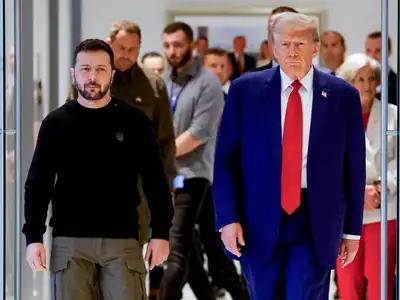
President Volodymyr Zelenskyy said it had been an "uneasy night" but commended the work of air defenses.
"Continuing to terrorize Ukraine, the enemy used 36 Shahed (drones). None of them reached their target. Thanks to our air defense forces for the 100% result," he wrote on the Telegram messaging app.
Zelenskyy urged Iran on Wednesday to reconsider the supply of the killer drones to Russia in order to stop their slide into "the dark side of history."
Since last October, Moscow, which launched its full-scale invasion in February last year, has regularly sent waves of drones to attack targets in Ukraine. Although they are slow, drones are cheaper and more expendable than advanced missiles.
Some experts say that Russia's use of the Shahed drones, costing around $20,000 each, either is meant to confuse Ukrainian air defenses during missile attacks, or to force Kyiv to spend its expensive Western-supplies anti air missiles.
"The enemy likely aimed to attack critical infrastructure and military facilities in the western regions of the state," the Ukrainian air force said on Telegram.
It said Iran-made Shahed 136 and Shahed 131 drones had been used.
The head of Kyiv's military administration said the capital had come under attack by several waves of drones but that all had been shot down. He said it was the 12th attack on Kyiv this month.
Regional and military authorities in southern and western Ukraine reported shooting down drones.
Western powers have strongly objected to Iran's decision to arm Russia with the Kamikaze drones, and possibly other weapons and ammunition.
With reporting by Reuters

Ukrainian President Volodymyr Zelenskyy urged Iran Wednesday to reconsider the supply of killer drones to Russia in order to stop their slide into "the dark side of history."
Iranian-made Shahed drones supplied to Moscow have played a major role in Russia's attacks on cities and infrastructure, though Zelenskyy said Kyiv's air defenses were now skilled at downing them - about 900 of 1,160 aimed at Ukrainian targets.
"The simple question is this: what is your interest in being an accomplice to Russian terror?" Zelenskyy said in his nightly video address.
"What is the benefit to Iran of such cynical killing? By Russian hands, but with your weapons, your weapons...Your Shaheds, which terrorize Ukraine every night, mean only that the people of Iran are being driven deeper and deeper into the dark side of history."
Western powers have strongly objected to Iran's decision to arm Russia with the Kamikaze drones, and possibly other weapons and ammunition.
Nuclear talks with Tehran that can result in suspending crippling economic sanctions, have been put on hold by the United States, which has called Iran's military cooperation with Russia one of the obstacles to a deal.
Russia has boosted its military cooperation with Iran since it launched its invasion of its neighbor in February 2022.
Iran initially denied supplying Shahed drones to Russia but later said it had provided a small number before the conflict began.

Israel retaliated against shots fired from Syria at a surveillance drone, the Israeli military said on Wednesday.
"IDF Machine Gun fire was directed towards the originating area of the shots in Syria," a statement from the military said. "The drone successfully completed its mission and no damage was caused."
Israel has for years been carrying out attacks against Iran-linked targets in Syria, where Tehran's influence has grown since it began supporting President Bashar al-Assad in the civil war that started in 2011.
Iran-backed militias have tried to set up strongpoints near the Israeli border in the Golan Heights, while the regime in Tehran openly calls for attacks against Israel.
The Israeli military also said on Wednesday that it convicted two soldiers of abusing a Palestinian man, along with additional soldiers. One other soldier was convicted of exceeding his authority to the extent of endangering life or health, it said.
Human rights groups accuse Israel of not taking strong action against soldiers who abuse their authority, particularly in the occupied West Bank.
According to the indictments, the soldiers took a Palestinian man in a military jeep and drove to a distant location, a military statement said. During the drive and afterwards, the man was abused and then left in the remote location, it said.
Report by Reuters