Iran Teachers' Union Calls For Demo On Tuesday Against Members Being Jailed
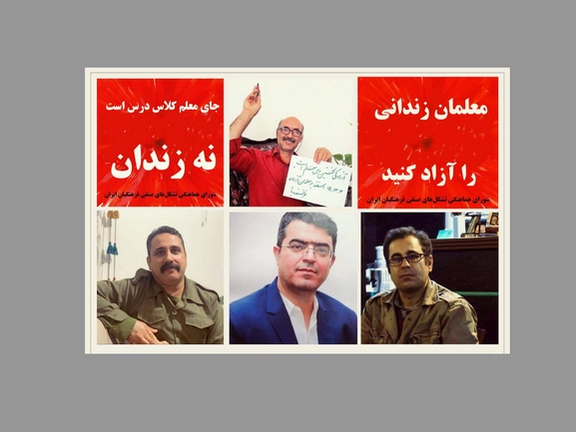
A teachers’ union in Iran has called for a demonstration on Tuesday against the imprisonment of members of the profession.
A teachers’ union in Iran has called for a demonstration on Tuesday against the imprisonment of members of the profession.
The Coordination Council of Iranian Teachers' Trade Associations said teachers should gather in protest in front of the parliament in Tehran and education ministry departments in other cities.
In recent weeks, Iran's security forces have violently attacked teachers’ protests in Tehran and other cities detaining several demonstrators.
While calling for better salaries and working conditions, the teachers’ council also stated that Iran’s education system will not improve without a fundamental change. The union urged an end to the "dominance of the ruling totalitarian ideology" in Iranian schools.
Earlier, the union had called for further protests just hours after the Supreme Leader failed to address nationwide school poisonings in his speech on Wednesday.
Khamenei had been speaking at an event for the Islamic Republic’s National Teachers’ Day with a cherry-picked group of teachers. During the meeting, Khamenei discussed the country’s education system but failed to even mention the months of gas attacks against the schools across Iran which have left thousands of schoolgirls sick and hospitalized.
Scores of schools in many of the country’s provinces have been attacked by unidentified chemicals since November 30 when the first case of poisoning among schoolgirls was reported in the religious city of Qom.
The union also voiced support for the recent wave of protests by teachers and families of students who have been victims of the mysterious chemical attacks on schools.
Amid spreading strikes by tens of thousands of workers across Iran, truck owners and drivers have announced plans to hold a nationwide open-ended work stoppage.
The labor force at Pars Paper company in Hafttapeh, Khuzestan Province, and the railway maintenance workers in Kerman province were the latest to join the countrywide industrial action on Thursday, when truck drivers said they will stageastrike beginning May 22.
The Union of Truck-Owners and Truck Drivers issued a statement on Thursday, saying their complaints and short-term strikes have not resulted in any change in their situation therefore they plan a long and nationwide action.
Referring to rising prices and rampant inflation, they demanded fares on par with the increasing prices for fuel and spare parts. Since their previous nationwide strike that took place in over 160 cities about five years ago, their demands have not been met and their lives have become harder.
Their demands include better transport fares based on the weight of the cargo per kilometer, lower prices for spare parts, lower fuel prices through subsidies, removing customs tariffs and road tolls, as well as welfare and health facilities at terminals.
"We have said many times that our patience has a limit and such cruelty and oppression that is imposed on this hardworking group can no longer be tolerated,” read their statement, adding that “the government should take this warning seriously.”
People on social media describe the strike by the truckers as a significant blow to the Islamic Republic since it has the potential to cripple the economy.
The strike would be so costly for the regime that it is expected to lure them back into work by giving the extra fuel subsidies.
The statement came as workers in more than 100 oil, gas, petrochemical and other plants across the country have been staging strikes since April 22, protesting poor working conditions, low wages and rising cost of living. Almost all the striking workers in oil, gas, steel, petrochemicals and other industries are not officially hired and are working on temporary contracts, risking their only means of livelihood by joining the strikes.
Authorities claim that the strikes are being organized by anti-regime groups, a charge the Islamic Republic often makes to de-legitimize the demands of the workers who earn less than $200 a month. An official at South Pars gas field on the Persian Gulf stated last week that 4,000 protesting workers will be replaced by new ones.
Earlier in the week, the Coordination Council of Iranian Teachers' Trade Associations also announced nationwide demonstrations, calling on teachers and educators to protest outside Education Ministry branches across the country and outside the parliament in Tehran on May 9.
The council stressed the necessity of ending the "dominance of the ruling totalitarian ideology" in Iranian schools, claiming the current incompetent managers of the educational system should be replaced by those educated under more modern, secular pedagogy.
After weeks of relative calm with sporadic bouts of unrest on streets, it seems that nighttime protests are gaining a new momentum. There are also calls by grassroot groups in a couple of neighborhoods in Tehran to hold rallies on Saturday.
The Islamic Republic hanged a member of the Baluch minority Thursday morning, bringing the number of the executed Baluch prisoners to 19, including two women, in five days.
Right groups have described the promptness of the regime’s executions of Baluch prisoners in recent weeks as “an official policy to intimidate protesters in Sistan and Baluchistan province,” where anti-regime rallies have been held weekly since the "Women, Life, Freedom” protests began in September.
The Thursday execution was carried out at Mashhad Central Prison and there are unconfirmed reports that several other people from the minority group have been transferred to death rows.
As Sunni Muslims, Baluch citizens are both an ethnic and religious minority. Estimates of the Iranian Baluch population range from 1.5 to 2 million people.
The Baluch community – along with the Kurds -- has always been among the most persecuted minorities of Iran, and has the largest number of people executed in the country. Most of the Baluchs are executed over drug-related charges, but activists say their cases do not receive due process through a fair trial and that the regime uses drug charges as a pretext to avenge 30 consecutive weeks of widespread protests after their Friday prayers.
The region is among the most impoverished ones across Iran and given the high rate of unemployment and no proper infrastructure, smuggling fuel, goods and in some cases drugs are their only lifeline.
More than 110 people from the community have been reportedly executed during the past four months, with activists voicing worries that the number is higher and there are cases that have not been reported in the media.
Journalist and activist Mehdi Nakhl-Ahmadi told Iran International that one of the common characteristics of these recent cases is the “unfair trials” and a “lack of due judicial process,” highlighting that a large number of these people do not have access to lawyers. “We are witnessing a rise in the number of executions in Sistan-Baluchestan, which, people believe, are meant to affect the public opinion of the residents of the province... particularly to put pressure on Sunni Leader Mowlavi Abdolhamid, several of whose aides as well other Sunni clerics have been arrested,” he said.
The Baloch campaign website, run by a group of ethnic rights activists, described “the new wave” of executions as a strategy by the regime to warn the people of the Sistan-Baluchestan province against holding further anti-government demonstrations, claiming that such measures have been taken by the regime before to crack down on earlier bouts of protests. Condemning the mass executions, the group also expressed concern about the violation of human rights as a form of "political game to put pressure on and create fear among the people."
Haalvsh website, a local news outlet that monitors rights violations in Iran's Baluchestan region, cited remarks by family members of the executed people, claiming that they confessed to crimes they had not committed under duress and that there were flaws and ambiguities in their cases, but the judiciary ignored them and carried out the death sentence anyway.
To raise awareness about the executions, Iranian social media users have launched a twitter campaign, denouncing the killings as a “Baluch genocide.”
Masih Alinejad, well-known journalist and political activist, warned Thursday that three Baluch citizens, all of them about 30 years of age, are in imminent danger of being executed, urging people to “be the voice of people of Baluchestan.” "They are the ones who chant death to the dictator on the streets after seven months of torture, imprisonment and bullets," she said.
According to a report released by the US-based Human Rights Activists News Agency (HRANA) in December, the number of the regime’s executions increased by over 88 percent in 2022. A glance at the rights group’s recent report clearly shows a sharp rise in reported human rights violations since mid-September when the 22-year-old Kurdish woman Mahsa (Jina) Amini died in the custody of the so-called “morality police” following which protests swept across the country.
Amnesty International also published a report early in March, revealing a “chilling execution spree with escalating use of the death penalty against persecuted ethnic minorities” by the regime. “The Iranian authorities have executed at least one Ahwazi Arab, 14 Kurds and 13 Baluchis following grossly unfair trials, and sentenced at least a dozen others to death since the start of the year,” the right group said, adding that the Islamic Republic “executed at least 94 people in January and February alone.”
Earlier in the day, 23 human rights organizations and four activists, along with the "Keep It On" coalition condemned the frequent internet disruptions in Sistan-Baluchestan province. Keep It On is a coalition of more than 300 organizations from 105 countries around the world that has been fighting internet shutdowns.
Every Friday when people of the province are set to begin their rallies, the regime shuts down the internet to stop people from uploading footage from the protests and communicating with each other.
A bid to "cover up human rights violations," the signatories said the repeated disruption of the Internet has led to "significant challenges for local communities that rely heavily on online communications for their daily activities".
Iranian teachers have called for further protests just hours after the Supreme Leader failed to address nationwide school poisonings.
Khamenei had been speaking at an event for the Islamic Republic’s National Teachers’ Day with a cherry picked group of teachers. During the meeting, Khamenei discussed the country’s education system but fell short of even mentioning the months of gas attacks against the schools across Iran which have left thousands of schoolgirls sick and hospitalized.
Instead of addressing one of the biggest human rights violations of recent months, affecting over 130 schools, Khamenei talked about pushing the regime’s extremist brand of Islam in the country’s education system.
He voiced the necessity of keeping schools under state control, encouraging students to attend religious ceremonies at mosques and praised the old generation of Iranian teachers who made students go to war with Iraq from 1980 to 1988. According to Khamenei's statistics, this led to “the martyrdom of 36,000 students”.
The Coordination Council of Iranian Teachers' Trade Associations reacted quickly and issued an outraged statement on Tuesday, calling on teachers and educators to protest outside Education Ministry branches across the country and outside the parliament in Tehran on Tuesday..
The rallies were scheduled for May 9 as a tribute to Jabbar Baghcheban, also known as Mirza Jabbar Asgarzadeh, an Iranian inventor and educator born on May 9, 1886, who established the first Iranian kindergarten and the first deaf school.
The council stressed the necessity of ending the "dominance of the ruling totalitarian ideology" in Iranian schools, claiming the current incompetent managers of the educational system should be replaced by those educated under more modern, secular pedagogy.
In addition to their usual demands such as better salaries and working conditions, the teachers’ council reiterated that Iran’s education system will not improve without a fundamental change.
"Without a deep and critical review of the intellectual and political foundations of the ruling ideology; without critical restructuring in school governance and management practices; without accepting the individual, cultural and social differences of students; … and without fundamental changes in the existing and failed mechanisms of school administration, the education system in the country will not bear fruits,” read their statement.
They also voiced support for the recent wave of protests by teachers and families of students who have been victims of mysterious chemical attacks on schools, which have been going on for at least six months.
While Khamenei was delivering his speech, more videos surfaced on social media of at least six schools that were attacked by an unknown chemical that has affected scores of mostly girls’ schools, since November.
In the videos, parents are seen anxiously comforting their children suffering from symptoms such as nausea and dizziness, while other videos showed ambulances taking students to hospital. Similar attacks were also reported both a day before Khamenei’s speech and a day after it on Monday and Wednesday.
The attacks have been condemned on the global stage by the likes of the UN and US, with calls for the regime to find the culprits, though it is unlikely attacks of such a scale could be perpetrated without the tacit approval of Tehran.
One of the schools in the Kurdish-majority of Sanandaj was raided by security forces after the latest attack, not to arrest the assailants but to beat the students and parents who showed anger at the regime’s handling of the issue.
In one video showing people running with panic through the corridors of a hospital, a woman is heard saying the girl filmed was hit on the head with a baton. Over 500 civilians have died at the hands of such brutality since protests against the regime began in September, with thousands more imprisoned.
Iranian American journalist, author, and women's rights campaigner Masih Alinejad presented a draft resolution to the UN condemning targeting journalists.
In her campaign, coinciding with World Press Freedom Day, she called upon the UK to sponsor the resolution in a bid to recognize the threats made to Iran International journalists who in February, were forced to evacuate the London offices and relocate to Washington after being warned that authorities could no longer protect them from threats originating with Iranian agents.
"The UK government actually asked one of the biggest [broadcasters], Iran International TV, to stop its activities and to move from the UK. It was advice. So, I want to call on you, the UK government … and the General Assembly to pass this [resolution]," Alinejad told delegations in attendance in the General Assembly Hall.
The appeal comes just days after it was revealed that Iran is the world’s second worst country, only after China, for the repression and imprisonment of journalists.
Worsened by revolutionary unrest, Iran jailed three times the number of writers in 2022 than 2021 as it cracked down on voices of dissent. The findings, from PEN America’s latest Freedom To Write Index, showed the extent of oppression haunting the country’s writers and journalists, heightened after the death in custody of 22-year-old Mahsa Amini in September.
Alinejad, who was forced into exile in 2009, is an outspoken critic of the Islamic Republic, and the founder of a campaign against gender apartheid practices in that country, where women who choose to appear in public without a hijab risk fines, arrest, imprisonment, and death.
In 2021, the US Department of Justice announced conspiracy charges against Iranian agents that sought to kidnap Alinejad from New York and rendition her to the Islamic Republic. Earlier this year, the Justice Department filed charges in a murder-for-hire plot directed against her by the Iranian regime.
Within Iran, the Intelligence Ministry has reportedly ordered journalists and activists to remove posts on social media about chemical attacks perpetrated against schoolgirls, and dozens of journalists have been arrested over the last seven months because they reported on nationwide anti-regime protests sparked by the death of 22-year-old Mahsa Amini while in police custody for allegedly violating the compulsory hijab laws.
Alinejad has long been a proponent for oppressed journalists who are living in fear both at home and abroad as the Iran International case proved. She said that with more than 70 journalists currently in jail in Iran, the risks continue.
She recently said: "The Islamic Republic uses the tools of the state – surveillance, intimidation, violence, and a corrupt judiciary – to browbeat people into submission, but they are failing. Even though being a journalist in Iran can land you in jail, can get you killed, can get you tortured, they are failing. But they cannot be left to fight alone.”
Some of the country’s leading voices have been severely punished in recent months including Nasrin Sotoudeh, who was threatened with being returned to jail after speaking to or writing for international media outlets; author and activist Narges Mohammadi, who bravely continued to speak out from Evin prison; and writer Golrokh Ebrahimi Iraee, arrested in September.
Last week, Karin Deutsch Karlekar, PEN America’s director of Free Expression at Risk Programs, said: “Iran’s creative community—long at the forefront of fighting for free expression and human rights—was singled out as part of a broader crackdown on dissent in 2022. Alongside the dozens of writers and artists detained, the harsh sentences handed down and custodial abuse faced by some prisoners were an attempt to warn others to keep silent.”
Night time protests were back in Iran on Monday night after weeks of calm.
Coinciding with international labor day, action was seen in several neighborhoods of the Iranian capital Tehran as well as the nearby city of Karaj and the central city of Esfahan (Isfahan).
Street protests -- which were held almost daily for a couple of months after the death of 22-year-old Mahsa Amini in police custody had dwindled in recent weeks after months of protests which saw more than 500 civilians killed and around 20,000 arrested.
Protesting against poor wages and inhumane working conditions, rallies saw thousands of workers gather. More than 100 oil, gas, petrochemical and other plants across the country have been staging strikes since April 22. The regime simultaneously stepped up arrests and indictment of union activists around the industrial action.
In Esfahan, protesters chanted slogans in support of workers and political prisoners with social media videos showing people expressing support for Tomaj Salehi, a rapper who has been detained since the early days of the current wave of protests. "We have come again, the uprising continues" and "The rule of turbans is over," they chanted.
In videos that surfaced on social media from the Monday night protests, dozens of women cast off their headscarves, with captions in which people made fun of the country’s head of police, who keeps warning hijab rebels that the protests would be over soon and those who unveil will continue to be prosecuted.
Since 22-year-old Mahsa Amini was beaten to death by hijab enforcers in September sparking a nationwide revolt, the simple act of unveiling in public has become a common occurrence across Iran, and a thorn in the side of the regime hardliners who are pushing for stricter measures.
Supreme Leader Ali Khamenei’s assertion Tuesday that flouting hijab is “religiously and politically haram” has prompted officials to signal harsher crackdown on those who unveil in public.
Following Khamenei’s cue, the ministry of interior in its second statement on hijab within a week, alleged that the opposition to compulsory hijab was an enemy plot advanced by foreign intelligence services and the opposition outside Iran, who through social media are trying to use it to “create deep social divides and a divide between the people and the government.”
The unrest since Amini’s killing by the police has made it increasingly difficult to enforce the mandatory Islamic dress code which has become a symbol of opposition against clerical rule.