• العربية
  • فارسی
Brand
  • Iran Insight
  • Politics
  • Economy
  • Analysis
  • Special Report
  • Opinion
  • Podcast
  • Iran Insight
  • Politics
  • Economy
  • Analysis
  • Special Report
  • Opinion
  • Podcast
  • Theme
  • Language
    • العربية
    • فارسی
  • Iran Insight
  • Politics
  • Economy
  • Analysis
  • Special Report
  • Opinion
  • Podcast
All rights reserved for Volant Media UK Limited
volant media logo

Media Warn About Iran's Worsening Situation In New Year

Iran International Newsroom
Mar 23, 2023, 04:23 GMT+0Updated: 17:56 GMT+1
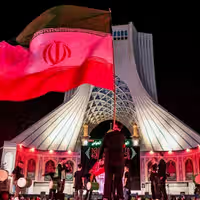
Street celebrations for the new Iranian year in Tehran

On the first day of the Iranian new year Media in Iran highlighted pessimism about the future, warning about the worsening political and economic situation.

Economic analyst Morteza Afghah told centrist news website Entekhab that tensions in Iran's domestic politics will escalate if the government fails to solve the country's economic problems and eliminate the impact of sanctions on the economy.

Afghah further argued that without resolving Iran's nuclear dispute with world powers and securing the lifting of US sanctions, back-breaking inflation in Iran will continue.

Economic analyst Morteza Afghah (undated)
100%
Economic analyst Morteza Afghah

Talks with the West to revive the 2015 nuclear accord known as the JCPOA came to a deadlock last September.

Iran is experiencing an annual inflation rate of more than 50 percent for the second year in a row, with food prices rising between 70-100 percent.

The economist also argued that government officials do not realize how far their legitimacy has declined and people no longer believe their promises and statements. He added that the government expects the improvement in the ties with Saudi Arabia to bring about hope in the future of the economy, but without tackling the issue of the JCPOA and reducing regional tensions cannot solve all of the country's problems.

Meanwhile, in an interview with ILNA, conservative political activist Hossein Kanani-Moqaddam asked, "Why the government can negotiate with the enemies, but it is not prepared to hold dialogue with its own citizens?" Highlighting some of Iran's domestic and international political problems, Kanani called for negotiations between the government and political groups to put an end to the worsening impasse as almost all groups except ultraconservatives have been barred from candidacy in parliamentary and presidential elections.

Conservative political activist Hossein Kanani-Moqaddam (undated)
100%
Conservative political activist Hossein Kanani-Moqaddam

Kanani-Moqaddam further stressed the need for national reconciliation, which would bring various orientations to the forefront of political activity in Iran. "Political groups and organizations should be able to discuss problems with state officials and the people…as a way of addressing major problems." He also called for boosting political participation and "religious democracy" in Iran.

A report in moderate Rouydad24 website quoted Yahya Ebrahimi, a member of parliament, as saying that if lawmakers had been allowed to impeach some minister, the government would have better realized that the country was in a critical situation.

The remark highlighted complaints by many lawmakers during the past year about parliament Speaker Mohammad Bagher Ghalibaf preventing impeachment motions.

Ebrahimi warned that the political and economic situation in Iran is likely to be worsen in the coming months. The low-income strata of the society are going to suffer more than others as "wage-earners live under the poverty line as we have only two economic classes in Iran: The rich and the poor."

Ebrahimi further charged that the Iranian government has left the people to their own devices and is not doing anything to improve the situation. He added that "The current economic team is an insult to the nation's intelligence."

Ebrahimi warned that the social implication of this situation is far dangerous than its economic consequences. Students are abandoning schools, and cases of drug addiction and delinquency are on the rise.” Officials should be held accountable when impoverished people take to the streets in protest.

Most Viewed

Iran negotiators ordered to return after internal rift over Islamabad talks
1
EXCLUSIVE

Iran negotiators ordered to return after internal rift over Islamabad talks

2
ANALYSIS

US blockade enters murky phase as tankers spoof signals and buyers hesitate

3
ANALYSIS

Why the $100 billion Hormuz toll revenue is a myth

4

US tightens financial squeeze on Iran, warns banks over oil money flows

5
ANALYSIS

US blockade targets Iran oil boom amid regional disruption

Banner
Banner

Spotlight

  • Hardliners push Hormuz ‘red line’ as US blockade tests Iran’s leverage
    INSIGHT

    Hardliners push Hormuz ‘red line’ as US blockade tests Iran’s leverage

  • Ideology may be fading in Iran, but not in Kashmir's ‘Mini Iran'
    INSIGHT

    Ideology may be fading in Iran, but not in Kashmir's ‘Mini Iran'

  • War damage amounts to $3,000 per Iranian, with blockade set to add to losses
    INSIGHT

    War damage amounts to $3,000 per Iranian, with blockade set to add to losses

  • Why the $100 billion Hormuz toll revenue is a myth
    ANALYSIS

    Why the $100 billion Hormuz toll revenue is a myth

  • US blockade targets Iran oil boom amid regional disruption
    ANALYSIS

    US blockade targets Iran oil boom amid regional disruption

  • Iran's digital economy battered by prolonged blackout
    INSIGHT

    Iran's digital economy battered by prolonged blackout

•
•
•

More Stories

Meager Wages Keep Iran’s Stability On The Edge

Mar 22, 2023, 22:06 GMT+0
•
Iran International Newsroom

After a year when the rial lost about half its value and inflation surpassed 50 percent, the Islamic Republic decided to raise minimum wage by just 27 percent to about $100 to $110 a month. 

The minimum wage has increased in rials but in comparison to the dollar, which was about 260,000 rials exactly a year ago and is now about 500,000, the workers lost a lot of purchasing power. 

The minimum monthly salary rose from 41,790,000 rials to 5,308,000 rials (about $100 to $110) for the current Iranian year, which started on Tuesday, March 21. The minimum needed for an average family to simply survive is about $310 to $390 a month. 

Iran has one of the lowest minimum wages in the world, but wages were increasing from 20 years ago to about 10 years ago when the minimum wage hit a record high of about $275 a month in 2010. This was when the United Nations Security Council began imposing economic sanctions to force Tehran to roll back its nuclear program.

In January 2023, minimum wages in the EU member states ranged from $410 per month in Bulgaria to $2,500 per month in Luxembourg.

Iranian workers were earning close to $300 a month before the United States imposed sanctions in 2018, which pushed Iran’s currency almost ninefold lower, creating inflation that wages have not kept up with.

The 27-percent increase, on the backdrop of rising prices -- especially foodstuff with 80 to 100 percent more expensive than a12 months ago – would likely lead to more labor protests and strikes this year, something that was already taking place regularly throughout the previous year. Rising prices and economic hardship have led to repeated labor strikes and nationwide protests since 2017, even before the imposition of US sanctions.

In his televised address early Tuesday, President Ebrahim Raisi claimed achievements for his administration, saying that sanctions on Iran failed, macroeconomic indicators improved, and thirdly, the public trust of the people in the regime increased. Several local media outlets dismissed his claims.

Iran’s President Ebrahim Raisi addressing the nation on the occasion of Nowruz or the Persian New Year on March 21, 2023
100%
Iran’s President Ebrahim Raisi addressing the nation on the occasion of Nowruz or the Persian New Year on March 21, 2023

In addition to round after round of US sanctions on Iran, several European countries as well as international organizations adopted resolutions or punitive measures against the Islamic Republic. Countries such as Iraq that used to be a source of foreign currency income for Iran started cooperation with the United States, making it difficult for the regime to launder its oil revenues and funnel them back. Moreover, the negotiations to revive the 2015 nuclear deal – the JCPOA – collapsed indefinitely and the global call not to restore the accord is getting stronger. 

Sanctions on the regime are actually working quite well despite the claims of more crude oil exports, as Tehran does not seem to be receiving any considerable sums in hard currencies. According to an article on Farazdaily published on Sunday, the government has signed $100 billion worth of interim investment deals in the form of memoranda of cooperation – the largest of which is a $40 billion one with Russia’s Gazprom -- but no binding contracts have been signed. 

Oil Minister Mohammad Javad Oji insists that about $20 billion worth of oil and gas contracts were finalized in the previous Iranian year, but the catch is that most of the finalized contracts were signed with Iranian companies, which means no foreign investment and transfer of technology will materialize, the article added. There is no official information about any foreign firm that has agreed to invest in Iran and jeopardize relations with the US. 

Iran’s centrally controlled economy is inefficient and not conducive to foreign investments, with high reliance on oil exports. With no legal and simple way to access its revenues and frozen assets, the Islamic Republic’s economic indicators are also in disarray, contrary to what President Raisi claimed.

According to a recent report, Iran’s misery index rose from 19.3 percent in 2018 to 49.4 percent in 2022, with estimates saying that the figure hit 56 percent by March 2023, which is the highest level in the past 27 years. The index is an economic indicator to determine how the average citizen is doing economically and is calculated by adding the seasonally adjusted unemployment rate to the annual inflation rate.

In the previous Iranian year, the country saw its boldest uprising against the Islamic Republic since its establishment in 1979. The antiregime protests that started in September 2022 flare up occasionally and could explode again under financial pressures.

Iran’s Oil Ministry Warns About High Gasoline Consumption

Mar 22, 2023, 20:30 GMT+0

The National Iranian Oil Refining and Distribution Company has urged people to reduce gasoline consumption, just days after Iran International reported that national reserves are down to five-days supply.

CEO of the company Ali-Akbar Nejad-Ali announced that the daily gasoline consumption record was broken for the second time in recent days.

According to him, on March 20, 144,300,000 liters of gasoline was consumed in the country which shows an increase by 28% compared to the same day last year.

Iranian are travelling in large numbers during the new year, Nowruz, holidays every year, but this year after consecutive waves of the COVID pandemic, travel has increased.

Meanwhile, ISNA state news agency reported that between March 11 and 20, the average consumption of gasoline was 121.8 million liters, which has grown by 13.9% compared to the same period last year.

Iran International had earlier obtained a classified document outlining the proceedings of a meeting of various government officials from different departments at the presidential office in late February according to which strategic fuel reserves have dropped to a dangerously low level, forcing major repairs at refineries to be delayed allowing maximum production for the time being.

Participants in the meeting decided that the oil ministry should offer assurances to the public that it will help maintain the supply of fuel at normal levels. The meeting decided to advise officials to avoid any public comments that could be interpreted as an intention to raise fuel prices.

In November 2019, the announcement of the government’s decision to increase fuel prices by 50–200 percent triggered a cycle of protests and unrest across the country that lasted for over two weeks. During this time, angry protesters torched hundreds of gas stations, banks, and government buildings.


Australian FM Condemns Iran’s Human Rights Abuses

Mar 22, 2023, 15:54 GMT+0

Australia’s Foreign Minister Penny Wong has condemned the regime’s human rights abuses against the people of Iran.

In a tweet Wednesday, she claimed she had expressed Australia's condemnation of Iran's brutal crackdown on protests, execution of protesters and oppression of women and minorities in a phone conversation with Hossein Amir-Abdollahian, her Iranian counterpart.

She also said that “she conveyed concerns over foreign interference” referring to recent reports presented in the Australian Parliament, claiming Iran’s Revolutionary Guard Corps agents targeted organizations in Australia with cyber-attacks in order to use their information for extortion.

“We will not tolerate surveillance or harassment of Iranian-Australians. We employ every strategy at our disposal - including dialogue - towards upholding human rights, consistent with our values and with our interests,” reads her tweet.

The phone conversation between Wong and Amir-Abdollahian came a few days after Canberra imposed new sanctions against Iran for violating human rights and providing Russia with drones to use in the Ukraine war.

Targeted financial sanctions and travel bans will now apply to 13 Iranian individuals and targeted financial sanctions on one entity involved in the production and supply of drones to Russia. Australia is among a growing list of foreign nations punishing members of the regime and its organizations with sanctions.

Sanctioned targets also include senior law enforcement, political and military figures, including within the Islamic Revolutionary Guard Corps, the regime's agency involved in the violent crackdown on protests following the death of Mahsa Amini and the continued oppression of the people of Iran.

Leaked Document Reveals Questions About Role Of Khamenei’s Son

Mar 22, 2023, 15:14 GMT+0
•
Iran International Newsroom

A recently-leaked document on a meeting of senior IRGC commanders and clerics with the Supreme Leader has revealed contention about the role of Khamenei’s son Mojtaba. 

The 44-page minutes leaked to media last week, contains citations of remarks by 45 IRGC commanders and clerics at a meeting at Khamenei’s office on January 3 on the anniversary of the death of Quds Force commander, Qassem Soleimani, who was killed by the US three years ago.

A sample page of the leaked document (March 2023)
100%
A sample page of the leaked document

During the meeting, Yadollah Bouali, the Revolutionary Guard’s commander in the southwestern province of Fars, criticized interventions by the Mojtaba Khamenei and forces under his command, saying that such measures disrupt the security structure of the country. He added that changes at senior level positions based on the opinions of a small group can be “disastrous.” 

However, several other commanders defended Mojtaba Khamenei and the role he plays in the country's security.

The IRGC commander in Kohgiluyeh and Boyer-Ahmad Province, Avaz Shahabi-Far, expressed support for Khamenei's son, alluding to a meeting attended by late Qassem Soleimani who praised him, calling him a “scholar in military science,” Shahabi-Far said, “I think that it is in the best interest of the country for him (Mojtaba Khamenei) to intervene and help in the matters he is allowed to.” 

Mojtaba does not hold any official position in the country, but is said to be the de facto leader of the IRGC’s Basij paramilitary forces, who are tasked with suppressing any voice of dissent among regime forces. 

Mojtaba Khamenei, the son of Iran’s Supreme Leader Ali Khamenei  (undated)
100%
Mojtaba Khamenei, the son of Iran’s Supreme Leader Ali Khamenei

Next to speak about Mojtaba’s interventions was Mohammad-Hossein Zibayinejad, also known as Hossein Nejat, another IRGC commander who served as the deputy for its Intelligence Organization and is currently the de facto commander of the IRGC's Sarallah Base. Tasked with keeping Tehran secure, it is the most important IRGC ground force HQ in Iran consisting of several of its most important units, which protect key institutions and the offices of the government.

Defending young Khamenei's role, he said he receives reports of disobedience and selling military information on a daily basis, and added that Mojtaba can help resolve such problems. Stressing that such problems should be delegated to IRGC’s Intelligence Protection Organization, and having someone like Mojtaba at the helm can be helpful.

Although it is not officially acknowledged, Mojtaba has a significant role in assigning and removing senior officials both in IRGC’s Intelligence Organization and IRGC’s Intelligence Protection Organization, two nominally separate institutions.

Amir Ali Hajizadeh, the commander of IRGC’s Aerospace Force, also supported the Supreme Leader's son. “I personally appreciate the help of Haj Agha Mojtaba's office in overcoming the problems of the air force, both in the supply sector and also... in obtaining better results,” he said. 

Mojtaba Khamenei, the son of Iran’s Supreme Leader Ali Khamenei  (undated)
100%
Mojtaba Khamenei, the son of Iran’s Supreme Leader Ali Khamenei

Morteza Amoumahdi, the IRGC commander in the city of Esfahan (Isfahan), came in as a supporter, saying that “the regrettable situation of the country is the result of ignorance, inefficiency and inability of (former president Hassan) Rouhani's administration, and worse than that, the result of the current administration's inefficient government.” 

Amoumahdi went on to say that in a meeting with Mojtaba Khamenei where the IRGC's commanders in Sistan-Baluchestan and Khuzestan provinces were also present, “we came to the conclusion that the managers appointed by the president in executive positions have led the country to this abrupt economic failure due to their incompetence and efficiency,” tacitly saying that Mojtaba can do a better job in managing the regime’s economic and political woes. 

In July 2022, an Iranian news agency’s use of the title “Ayatollah” for Mojtaba Khamenei rekindled suspicions that he is being groomed to succeed his father as the Supreme Leader. The news agency used the title in an announcement about registration at Mojtaba Khamenei’s theology course, (kharej fiqh), at Qom seminary where he has been studying and teaching for a few years now.

Road Deaths Soar As Holidays Begin: Over 325 Dead

Mar 22, 2023, 14:41 GMT+0

The annual Nowruz road death toll began to climb this week with at least 325 dead in the first seven days of the new year holidays.

In spite of a plan from the country’s Traffic Police to reduce deaths during the fatal season which every year sees hundreds die on the country’s roads, fatalities were soaring once more.

On Wednesday, Chief of the Traffic Police, Kamal Hadianfar, said since March 15, 7,200 people were also injured in accidents, a significant number of those left permanently disabled.

The annual phenomenon is caused by a variety of factors as the country’s 88 million population travels for the festive season.

A combination of poor roads, poor vehicle manufacturing and maintenance and dangerous driving, make it the most fatal time of year for the country’s citizens, a bitter twist to the celebrations and symbolism of hope and new life associated with new year.

On Monday, Chief of the Traffic Police Information and Control Center, Ahmad Shirani, said Khorasan Razavi, Fars, Kerman, Esfahan and Sistan and Baluchistan provinces have the highest number of fatalities.

With the holiday continuing for another 10 days, numbers are expected to continue the upward trend. Last year, 746 people were killed in road accidents during the first 18 days of Iranian new year.

Iran has one of the worst world’s statistics in terms of road accidents -- at its worst during Nowruz.

Based on official statistics, more than 33,000 Iranians died instantly in or after road accidents in 2018. Third only to heart diseases and strokes, road accidents also account for a significant share of mortalities in the country.