Australia Imposes New Sanctions On Iran, Cites Rights Abuses

Australia has issued sanctions on Iran for human rights violations and its support for Russia's war on Ukraine.

Australia has issued sanctions on Iran for human rights violations and its support for Russia's war on Ukraine.
Targeted financial sanctions and travel bans will now apply to 13 Iranian individuals and targeted financial sanctions on one entity involved in the production and supply of drones to Russia.
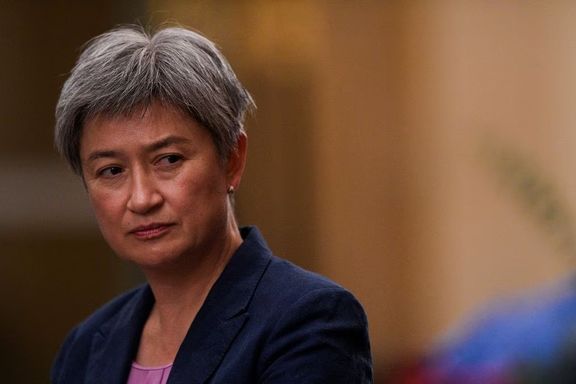
The statement issued by Foreign Minister, Penny Wong, said the sanctions target those "responsible for egregious human rights abuses and violations in Iran".
Sanctioned targets also include senior law enforcement, political and military figures, including within the Islamic Revolutionary Guard Corps, the regime's agency involved in the violent crackdown on protests following the death of Mahsa Amini and the continued oppression of the people of Iran.
According to the list seen by Iran International, the commander of the IRGC's Sarallah Base, Mohammad Hossein Zibaee Nejad, also known as Hossein Nejat, is also on the list. Tasked with keeping Tehran secure, it is the most important IRGC ground force HQ in Iran consisting of several of its most important units, which protect key institutions and the offices of the government. The operations deputy of the Police Force, Hossein Sajedinia, also appears on the list.
Four members of the morality police cited as "responsible for the arrest, detention and ill-treatment of Mahsa Amini" are among those facing the Magnitsky-style human rights sanctions.

The Islamic Republic insists it has reached a deal with the US on a prisoner swap, a development that Washington has been denying but Tehran is getting more vocal about it.
Iranian Foreign Minister Hossein Amir-Abdollahian repeated on Sunday that the two countries have agreed on such a deal but it is not clear if the claim is true or it is a stunt by the regime. The new snippet of information that was divulged to the media in Amir-Abdollahian’s remarks was that the US and Iran had agreed on the deal March last year and they are tweaking the details through an unnamed third party in recent weeks.
“We have signed a document in March last year through a representative introduced by the United States from a third country. We consider the issue of prisoner exchange to be a completely human issue. In recent weeks, there have been indirect discussions to update that document regarding the exchange of prisoners," he said.
The minister added that the basis of any new agreement is the minutes of the meeting that were signed in March last year. “Our opinion is that the American side should pay attention to the human aspects of this issue above all, this is something that is strongly emphasized by us,” he said.

If true, a deal one year ago might have been within the context of a nuclear agreement that never materialized and probably hinged on a US agreeing to free Iran’s frozen funds. It has long been reported that South Korea would free about $7 billion held in escrow by its banks due to US sanctions.
The United States has categorically denied the existence of such a deal, but it can simply be the Biden administration’s tactic not to build up the hopes of the involved families or to avoid international outcry over its covert appeasement of a regime that is condemned by the international community over its gross human rights violation during recent protests and its military assistance to Russia.
Washington has repeatedly expressed concern about the fate of its citizens imprisoned in Iran but also has rejected the existence of such a deal, that can be construed as a failure to stand up against the Islamic Republic’s policy of hostage taking, a practice that started in the early days after the establishment of the regime and has been often used ever since.
In November 1979, a group of leftist students backed by the new revolutionary government occupied the US embassy in Tehran and took 54 Americans hostage for 444 days. Iran never condemned the act that ruptured bilateral relations. Tehran denies any policy of hostage taking and insists all foreigners are tried legally. However, it has frequently shown readiness for prisoner exchanges and participated in swaps in the past.
UN experts and international human rights organizations say that the Islamic Republic takes foreigners hostage to extract concessions from the West.
Currently, the regime is in the midst of negotiations to bring home one of its former diplomats, who is serving a life sentence in Belgium for his involvement in a plot to bomb a gathering of an exiled dissident group. Belgium's Constitutional Court said in a press release earlier in the month refused to annul a treaty with Iran that could lead to the diplomat, Assadollah Assadi, convicted of terrorism, to be swapped for Belgian aid worker Olivier Vandecasteele, held hostage in Iran.

Since early March, Iran insists it is doing a prisoner swap with the US in spite of the Biden administration’s categorical denials. The Iranian foreign ministry says the "written agreement has been signed by the official representative of the United States” though has not named the official.
White House denies such claims, calling it “a cruel lie”, but reiterates that the United States is committed to securing the release of Americans held in Iran.
Three Iranian-American citizens, Siamak Namazi, Emad Sharqi, and Morad Tahbaz, are still imprisoned in Iran. In exchange for the release of the hostages, in addition to demanding money, the Islamic Republic plans to urge Washington to release the Iranians imprisoned in the US for circumventing sanctions or involvement in terror activities.

Jailed women's rights activist Bahareh Hedayat says the Iranian regime must be overthrown adding that if Iranians want freedom they must oust the Islamic regime.
In a letter sent from prison and published by Iranwire, Hedayat referred to the killing and execution of youths during the nationwide protests against the Islamic Republic, stressing that she has faith more than ever that victory can be won.
"The Islamic Republic has become the most immoral element in Iranians' daily life and its survival is the negation of our survival, our children and our land, therefore demanding its ouster still makes sense,” underlined Hedayat.
This is not the first time that Hedayat calls for the overthrow of the Islamic Republic from prison.
Earlier and during the popular uprising against the Islamic regime she explained the difference between the protests following the death of Mahsa Amini and previous protests saying that people detached themselves from political and regime-made Islam this time.
Hedayat was one of the activists who worked on the One Million Signatures campaign to change laws that discriminate against women in Iran. She has been arrested and imprisoned several times.
She was arrested by security forces in Tehran on October 11, 2022, amid the Mahsa Amini protests. After eight days of detention, in a phone call, she informed her family that she was in ward 209 of Evin prison and did not know the reason for her arrest, nor the charges against her.

Iran’s exiled queen has expressed hope that Iran will be free in the coming year in a message on the occasion of Iranian new year, Nowruz.
Farah Pahlavi expressed sympathy with the families of the dead protesters, prisoners and people under pressure in Iran, saying that the essence of Nowruz heralds the victory of truth over lies.
"Nowruz, which always brings joy and hope, will be celebrated this year in a situation in which our nation is mourning its lost ones," she said.
The exiled queen further noted that hundreds of young men and women died with the slogan ‘Women, Life, Freedom’ in confrontation with brutality and darkness, but “their names and memories will be eternal in the history of Iran”.
She further underlined that “my thoughts are with the bereaved mothers and fathers, thousands of Iranians who are imprisoned, and teenagers who have been poisoned in Iranian schools”.
Elsewhere in her remarks, Pahlavi expressed concern over the situation of millions of Iranians who are struggling to earn a living and are victims of the brutality and incompetence of the regime.
She also congratulated the arrival of the ancient Iranian tradition Nowruz which is a “sign of stability, continuity and national identity.”
Iran has been witnessing nationwide protests within the past six months, during which time, regime agents have killed over 500 people so far and executed several who were arrested during demonstrations. Thousands more have been arrested arbitrarily.

Dozens of clerics from seminaries in Tehran demanded the government to take decisive action to enforce the hijab and stop what they called the “spread of nudism”.
“Nudism has been spreading due to the enemy’s trickery more and more but while we are showing patience, there is only passivity and lack of decisive action in the atmosphere of the country,” 46 officials of religious seminaries, including officials of women’s seminaries, wrote in a letter to President Ebrahim Raisi Thursday.
“We will not be able to demand the implementation of other laws in the future if we back down on the Hijab Law now,” seminarians said in their letter while criticizing the withdrawal of the infamous morality police patrols from the streets and demanding “immediate” action.
Morality police patrols were withdrawn from the streets in October amid nationwide protests that followed the death in custody of the 22-year-old Mahsa Amini who was arrested for failing to wear her hijab ‘properly’.
Protests sparked by Mahsa’s death have grown much less fierce and frequent since January while hardliners’ demands for enforcement of the Hijab Law have considerably grown.
Many of the women who burned their headscarves during the protests, particularly the younger generation, are still defiantly appearing ‘hijabless’ in public in unprecedented numbers.
Women’s defiance, which also signals their defiance of the clerical rule, is too vexing to the hardline establishment many of whom are trying to cast the responsibility of enforcement of hijab rules on businesses and encouraging individuals to take the matter into their own hands.
Ayatollah Mohammad-Mahdi Hosseini-Hamedani, the Friday imam of Karaj, criticized businesses for not addressing the hijab issue and said retailers, banks and government offices must enforce the rules.
Last week, the judiciary in Kashan ordered a very popular boutique hotel, Sara-ye Ameriha, in Kashan and Matin Abad Eco Camp about 45km from the same city to shut down on the grounds that their guests had not abided by “Islamic norms and the hijab rules”.
Sara-ye Ameriha, a massive historical house restored and turned into a boutique hotel shut down for failing to force guests abide by hijab rules.
The hotel and eco camp were both reopened Thursday after the tourism minister, Ezzatollah Zarghami, denied his ministry’s involvement and said shutting down such places was unacceptable because it violated the rights of domestic and foreign tourists that had made reservations and promised to resolve the problem.
Local authorities often take the matter of enforcement of hijab into their own hands by threatening businesses and even shutting them down if they fail to force their clients to abide by the rules.
On Thursday, the public and revolutionary prosecutor of Khuzestan Province not only warned to shut down local businesses but also warned that vehicles, presumably taxis and private cars, could also be impounded for passengers’ infringement as this “promoted hijablessness” .
Lawmakers have also drafted a new law that if approved would increase CCTV and social media surveillance of hijab and punish not only “offenders” but also businesses which fail to enforce the rules on their premises.
Bijan Nobaveh, one of the lawmakers behind the plan, said earlier this week that punishments included cutting mobile phone and internet access of “offenders” but Ahmad Naderi, a member of the presidium, later accused the media of using Nobaveh’s personal views to launch “an onslaught against the parliament”.
The plan demonstrates that lawmakers are not learning from experience. “Do not step on people and the society’s nerves,” the reformist Ham Mihan newspaper wrote Thursday, while mentioning other serious problems such as the high rate of inflation plaguing the economy.
An Iranian court has handed out death sentences to two men over an attack on a Shiite shrine in Iran that killed 15 people in October and was claimed by the militant group Islamic State.
Fars Province judiciary head Kazem Mousavi said the two men had been found guilty of charges including "spreading corruption on earth" and acting against national security, the official news agency IRNA reported, adding that the sentences can be appealed.
CCTV footage broadcast on state TV showed the attacker entering the popular Shah Cheragh shrine in the southern city of Shiraz after hiding an assault rifle in a bag and shooting as worshippers tried to flee and hide in corridors.
The gunman, identified as a citizen of Tajikistan, later died in a hospital from injuries sustained during the attack.
The two men sentenced to death said during the trial that they had been in contact with the Islamic State in neighboring Afghanistan and helped organize the attack, Iranian media reported.
Three other men received jail sentences ranging from five to 25 years in the trial, Mousavi said, adding that several other "Daesh (Islamic State) suspects linked to this case" were awaiting trial.
ISIS took responsibility for the attack on the Shahcheragh in Shiraz on October 26, but some questioned the Islamic Republic’s account saying it was staged by the regime itself to distract attention from nationwide protests.
With reporting by Reuters