Iranians Have Lost Trust In Their Government, Says Sociologist

An Iranian reformist cleric says two hardliner factions in Iran control the whole political system and prevent a dialogue to make changes or revise the constitution.
An Iranian reformist cleric says two hardliner factions in Iran control the whole political system and prevent a dialogue to make changes or revise the constitution.
Ahmad Mazani, who was also a lawmaker, likened one group of hardliners to the Islamic State militant group. However, he said that both hardliner factions are reactionaries.
Speaking at the congress of the pro-reform Mardomsalari (Democracy) Party, on Thursday, Mazani said one of the two poles consists of political dwarves. He was presumably referring to the Raisi administration. Also, in an apparent reference to ultraconservatives who challenge the government from within, he called one faction an ISIS-like pole that has deprived Iranians from their right to run "an ordinary life".
Meanwhile, in an interview with the website of Iranian Sociologists’ Association, prominent academic Mohammad Fazeli said that the current situation in Iran is marked by people’s deep distrust of the government.
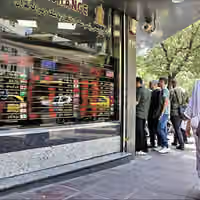
Fazeli argued that "in the absence of trust in the government people do not have any long-term plans. In an economy with a double-digit inflation rate and under economic sanctions, political pressures, and the government's intervention in the citizen's private lives, those who have the financial resources will not invest in a factory. They will instead purchase gold and foreign currencies for short-term profit."
Opportunism and short-term planning will become a characteristic of a society in which the people do not trust the government. Such a situation does not leave too many choices for citizens, he said. “
“When the house is on fire, you have only two choices, jumping out of the window or taking the fire exit to make it to safety," he said, adding that "In a society under pressure you cannot expect individuals to consider a series of options. Even if there are really some other options, people tend to choose the ones that help them save themselves as soon as possible."
Asked if Iran's future is going to be as horrible as some analysts portray, Fazeli said, "I cannot say for sure, but I can only say it can well end up that way. We have seen other countries in similar situations in the Middle East, the Balkans and Africa. Whether the same thing will happen in Iran depends on other factors," but did not elaborate.
Fazeli said, "The Iranian state television, for instance, has said that as a media outlet that has to convey the government's messages, it has been losing audience during the past years. This is an example of loss of social capital. So, the state television in Iran is no longer a media outlet for the people of Iran. It is a radio and television organization that broadcasts to a small group of people and likes to convince them, not the nation as a whole."
He added, "I believe the only thing on the Iranian state television that is meant for everyone is football. Because it lacks any ideological content and advertisers are happy to pay for commercials." Fazeli added that state TV officials have deliberately decided not to run a television station for all the people.
In the current Iranian crisis, there are also elements who advocate destruction, the sociologist maintained. They believe nothing will be made right before everything goes wrong. In fact, in a situation marked by distrust anything goes.
The academic reiterated that lost social trust cannot be restored easily. "The government needs to take the first step for confidence building by engaging in symbolic acts. It should offer gestures to the society that indicate there is a will in the government to make things right."