Iran’s Exiled Prince Calls For More Unity To Oust Islamic Republic

Iran’s exiled Prince Reza Pahlavi says the charter of solidarity and freedom of Iran creates the basis of cooperation among opposition forces to oust the Islamic Republic.

Iran’s exiled Prince Reza Pahlavi says the charter of solidarity and freedom of Iran creates the basis of cooperation among opposition forces to oust the Islamic Republic.
However, it is important that “we all know we agree on basic principles, otherwise there will be no understanding in practice,” Reza Pahlavi told Iran International on the sidelines of an anti-regime rally in Los Angeles on Saturday.
Emphasizing the need to support civil activists and political prisoners in Iran, he said "Iran's Charter of Solidarity and Freedom", which is being finalized, includes the minimum principles of agreement for the majority of secular democratic forces.
He also touched upon the need to continue the demonstrations abroad saying that this will make the Iranian people and activists gain energy and continue the movement with more strength.
In a historic event on Friday, eight leading Iranian opposition figures called for support from democratic countries to change the regime in Iran and establish democracy.
At an event at Georgetown University's Institute for Women, Peace and Security, exiled Prince Reza Pahlavi, Nobel laureate Shirin Ebadi and Canada-based activist Hamed Esmaeilion, as well as US-based journalist Masih Alinejad, actresses and activists Nazanin Boniadi and Golshifteh Farahani, former captain of Iran’s national soccer team Ali Karimi and Secretary General of Komala Iranian Kurdish party Abdullah Mohtadi made a speech.


Iran’s chief nuclear negotiator, Ali Bagheri-Kani, says “negotiations in the framework of exchanging indirect messages between the two sides continue.”
The government’s official news website IRNA Sunday published an interview Bagheri had with Al Manar TV in Lebanon, where he tried to reassure the public that the chance to revive the 2015 nuclear agreement is not lost and talks are taking place.
The Islamic Republic faces multiple economic and political crises that have deepened in the past six months, as 18 months of indirect talks with the United States failed to produce a result and popular protests dealt a further blow to Tehran’s political standing.
The Biden Administration announced in October that its focus has shifted from the nuclear issue to supporting the rights of Iranian protesters and increasingly a negative mood emerged about the chances of any new talks.
“In the past year and a half when talks were taking place, the speed of negotiations might have increased and decreased at times but there was a continuity. Now also [talks] are taking place in the framework of exchanging messages between the two sides,” Bagheri said.
The Biden Administration has not explicitly denied exchange of messages with Tehran.
Iran International reported in January that the State Department did not deny information obtained by the network that US Iran Envoy Robert Malley had held meeting in New York with Tehran’s UN ambassador.
In response to questions submitted by Iran International on January 17, State Department spokesperson Ned Price said, “We have the means to deliver specific and firm messages to Iran when it is in America’s interest to do so.”
The contents of Malley’s meetings with the Iranians remain unclear, but the issue of Americans held hostage in Tehran or regional issues are all intertwined with the nuclear negotiations.
In early November, President Joe Biden told a citizen who asked him about the nuclear talks during an election campaign event that the “JCPOA is dead.” Bagheri commented about this and said that later US officials spoke about this – referring to comments that diplomacy will continue – and “in practice messages are being exchanged.”
Bagheri also did not deny that Qatar is playing a mediating role
There was little else new in what Iran’s chief negotiator had to say about the nuclear talks or the increasingly tense relations with the West. He repeated Supreme Leader Ali Khamenei’s accusation that the West instigated the protests in Iran.
He also reiterated that Iran’s most important “red line is the issue of guarantees”, that in case of a deal “the other party discharges its commitments.” Throughout the talks Tehran has been insisting on receiving guarantees from the United States that it will not pull out of an agreement, similar to President Donald Trump’s decision in 2018. Tehran is also insisting that it should receive the economic benefits once sanctions are lifted.
The US has said that it cannot guarantee an accord, which is not a treaty, beyond the term of the current administration.
However, on the issue of sanctions, Bagheri appeared to demand that only economic sanctions imposed by the Trump administration, not mentioning many new sanctions imposed by the current administration on companies and individuals.
Facing a worsening economic crisis and a popular revolt, Tehran wants to exhibit an aura of normalcy and hope. The target of positive statements about the chances of talks with the West is more the domestic audience that fast is losing hope in the future.

Five months into Iran's protest movement, an important question is whether the opposition in Iran and in the diaspora can unite to oust the Islamic Republic.
In the past few months, protesters on the streets have been looking up to some leading opposition figures abroad, particularly the exiled Prince Reza Pahlavi whose father was ousted by the Islamic Revolution of 1979 when he was still a teenager.
Many have hoped that the exiled prince and others, mainly activists and celebrities who have been campaigning against the regime, would form a united front, coordinate moves against the regime, lobby with western powers, and eventually assume the leadership of the revolution when the time comes.
Having to look up to the diaspora is in fact a situation imposed by the Islamic Republic which has practically eliminated, or forced into silence, any strong opposition figure or group inside Iran that could pose a danger to its existence.
Five months after the death in custody of Mahsa Amini sparked widespread protests in Iran, the opposition in diaspora seems to have come to an agreement to work together. Leading opposition figures – including exiled Prince Reza Pahlavi and seven others at an event Friday in Washington DC expressed their views and their vision of the future and said they are drawing up a manifesto for the revolution.
Meanwhile, Mir-Hossein Mousavi, who was a presidential candidate in 2009 and has been under house arrest since 2011, said in a statement a week earlier that fundamental change was required to “save Iran” and proposed elections to appoint a constitutional assembly to decide the future form of government and a referendum on the new constitution.

Mousavi’s rejection of the reform option in the Islamic Republic which puts him in the same boat as the diaspora figures has been met with admiration and antipathy alike. Many agree that declaring that the Islamic Republic is no longer reformable was a brave move on the part of Mousavi, a staunch believer in the Islamic Republic who served as its prime minister in the 1980s.
When asked by BBC Persian about the possibility of collaboration with Mousavi at the event Friday, Prince Reza Pahlavi said the diaspora opposition aims at “maximum participation” in the struggle against the regime and welcomes anyone who wants a secular Iran, not a reformed Islamic Republic.
“Reza Pahlavi’s response about Mousavi’s statement was diplomatic. In a way, he tried not to cause animosity…I hope his supporters will agree that Iranian politics is multi-faceted,” Mojtaba Najafi, a France-based academic tweeted referring to the many Pahlavi supporters’ strong objection to Mousavi and other reformists.
The former crown prince and the former prime minister in the Islamic Republic say the future form of the government should be decided by the people of Iran through the free election of a constitutional assembly and referendum.
In his short statement, Mousavi also called for cooperation among all political forces and figures who believe in preserving the country’s “territorial integrity” and “non-violence” to decide the transition from the Islamic Republic.
But differences between the political views of Pahlavi, other activists and Mousavi also run very deep, probably on many issues, as long as the former official has not acknowledged his responsibility in the misdeeds of the regime in the 1980s.
At the event, for instance, Prince Reza Pahlavi brought up an issue which could potentially be divisive: Relations with Israel.
When speaking about water crisis as one of Iran's major problems, he said Iran could seek assistance from “the best of Israeli experts”. He also referred to the former President Mahmoud Ahmadinejad who “wanted Israel not to exist at all” which implied he favors normal relations with Israel.
Mousavi and his supporters are now in agreement with the diaspora opposition that the people should decide the future form of government through a free vote, but although they may not call for Israel’s annihilation like Ahmadinejad and Khamenei, they are more likely to champion the Palestinian cause and be opposed to recognizing Israel.
However, Mousavi is not the leader of the young protesters in the streets, who seem to oppose a revolutionary foreign policy and favor good relations with regional countries.

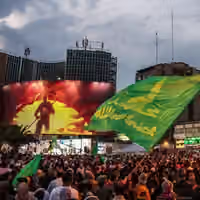
Iranians have once again staged mass rallies in dozens of cities across the world calling for the overthrow of the Islamic Republic.
Pursuant to calls to hold a global rally against the Islamic Republic on Saturday, which coincided with the anniversary of the establishment of the Islamic Republic in 1979, dozens of cities around the world witnessed protests against the regime.
Iranians from various European cities traveled to the French capital Paris to express their anger at the brutalities of Iran’s rulers against unarmed civilian protesters.
A number of politicians, artists and family members of people killed by the Islamic Republic, participated in the gathering.
Danial Ilkhanipour, a German-Iranian member of the Hamburg city parliament, said, "We are here today to announce that the last five months were just the beginning and it was the beginning of the end of the Islamic Republic."
This representative of young Iranians who have become full-fledged European citizens and politicians added, "We will be in Brussels on February 20."
Alireza Akhundi, a member of the Swedish parliament, also spoke at the Paris rally, saying, "44 years ago a bitter incident happened in this city, and today we are all together and united for the revolution of the brave people of Iran."
He was referring to Ayatollah Ruhollah Khomeini’s return to Iran from Paris, where he had found refuge after leaving Iraq. Days after Khomeini’s return his followers took over the government.
"Until the victory, the brave people of Iran will stand without fear,” he added.
Ramin Seyed-Emami a musician and composer known by the stage name "King Raam", performed a song at the gathering of Iranians in Paris.
His father Kavous Seyed-Emami was an Iranian-Canadian academic and conservationist. He ran the Persian Wildlife Heritage Foundation (PWHF) and was a sociology professor. In February 2018, he died days after being arrested by the IRGC intelligence. Iran's judiciary said that he killed himself in Tehran’s Evin Prison because of the evidence against him in a spying case. This claim, including the alleged suicide, has been rejected by his family.
The ministry of intelligence later said that there was no evidence against him and several other environmentalists arrested in January 2018.
Ramtin Fatehi, son of Ramin Fatehi, who was killed during the anti-regime protests following the death of Mahsa Amini in police custody, also spoke about the necessity of filing a lawsuit against the Islamic Republic for its brutality.
Niaz Zam, daughter of Ruhollah Zam, who was kidnapped and killed by the regime said, "We only want one thing, and that is the end of the Islamic Republic, which calls itself a republic but is actually a dictatorship."
Best known for operating a Telegram channel named 'Amadnews', which he founded in 2015, Ruhollah Zam played a high-profile role in the 2017–2018 Iranian protests. He was kidnapped while visiting Iraq and taken to Iran where he was sentenced to death and was executed on 12 December 2020.
Iranians living in London also held a gathering and chanted slogans in support of the move to designate the IRGC as a terrorist organization.
A large protest was also held in Washington DC.
Similar protests were held in Oslo, Bologna, Berlin, Dusseldorf, Hamburg, Nicosia, Copenhagen, Aarhus, Vienna, Sofia, Madrid, Istanbul, Sydney, Melbourne, Adelaid, Perth, Brisbane, Auckland, Stockholm, and Gutenberg.
In the past days, activists called on diaspora Iranians to participate in the anti-regime protests on Saturday. Dozens of Iranian artists living abroad also stated that they would take part in these gatherings with the slogan of overthrowing the Islamic Republic.
Exiled Prince Reza Pahlavi also called on all his compatriots to make this event "the most glorious day in the calendar of the Iranian national uprising" with showing solidarity and unity.

A group of teachers’ organizations in Iran’s Kordestan province have expressed concern about the situation of Sunni clerics (Mamoustas) arrested for supporting popular protests.
In a statement, "Working and Retired Teachers Association of Kordestan" stated that after the popular uprising against the regime following the death of Mahsa Amini, “a large number of the Mamoustas stood by the people and on the right side of history with brave stances, statements and participation in protests.”
The statement, published on Friday, stated that "Mamousta Loqman Amini, Seifollah Hosseini, Ebrahim Karimi and dozens of other Sunni clerics" from Kordestan are "influential figures" who supported the protests and must be released.
“The intelligence and security organizations imprisoned them, but they don’t know that by imprisoning each fighter, thousands of other fighters are born,” added the statement.
The statement also calls for the “quick and unconditional” release of all protesters.
The Kurdish teachers also warned the government that “no amount repression” will stop the people, stressing that “torture and prison will no longer work.”
In November, a group of Sunni religious leaders and Friday prayer Imams in Kordestan called for a referendum under the supervision of international bodies in the country.
Earlier, Molavi Abdolhamid, the top Sunni cleric of Zahedan in the southeast had also called for an internationally monitored referendum, saying by killing and suppressing protesters the government cannot push back a nation.

Germany has acknowledged an increase in spying by Iranian agents on exiled Iranians since the start of mass protests last year, Welt am Sonntag newspaper reported on Saturday.
Nationwide unrest triggered by the death of a young woman detained by Iranian morality police last year has led to "increasing indications of possible spying on opposition events and individuals" in Germany, the federal government said in response to an information request from the far-left Linke Party.
"Opposition groups and individuals (...) are considered by the rulers in Iran as a threat to the continued existence of the regime," the government said in its response.
It said the country's domestic intelligence service had identified 160 individuals with links to Germany as well as the Iranian Revolutionary Guards.
The Islamic Republic has persecuted exiled dissidents for four decades, often threatening, assassinating or kidnapping activists in Europe, including a former prime minister and several journalists.
The Revolutionary Guards' "extensive spying activities" are directed in particular against pro-Israeli and pro-Jewish targets in Germany, the newspaper cited the government as saying.
Demonstrations that first erupted in September over the death of a 22-year-old Kurdish woman who had been placed in detention by police enforcing the Islamic Republic's strict restrictions on women's dress have turned into the biggest protests in years.
Reporting by Reuters