• العربية
  • فارسی
Brand
  • Iran Insight
  • Politics
  • Economy
  • Analysis
  • Special Report
  • Opinion
  • Podcast
  • Iran Insight
  • Politics
  • Economy
  • Analysis
  • Special Report
  • Opinion
  • Podcast
  • Theme
  • Language
    • العربية
    • فارسی
  • Iran Insight
  • Politics
  • Economy
  • Analysis
  • Special Report
  • Opinion
  • Podcast
All rights reserved for Volant Media UK Limited
volant media logo

Iran’s Budget Bill Delayed, As Currency Continues To Fall

Iran International Newsroom
Dec 27, 2022, 19:15 GMT+0Updated: 17:49 GMT+1
President Ebrahim Raisi submitting the administration’s draft of the national budget bill for the Iranian calendar year 1401, which started on March 21, 2022

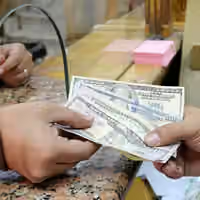
While the Islamic Republic’s currency rial is in a freefall, President Ebrahim Raisi’s government has not finalized the country's budget for the next Iranian year starting March 21. 

The delay by the government, which should have submitted the budget bill by December 6 according to the regulations, is reminiscent of the administration of Mahmoud Ahmadinejad who postponed the budget bill until a few months into the year. This means that government departments and organizations were disoriented for a couple of months before they understood how they had to plan their spending. 

According to parliament rules, if the administration misses the December 6 deadline, it must attach an addendum to the budget bill that will earmark the spendings for quarterly portions of the year. This means demanding extra work from an administration that has already failed to perform its ordinary procedural duty.

Quarterly allocations means parliament will approve only three-month budgets, which will tremendously complicate operations not just for government departments but all the businesses owned or controlled by the state, which constitute up to 80 percent of the economy.

Many economic experts are of the opinion that the delay by the administration means economic chaos for at least the first few months of the next Iranian year. Meanwhile, many lawmakers believe that the administration is deferring the decision until the very last minute so that the MPs do not have enough time to fiddle with the figures and are forced to pass the bill as is. 

Parliament approved the broad outline of the current budget in January with a significant number voting against the bill that raised taxes and cut subsidies.

Another reason that may be behind the delay in submitting the budget bill is timing for the country’s Seventh Five-year National Development Plan (2022-2026). Since 1989, the Islamic Republic has been devising five-year development plans for the country. A lot of organizations and institutions are involved in designing and actualizing these plans, which mostly remain on paper, because of they are full of general statements without planning for the needed monetary resources.

For example, “The country should see a rise in the speed of scientific and technological progress and commercialization of their products, while the educational and research systems need to be updated and upgraded over the target period,” reads part of the Seventh Five-year National Development Plan. 

In September, the Supreme Leader outlined the general policies of the seventh development plan and Raisi tasked the Planning and Budget Organization (PBO) to officially start its compilation.

According to the general policies, the 7th development plan’s main goal and priority is economic progress with an average rate of eight percent during the five-year period, with an emphasis on boosting productivity, capital, technology and management. Reforming the structure of the government budget was also among the major policies stressed in the Seventh National Development Plan. The economic policies also call for transformation in the tax system with a view to making levies the primary source of the government’s current budget.

Amid ongoing antigovernment protests, the Islamic Republic’s currency rial has been losing value so much that regime insiders have started passing the buck. Iran’s currency dropped to a new historic low on Tuesday, breaking the 421,000 rial resistance point against the US dollar. 

Most Viewed

Iran negotiators ordered to return after internal rift over Islamabad talks
1
EXCLUSIVE

Iran negotiators ordered to return after internal rift over Islamabad talks

2
ANALYSIS

US blockade enters murky phase as tankers spoof signals and buyers hesitate

3
ANALYSIS

Why the $100 billion Hormuz toll revenue is a myth

4

US tightens financial squeeze on Iran, warns banks over oil money flows

5
INSIGHT

Ideology may be fading in Iran, but not in Kashmir's ‘Mini Iran'

Banner
Banner

Spotlight

  • Hardliners push Hormuz ‘red line’ as US blockade tests Iran’s leverage
    INSIGHT

    Hardliners push Hormuz ‘red line’ as US blockade tests Iran’s leverage

  • Ideology may be fading in Iran, but not in Kashmir's ‘Mini Iran'
    INSIGHT

    Ideology may be fading in Iran, but not in Kashmir's ‘Mini Iran'

  • War damage amounts to $3,000 per Iranian, with blockade set to add to losses
    INSIGHT

    War damage amounts to $3,000 per Iranian, with blockade set to add to losses

  • Why the $100 billion Hormuz toll revenue is a myth
    ANALYSIS

    Why the $100 billion Hormuz toll revenue is a myth

  • US blockade targets Iran oil boom amid regional disruption
    ANALYSIS

    US blockade targets Iran oil boom amid regional disruption

  • Iran's digital economy battered by prolonged blackout
    INSIGHT

    Iran's digital economy battered by prolonged blackout

•
•
•

More Stories

Iran's Raisi Likely To Reshuffle Economic Team Amid Financial Crisis

Dec 26, 2022, 16:58 GMT+0

Although the need for changes in President Ebrahim Raisi's cabinet has been long discussed by the media, debate on an urgent reshuffling has intensified.

Although the demand of anti-regime protesters is not about a government reshuffling, regime insiders are debating the matter amid a fast-deteriorating economic situation. The unprecedented steep fall in the value of Iran’s currency puts pressure on political elites to appear responsive to public anger.

Proreform Ensaf News website wrote December 24 about "The increasing possibility of changes in the cabinet." It said "moves among conservative political groups, as well as debates among conservative politicians and lobbyists to put forth their preferred choices indicate that a change in the cabinet is imminent."

A few changes Raisi has already made in his cabinet have remained unnoticed probably because those who left had not done anything significant and those who joined were not much different in calibre.

IRGC-linked Housing Minister Rostam Ghasemi died less than a month ago and was replaced by ultraconservative Mehrdad Bazrpash. Vice President for parliamentary Affairs Mohammad Hosseini was silently removed from his post for an unknown reason. Populist Labor Minister Hojjat Abdolmaleki was replaced by Solat Mortazavi a politician with long experience and no eye-catching achievement at the Interior Ministry.

Oil minister Javad Owji with his senior team seen on March 9, 2022
100%
Oil minister Javad Owji with his senior team seen on March 9, 2022

One of the outgoing ministers is said to be Javad Owji who had a minor heart attack at the cabinet meeting two weeks ago, apparently due to pressures caused by a chronic shortage of natural gas. Ensaf News wrote: "Ironically, those who lobbied to get the oil minister’s post during his illness were his close aides!" The candidates named so far for the post include Hossein Shiva the head of the Iranian Oil Tankers Company and Alireza Zeighami, a former senior official at the ministry.

According to Ensaf News, there are talks in the corridors of the government about possible changes at top level in the Oil Ministry and the Ministry of Education. Politicians in Tehran say that individuals close to the IRGC and the ultraconservative Paydari party are in fierce competition over winning the posts. The lucrative nature of the oil ministry post is clear to everyone. The candidate for the post of education is Yousef Nouri from the Teachers' Fund, an organization known for a major financial corruption case.

Meanwhile, as parliament’s term comes to an end in early 2024, some lawmakers are also trying to get closer to Raisi in a bid to win a post in the cabinet.

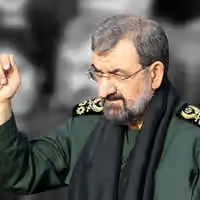
Mohsen Rezaei, Raisi's vice president for economic affairs, is a former IRGC officer who says he received a PhD in economics
100%
Mohsen Rezaei, Raisi's vice president for economic affairs, is a former IRGC officer who says he received a PhD in economics

According to most Iranian news outlets including the moderate news website Rouyda24, Raisi's economic team is likely to be where most of the changes will take place. Economist Kamran Naderi told the website that changing the members of his economic team is Raisi's only way out of the problems created by the current team.

Economy Minister Ehsan Khandouzi is said to be under pressure to leave the cabinet, reportedly for giving many posts to individuals from Khorasan Province, presumably those linked to hardliner Friday prayer leader Ahmad Alamolhoda. According to recently leaked top-secret documents, even Raisi himself, who is Alamolhoda's son-in-law is not happy about the cleric's interventions in the affairs of the government.

Naderi attributed the continuing fall of the rial to the inefficiency of the government's team, including self-proclaimed economic genius Mohsen Rezaei who is the vice president for economic affairs.

Meanwhile, former IRGC officer and presidential candidate Saeed Mohammad, who recently left his post as the head of wealthy Kish Free Trade Zone and was once one of Raisi's closest allies, has started harshly criticizing Raisi's economic team. Mohammad's new stances reveals that dissatisfaction of with Raisi's economic team has reached his closest inner circle.

Lawmakers Deflecting Blame, Slam Government For Iran’s Falling Currency

Dec 25, 2022, 23:24 GMT+0
•
Iran International Newsroom

Amid ongoing antigovernment protests, the Islamic Republic’s currency rial has been on freefall, losing value so much that regime’s insiders have started passing the buck. 

Iran’s currency dropped to a new historic low on Sunday, breaking the 410,000 rial resistance point against the US dollar, prompting some parliament members to blame the presidential administration of Ebrahim Riaisi for the economic blow. 

Parliament’s Sunday session was held behind closed doors when lawmakers, particularly members of the economic committee, briefed the parliament about the falling rial as well as the high rate of inflation. The explanations by the head of the Central Bank of Iran (CBI), Ali Salehabadi, and Ehsan Khandouzi, the minister of economic and financial affairs, were also delivered before the reporters were allowed to enter. 

Mehdi Toghiani, the spokesman of the economic committee, said that one of the main reasons behind the rial’s unprecedented fall is the government’s insistence on ineffective policies, and especially the "mandatory determination of the exchange rate" and "increasing the money supply."

The parliament stacked with hardliners rarely criticizes the like-minded government, but as the crisis has rattled the public amid antigovernment protests, lawmakers tried to deflect blame from the legislature. Economists have long been warning of an impending meltdown, as the regime has failed to resolve its nuclear dispute with the United States, which maintains crippling sanctions on Iran.

Ehsan Khandouzi, the minister of economic and financial affairs
100%
Ehsan Khandouzi, the minister of economic and financial affairs

Another lawmaker, Rouhollah Izadkhah slammed the 50-percent devaluation of the rial during the current administration, noting that the high demand for foreign currencies should not lead to higher prices for essential goods.

“The national currency of war-torn Syria is eight times higher than Iran’s because it has managed the unofficial (free) market,” he argued.

“The currency market is very turbulent and chaotic, and there is no clear prospect in the horizon, and it is not clear when the exchange rate will be recovered,” said another MP, Kamal Hosseinpour. 

"What kind of sustainable economy the minister is talking about," he quipped, criticizing the ministry’s actions – or lack of action – in the currency market. “You cannot blame the enemy for all the problems of the country. What is the plan of the economic team of the government?” he said, urging President Ebrahim Raisi to intervene and introduce measures to control the prices. 

Iran has been rocked by nationwide antigovernment protests since mid-September after a 22-year-old woman, Mahsa (Zhina) Amini, was killed in police custody. She was arrested for violating the country’s forced hijab rules. But since then, protests have turned against the ruling regime, with many Iranians demanding a secular and democratic form of government.

Opponents of the Islamic Republic have also urged people to withdraw their deposits from government banks to put further pressure on the government, which has been printing more money in recent years. The money supply has grown at an unprecedented pace since September.

Energy Shortages In Iran Herald More Bad Economic News

Dec 24, 2022, 14:21 GMT+0
•
Mardo Soghom

Government has cut off gas to 840 government and public entities, Iran’s Tasnim news reported Saturday, as consumption outpaces production.

The news might sound shocking for a country that has the second largest natural gas reserves in the world, but it has been long clear that production is falling with lack of investments and Western technology. This means many factories and steel as well as petrochemical plants stopping production, which will deal a severe blow to an economy in crisis.

Equally shocking was news this week, published by Tejarat (Commerce) newspaper in Tehran, that some Iranian oil experts believe the government is selling oil at just $37 per barrel amid US sanctions. This is only $7 more than the production cost for Iran, which might explain why the government is facing a serious financial crisis.

As the year comes to a close, the Iranian currency, rial, has been shattering low records against major currencies. On Thursday, the rial fell to 400,000 against the US dollar and the fall continued Saturday in a sign that the Islamic Republic, grappling with antigovernment protests, is unable to support its currency.

As international oil industry watchers believe Iran is selling around 700,000 barrels of oil per day, it is puzzling as to why it is in deep financial trouble, even unable to import sufficient medicines in the past few months.

The estimate that Iran is shipping crude for just $37 a barrel is piece of new information that might explain the puzzle. Previously, it was believed that Iran was giving 10-20 percent discounts to China, its major oil customer, which would still price its exports at around $65 per barrel at current prices. But $37 had never been mentioned by an informed source.

It means that Tehran might be making less than $6 million per day, or around $16 billion annually – less than half the previous estimates. That is $200 per capita in oil income, only higher than Nigeria and Venezuela in OPEC.

Despite these facts, the government has been issuing rosy news about its oil shipments, without saying anything about actual revenues, which it says is a national security secret.

Its budget and economy dependent on oil exports, the Islamic Republic has been claiming that sanctions imposed by the United States since 2018 have been defeated and it does not need to make concessions in nuclear talks with the West, which have stalled since September.

But the danger of an overall popular revolt lies in the economic misery facing a large majority of Iranians who do not have savings in foreign currencies or gold. The middle and working classes have already become impoverished by unabating high inflation since 2018.

While the general annual inflation rate is estimated to be around 50 percent, many food items have doubled in price, and so have rents.

Instead of accepting a Western offer, deemed generous, on the nuclear issue, Tehran has started supplying weapons to Russia, which has angered the US and its NATO allies.

With no prospect of resolution, the Islamic Republic is walking a tightrope, as daily sporadic protests continue, with signs of some young people becoming more radical and prone to resort to arms.

While Iran Hoped Europe Would Freeze, It Sells Oil At Half Price

Dec 24, 2022, 09:28 GMT+0
•
Iran International Newsroom

Some pundits in Iran are reminding the hardliners that a few months ago they were predicting Europe’s agony in winter cold, while now Iran faces energy shortage.

Heshmatollah Falahatpisheh, an outspoken critic of the government in foreign policy, nuclear talks and energy, says predictions by Iranian officials that Europe would plunge in cold and darkness this winter and they would run back to nuclear negotiations with Iran have turned out to be "illusions."

Some Iranian officials including Mohammad Marandi, who accompanies Iranian nuclear negotiators, have been saying since last summer that "a hard winter in Europe" will force European powers to come back to the negotiating table. Marandi had predicted: "The winter is coming, and the EU will have to face a paralyzing energy crisis."

The hardliner editor of the ultraconservative Kayhan daily had also said in the summer that after "only two months" the United States and Europe will beg Iran to resume the negotiations and will surrender to Iran's terms.

The flawed argument was being used to justify Tehran’s hard position after 18 months of multilateral talks to revive the 2015 nuclear deal with the West, which would lift crippling sanctions imposed on Iran.

Hardline officials were making these claims while Europe needed natural gas, something Iran does not produce enough of to export and has no way of shipping it to Europe. On the contrary, Iran is suffering from a natural gas shortage this winter like every year. It shut down several cement factories this week only to save gas for homes.

Mohammad Marandi, a US-born regime insider whose father is the personal physician of Ali Khamenei
100%
Mohammad Marandi, a US-born regime insider whose father is the personal physician of Ali Khamenei

Falahatpisheh, the former head of parliament's foreign policy and national security committee also criticized Iranian officials in an interview with the moderate conservative Khabar Online website, saying that "They are selling Iran's oil at a discounted price and still take pride in it."

The former lawmaker said that Iranian officials and hardliner commentators have been taken by surprise as their misplaced predictions in foreign policy did not come true.

Falahatpisheh also noted that while Iran counts on Russia as a "strategic ally," Russia has been selling oil at a discounted price, and Iran has no solution for its oil other than offering even more discounts than Russia. He added that Iranian officials take pride in selling oil despite US sanctions and call it a "victory", while what they are doing is wasting Iran's wealth to the tune of millions of dollars a day.

Tejarat (Commerce) Daily in Tehran quoted some oil market experts as saying that Iran has been lately selling its oil at the price of $37 per barrel while the market price for oil is around $79.25 per barrel. According to estimates, the production of every barrel of oil costs Iran nearly 30 dollars due to its aging equipment after years of token investments.

On the other hand, Iran's neighbor, Saudi Arabia invested some $82 billion in infrastructure in the past ten years to preserve its supremacy in the oil market.

Falahatpisheh in his interview argued that "Iran needs a new spirit in its foreign policy. In today's world only the countries are successful that have managed to reduce tensions with other countries." He suggested that Iran's first measure should be to settle differences with other countries and take serious steps toward détente. He said: "I believe the US and EU's current policies will not last forever. These policies are mainly meant to reduce Iran's bargaining power. However, the West will return to negotiations when and if they see that Iran has resolved its internal crisis and everyone, including all Iranian officials, are behaving in a way to serve the country's national interests."

Iran's Factories Suffering From Natural Gas Shortages

Dec 23, 2022, 17:29 GMT+0

Cement factories in Iran face serious problems due to lack of natural gas and other fossil fuels in winter, an industry insider told ILNA news website in Tehran.

Ali-Akbar Alvandian, secretary of cement producers’ association told the website that natural gas flows to many factories have been reduced and the alternative fuel, mazut, which is a dirty variety of diesel is also hard to procure.

Iran, which has the world’s second largest natural gas reserves is unable to meet domestic demand, especially in cold and hot months when energy consumption rises to its highest levels.

Power generation stations also receive less gas and resort to burning the highly polluting mazut, which has blanketed Iranian cities in a thick layer of pollution in recent weeks. As a result, the government has restricted mazut shipments to cement and other factories.

Lack of natural gas also hurts Iran’s petrochemical industry, which is a significant source of export earnings.

Iran needs around $40 billion of investment and Western technology to boost its gas production, which has been gradually falling. At the same time due to extremely low prices for consumers, gas and electricity usage increases by around 6 percent annually.

Without resolving its disputes with Western powers, Iran would not be able to provide the investment and acquire the technology needed for revitalizing its natural gas production.