While Iran Hoped Europe Would Freeze, It Sells Oil At Half Price

Some pundits in Iran are reminding the hardliners that a few months ago they were predicting Europe’s agony in winter cold, while now Iran faces energy shortage.
Some pundits in Iran are reminding the hardliners that a few months ago they were predicting Europe’s agony in winter cold, while now Iran faces energy shortage.
Heshmatollah Falahatpisheh, an outspoken critic of the government in foreign policy, nuclear talks and energy, says predictions by Iranian officials that Europe would plunge in cold and darkness this winter and they would run back to nuclear negotiations with Iran have turned out to be "illusions."
Some Iranian officials including Mohammad Marandi, who accompanies Iranian nuclear negotiators, have been saying since last summer that "a hard winter in Europe" will force European powers to come back to the negotiating table. Marandi had predicted: "The winter is coming, and the EU will have to face a paralyzing energy crisis."
The hardliner editor of the ultraconservative Kayhan daily had also said in the summer that after "only two months" the United States and Europe will beg Iran to resume the negotiations and will surrender to Iran's terms.
The flawed argument was being used to justify Tehran’s hard position after 18 months of multilateral talks to revive the 2015 nuclear deal with the West, which would lift crippling sanctions imposed on Iran.
Hardline officials were making these claims while Europe needed natural gas, something Iran does not produce enough of to export and has no way of shipping it to Europe. On the contrary, Iran is suffering from a natural gas shortage this winter like every year. It shut down several cement factories this week only to save gas for homes.
Falahatpisheh, the former head of parliament's foreign policy and national security committee also criticized Iranian officials in an interview with the moderate conservative Khabar Online website, saying that "They are selling Iran's oil at a discounted price and still take pride in it."
The former lawmaker said that Iranian officials and hardliner commentators have been taken by surprise as their misplaced predictions in foreign policy did not come true.
Falahatpisheh also noted that while Iran counts on Russia as a "strategic ally," Russia has been selling oil at a discounted price, and Iran has no solution for its oil other than offering even more discounts than Russia. He added that Iranian officials take pride in selling oil despite US sanctions and call it a "victory", while what they are doing is wasting Iran's wealth to the tune of millions of dollars a day.
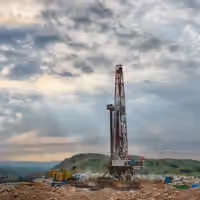
Tejarat (Commerce) Daily in Tehran quoted some oil market experts as saying that Iran has been lately selling its oil at the price of $37 per barrel while the market price for oil is around $79.25 per barrel. According to estimates, the production of every barrel of oil costs Iran nearly 30 dollars due to its aging equipment after years of token investments.
On the other hand, Iran's neighbor, Saudi Arabia invested some $82 billion in infrastructure in the past ten years to preserve its supremacy in the oil market.
Falahatpisheh in his interview argued that "Iran needs a new spirit in its foreign policy. In today's world only the countries are successful that have managed to reduce tensions with other countries." He suggested that Iran's first measure should be to settle differences with other countries and take serious steps toward détente. He said: "I believe the US and EU's current policies will not last forever. These policies are mainly meant to reduce Iran's bargaining power. However, the West will return to negotiations when and if they see that Iran has resolved its internal crisis and everyone, including all Iranian officials, are behaving in a way to serve the country's national interests."