• العربية
  • فارسی
Brand
  • Iran Insight
  • Politics
  • Economy
  • Analysis
  • Special Report
  • Opinion
  • Podcast
  • Iran Insight
  • Politics
  • Economy
  • Analysis
  • Special Report
  • Opinion
  • Podcast
  • Theme
  • Language
    • العربية
    • فارسی
  • Iran Insight
  • Politics
  • Economy
  • Analysis
  • Special Report
  • Opinion
  • Podcast
All rights reserved for Volant Media UK Limited
volant media logo

Raisi Says Not Planning To Meet With Biden At UN

Maryam Sinaiee
Maryam Sinaiee

Iran International

Aug 29, 2022, 13:06 GMT+1Updated: 17:40 GMT+1
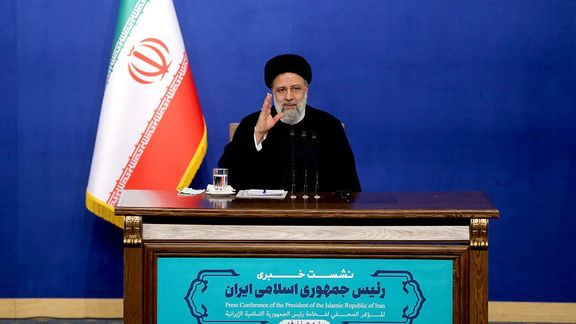
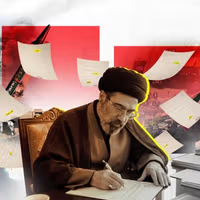
Iranian president Ebrahim Raisi at a press briefing, August 29, 2022

Iran’s President Ebrahim Raisi said at a briefing Monday that he has no plans to meet with The US President at the UN General Assembly in New York in September.

“I said no at the previous briefing in response to a similar question and I'm repeating it again: meeting with [the US President Joe] Biden has no benefit for Iran or the Iranian people. There is no plan for such a meeting and there will not be in the future,” the Iranian president said at the briefing in Tehran attended by local and foreign reporters.

Elsewhere in his briefing,Raisi underlined that Tehran and Beijing are both determined to broaden their relations, especially in commercial and economic areas and said Iran will not allow bilateral ties with China to be affected by globaland other issues.”

Referring to the 25-year comprehensive cooperation agreement between the two countries, he stressed Tehran’s determination to implement the deal.

Raisi also reiterated the importance of Iran's presence in the Shanghai Cooperation Organization (SCO)and said corporation with its members will help Iran connect to Asia’s economic infrastructures and have its fair share of trade in the region.

In response to questions regarding the nuclear issue, Raisi said no one can “deprive the Iranian nation of its inalienable right to access peaceful nuclear technology.”

The Iranian president also said Iran has managed to access some of its frozen assets under the US sanctions and demanded the release of the rest of assets frozen abroad. Iran claimed in July that it had received some funds frozen in Iraq.

Raisi said the Iranian team will not leave the negotiating table in the talks on reviving the 2015 nuclear deal, officially known as the Joint Comprehensive Plan of Action (JCPOA), but reaching an agreement, hinges on the settlement of safeguards issues between Iran and the International Atomic Energy Agency (IAEA).

“Negotiations are for the sake of removing the sanctions. Those who abandoned their commitments should return and fulfil their obligations. Our emphasis in these negotiations is on the removal of sanctions.”

Referring to Israel’s threats against Iran, he said that the assassinationof the country’s nuclear scientists was aimed at stopping it runs progress in nuclear technologyand added that Israel is not capable of “protecting itself against Palestinian people’s stone-throwing, let alone their precision strike missiles.

Commenting on Tehran relations with neighboring countries and allies Raisi said Tehran and Moscow enjoy strategic cooperation in various areas. "Our cooperation with Russia is strategic and is defined in economic, commercial, energy, air and space fields, and many other issues,” he said, adding that the issue of the North-South Corridor is on the agenda of talks with Moscow.

Raisi noted that negotiations between senior representatives from Iran and Saudi Arabia have continued in the Iraqi capital Baghdad to resolve differences and to restore diplomatic relations and described relations between Tehran and Ankara as good. “Turkish President Recep Tayyip Erdogan has promised to pursue joint water diplomacy with neighbors,” he said.


Most Viewed

Iran negotiators ordered to return after internal rift over Islamabad talks
1
EXCLUSIVE

Iran negotiators ordered to return after internal rift over Islamabad talks

2
ANALYSIS

US blockade enters murky phase as tankers spoof signals and buyers hesitate

3
ANALYSIS

Why the $100 billion Hormuz toll revenue is a myth

4

US tightens financial squeeze on Iran, warns banks over oil money flows

5
ANALYSIS

US blockade targets Iran oil boom amid regional disruption

Banner
Banner

Spotlight

  • Hardliners push Hormuz ‘red line’ as US blockade tests Iran’s leverage
    INSIGHT

    Hardliners push Hormuz ‘red line’ as US blockade tests Iran’s leverage

  • Ideology may be fading in Iran, but not in Kashmir's ‘Mini Iran'
    INSIGHT

    Ideology may be fading in Iran, but not in Kashmir's ‘Mini Iran'

  • War damage amounts to $3,000 per Iranian, with blockade set to add to losses
    INSIGHT

    War damage amounts to $3,000 per Iranian, with blockade set to add to losses

  • Why the $100 billion Hormuz toll revenue is a myth
    ANALYSIS

    Why the $100 billion Hormuz toll revenue is a myth

  • US blockade targets Iran oil boom amid regional disruption
    ANALYSIS

    US blockade targets Iran oil boom amid regional disruption

  • Iran's digital economy battered by prolonged blackout
    INSIGHT

    Iran's digital economy battered by prolonged blackout

•
•
•

More Stories

After 73 Years Of Development Plans, Iran Still Struggles

Aug 28, 2022, 22:26 GMT+1
•
Iran International Newsroom

The Islamic Republic will soon start its 7th national developmental plan, but an expert who worked in previous government economic plans doubts it can succeed.

Since 1940s Iran has launched 11 plans to build infrastructure, establish key industries, expand public services and education. Five plans were launched under the monarchy until 1979, and six during the Islamic Republic. Nevertheless, Iran is still considered a developing country.

There are a few reasons for this. The revolutionary chaos of the early 1980s, immediately followed by the 8-year Iran-Iraq war that caused hundreds of thousands of casualties derailed Iran from its modernization trajectory.

Also, the Islamic government, built on an anti-Western ideology engaged in hostage taking and supporting militant groups from its very inception. This kept Iran isolated from advanced economies. Inefficiency of successive clerical governments during the past four decades, and many years of international sanctions that have crippled the country's economy, were added to the adverse factors.

Reza Shah on the inauguration of Iran's railways in 1938, with the crown prince next to him
100%
Reza Shah on the inauguration of Iran's railways in 1938, with the crown prince next to him

For longer than a decade, governments have not been able to carry out any meaningful development plans as sanctions and growing corruption kept the economic growth rate at around zero.

Economic development until the 1979 revolution

In an interview, Fathollah Aghasizadeh, the author of the book Seventy Years of Planning for Development in Iran, told Khabar Online website in Tehran on Saturday offered his expert views about the failures of developmental plans.

Interestingly, he had words of praise for the pre-revolution plan during the reign of Mohammad Reza Shah Pahlavi.

Fathollah Aghasizadeh, economist and expert on Iran's development plans
100%
Fathollah Aghasizadeh, economist and expert on Iran's development plans

Aghasizadeh said in the interview that Iran's initial development plans which started in 1949 were successful partly because the country's -then- newly established Planning Organization was genuinely interested in furthering development plans.The powerful organization operated independent of the prime ministerial bureaucracy and was directly accountable to the Shah.

With focused governance and rising oil prices in the 1970s Iran was perhaps the best placed country in the region to take the next leap, just as South Korea did in the following two decades. Economic development was taking place and per capita income was rising until the 1979 revolution.

Success with development plans

The outcome of the first two development plans included major projects such as several dams, fertilizer production companies, the construction of some 11,000 kilometers of railways, the Mehrabad Airport as well as several garment factories, sugar mills and cement production companies. At that time, Iran was not a rich oil exporter. It was still a poor country, getting a small share of the oil income from the British who controlled the industry.

Abolhassan Ebtehaj (L), head of Iran's Planning Organization in 1950s
100%
Abolhassan Ebtehaj (L), head of Iran's Planning Organization in 1950s

Another reason for the success, according to Aghasizadeh, was the authority and independence of the organization and its chairmen, particularly Abolhassan Ebtehaj who was chairman after 1954. Ebtehaj left the post in 1958 when his powers were curtailed by the Prime Minister's Office. Later Ebtehaj wrote in his memoires that he got his mandate from the Shah and his mission was to make sure that no one other than himself would have access to the oil income set aside of infrastructural development.

Aghasizadeh says that evidence supports the fact that Ebtehaj was directly backed by the Shah. Even the Islamic Majles acknowledged in a 2010 report that "The Shah personally backed the development efforts."

The expert said that as the organization lost its authority, its success began to diminish, and development plans were changed into comprehensive plans that lacked focus. However, Aghasizadeh said he is not sure whether the current development plans could be effective. "They have very little if any achievement and the country can do without them," he added.

Post-revolution developmental plans

He agreed with Khabar Online that post-revolution development plans reflect Iranian politicians wishful thinking rather than the country's needs. "Plans are no longer written to be executed," he said, adding that institution such as the parliament and the Expediency Council also try to reflect the country's general [ideological] orientation in the new development plans. Meanwhile, he added that governments in the Islamic Republic are more interested in long-term plans that cannot be effective in Iran.

Ayatollah Hashemi Rafsanjani, the post-war president who tried to relaunch Iran's development in the early 1990s
100%
Ayatollah Hashemi Rafsanjani, the post-war president who tried to relaunch Iran's development in the early 1990s

He did not say why, but it appears that politicians' short-sightedness, and the transitional nature of presidential governments, each representing a different faction in the Islamic system, derail their own long-term plans. On the other hand, it appears that the plans with ill-defined objectives provide a better situation for corrupt politicians who block inspections and spend the money for unrelated projects where their allies can enrich themselves.

Aghasizadeh said that Iranians cannot expect much from the 7th development plan for similar reasons as the government is barely taking care of the nation's day to day business amid sanctions and a perpetual economic crisis.

Like India, Iran should turn to one-year developmental plans, Aghasizadeh believes, or plans for a maximum of four years. This gives officials a better chance to follow up on the successful parts of their plans. At the same time, their expectations from each plan is well defined and objective.

Two Swedish-Iranian Brothers Face Trial Over Spying For Iran

Aug 28, 2022, 18:17 GMT+1

Sweden has started planning for the prosecution of two Iranian-Swedish brothers who were arrested in 2021 over allegations of espionage for Iranian Intelligence organizations. 

According to Swedish newspaper Expressen, the Stockholm District Court began Thursday planning for a meeting with the prosecutors and defense attorneys for the upcoming trial.

The details of the case against them are not very transparent as prosecutors Per Lindqvist and Mats Ljungqvist have commented very little on the substance of the allegations. Formal charges against the two are expected in the coming months and their trial will not be open to the public. Both brothers’ lawyers have so far maintained that their clients are innocent.

Both brothers, who were born in Iran but came to Sweden as children in 1994, are accused of spying activity from March of 2011 until their arrest in September and November of last year, and are currently kept in strict isolation at the Kronoberg prison. 

The Swedish paper did not mention their names but earlier reports at the time of their arrest disclosed their identities as Peyman Kia, now 42 years old, and his brother Payam, who is 35 years old.

A picture of Peyman Kia circulated in Swedish media (undated)
100%
A picture of Peyman Kia circulated in Swedish media

The older brother of the pair is said to have worked as an investigator and spent time in the Security Police (SÄPO) as well as working for military intelligence and the Office for Special Acquisition (KSI), one of Sweden’s most secretive intelligence agencies. The younger brother has also worked for SÄPO for a brief period. 

Tensions are relatively high between Iran and Sweden over a Swedish court’s sentencing of former Iranian jailor Hamid Nouri to life imprisonment over executions of political prisoners in 1988.

Mossad Chief Due In Washington To Dissuade US From Reviving JCPOA

Aug 28, 2022, 16:19 GMT+1

The director of Israel’s intelligence agency Mossad is set to travel to Washington DC next week for talks as the US and Iran seem ready for an agreement to revive the 2015 nuclear deal. 

Axios correspondent Barak Ravid quoted a senior Israeli official as saying on Sunday that David Barnea will attend closed door classified meetings of House and Senate intelligence committees.

In remarks that were not coordinated with Prime Minister Yair Lapid, the spymaster described the emerging agreement "a strategic disaster" for Israel and the United States “is rushing into an accord that is ultimately based on lies,” referring to Iran’s claim that its nuclear activities are peaceful in nature.

Shortly after Barnea’s comments were published, Lapid called the Mossad chief, telling him he had gone off script in his criticism of the US and asking for a clarification.

Barnea’s visit is the latest effort by Israel to sway Western powers from returning to the landmark accord. 

Earlier in the day, Lapid said that Israel's “diplomatic fight” against the deal included its National Security Adviser Eyal Hulata and Defense Minister Benny Gantz holding recent meetings in the US.

“We are making a concerted effort to ensure the Americans and Europeans understand the dangers involved in this agreement,” Lapid said, reiterating that what was signed in 2015 was “not a good deal,” and that the one currently being discussed entails “greater dangers.”

Lapid and US President Joe Biden are likely to meet in September, Israel’s Kan news reported on Saturday, citing unnamed officials. 

Iran is currently reviewing the US response to its position earlier sent to the European Union, which acts as a mediator between the two sides.

Heads Of Iran’s Government Branches Meet Over Large Corruption Case

Aug 28, 2022, 15:05 GMT+1

The heads of the three branches of the Iranian government have held a meeting as a major corruption case at Iran's Mobarakeh Steel Plant implicated dozens of state entities.

Following their meeting on Saturday afternoon, President Ebrahim Raisi, Parliament Speaker Mohammad-Bagher Ghalibaf, and Chief Justice Gholam-Hossein Mohseni-Ejei warned against "media speculations" until the review of the case is completed by the judiciary.

Only the judiciary should review and assess the reports of the parliament’s investigation, and it is necessary to refrain from media speculations until these reports are scrutinized in judicial courts, they announced. 

Last week, a scathing report about an alleged $3 billion corruption case revealed massive irregularities and mismanagement in government-controlled Mobarakeh Steel Company, the largest steel producer in the Middle East and Northern Africa, which is located near the city of Mobarakeh, Esfahan Province. 

The over 250-page report says the company paid astronomical sums of money to various government entities including the Revolutionary Guard (IRGC), ministry of intelligence, police, state broadcaster (IRIB), Friday prayer imam’s offices, religious seminaries, and bribed others such as certain media outlets, individuals, and social media influencers.

The company, which has a share of around 1% in Iran's GDP, employs around 350,000 people directly and indirectly and feeds over 2,800 other large and small enterprises.

Israeli Airstrike In Syria Destroyed Over 1,000 Iranian-Made Missiles

Aug 28, 2022, 13:00 GMT+1

An Israeli airstrike on the western Syrian city of Masyaf on Thursday destroyed more than 1,000 Iranian-made missiles, a Syrian war monitor reported Saturday.

According to the UK-based Syrian Observatory for Human Rights, the attack targeted a missile warehouse in the city’s Syrian Scientific Studies and Research Center (SSRC) complex that stored thousands of medium-range, surface-to-surface missiles assembled under the supervision of Iran’s Revolutionary Guard’s “expert officers.”

The observatory added that 14 Syrian civilians sustained injuries with varying levels of severity during the Masyaf airstrike, in addition to casualties reported among Iranian-backed militias guarding the research center– which is heavily damaged during the attack.

Moreover, several fires broke out in areas surrounding the city ignited by the shrapnel from the explosions of the warehouse, with nearby civilian houses and property suffering material damage, the report said. Secondary explosions continued for hours after the strikes, along with the blazes caused by them. Local residents were reportedly instructed to remain in shelters until the fires were brought under control.

In addition to the strikes attributed to Israel, the United States also engaged in a string of tit-for-tat attacks last week against Iranian militias in northern Syria who had targeted US forces with rockets and drones.

Iran-backed militias established a foothold in Syria while fighting in support of President Bashar al-Assad during Syria's civil war.