US Says Iran’s Draft Internet Bill Aims At Censorship
The US State Department has criticized Iran over its plans to tighten Internet access and urged the government “to allow its citizens to exercise their right to freedom of expression and to freely access information.”
The department’s Bureau of Democracy, Human Rights and Labor, which says it “champions American values, including the rule of law and individual rights,” “Iran’s proposed User Protection Bill aims to further limit Internet access, increasing censorship and restricting free speech online.”
In February 18 members of an ad hoc parliamentary committee in Iran said they had ratified the outlinesof a bill entitled 'Legislation to Protect Cyberspace Users' to regulate internet and social media access, only for the parliament's Regulations and Bylaws Division to issue a statement that the committee had broken the law in ratifying a different version of the bill referred to it for examination and approval.
Iran has blocked websites and social media apps over the past two decades, but these are readily sidestepped with wide use of VPNs (virtual private networks) and other tools. Some social media users have alleged that problems with internet coveragein recent months are a trial run for a plan to curb internet access and social media. In February Speedtest global index ranked Iran 80of 138 countries worldwide for mobile internet connection, and 145 out of 180 for fixed broadband speed.
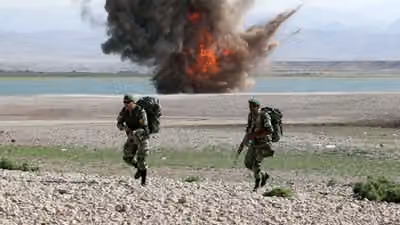
The United States, its Western allies and others have condemned drone and missile attacks by Yemen's Iran-backed Houthis on Saudi energy facilities on Friday.
US National Security Advisor Jake Sullivan issued a statement saying, “We condemn the Houthi attacks launched against Saudi Arabia’s civil infrastructure earlier today. Unprovoked Houthi attacks against Saudi Aramco’s oil storage facilities in Jeddah as well as attacks against civil facilities in Jizan, Najran, and Dhahran are acts of terrorism aimed to prolong the suffering of the Yemeni people.”
Sullivan went on to accuse Iran of arms shipments to Houthis. “Today’s attacks…were clearly enabled by Iran in violation of UN Security Council resolutions prohibiting the import of weapons into Yemen.”
UK Prime Minister Boris Johnson said in a tweet, “I fully condemn the latest Houthi attack against critical sites in Saudi Arabia, including in Jeddah. These strikes put civilian lives at risk and must stop.”
The Iran-aligned Houthis said they launched attacks on Saudi energy facilities on Friday and the Saudi-led coalition said oil giant Aramco's petroleum products distribution station in Jeddah was hit, causing a fire in two storage tanks but no casualties.
A huge plume of black smoke could be seen rising over the Red Sea city where the Saudi Arabian Grand Prix is taking place this weekend.
France and Germany echoed the US and UK condemnations. The German Foreign Office tweeted, “We strongly condemn today's attacks on essential civilian infrastructure in Saudi Arabia which violate international humanitarian law and further undermine regional stability.”
The swift and clear Western condemnations came as Iran’s nuclear talks with world powers apparently hinge on a demand by Tehran to remove its Revolutionary Guard (IRGC) from the US list of terrorist organizations. The Guards are known for providing military assistance to the Houthis. The United States, Saudi Arabia and UN arms experts have said that drone and missile technology used by Houthis are supplied by Iran.
Egypt, the Gulf Cooperation Council and Secretary-General of the Arab League also condemned the strikes at Saudi civilian targets, saying Houthi attacks threaten security in the region and global energy supplies.
Saudi Arabia’s Energy Ministry reiterated that the Kingdom will not be responsible for any shortage of oil supplies to global markets. This is particularly noteworthy given the Russian invasion of Ukraine and a possible global shortages of oil and gas supplies.
The Iran-aligned Houthis who have been battling a coalition led by Saudi Arabia for seven years launched missiles on Aramco's facilities in Jeddah and drones at Ras Tanura and Rabigh refineries, the group's military spokesman said. He said they also targeted "vital facilities" in the capital Riyadh.
Saudi state media had earlier reported that a string of drone and rocket attacks by the Houthis was foiled by the coalition.
Saudi air defenses also intercepted and destroyed a ballistic rocket launched towards the port city of Jazan, which caused a "limited" fire to break out at an electricity distribution plant, state media reported.
This article is the fourth in a series about Iran’s Shiite clerics, explaining how they study, get a clerical rank, get married and what they do for a living.
According to Hojjat ul-Eslam Mehdi Parnian, the length of a cleric's beard and the size of his turban have nothing to do with his title or rank. However, observation at seminaries indicate that the higher the rank of a cleric, the longer is his beard and the bigger his turban. Nonetheless, long beard and big turban are not necessarily a sign of a great scholar, as is the case with Tehran Friday Prayer Imam, Ahmad Khatami, who likes to be called an ayatollah.
He has the right beard, turban and official position for the title, but his aggressive, and often offensive style of speaking and his perpetual angry tone and gestures betray the long beard and big turban.
Ahmad Khatami, a Friday Prayer Imam in Tehran
High-ranking clerics generally have a calm demeanour. They wear leather slippers, usually yellow ones, and thin robes woven of camel wool. Most of them hold a walking stick in their hand even if there is nothing wrong with their feet or legs. They speak calmly and softly. But there are sometimes exceptions. Firebrand former Judiciary Chief Sheikh Mohammad Yazdi, always spoke angrily and raised his voice in an increasing pitch sentence after sentence. Toward the end of his speeches and sermons everyone thought he was having an argument with someone.
President Ebrahim Raisi, around twenty years younger than Yazdi, has more or less the same style or habit. The difference between his and Yazdi's style is that Raisi occasionally uses foreign words but invariably mispronounces them. For instance, he used the word "locomotir" instead of "locomotive," and Megawamata instead of Mega Watt.
The color of robes
Parnian has also observed that although Iranian clerics traditionally wear black or brown robes, in recent years, beige robes have become fashionable among clerics after former President Mohammad Khatami wore them during his presidency (1997-2005). The two jackets qaba and labbadeh that are worn under the robe (aba), can be black or blue. The latter was former President Hassan Rouhani's favorite.
Former president Mohammad Khatami in his tan-color robe
Rouhani was one of the few Iranian clerics who was always well-dressed and applied gel to his hair, a practice frowned at by traditional clerics who also happen not to like the beige robe for which Khatami was often criticized. Rouhani also slightly dyed his white beard.
Speaking of clerical fashion, Parnian has also observed that black and brown slippers are nowadays more fashionable than the yellow ones said to be the holy prophet's favorite. On official occasions some clerics prefer to wear shoes rather than slippers which make them walk in a sloppy way.
The turban department
In the turban department, one should also make note of a less fashionable turban which is called crown-style turban. The front side of this turban is a bit elevated, so that it could show a short cleric taller. Some simply wear it only to look more elegant. Hardliner lawmaker Mahmoud Nabavian always wears this type of turban. President Raisi tried it a few times immediately after his election, but he was probably cautioned by those around him that it did look nice on him or that other clerics did not like it.
Parnian observed that some senior clerics were so famous that people knew them by their title rather than their names. For instance, when clerics talk respectfully about "the Akhund," they do not mean any cleric. There are thousands of akhunds in Qom only. But in this case, they are talking about Akhund Khorassani, who was a prominent Shiite scholar. He was otherwise known as Molla Mohammad Kazem Khorassani (1839-1911).
Group of clerics circa 1900. Akhund Khorasani among them.
Likewise, when they talk about Allameh in an old book, they are talking about renowned scholar Allameh Helli, who lived in 13th and 14th centuries and whose full name was Abou Mansour Jamaleddin Hassan ibn Yousuf ibn Motahhar Helli.
Titles or simplicity
Nonetheless, renowned clerics did not believe in titles. Even in modern times, Ayatollah Ruhollah Khomeini who was called the Imam by his followers, never called anyone an ayatollah or a grand ayatollah. As far as he was concerned, all clerics were Hojjat ul-Eslam.
For the man in the street also, anyone with a turban on his head is an akhund. They generally do not know and do not care about them. Parnian's observation indicates that at the end of the day they find any cleric with a longer beard and a bigger turban more prominent.
According to Mehdi Sharifi, a seminary graduate in plainclothes, and a sociologist, "It is hardly believable today, but once those who had studied divinity and knew the rules of the religion were highly respected."
Sharifi says that the first Shi'ite seminaries were set up probably in the 10th century after the 12th Imam disappeared into the occult and the followers of the Imams (the children and grandchildren and great grandchildren of the holy prophet) made it their own responsibility to promote their teachings even at the expense of being imprisoned by the enemies of the sect.
Sharifi says: "Clerics such as Sehiek Sadouq, Sheikh Mofid and Sheikh Tousi, who founded the first seminaries were the Steve Jobs, Elon Musks, and Mark Zuckerbergs of their times in Baghdad, Qom and An-Najaf. They were the pioneers of their times."
Things were different during those early days at the height of the clerical power during the Safavid dynasty in Iran (1501-1736) when the clergy advised the king.
The 1979 Islamic revolution brought them back to the forefront, but this time elevated them to the peacock throne for the first time and made them the rulers of Iran.
An Iranian lawmaker has warned that reserves of essential commodities are running out and it would be very hard to replenish them given current circumstances.
"Our strategic reserves are finishing, and we won't be able to replenish them," Jalal Mahmoudzadeh, a member of the parliament's Agriculture Committee, told Shafaq News Agency on Friday.
According to Mahmoudzadeh, the war in Ukraine, the government's decision to scrap cheap dollars for importing essential commodities, and mismanagement are the three factors that will affect the availability and prices of essential goods.
Mahmoudzadeh predicted that prices of commodities such as sugar, oil, and rice in the Iranian market will rise considerably in the coming months due to the elimination of subsidies.
Iran decided to end a costly subsidy for importing food and animal feed recently, raising fears of rising prices in the new year that started on March 21. According to a report by ISNA on March 19, out of about $19 billion worth of basic goods imported in the past 12 months nearly $15 billion was subsidized with cheap dollars provided to importers.
Member of Iranian parliament Jalal Mahmoudzadeh
Animal feed, much of the grains imported from Russia and Ukraine with cheap dollars until now would also become scarce and prices of red and white meat will therefore rise considerably, he said. Importers might be jittery about making commitments given the unpredictable foreign currency rates in Iran and government price fixing.
Last week it was announced that Iran’s agriculture minister, Javad Sadatinejad, had signed an agreement during a recent visit to Russia to import 20 million tons of basic goods, including vegetable oil, wheat, barley and corn. The report said the deal is to address concerns about shortages of basic goods and livestock feed in the coming months but did not mention the monetary value of the deal.
Iran is under US sanctions, but the government of President Ebrahim Raisi insists that it has succeeded in blocking their effect on the economy and neutralized the sanctions to a great extent. "The biggest achievement of the government in Vienna [nuclear] talks has been greatly reducing the strategic value of sanctions for the other side through the strategy of neutralizing sanctions," the official news agency (IRNA) wrote Friday.
Recent news about higher oil exports coincides with the most critical phase of indirect nuclear talks that the Biden Administration started with Iran almost a year ago. If talks fail, sanctions will continue.
Reuters reported on February 10that daily illicit shipments of crude oil had surpassed one million barrels a day in the previous two months. This was the highest since May 2019 when the Trump administration imposed full sanctions on Iran’s oil exports.
Between May 2019 and late 2020, Iran’s clandestine oil exports hovered around 200,000 bpd, or 10 percent of its sales before Donald Trump withdrew from the Iran nuclear agreement, JCPOA, and imposed sanctions. The exports increased in 2021, but it is not clear how much cash revenues Iran receives, given the illicit nature of the shipments primarily going to China.
Oil exports may have increased but the government coffers appear to be still empty. The value of rial remains near its all-time lows at 260,000 to the US dollar, while liquidity keeps rising as the government prints more money.
Just before the Iranian New Year earlier this week, for the first time in over four decades, the Islamic Republic's government failed to make the monthly payments of millions of pensioners. Payments had regularly been made even during eight years of war with Iraq (1980-1988) under difficult conditions.
Yemen's Iran-backed Houthis launched attacks on Saudi energy facilities on Friday and the Saudi-led coalition said a facility of oil giant Aramco was hit.
The attack caused a fire at a petroleum products distribution station in Jeddah where two tanks were set ablaze, but there were no casualties.
A huge plume of black smoke could be seen rising over the Red Sea city where the Saudi Arabian Grand Prix is taking place this weekend, an eyewitness said.
Unverified videos shared on social media showed fire raging in oil tanks in an Aramco facility on the outskirts of Jeddah.
There was no immediate comment from Aramco or the energy ministry when contacted by Reuters.
The Iran-aligned Houthis who have been battling a coalition led by Saudi Arabia for seven years launched missiles on Aramco's facilities in Jeddah and drones at Ras Tanura and Rabigh refineries, the group's military spokesman said. He said they also targeted "vital facilities" in the capital Riyadh.
Saudi state media had earlier reported that a string of drone and rocket attacks by the Houthis was foiled by the coalition.
Saudi air defenses also intercepted and destroyed a ballistic rocket launched towards the port city of Jazan, which caused a "limited" fire to break out at an electricity distribution plant, state media reported.
Hossein Amir-Abdollahian, Iran’s foreign minister, has said the whole Middle East would benefit from a renewed nuclear deal between Tehran and world powers.
But during a meeting with Lebanese Prime Minister Najib Mikati Thursday evening, Amir-Abdollahian said “we’ve not reached the final point on lifting sanctions yet.”
Opponents of reviving the 2015 nuclear deal and lifting US sanctions say that giving Iran tens of billions of dollars will enable it to finance its allies and militant proxies in the region.
The foreign minister continuing his trip on Friday, met political leaders from all Lebanese sects, including President Michel Aoun, a Maronite Christian, and the heads of the two main Shia parties, house speaker Nabih Berri of Amal, and Hassan Nasrallah, general secretary of Hezbollah.
In a news conference after meeting with his counterpart Abdallah Bou Habib, Amir-Abdollahian said Iran wanted “a good, strong and lasting agreement, but not at the cost of crossing its red lines.” The foreign minister said United States sanctions should be removed “in the maximum way.”
A recurrent theme of Amir-Abdollahian’s visit has been the need for detente with Saudi Arabia in line with President Ebrahim Raisi’s commitment to improved relations with Iran’s neighbors.
The Lebanese foreign minister welcomed détente between Iran and Saudi Arabia, according to a readout of the meeting provided by Iran’s Foreign Ministry. Saudi-Iran tensions have often played out in Lebanon, which has a substantial population of both Sunni and Shia Muslims. Riyadh in October broke off diplomatic relations with Beirut, and its influence has also diminished with the withdrawal from politics of Saad Hariri, leader of the Sunni Mustaqbal party and a Saudi citizen, in January.
Keeping Doors Open
Bou Habib, according to a readout from the Lebanese foreign ministry, said not only Lebanon would benefit from an improvement in Tehran-Riyadh relations, which would also “provide an opportunity to help advance intra-Yemeni dialogue and resolve the crisis in that country.”
In an interview with Al Mayadeen television Friday, Amir-Abdollahian reiterated that Iran was ready for a fifth round of talks with Saudi Arabis and was “working hard to keep the doors of dialogue open between the two countries.” Earlier this month Iran suspended bilateral contacts, facilitated by Iraq, after Saudi Arabia beheaded 81 men − including 41 Shia Saudi Shia, seven Yemenis and a Syrian − for “heinous crimes.”
In a meeting with cultural and political scholars and figures Friday, the Iranian foreign minister said Tehran was “ready to help Lebanon with medical services, medicine and medical equipment and other basic needs.” Amir-Abdollahian said Thursday Iran had offered to establish two 1,000-megawatt power stations in Lebanon to help with its chronic power crisis and connect its energy grid to Lebanon through Syria and Iraq.
Much of Lebanon has zero mains electricity, following decades of corruption and a financial crisis that erupted in late 2020, plunging 80 percent of the population into poverty. The crash followed the failure of post-war governments to control a spiraling debt financed by expatriate deposits in the Lebanese banking sector.
But the Iranian foreign minister’s offer of assistance comes as Tehran has often complained about shortage of medicine and medical supplies because of US sanctions. It also suffers from chronic electricity shortages partly because the capacity of its power stations is inadequate.
Iranian government-controlled media reporting on Amir-Abdollahian's meetings did not mention his offer of assistance, possibly because of popular resentment toward Islamic Republic's long-standing policy of providing financial and military resources to allies and proxies in the region.