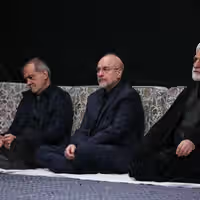
Former oil minister Bijan Zanganeh with top aides on April 9, 2021
IRGC has banned many oil officials of the former government from leaving Iran for fear of revealing sanctions-busting methods, a hactivist group has revealed.
Edalat-e Ali group has provided a copy of a highly confidential letter to Iran International which includes a list of 37 mid-level officials of ex-President Hassan Rouhani’s administration, including 16 oil ministry officials and six working in the gas field, that the IRGC wants to be banned from leaving the country.
The letter dated September 6, 2021, with an attached list from the Revolutionary Guards (IRGC) Intelligence Organization to the Revolutionary Prosecutor of Tehran Ali Alghasi-Mehr also cites reasons for the bans. In the case of most oil officials the reason is preventing them from revealing "secret information" on how Iran manages to circumvent US sanctions to sell crude oil.
IRGC revenge
Nicosia-based oil and gas reporter Behzad Ahmadinia told Iran International that Iranian officials in sensitive positions are commonly banned from leaving the country after the end of their tenure or must get permission to do so. However, he said, the fact that the IRGC has taken extraordinary action in this case is significant.
An image of the list of former officials banned from leaving Iran provided by hactivists.
The IRGC forced the Rouhani administration to give up the government monopoly on oil exports during US sanctions, Ahmadinia said, explaining that they went as far as confiscating tankers belonging to the oil ministry under the pretext of seizing "smuggled oil" to get control of the profitable illicit oil sales.
"This is part of settling accounts with officials who resisted surrendering oil and oil products exports to the IRGC which they eventually had to do … This is revenge … Otherwise information on circumvention of sanctions is no longer secret," he said.
Iran devised various methods to circumvent international sanctions, first imposed in 2011 by the UN Security Council, by recruiting businessmen, officials and IRGC networks to clandestinely market the crude, often at a much higher cost to Iran. Such methods resulted in several major corruption schemes and misappropriation of billions of dollars in oil and petrochemical sales that came to light after the UN sanctions were removed.
Such methods were employed again after former US President Donald Trump pulled out of the 2015 nuclear deal, Joint Comprehensive Plan of Action (JCPOA) in 2018 and re-imposed sanctions on Iran.
Oil exports dropped to around 200,000 barrels per day in 2019, but in late 2020, Tehran increased its sales through illicit channels. China is the biggest buyer, with shipments disguised as exports from other countries.
Hardliners sell more oil
The Raisi administration and its political allies say his government has a far better record than his predecessor, Hassan Rouhani, in economic performance, including circumventing US sanctions. In a speech in January Raisi said oil exports had increased by 40 percent after he took office, and that Tehran pursued a dual-track policy of circumventing US sanctions and working for their removal.
In the case of some of the officials named in the list, including officials of the Persian Gulf Petrochemical Industries, the IRGC intelligence organization demanded that they be prevented from leaving Iran for involvement in corruption and bribery. The Persian Gulf Petrochemical Industries is a public holding company active in investment and administering natural-gas processing plants, chemical factories, oil and polymer. It is the second-largest petrochemical industries holding in the Middle East.
Other reasons offered by the IRGC intelligence for demanding such a ban also included affiliation of an official's brother to the exiled opposition group Mujahedin-e Khalq (MEK) and his family's residence in Spain.
An official of the oil ministry has also been accused of "multi-layered connections with infiltration networks" and the National Iranian American Council (NIAC), a lobbying NGO based in the US.