Pundit Calls On Iran Foreign Minister To Resign Over Raisi Moscow Trip
Iran's President Ebrahim Raisi meeting Vladimir Putin at the Kremlin. January 19, 2022
An Iranian conservative journalist has called for Iran’s Foreign Minister Hossein Amir-Abdollahian to step down over President Ebrahim Raisi’s treatment during his recent Russia visit.
Mohammad Mohajeri he was in Amir-Abdollahian’s shoes he would resign, as the foreign minister had failed to maintain diplomatic protocols during the president’s “disgraceful trip to Russia.”
Many reformist pundits as well social media users criticized various aspects of Raisi’s trip, but such criticisms are rare from conservatives.
Mohajeri earlier slammed the president’s media team for promoting a photograph of Raisi praying in the Kremlin. Some principlists and Friday prayer leaders had eulogized an act of great significancegiven the building’s long association with atheistic Communism.
Among Twitterati taking offence, some took umbrage at Putin not welcoming Raisi at the airport, some at Putin not leaving his chair to greet the Iranian president at their meeting, some at the Russian president’s alleged impoliteness in chewing gum while Raisi spoke.
Some even interpreted the large table between the two presidents at the meeting as intentionally implying "distance," and pointed out that the two countries’ flags were nowhere to be seen. Fars news website, affiliated with the IRGC, by contrast suggested Putin was so impressed with Raisi that he became fidgety and tidied his tie to calm down.
Iran intends to set the minimum monthly salary for the next Iranian year (starting March 21) at 56 million rials, which is about $200 at today’s exchange rate.
Mohammad-Reza Mirtajodini, a member of the parliament’s budget committee announced the figure on Monday, noting that it is about 20 percent higher than what was proposed by the presidential administration.
According to Mirtajodini, 6 million rials will also be cut from payroll taxes. The government intends to raise asset taxes next year.
Iran has one of the lowest minimum wages in the world, but salaries were increasing from 20 years ago to about 10 years ago when the minimum wage hit a record high of about $275 in 2010. This coincides with the time when the United Nations Security Council began imposing sanctions to force Tehran to roll back its nuclear program.
Labor groups insist that the poverty line in Iran is now around $400 a month for a family of 3.3 people, so the proposed minimum wage is half of the needed money just to be able to survive.
Considering the roughly 60-percent rise in food prices this year and an over 40-percent inflation rate, most of the population is set to become dramatically poorer.
Earlier in the month, Iran’s parliament approved the broad outline of the budget with a significant number voting against the bill that would raise taxes and cut subsidies.
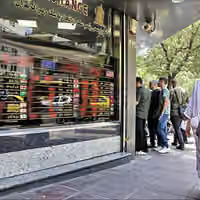
Small investors are exiting Tehran’s stock exchange after 18 months of losses, with the hope of making alternative investments and recoup some of their capital.
In the Iranian month of Day which ended on January 20, sixty trillion rials was taken out of the stock market, local media reported. Based on Tehran’s free market exchange rate on January 24, this equals $240 million, a small sum compared with the world’s large stock markets, but for Iran the amount in local currency and considering the size of the economy it is an alarming development.
In 1978, just before the overthrow of the pro-West monarchy, 70 rials bought one US dollar – a 4000-fold decline in 44 years.
The stock exchange index declined by a further five percent in the same 30-day period, prompting the exodus of capital from the market. Trading has been very low at the stock exchange with less than $100 million exchanging hands in one month. This is a sign of growing concern among small investors who have badly lost money in the market since mid-2020.
In early 2020 the stock index was less than 500,000 points until the government offered to sell its assets through the Tehran stock exchange which moved the index higher. Then the government began encouraging small investors to commit capital to the market. Top officials spoke through state-controlled media of the supposed benefits of buying stocks and securities. Amid the declining value of the rial and rising stock prices, many small investors concluded that investing in the stock market is a good way to protect their capital from devaluation.
The index rose to 2 million points by mid-2020 in an unbelievable bull market amid US sanctions and a deep economic crisis. Many people began investing when the market was already too high and then it crumbled to 1.2 million points, or a 40-percent decline, wiping out the savings of small investors.
With 18 months of declines or sideways movements, there is no hope for a quick recovery. The government keeps promising to fix the stock market value, as though it is a savings account that a bank must protect and is divorced from the real economy, which is in deep trouble.
There is little available private equity in the market as people have become distrustful of banks and the stock market, both of which the government can manipulate or mismanage. Reports in the past have said that Iranians hold more than $30 billion in cash at home, not trusting the rial, which has declined eightfold since late 2017.
With talks taking place with the United States over Iran’s nuclear program, there is hope that an agreement will end sanctions imposed by the former US administration in 2018. If that happens, it will help the rial to an extent, but the issue is that the government and its banks and companies are mired in debt and inflation. It would take years of high economic growth to save the economy, but in a centrally controlled system without foreign investments, and with cronyism and mismanagement that is a long shot.
Iran is installing sensors and cameras on roadside electrical equipment to help catch anyone stealing power cables and lamps.
An official from Iran’s Road Maintenance and Transportation Organization told ILNA Monday that theft of power cables and road equipment such as lamps and traffic signs had increased significantly.
Reza Akbari said that with most thieves on low incomes, heavy sentences were not possible, even though removing lights and signs threatened road safety. He added that thefts were happening both in provinces like Sistan-Baluchestan and Kerman with relatively light traffic and on roads just 50km from the capital Tehran.
The installation of GPS tracking devices on the most expensive equipment would enable the identification of major buyers of the stolen goods, Akbari said. Some had already been identified and referred to the judicial authorities, “unfortunately…[with] cases…in most of the provinces”.
With the purchasing power of Iranians in decline, shoplifting and burglaries have increased along with protests over working conditions and salaries. Food prices have jumped over 60 percent this year, following high inflation since the imposition of US ‘maximum pressure’ sanctions in 2018. Government figures show that prices for 83 percent of food staples have reached a level deemed ‘critical’ for those on broadly average wages.
The top military adviser to Iran’s Supreme Leader Ali Khamenei says a new era of relations with neighboring countries has begun in Tehran's foreign policy.
Addressing the First National Conference of Iran and Neighbors on Monday, Major General Yahya Rahim Safavi, who is a former chief commander of Revolutionary Guard, said finding shared interests with the neighboring countries is now necessary for peace, progress and prosperity in the region.
Safavi’s remarks came as Iran-backed Houthis in Yemen launched a missile attack against the United Arab Emirates on Monday, for second time in a week.
Tensions between Iran and Persian Gulf Arab States have been high in the past few years, as Tehran expanded its network of proxy forces in the region and backed Houthi rebels in Yemen.
Referring to Iran’s long-term agreements with China and Russia, he said that Iran’s closer cooperation with the East has surprised “Western enemies and some regional rivals.”
Safavi said signing a “20-year non-aggression pacts” with all the neighboring states can be a good start to achieve a lasting security in the region.
In a similar conference in November, Safavi had said Iran should boost its intelligence cooperation with regional countries to coordinate the exchange and analysis of strategic data.
The United Arab Emirates intercepted two Houthi ballistic missiles on Monday with no casualties, its defense ministry said, following a deadly attack a week earlier.
"The remnants of the intercepted ballistic missiles fell in separate areas around Abu Dhabi," the ministry said, adding it was taking necessary protective measures against all attacks.
Iran-backed Houthis who have been battling a Saudi-led coalition that includes the UAE, have repeatedly carried out cross-border missile and drone attacks on Saudi Arabia and launched an unprecedented assault on the UAE on January 17.
UAE newspaper The National cited residents reporting flashes in the sky over the capital around 4:30 a.m.
Saudi state media early on Monday said the coalition intercepted a ballistic missile, with remnants damaging workshops and vehicles in the south of the kingdom. It said late on Sunday that a ballistic missile fell in the south, injuring two foreigners and causing damage in an industrial area.
The Yemen conflict is largely seen as a proxy war between Saudi Arabia and Iran. UAE has reduced its direct military role in the past two years.
The Saudi-led coalition has ramped up air strikes on what it describes as Houthi targets in Yemen.
At least 60 people were killed in a strike on a temporary detention center in northern Saada province on Friday.
The coalition intervened in Yemen in March 2015 months after the Houthis ousted the internationally recognized government from Sanaa.