Iran Holding Imprisoned Students In Evin’s Notorious Security Ward

The attorney of imprisoned student Ali Younesi says the authorities want to keep him and another jailed student, Amir Hossein Moradi in the high security ward of the Evin prison.

The attorney of imprisoned student Ali Younesi says the authorities want to keep him and another jailed student, Amir Hossein Moradi in the high security ward of the Evin prison.
Mostafa Nili said in an interview on Tuesday that these two award winning students, who are only 21 years old, have been held in harsh conditions of the notorious 209 section of the prison for over 600 days.
He added that despite repeated demands to transfer them to other wards, the prosecutors want to keep them there until a final verdict is issued.
Section 209 of Evin Prison, reportedly the most dreadful ward of the detention facility, is one of three prison sections that are controlled by Iran’s intelligence ministry.
Nili also talked about a video of forced confessions by the two students that was published by the Fars news agency, saying that it was recorded under duress and was not even included in their files. “The question is how the agency even acquired such a document that we, as the lawyers of the case, hadn’t seen them”, he asked.
Younesi, who was the winner of the gold medal in the International Astronomy Olympiad in 2018 in China, was arrested in April 2020 along with Moradi, another award-winning physics student of the Sharif University. They are charged with “corruption on earth”, which is punishable by death in Iran.

The sister of a prisoner who died in prison in the past week says “security forces” made the family promise to bury him quietly before handing over the body.
"The elders of the family had to sign a pledge not to do anything, not to talk [to the media?], or they would not allow the funeral to be held," Azar Kianpour said in an audio file sent to Iran International TV Tuesday.
She said there had anyway been a “clash” at the funeral between “plainclothes security forces” and male cousins of the deceased.
Azar Kianpour said her brother, Adel Kianpour, demanding his case be reopened, told relatives last week he was going on hunger strike and would "either die or be set free.” She claimed he had been denied proper medical attention, that the family had found out about his death from a cellmate who phoned them, and that they had been left to search for his remains at various hospitals.
The family has said Adel Kianpour was arrested in August 2020 after returning home from abroad, and was sentenced to three years after conviction on offences over national security and ‘propaganda against the system.’ He was held at Shiban prison in Ahvaz, provincial capital of Khuzestan, and the family have said, sentenced to three years in prison.
At a regular press conference Tuesday, judiciary spokesman Zabihollah Khodaeian said Kianpour had been “convicted of financial crimes" that were “not political” and that he had not been refusing food.
"According to Ahvaz Department of Justice, the said individual was not on hunger strike,” Khodaeian said. “He complained about his health without showing any signs, was sent to a hospital and eventually passed away.”
In an audio message from prison sent to the Iran’s chief justice, Gholam-Hossein Mohseni-Ejei, and circulated on social media December 25, Kianpour called himself as a “political prisoner fighting for justice and democracy.”
Kianpour said he was going on hunger strike, and that he had returned from abroad – he did not say where from, or what his political background was – expecting safety. “You said that anyone with security issues who lives abroad should return to Iran and you will help them return to life,” Kianour said, addressing Mohseni-Ejei. “Did you mean life in prison?”
In February, the death in custody of Behnam Mahjoubi brought allegations of mistreatment. Mahjoubi, who was sentenced to two years’ jail after protests by Gonabadi Dervishes around the Tehran home of their leader, suffered from panic disorder and other health issues.
In June monarchist Sasan Niknafs, serving five years after convictions on national security grounds and ‘propaganda against the system,’ died at the Greater Tehran Central Penitentiary. Niknafs suffered from epilepsy and diabetes.

Hackers on Tuesday interrupted a video briefing by lawyers for relatives of those who died when Iran shot down a Ukrainian airliner, playing clips of loud music and showing sometimes violent images for more than two minutes.
The lawyers ended the Zoom call and restarted it without further incident. The briefing was held after a Canadian court this week awarded C$107 million ($84 million) to the families of six people who died when Iranian Revolutionary Guards downed the jet near Tehran two years ago.
The interference started shortly after Mark Arnold, one of the lawyers, said "if anybody from the Islamic Republic of Iran is on this call ... we're coming after your assets."
Images of a doll with sharp teeth and a dog with shining eyes then popped up on the screen, followed by a clip of a man singing a rap song with obscene lyrics and then repeated images of a man running towards a camera and pretending to kick it.
"I cannot speculate on who hijacked the call, but it was indeed interference," Jonah Arnold, another lawyer on the call, said by email when asked whether he thought Iranian actors were responsible.
No one has claimed responsibility. The lawyers had sent out a news release to the media with the dial-in details and password for the call.
Iran shot down the airliner in January 2020. All 176 people onboard were killed, including 55 Canadian citizens and 30 permanent residents.
The six family members awarded compensation by the court had filed a civil lawsuit against Iran and other officials they believe were to blame for the incident.
Report by Reuters

A Canadian court, which had concluded in May that the downing of a Ukrainian airliner by Iran in 2020 was deliberate, has awarded C$107 million ($84 million) to the families of six people.
Iran’s Revolutionary Guard (IRGC) shot down the Ukraine International Airlines plane on January 8, 2020, as it was taking off from the capital’s international airport. All 176 people onboard were killed, including 55 Canadian citizens and 30 permanent residents.
The six family members awarded compensation by an Ontario court lost spouses, siblings, children, nieces and nephews aboard Flight 752, their lawyer, Mark Arnold, said in a statement on Monday. They had filed a civil lawsuit against Iran and senior officials they believe were to blame for the incident.
A report by an association composed of mostly Canadian families of Flight PS752 victims in November challenged Iran's official findings that blamed a misaligned radar and an error by the air defense operator for downing the plane. Iran has not allowed any independent investigation to take place.
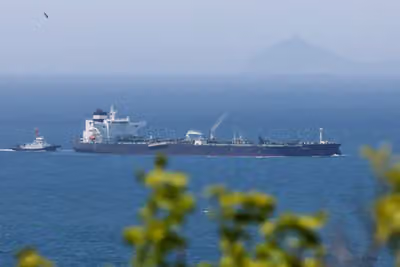
The lawyer said his team will look to seize Iranian assets in Canada and abroad. He said Iran has oil tankers in other countries and his team will be looking to seize whatever it can to pay what the families are owed.
The decision by Justice Edward Belobaba of Ontario's Superior Court of Justice was dated December 31 and announced by Arnold on Monday and awarded $100 million in punitive damages to be shared by the estates of the six victims. The court also awarded another $1 million to family members for the loss of guidance, care and companionship, and $6 million for pain and suffering.
Since it was a civil and not a criminal lawsuit the plaintiffs did not have to prove beyond “a reasonable doubt” that the downing of the plane was a deliberate terror act.
The case was filed by Shahin Moghaddam, Mehrzad Zarei and Ali Gorji. Fearing reprisals from Iran, some of the other plaintiffs withheld their names, CBC News reported earlier. Earlier reports had said that there are other pending court cases in Canada and in the United States.
A special Canadian forensic team had produced a report in mid-2021 that accused Iran of incompetence and recklessness over the downing of the Ukrainian passenger plane. Iran criticized the report as being "highly politicized".
Canada is not the only country seeking justice in the incident. Ukraine has been the most vocal party affected by the tragedy and has repeatedly blamed Iran for lack of cooperation in the investigation.
The report found that while the shooting down of Ukrainian International Airlines flight 752 had not been premeditated, it did not absolve Iranian officials of responsibility for the incident.
Iran admitted it shot down the airliner shortly after takeoff from Tehran in January 2020 and blamed a "disastrous mistake" by forces on high alert during a confrontation with the United States.
At the time, Iran was on edge about possible attacks after it fired missiles at Iraqi bases housing US forces in retaliation for the killing days before of its most powerful military commander, Qasem Soleimani, in a US missile strike at Baghdad airport. But authorities failed to close the civilian airspace that led to the tragedy.
With reporting by Reuters

Jailed Iranian writer Baktash Abtin has been put in a medically induced coma as his health condition is deteriorating due to complications caused by Covid-19 that he contracted in prison.
Abtin was denied timely treatment by the authorities of Evin prison for about 10 days after he caught Covid for the second time and was allowed to leave the prison for hospitalization on December 13.
The banned association said in their Sunday statement that Abtin’s condition is the direct result of the authorities’ “deliberate delay” to start his treatment.
The writer was sentenced to six years in prison in May 2019 for publishing documents about the history of the association and some comments against censorship.
Along with writers Reza Khandan Mahabadi and Kayvan Bajan, Abtin was charged with “propaganda against the state”and “assembly and collusion against national security”. These are vague charges used against political prisoners for criticism against the government.
Both courts and prosecutors are controlled by Iran’s hardline Judiciary which is accountable to Supreme Leader Ali Khamenei. Judges and prosecutors work in tandem with orders they receive from the Judiciary.
In October 2021, PEN America bestowed its 2021 PEN/Barbey Freedom to Write Award to the three imprisoned writers.

An Iranian human rights monitoring group based abroad has reported over 2,300 protest rallies in the country in 2021, with most events related to labor issues.
Unofficial labor unions organized 1,261 rallies across the country from January 1-December 20, and workers in specific workplaces or sectors held 618 protest gatherings, Human Rights Activists News Agency said in an annual report published on Monday, December 27.
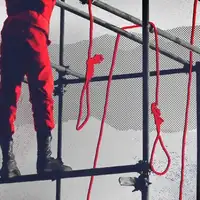
Iran executed 299 individuals in 2021, including four juvenile offenders - a 26-percent increase compared with 2020. Courts issued 85 death sentences until December 20.
Military forces shot 242 people, killing 94 individuals, some during protests and others who were small-time cross border traders essentially smuggling consumer goods between Iraq and Iran or fuel to Pakistan.

The report also covers ethnic and religious minorities, freedom of expression, the death penalty, women’s rights and other areas of human rights violations.
A lot of the information comes from sources inside Iran who cooperate with human rights monitors abroad and from government-controlled media that reports on labor protests but is mostly silent on prisoners and detentions. This kind of news comes from family members, lawyers and activists in Iran, often via social media.
The report also details the geographic location of reports in Iran, categorizing provinces with the number of human rights violation or protests that are often met with the forceful intervention of security forces.
Based on various types of reports, there were 390 violations of ethnic minority rights in 2021 registered by the Human Rights Activists in Iran (HRA). For religious minorities 144 cases were registered, including 57 arrests and 60 cases of police raiding homes. Still arrests of members of religious minorities decreased by 25 percent in 2021 compared with the previous year.
Members of the Baha’i faith suffered most with 72 percent of violations directed at the persecuted group. Persecution of newly c

onverted Christians constituted 14 percent of all violations.
Muslims are not allowed to convert to another religion. Most cases of conversion in Iran involve Muslims adopting Christianity and holding secret congregations at homes, which are raided if security forces get tipped off.
There were 674 reports of violations against freedom of expression in 2021, including the arrest of 1,043 individuals, with 111 trials held. In 2021, prison terms were issued for 215 people, totaling 10,140 months on accusations of “propaganda against the regime” and similar charges that would be incomprehensible in a modern society. Criticism of Supreme Leader Ali Khamenei, the military and the clergy usually trigger arrest and heavy punishment including lashing. This year, 16 people received a total of 998 lashes.
Authorities arrested 1,676 individuals because of political or civil-rights advocacy activities. “The statistical analysis exhibited 26 cases of arrest in the trade union category, 445 arrests in the category of ethnic minorities, 57 arrests in the category of religious minorities, 1043 arrests in the category of freedom of expression, 25 arrests related to children’s rights, 3 arrests of students related to the right to education, 6 arrests in the field of cultural rights, and 64 arrests in the category of workers’ rights,” the report said.
The report says that 575 cases of prisoner abuse were registered, including 232 cases of officials denying prisoners medical care and 68 cases of prisoners being deprived of lawyers.