Armed Groups Kill Two IRGC Men In Southeastern Iran

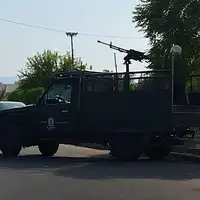
Two members of the Iran’s Revolutionary Guard have been killed in clashes with armed groups in the country's restive southeastern region, the military has said.

Two members of the Iran’s Revolutionary Guard have been killed in clashes with armed groups in the country's restive southeastern region, the military has said.
The Qods (Quds) Base of IRGC ground force said on Sunday that the two were killed on December 25 in Iran’s province of Sistan-and-Baluchestanon, bordering Pakistan and Afghanistan, without any further details about the clashes that led to the deaths.The Qods Base in question is not related to the Qods extraterritorial force of the IRGC. It has the largest area of command in Iran, covering two big provinces.In recent years, Sistan-Baluchestan has been the scene of frequent clashes between Iranian security forces and drug smugglers and Sunni Baluch militant groups, which are designated as terrorist organizations by the Islamic Republic.In February, a series of after over 20 Baluch fuel traders were killed by the IRGC at the Iran-Pakistan border.Earlier in December, clashes erupted between Iranian soldiers and Taliban forces near the Afghanistan-Iran border, but was later described as a “misunderstanding”.Iran accuses the United States and its regional allies of providing support for armed groups that are active in the region.

Iran simulated an attack against Israel's Dimona nuclear reactor during extensive military drills this week, that included launching multiple ballistic missiles.
Fars news agency, an affiliate of Iran’s Revolutionary Guard, published a video on Sunday that shows a mock-up of the Israeli nuclear site as the target of the simulated operation.
The Dimona reactor, officially known as the Shimon Peres Negev Nuclear Research Center, was marked as “WMD production center” in the high-resolution video.
Sixteen ballistic missiles and five suicide drones were launched against the mock target in the operation.
Rhetpric has intensified between Iran and Israel in recent weeks as nuclear talks between Tehran and world powers have stalled in Vienna. Israel has vowed that if Iran's nuclear program reaches a statge close to production of weapons, it will act regardless of an agreement the United States and other world powers reach with Tehran.
An article published by the Jerusalem Post on Sunday says such threats matter more than ever now, calling them “a dangerous escalation in rhetoric. It is also tied to Iran revealing aspects ofits drone program and new technology.”
Back in January 2012, Israeli media reported that the country’s Atomic Energy Commission had decided to temporarily shut down the reactor, citing vulnerability to attack from Iran as the main reason for the decision.
The main targets of Iran's long-range ballistic missiles are Israel, possibly US bases in the Middle East and vital oil installations. Israel has one of the world's most concentrated missile defense systems, known as the Iron Dome. US bases are also defended by Patriot and other missile defense systems.
The IRGC chief commander Major General Hossein Salami said on the last day of wargames on Friday that the drills carried a stark warning to “threats made by the Zionist regime’s officials that they need to be careful not making mistakes, and if they do, we will cut off their hands”.He said the only difference between the military exercise and a real attack to Israel is a change in the angle and trajectory of the missiles.

An Israeli source has told Iran International that Iran plans to make drone strikes the focus of its offensive activities across the region in the near future.
The source, who did not want to be named, said in an exclusive interview that in recent months Iran’s Revolution Guard Corps (IRGC) has been increasing delivery of drones to its proxies in the region and beyond.
He noted that now Iranian-backed forces in Iraq, Syria, Yemen, as well as Hezbollah in Lebanon have received these drones, adding that they were also sold to Venezuela.
Iranian proxies have begun using drones in attacks in Iraq and Syria in recent months. In early November, the residence of Iraq’s prime minister was the target of a drone attack, believed to have been launched by pro-Iran militias upset with losing in Iraq’s parliamentary elections.
Yemen's Iran-backed Houthi movement said in November it had fired 14 drones at several Saudi cities, including at Saudi Aramco facilities in Jeddah.

Gen. Kenneth McKenzie, US CENTCOM commander expressed concern in an Associated Press interviewpublished two weeks ago over the growing capabilities of Iran’s missiles and drones.
He said that Iran started the mass production and delivery of drones following failures and frustration in smuggling missiles and heavy weapons to its supporters in the Middle East.
Among other reasons for this change of strategy are the lower price and higher destruction power of drones, he underlined, adding that since drones can hit their target after many detours, it is difficult to detect from where they set off so the Islamic Republic can simply deny its role in the attacks.
He said that almost all of IRGC’s different types of drones were reverse-engineered and assembled from downed US-made drones in Afghanistan, Iran, Iraq and elsewhere, as well as from Israeli-made models. For example, Iran’s Shahed 129 drone is modeled after an Israeli Hermes drone that Iran shot down near the Natanz nuclear enrichment facility.
Iran has other Shahed drones, including the 191 and 171 which are copies of the US RQ-170, a flying wing design, or the Shahed 125 that is a copy of the US Shadow. Iran has armed the 123, 129 and 191 with missiles.
According to the source, the drones are trafficked by the Unit 190 of the IRGC’s Qods (Quds) force under the direct supervision of Amirali Hajizadeh, the commander of the Aerospace Force.
This month bills were introduced in the US Congress to ban assistance to Iran’s military drones. The bill seek to amend the Countering America’s Adversaries Through Sanctions Act (CAATSA) to include any action that seeks to advance the program as sanctionable under US law.

A senior Iranian commander has claimed that the military has deployed ballistic missiles, which can change targets in flight and render defenses ineffective.
Amirali Hajizadeh, Commander of Iran’s Aerospace Force, made the comment on the last day of military drills that began on Monday, saying that hundreds of billions of dollars “the enemy” has spent on defense against ballistic missiles have been wasted.
A ballistic missile has a pre-determined trajectory and target, with a guidance system that can adjust course just to ensure it impacts as close as possible to the pre-determined target. But Hajizadeh said Iranian missiles “can maneuver” and make interception virtually impossible.
On the last day of the large-scale military exercise, codenamed The Great Prophet 17, Iran launched 16 ballistic missiles of different classes simultaneously while 10 of the Aerospace Force’s offensive drones also launched a simultaneous operation and destroyed the designated targets, the military said.
During the drills, which took place on the coastlines of the southern provinces of Hormozgan, Bushehr, and Khuzestan, Iran also unveiled ‘suicide’ and reconnaissance drones as new components of its Ground Force.

The main targets of Iran's long-range ballistic missiles are Israel, possibly US bases in the Middle East and vital oil installations. Israel has one of the world's most concentrated missile defense systems, known as the Iron Dome. US bases are also defended by Patriot and other missile defense systems.
The IRGC chief commander Major General Hossein Salami said on Friday that the drills carried a stark warning to “threats made by the Zionist regime’s officials that they need to be careful not making mistakes, and if they do, we will cut off their hands”.
Chairman of the chiefs of staff of the Iranian Armed Forces noted that although the maneuver was planned before, it was an appropriate response to the recent threats by Israel.
"These exercises were designed to respond to threats made in recent days by the Zionist regime," Major General Mohammad Baqeri said.
Israel has long threatened military action against Iran, and recently reportedly allocated $1.5 billion for an attack if Iran gets dangerously close to obtaining a nuclear weapon.
The escalation comes as world powers have been discussing the revival of the 2015 Iran nuclear deal (JCPOA) aimed at limiting Iran’s nuclear program, which Israel has opposed.
Only hours after the war games ended, Britain condemned the launch of ballistic missiles by the Islamic Republic.
"These actions are a threat to regional and international security and we call on Iran to immediately cease its activities," the UK Foreign Office said in a statement.

US State Department told Iran International that the deceased former Iran envoy with Houthis was not the IRGC operator with a 15-million reward on his head.
A State Department spokesman on Wednesday [Dec. 22} had confirmed to Iran International that Hassan Irloo, the Iran envoy with Houthis who was evacuated from Sanaa earlier and died shortly after was a senior member of the Revolutionary Guard, but had not clarified if he was a person wanted by the United States.
On Thursday however, the State Department confirmed to Iran International that Irloo was not general Shalaei, a mysterious figure sought by the US, with a $15 million reward on his head.
The Iranian government's official news agency IRNA in a Tuesday report on Irloo's death had said that "he was also known as General Shahlaei", raising suspicion about his identity and mission in Yemen.
Later in the evening, however, the agency had deleted the reference to Shahlaei – aka Hajj Yusef and Yusuf Abu-al-Karkh -- who is an IRGC’s Qods (Quds) Force commander classified by the US government as a terrorist.
When asked if Irloo is the same person as Shahlaei on Wednesday, the spokesperson had not given a clear answer but said that "the reward for Abdul Reza Shahlaei still stands." Subsequently on Thursday, the State Department said that the two individuals were indeed different people.

On the third of January 2020, the night when the United States killed the head of the Qods Force Qasem Soleimani, the US military attempted to also assassinate Shahlaei via a drone strike. The drone strike in Sana'a, where Shahlaei was said to be based, failed to kill him but did lead to the death of a lower-ranking IRGC member Mohammad Mirza.
It remains a possibility that the IRNA statement saying Irloo and Shalaei were the same people could have been a diversionary move to throw others off Shalaei's tracks.
One thing remains clear that Irloo (Irlu or Irlou) himself was a senior IRGC operator who spent years on secret missions with militant groups throughout the region and was sent to Yemen as "ambassador" in Sanaa, controlled by Iran-aligned Houuthis.
Irloo's importance and staure cannot be underestimated. Leader of the Islamic Revolution Ali Khamenei issued a message of condolence Wednesday over Irloo’s death, describing him as an “efficient envoy” with a track record of” political struggle, diplomatic endeavors, and social activism”.
On Thursday, Chairman of the Chiefs of Staff of the Iranian Armed Forces Major General Mohammad Bagheri called Irloo a martyr of the Islamic Revolution who dedicated his life to the resistance axis in the region.
The title shahid (martyr) is usually reserved for those killed in battle and 'resistance' is a term the Islamic Republic uses to describe its allies and proxies in the region.
At Irloo's funeral ceremony Wednesday, deputy commander of the IRGC, Ali Fadavi, also named him as a “fighter in the resistance front" and accused the US and its allies of delaying Irlou’s evacuation from Sanaa and his death.
Even before reportedly catching COVID-19, he was already suffering from respiratory problems sustained in chemical attacks during the Iran-Iraq war.
The Wall Street Journal in a report last week claimed that Houthis had asked Tehran to remove Irloo from Sanaa. Both Iran and the Houthi leadership denied the report, insisting that the ambassador suffered from Covid and needed to receive medical attention in Iran.

The US Navy said on Wednesday that two of its patrol coastal ships seized a cargo of illicit weapons from a fishing vessel in the North Arabian Sea on Monday.
The shipment consists of approximately 1,400 AK-47 assault rifles and 226,600 rounds of ammunition, the fleet said in a statement.
"The stateless vessel was assessed to have originated in Iran and transited international waters along a route historically used to traffic weapons unlawfully to the Houthis in Yemen," it added.
Direct or indirect supply, sale or transfer of weapons to the Houthi movement violates UN Security Council resolutions and US sanctions.
The vessel's five crew members, who identified themselves as Yemeni nationals, will be returned to Yemen, the fleet said, adding that the US naval forces sank the vessel after removing the crew and illicit cargo.
Guided-missile cruiser USS Monterey (CG 61) seized dozens of advanced Russian-made anti-tank guided missiles, thousands of Chinese Type 56 assault rifles, and hundreds of PKM machine guns, sniper rifles and rocket-propelled grenade launchers from a stateless vessel transiting the North Arabian Sea in May.
Iran supplies weapons to Houthi rebels in Yemen who are fighting a Saudi-led coalition that intervened in the country’s civil war in 2015 to back the internationally-recognized government.
Report by Reuters