• العربية
  • فارسی
BrandBrand
  • Iran Insight
  • Politics
  • Economy
  • Analysis
  • Special Report
  • Opinion
  • Podcast
  • Live TV
  • Iran Insight
  • Politics
  • Economy
  • Analysis
  • Special Report
  • Opinion
  • Podcast
  • Live TV
  • Theme
  • Language
    • العربية
    • فارسی
  • Iran Insight
  • Politics
  • Economy
  • Analysis
  • Special Report
  • Opinion
  • Podcast
  • Live TV
All rights reserved for Volant Media UK Limited
volant media logo

Iran says IAEA cannot inspect attacked sites until it condemns military strikes

Nov 29, 2026, 12:44 GMT+0

The UN nuclear watchdog could not inspect Iranian nuclear facilities as long as it refused to condemn strikes on them, the head of the country's Atomic Energy Organization said on Sunday.

Mohammad Eslami said Iran’s nuclear facilities had been under International Atomic Energy Agency supervision regardless of their location.

He rejected accusations that Iran had built underground nuclear facilities to conceal its activities, saying the decision was driven by security concerns.

“This was not for concealment but because of the vulnerability of our nuclear industry and the various forms of aggression it has faced from the United States and Israel over the past 30 years,” Eslami said.

  • Iran rapidly builds underground complex near nuclear sites – US institute

    Iran rapidly builds underground complex near nuclear sites – US institute

Most Viewed

Turkish aviation firm to shut down over US sanctions for Iran ties
1

Turkish aviation firm to shut down over US sanctions for Iran ties

2

Iran's security chief builds parallel power structure outside cabinet

3
ANALYSIS

Iran cries wolf over nuclear treaty withdrawal

4

Iran’s central bank chief admits economic squeeze is hurting families

5

A dark, cold office: Pezeshkian's austerity gesture backfires

Banner

Spotlight

  • Iran locks in gas sales to Turkey it may struggle to supply
    ANALYSIS

    Iran locks in gas sales to Turkey it may struggle to supply

  • Iran cries wolf over nuclear treaty withdrawal
    ANALYSIS

    Iran cries wolf over nuclear treaty withdrawal

  • Who flogs a singer? The ‘public decency’ case against Parastoo Ahmadi
    PODCAST

    Who flogs a singer? The ‘public decency’ case against Parastoo Ahmadi

  • A dark, cold office: Pezeshkian's austerity gesture backfires

    A dark, cold office: Pezeshkian's austerity gesture backfires

  • Iranian women break silence on a lifetime of violence
    VOICES FROM IRAN

    Iranian women break silence on a lifetime of violence

  • Too poor to marry, young Iranians are offered religious workarounds
    INSIGHT

    Too poor to marry, young Iranians are offered religious workarounds

Banner
Banner
Banner
Banner
Banner
Banner
•
•
•

More Stories

Iran files charges over pop singer’s promotional campaign

Nov 29, 2026, 10:51 GMT+0
100%
A still from the promotional video for Sasy’s forthcoming song “Zakaria,” featuring branded snack packages and a banner encouraging fans to submit dance videos.

Iranian prosecutors have filed charges against people involved in a promotional campaign linked to US-based Iranian pop singer Sasy and are seeking to identify fans who sent him dance videos, judicial media reported on Sunday.

The judiciary’s Mizan news agency did not name the singer, but details of its report matched Sasy’s campaign to promote his forthcoming music video, “Zakaria.”

“I’ll provide the chips and yogurt; you send the dance videos,” Sasy said in a promotional clip, encouraging fans to film themselves dancing with packages bearing the song’s title.

Potato chips and yogurt dip are a popular snack combination among Iranians, particularly at private gatherings where alcohol is consumed, despite the country’s ban on drinking.

Iranian media reported that the packages had been distributed free of charge in Tehran.

The song’s title appears to refer to Mohammad ibn Zakaria al-Razi, a Persian physician and chemist popularly credited in Iran with discovering alcohol.

The judiciary accused the campaign of encouraging alcohol consumption and said prosecutors were pursuing both those involved in preparing and distributing the packages and fans who submitted videos.

The number of people identified and details of their cases have not been disclosed.

Previous music videos triggered arrests

Sasy began his career as an underground musician in Iran before moving abroad. Now based in Los Angeles, he is known for his dance music, sexually suggestive lyrics and music videos featuring subjects considered taboo under the Islamic Republic.

  • A Viral Music Video Exposes Hypocrisy Among Iranian Officials

    A Viral Music Video Exposes Hypocrisy Among Iranian Officials

His 2019 hit “Gentleman” drew criticism from Iranian officials after videos of schoolchildren dancing and singing along to the song circulated online.

His 2021 music video “Tehran Tokyo,” featuring American adult film actress Alexis Texas, prompted a judicial investigation and the arrest of two brothers in Shiraz over their alleged involvement in arranging the song.

Dozens of Iranian news websites were blocked in December 2023 after publishing excerpts from another of his music videos, “Leila’s Brothers,” the Iranian newspaper Etemad reported.

Judicial crackdown on musicians

The latest case comes days after Iranian authorities flogged singer Parastoo Ahmadi and four members of her concert team over a December 2024 online performance in which she appeared without the mandatory hijab.

  • Iran flogged singer to deter dissent, insiders tell Reuters

    Iran flogged singer to deter dissent, insiders tell Reuters

Each received 74 lashes for offending public decency through the production and publication of the concert video, their lawyer Mostafa Nili said.

The punishment was intended to warn opponents of the Islamic Republic against renewed nationwide protests, Reuters reported on Saturday, citing three officials and two people close to the government.

Iran’s flaring nearly doubled in five years, wasting gas it badly needs in winter

Nov 29, 2026, 09:21 GMT+0
•
Dalga Khatinoglu
100%
A photo released in August 2025 by the Iranian oil ministry's news agency SHANA shows a photographer taking a picture as gas burns from a flare stack in Iran.

Iran burned off nearly 30 billion cubic meters of gas in 2025, nearly double the volume five years earlier, according to World Bank estimates, and now faces a winter gas shortfall that could reach 430 million cubic meters a day at peak demand.

President Masoud Pezeshkian said on November 28 that even a single cubic foot of Iran’s gas was too much to burn without a useful purpose, praising efforts to capture gas that would otherwise be flared.

A 61-kilometer pipeline inaugurated Saturday is carrying about 2.8 million cubic meters of gas a day from the Darkhovin oil field to the NGL 3200 processing plant, the Oil Ministry’s news agency Shana reported.

Hamid Deris, head of Arvandan Oil and Gas Company, said the gas had previously been burned off at the field.

Only Russia flared more gas than Iran in 2025. The volume Iran burned off was equivalent to roughly half of Turkey’s natural gas consumption that year.

The scale of that waste has implications for a country that routinely restricts gas supplies to factories and power plants during winter to keep homes heated. Damage to gas processing facilities during this year’s war has further reduced the amount of gas Iran can deliver when demand peaks.

Russia and Iran flared roughly similar volumes of gas in 2025, although Russia produced about three times as much oil. Iran therefore burned off considerably more gas for each barrel of oil it produced.

Iraq ranked third globally, flaring about 24 billion cubic meters, followed by Venezuela with around 13.5 billion cubic meters, according to the World Bank.

Iran also ranks among the world’s largest sources of methane emissions from oil and gas operations. The International Energy Agency estimates that the sector emitted about 6 million tonnes of methane in Iran in 2025.

The estimate includes leaks from equipment and pipelines, gas deliberately released into the atmosphere and methane that escapes when flares burn incompletely.

Billions of cubic meters burned at oil fields

Associated gas is natural gas that comes to the surface alongside crude oil during extraction. At many Iranian oil fields, operators burn the gas at the production site because they lack the equipment to collect, transport and process it.

Iran has installed gas collection equipment at some oil fields over the past several decades. Several fields that began producing oil in the past 20 years, however, still lack the infrastructure to capture the gas and put it to use.

Bijan Zanganeh, who served as oil minister under President Hassan Rouhani from 2013 to 2021, estimated while in office that Iran needed about $5 billion in investment to substantially reduce flaring.

The World Bank’s revised estimates show that Iran flared about 14 billion cubic meters of gas in 2013. Oil production rose following the 2015 nuclear agreement, known as the JCPOA, and flaring reached nearly 25 billion cubic meters in 2017.

Iranian oil output fell after the United States reinstated sanctions during Donald Trump’s first presidency. Flaring declined alongside production, dropping to about 16 billion cubic meters in 2020.

As oil production recovered during Joe Biden’s presidency, flaring rose again, reaching about 26 billion cubic meters in 2023 and 28.5 billion in 2024. The increase continued in 2025.

Winter gas shortfall deepens

Iranian officials have blamed rising consumption by households, businesses and small industries for the winter gas crisis. In recent winters, authorities have sharply curtailed supplies to factories and power plants as demand for heating has risen.

Household gas use rose from about 50 million cubic meters a day in summer 2025 to more than 182 million in autumn and 323 million in winter, according to figures from the Statistical Center of Iran.

Iran produced an average of about 764 million cubic meters of processed gas a day in the Iranian year ending in March 2026. In recent winters, the country’s gas shortfall has reached an estimated 250 million to 300 million cubic meters a day during periods of peak demand, forcing authorities to cut supplies to factories and power plants.

This winter, Iran also faces the effects of Israeli strikes on facilities in Assaluyeh that process gas from South Pars. The field accounts for around 73% of Iran’s natural gas production, according to Oil Ministry figures.

The strikes knocked about 230 million cubic meters a day of processing capacity offline, according to Saeed Tavakoli, head of the National Iranian Gas Company. Repairs restored about 100 million cubic meters a day, he said, leaving 130 million cubic meters a day of capacity unavailable ahead of winter.

Farhad Shahraki, deputy chair of parliament’s energy committee, said Saturday that the third gas processing unit at the sixth South Pars refinery had returned to service after repairs, the Oil Ministry’s news agency Shana reported.

Officials have warned that supply restrictions could extend to households on the coldest days. The National Iranian Gas Company has identified 11 provinces where supplies are under strain, with the situation particularly severe in three northern provinces.

Iran locks in gas sales to Turkey it may struggle to supply

Nov 29, 2026, 03:50 GMT+0
•
Umud Shokri
100%
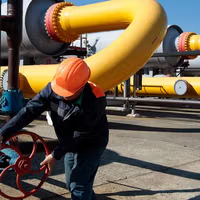
File photo: A worker operates a valve at a natural gas facility in Iran.

Iran and Turkey have extended their natural gas supply agreement until 2032, preserving one of Tehran's most important export markets even as domestic shortages and US economic pressure threaten its ability to meet supply commitments.

The extension, reported by Bloomberg on Friday, follows the expiry of the countries' original 25-year agreement in July. The volumes and financial terms of the new arrangement have not been disclosed.

For Turkey, the deal preserves another source of gas in an increasingly diverse mix of suppliers. For Iran, it secures a valuable customer at a time when its export options are narrowing.

The agreement comes as Iranian officials warn that domestic gas shortages could reach 430 million cubic meters a day during peak winter demand.

Why Turkey still needs Iranian gas

Turkey has significantly diversified its natural gas supplies over the past decade, reducing its dependence on Iran.

Once Turkey's second-largest gas supplier, Iran fell to fourth place in 2025, behind Russia, Azerbaijan and the United States.

According to Turkey's energy regulator, the country imported approximately 58.4 billion cubic meters of natural gas last year, with Iran supplying 7.7 billion cubic meters, or just over 13%.

Those deliveries were well below the 10 billion cubic meters a year covered by the previous agreement.

Ankara has expanded its facilities for importing liquefied natural gas (LNG), strengthened energy ties with Azerbaijan and signed long-term supply agreements with European companies.

Turkish Energy Minister Alparslan Bayraktar said in June 2025 that the country had sufficient infrastructure to compensate for potential disruptions in Iranian supplies.

But Iranian gas still has commercial advantages. Pipeline gas can be more economical than LNG when global prices rise, making Iranian supplies a useful option for Turkey. Keeping Iran among its suppliers also gives Ankara more flexibility when energy markets are disrupted.

The shorter agreement may give Ankara greater room to reconsider prices and supply arrangements as energy markets change. For Iran, however, losing the Turkish market would mean losing an important source of revenue and one of its largest regional energy customers.

Iran's gas shortage threatens exports

Iran faces a striking contradiction: despite possessing the world's second-largest proven natural gas reserves, it struggles to supply enough gas to its own population and industries.

According to the US Energy Information Administration, Iranian gas consumption increased by 60% over the decade ending in 2023, driven partly by heavily subsidized prices, industrial growth and greater reliance on gas to generate electricity.

Years of underinvestment, sanctions and aging infrastructure have made it difficult to keep production ahead of demand.

Declining pressure at the giant South Pars gas field has added to the problems, while damage to processing facilities during the 2026 war has further reduced available supplies.

On November 26, National Iranian Gas Company managing director Saeid Tavakoli warned that the country's gas shortfall could reach 430 million cubic meters a day during peak winter demand, with around 130 million cubic meters of daily production capacity still unavailable.

When gas runs short, authorities restrict supplies to factories, including steel, cement and petrochemical producers. The interruptions reduce production and export earnings, while power plants may switch to more polluting fuels.

Maintaining exports under these conditions presents a difficult choice. Selling gas abroad brings in valuable revenue, but it can also leave less available for domestic industries already struggling with shortages.

Even the money Iran earns from Turkey is not necessarily freely available to Tehran.

In September, Turkish Finance Minister Mehmet Şimşek said payments for Iranian gas were deposited in restricted accounts under an arrangement with Washington. The funds could be used for essential imports, including food and medicine.

Without greater investment in gas production, processing facilities and energy efficiency, Tehran could find it increasingly difficult to meet both domestic demand and its export commitments.

Regional ambitions face growing obstacles

The renewed agreement also helps Iran maintain an important economic relationship with Turkey despite their competing interests across the Middle East and South Caucasus.

But retaining a major customer is different from becoming a regional center for gas trade, an ambition Tehran has pursued for years.

Iran hopes to expand gas exports and serve as a transit route for supplies from Central Asia to neighboring countries. Sanctions, inadequate infrastructure and domestic shortages have repeatedly frustrated those plans.

Turkey's decision to suspend imports of Turkmen gas transported through Iran because of concerns over US sanctions illustrates those obstacles.

Turkey's growing range of suppliers and Iran's shrinking export options could give Ankara greater leverage in future negotiations, although the undisclosed terms of the renewed contract make it difficult to assess the concessions either side has made.

The agreement secures a valuable customer for Tehran at a time when its export markets are shrinking. Whether Iran can reliably deliver the gas it has agreed to sell is another matter.
Iran’s rial nears 3 million to the US dollar as families struggle to get by

Nov 29, 2026, 00:32 GMT+0
100%
FILE PHOTO: Iranian rials, U.S. dollars and Iraqi dinars at a currency exchange shop in Basra, Iraq, November 3, 2018.

Iran’s currency weakened to just under 3 million rials per US dollar on the open market on Saturday, deepening a squeeze on households already facing consumer prices nearly 90% higher than a year earlier.

The dollar traded between 2.98 million and just under 3 million rials on Saturday, according to exchange rate tracking websites. It had passed 2.90 million rials on Wednesday and 2.95 million on Thursday.

The euro rose above 3.26 million rials and the British pound topped 3.9 million on Saturday.

The record-breaking devaluation of rial comes as some Iranians told Iran International in recent days that they could no longer cover basic expenses. Others said rising costs had forced them to close their businesses.

Iran’s Statistical Center put year-on-year consumer inflation at 88.7% in the Iranian month ending in October.

Central Bank governor under fire

A senior lawmaker called for the dismissal of Central Bank Governor Abdolnaser Hemmati on Saturday, making him a target of mounting criticism over the country's deepening economic crisis.

Alaeddin Boroujerdi, a member of parliament's National Security and Foreign Policy Committee, said Hemmati should be held accountable for the currency's collapse, accusing him of overseeing a fivefold increase in the dollar's value during his time as economy minister and then central bank chief.

He sarcastically described Hemmati as a “specialist in raising exchange rates,” saying he should be replaced if he could not stabilize the currency and protect Iranians' purchasing power.

Hemmati was previously dismissed as economy minister by parliament in March 2025 over the rial's decline, but returned to government as central bank governor in December.

Hemmati attributed the rial’s latest decline to US sanctions on the Iran Center for Exchange of Currency and Gold, allegations about Iran’s shadow banking network and a jump in the price of the dollar-pegged cryptocurrency Tether on unlicensed exchanges.

The US Treasury on Monday imposed sanctions on eight people and 22 companies and other entities it linked to the network. Washington said the measures aimed to limit Tehran’s access to financial channels it uses to move oil revenue.

Banking curbs reach six more crypto platforms

Crypto exchange Nobitex said Saturday it had temporarily suspended Tether trading because of sharp price swings and frenzied trading, the Revolutionary Guards-affiliated Fars news agency reported. Currency traders in Iran use Tether’s price in rials as a gauge of the open-market dollar rate.

Separately, the central bank said it had restricted six more crypto platforms’ ability to withdraw funds remotely from their bank accounts. It accused them of violating trading rules and promoting stablecoin prices that lacked a clear benchmark. It did not identify the platforms or say how long the restrictions would last.

On Wednesday, the bank ordered a halt to deposits into accounts belonging to three exchanges, Nikpardakht, Bitmit and Rivonex, with approval from the prosecutor general’s office. Authorities accused the three of disrupting the economic system.

Iran's security chief builds parallel power structure outside cabinet

Nov 28, 2026, 19:16 GMT+0
100%
President Masoud Pezeshkian and Mohsen Rezaei attend a farewell ceremony for Iran's late Supreme Leader Ali Khamenei, July 3, 2026

Iran's top security official has appointed a group of conservative politicians to oversee economic, energy and infrastructure affairs, raising questions about the growing reach of the security establishment into areas traditionally managed by the elected government.

Mohsen Rezaei, secretary of the Supreme National Security Council (SNSC) and a former commander of the Revolutionary Guards, announced eight appointments to the council's secretariat, drawing heavily on officials who served under the late President Ebrahim Raisi.

The appointments extend across economic resilience, infrastructure, energy, food security, social affairs and relations with parliament, giving the secretariat a team whose responsibilities overlap with those of several government ministries.

The changes come as Iran faces a prolonged confrontation with the United States, a naval blockade that has severely restricted oil exports, and mounting pressure on its economy.

They also raise questions about how much authority President Masoud Pezeshkian and his cabinet retain as more of the country's economic and administrative challenges are treated as matters of national security.

Although Pezeshkian chairs the council, the appointments were made by Rezaei, whose authority also derives from the supreme leader.

A government outside the cabinet?

Among the most prominent appointments is Seyed Mohsen Dehnavi, a former conservative lawmaker named deputy for the so-called resistance economy.

Dehnavi has longstanding ties to ultraconservative politician Saeed Jalili, whose student campaign he headed during the 2013 presidential election.

Ali-Akbar Mehrabian, Ebrahim Raisi's energy minister and a former industries minister under Mahmoud Ahmadinejad, was appointed Rezaei's energy adviser.

Alireza Peyman-Pak, who headed Iran's Trade Promotion Organization and later held a senior agricultural trade position under Raisi, was named head of the secretariat's food security headquarters.

Mehdi Dousti, a former governor of Hormozgan province under Raisi, was appointed deputy for infrastructure. He previously worked with the Revolutionary Guards' Khatam al-Anbiya construction organization and in the oil, gas and petrochemical industries.

Unlike several other appointees, Dousti also held a senior economic position in Pezeshkian's Interior Ministry.

The other appointments include Mostafa Zamanian, who headed the presidential Center for Strategic Studies under Raisi, as Rezaei's social affairs adviser.

Former conservative lawmaker Majid Fooladgar was appointed head of Rezaei's office, while former parliamentarian Ali Ahmadi took charge of legal and parliamentary affairs.

The appointments bring several prominent figures from Raisi's administration back into influential positions, despite the change of government following his death in 2024.

Who runs the security council?

The Supreme National Security Council is formally chaired by the president, and its membership includes senior ministers, military commanders and the heads of Iran's other branches of government.

But the president does not exercise exclusive control over the institution.

Under Article 176 of Iran's Constitution, the council coordinates political, intelligence, social, cultural and economic activities related to national security. Its decisions take effect only after approval by the supreme leader.

Rezaei was appointed the supreme leader's representative on the council by Mojtaba Khamenei in August, before Pezeshkian formally appointed him secretary.

That sequence illustrates the overlapping lines of authority within the institution. Although the president chairs the council, its secretary also represents the supreme leader and oversees the secretariat's day-to-day work.

The latest appointments were made by Rezaei, rather than announced as cabinet appointments by Pezeshkian.

There is no public evidence that the president opposed the choices or that the secretariat has formally assumed powers belonging to government ministries.

Nevertheless, the appointment of senior officials covering energy, infrastructure, food supplies and economic policy highlights the extent to which the council's machinery operates in areas that would ordinarily fall within the government's responsibilities.

One more step

The reshuffle comes at a time when Iran's economic problems are increasingly inseparable from its confrontation with the United States.

The American naval blockade has disrupted oil exports, while sanctions and the continuing threat of military escalation have made access to energy, essential goods and trade routes central security concerns.

Ministers are nominated by the president and must secure parliamentary approval. Senior officials appointed to the security council's secretariat do not undergo the same process, even when their portfolios overlap with those of cabinet ministers.

Rezaei's appointments do not establish that the council has displaced the cabinet or acquired new constitutional powers. But they suggest that more of the government's work is being drawn into a security apparatus beyond the president's direct control.