A woman can sing a wordless melody in some settings in Iran. When she sings lyrics, authorities can weigh whether her voice might arouse men. That’s how music researcher Siavash Rokni explains the religious thinking behind restrictions on women’s singing.
Parastoo Ahmadi’s case shows how Iran enforces its rules on public decency. A court deemed her concert video obscene and immoral. Ahmadi and four men who helped stage the concert each received 74 lashes.
Ahmadi performed without a hijab at the historic Deir-e Gachin Caravanserai near Qom in December 2024. There was no audience in the courtyard. The recording drew millions of views online.
In June, a Qom court convicted Ahmadi and eight members of her concert team of “offending public decency” by producing and publishing the video. It sentenced all nine to 74 lashes each and barred them from leaving Iran or pursuing artistic and musical activities for two years.
On November 23, authorities carried out the floggings of Ahmadi and four of the men at the prosecutor’s office in Qom, their lawyer Mostafa Nili said. He identified the men as concert organizer Mohsen Lashkari and musicians Soheil Faghih-Nasiri, Amin Taheri and Amirali Pirnia.
Who decides when a woman’s voice is ‘indecent’?
Iranian authorities generally bar women from singing solo before audiences that include men. Women can sing in a chorus or perform solo for women-only audiences. They have also sung lullabies and children’s songs on television and performed at some regional folk music festivals.
In an interview with Eye for Iran, Rokni traced the distinction to the writings of Ayatollahs Ruhollah Khomeini and Ali Khamenei. “The voice of woman is not haram,” he said, describing their interpretation. “It is when the voice of women incites excitement that it becomes haram.”
A male countertenor can sing in the same range as a woman and be permitted to perform, Rokni said. The distinction he described turns in part on who is singing, whether she is singing words and how authorities judge the effect of her voice on a listener.
Rokni said the definition of public indecency gives judges room to decide what crosses the line. In Ahmadi’s case, the charge concerned the production and publication of the concert video.
The men who stood with her
“When we’re dealing with flogging, this is a form of torture or other cruel, inhuman, or degrading punishment. There is an absolute prohibition,” international human rights lawyer Gissou Nia told Eye for Iran.
Nia pointed to the International Covenant on Civil and Political Rights, which binds Iran. The UN Human Rights Committee has said the treaty’s prohibition on torture and cruel, inhuman or degrading punishment extends to corporal punishment.
The punishment of the four men, Nia said, shows how a system she describes as gender apartheid also harms men who challenge it. They helped put a woman onstage and received the same number of lashes she did.
“It’s really important to remember that men are victims of these gender crimes as well,” Nia said. “The bravery of them in expressing that solidarity with their bodies is quite significant.”
In March 2025, Iranian singer Mehdi Yarrahi also received 74 lashes, his lawyer Zahra Minooei said. He was arrested in 2023 after releasing Rousarieto, or “Take Off Your Headscarf,” a protest song challenging compulsory hijab. After Ahmadi and her team were flogged, Yarrahi shared footage of her concert in solidarity.
The fear a flogging can spread
Azadeh Afsahi, a psychotherapist and founder of Iran House who works with survivors of political violence, said the punishment was meant to instill fear and shame in people who step outside the rules. Flogging can damage a person’s sense of agency, she said, and signal to others what they risk when they speak up or support someone who does.
In Ahmadi’s case, Afsahi saw people rally around the singer. She said the men who helped stage the performance reflected a shift she has seen since the Woman, Life, Freedom movement, with men more willing to take risks in support of women’s freedom.
Afsahi said both trauma and resilience can pass from one generation to the next.
Kiyah Willis, an American fellow at the Objective Standard Institute who made videos about Ahmadi’s case, said she spoke out because Iranian women’s experiences are often overlooked in US conversations about women’s rights. Some viewers had assumed Iranian women broadly supported compulsory hijab, she said. For those viewers, Willis said, the flogging showed how far the state would go to enforce its rules.
“These Iranian stories don’t get told,” Willis said.
Condemnation abroad and a father’s pride
Amnesty International had urged Iran to halt the floggings. After the sentences were carried out, France condemned the punishment, UN human rights chief Volker Türk called it “abhorrent,” and US Ambassador to the UN Mike Waltz called it “pure medieval barbarism.”
Ahmadi’s father, Amir Ahmadi, said he was proud of his daughter’s courage. He described the flogging as a symbol of oppression against art and the women of Iran.
“Liberté” (freedom) lights up the facade of the Arab World Institute in Paris on November 25, 2026, as part of a projection of the Iranian protest slogan “Woman, Life, Freedom.” Screengrab from a video shared on X by French Foreign Minister Jean-Noël Barrot.
France urged Iran to halt executions immediately at a Paris gathering of Iranian artists on Wednesday, drawing a rebuke from Tehran’s foreign minister, who accused his French counterpart of lecturing Iranians about their rights.
French Foreign Minister Jean-Noël Barrot opened the “Iranian Voices” event at the Arab World Institute by naming Milad Armoon and Navid Najjaran, two protesters facing execution in a case dating back to the 2022 uprising.
He said the Islamic Republic had failed to crush the protest movement.
“France stands with Iranian women and men who are rightly calling for justice, freedom and dignity,” Barrot wrote on X on Wednesday. His post included a video showing the slogan “Woman, Life, Freedom” projected onto the facade of the Arab World Institute in Paris.
In a separate Instagram post, Barrot shared a clip pairing his French television interview with footage of Iranian singer Parastoo Ahmadi performing. “Caught between repression and war, Iranian voices must not fall silent,” he wrote.
Iranian Foreign Minister Abbas Araghchi mocked the gathering in a post on X on Thursday, pointing to the French foreign ministry’s role in organizing it.
Araghchi shared footage of chanting during a dispute at the gathering and said Barrot should focus on protecting freedom of expression for Iranians in France before lecturing Tehran about the rights of Iranians at home.
Barrot’s appeal came hours after Armoon’s lawyer said he had received word by phone that his client’s execution had been suspended shortly before it was due to take place.
Iran’s judiciary-affiliated Mizan news agency disputed reports about the timing and said the death sentences against both men, who were detained over protests in Tehran’s Ekbatan neighborhood, remained in force.
Barrot also spoke about Iranian singer Parastoo Ahmadi, who received 74 lashes on Monday for performing without a headscarf in a concert streamed online in 2024.
Ahmadi’s voice accompanied a video Barrot shared on Instagram showing the words “Woman, Life, Freedom” projected onto the institute’s facade. France stood with Iranian women and men demanding “justice, freedom and dignity,” he wrote.
A photo of Mahsa "Jina" Amini at the Paris event held on Nov. 25, 2026.
The event marked the International Day for the Elimination of Violence against Women. The Arshid Azarine Trio performed “Song to Jina,” and actor Mina Kavani read Iranian poet Forough Farrokhzad’s “Earthly Verses” in Persian and French. A short film by Tanin Torabi showed a young woman dancing in public spaces in Iran.
Barrot had announced the gathering in Brussels on November 16, when he sought European Union sanctions over an October cyberattack on refrigeration systems at about 700 French supermarkets.
Paris blamed Iran’s Revolutionary Guards, an accusation Tehran rejected. Barrot said he hoped EU foreign ministers would approve sanctions against those responsible at their December 14 meeting.
A medical worker attends to a patient at a hospital in Iran.
Weak oversight and financial strain in Iran's healthcare system have left patients facing demands for under-the-table payments, some running to billions of rials for essential treatment, the state news agency IRNA reported on Wednesday.
IRNA called the practice, known in Iran as zirmizi, or "under the table," a possible form of "modern-day extortion" that exploits patients' dependence on their doctors and their fear of losing treatment.
Patients have reported demands for hundreds of millions of rials for routine operations such as removing an appendix or tonsils, and several billion rials for specialized treatment such as bone marrow procedures, IRNA said. One hundred million rials is about $36, and 3 billion rials about $1,070, at a time when the monthly minimum wage is about 166 million rials, or $59.
The payments fall outside insurance and can bypass hospital accounts through cash, personal bank accounts, intermediaries and installments. Patients have told Iran International that some doctors demanded cash or gold coins before performing surgery.
Fear of delayed surgery, retaliation or losing follow-up care keeps many patients from reporting unauthorized charges, which weakens a system of oversight that depends on formal complaints.
Many cases referred to the Government Discretionary Penalties Organization end in acquittal for lack of evidence, such as missing receipts, Deputy Health Minister Sajjad Razavi told local media last month.
There are no reliable figures, said lawmaker Mohammad Jamalian, who heads a parliamentary committee investigating the payments, because so few violations lead to complaints.
In August, the head of the Medical Council, Mohammad Raeeszadeh, cited a survey of more than 60,000 people in which only 5.6 percent said they had paid above approved rates. IRNA questioned the survey's method and whether it counted payments that went unreported.
Patients pay
Iranian patients are paying 55 to 75 percent of their healthcare costs out of pocket this year, and some medicine prices have risen 400 to 500 percent, Hosseinali Shahriari, chairman of parliament's Health Committee, said in September.
Nearly half of those who answered a voluntary Iran International audience survey from October 30 to November 3 said they had postponed treatment or medication because of rising prices. Rising costs have also pushed patients from private hospitals into overstretched public ones.
Much of the strain comes from the state itself. Hospitals and doctors say official tariffs are too low to cover costs, and some state-run basic and supplementary insurers are seven to eight months behind on their payments, Raeeszadeh has said.
None of that justifies unlawful charges, IRNA said, adding that fixing medical pricing and health financing was the job of policymakers, not patients. It called for insurers to pay on time, for transparent hospital billing, for protection for patients who report violations, and for disciplinary cases to be made public.
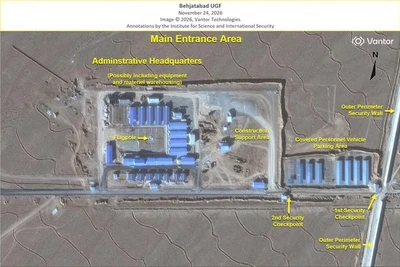
Satellite imagery shows construction at Iran’s Behjatabad underground facility on November 24, 2026. (Vantor Technologies/Institute for Science and International Security)
Iran is rapidly constructing a fortified underground complex between two of its main nuclear sites that could house weapons systems or infrastructure linked to its nuclear program, a Washington-based research institute said on Wednesday.
“The function of the facility is not clear at this time. More information is needed to make an accurate assessment,” the Institute for Science and International Security said in a post on X.
The Behjatabad facility stands out among similar underground complexes built across Iran for its unusually rapid pace of construction, according to the institute, which published satellite imagery provided by Vantor Technologies.
The complex lies midway between the Isfahan nuclear site and Pickaxe Mountain near Natanz, approximately 62 kilometers from each. Its outer security perimeter is expected to encompass roughly 12,000 acres (5,000 hectares).
The site's security measures, the nature and pace of construction and Iran’s previous construction practices suggest the complex could serve several military purposes, including housing missile systems or other major weapons systems, the institute said.
“A nuclear purpose cannot be ruled out,” it added.
The facility was first identified by satellite imagery analyst Ben Tzion Macales, who said in a November 17 post on X that construction activity had accelerated following Operation Epic Fury, the US military campaign against Iran earlier this year.
The scale of construction activity was such that progress could be tracked even using relatively low-resolution Sentinel-2 satellite imagery, Macales added.
Satellite imagery reviewed by Vantor showed that initial construction activity began in December 2025 and expanded considerably throughout 2026.
The institute said it would publish additional satellite imagery and a more detailed assessment of the facility in a forthcoming report.
Rebuilding nuclear infrastructure
Construction of the Behjatabad complex comes as the Islamic Republic has sought to rebuild and reinforce some of its underground facilities following attacks on its nuclear and military infrastructure during the 12-day and 40-day wars.
An assessment published by the institute on November 21, 2025, five months after the 12-day war, found that the June attacks on Fordow, Natanz and Isfahan had inflicted extensive and, in some cases, catastrophic damage on Iran’s nuclear infrastructure.
Iran was unable at the time to enrich uranium on a significant scale or manufacture large numbers of centrifuges and had made little progress in restoring its damaged capabilities, according to the assessment.
Researchers warned, however, that the destruction of Iran’s main enrichment facilities did not mean all of its sensitive nuclear capabilities had been eliminated.
Satellite imagery at the time showed activity consistent with debris removal, equipment recovery and efforts to reinforce some facilities.
Remaining nuclear facilities
Among the facilities examined by the institute was Pickaxe Mountain, an underground complex near Natanz that was not targeted during the 12-day war in June 2025.
Iran announced in 2020 that it intended to establish a facility capable of assembling thousands of centrifuges annually at the complex.
Construction of the new facility was approaching completion by November 2025, according to the institute’s assessment.
Researchers identified Pickaxe Mountain as one of the potential sites where Iran could restore parts of its centrifuge manufacturing and assembly capabilities or potentially resume uranium enrichment.
The institute also examined reconstruction at Taleghan 2, a facility within the Parchin military complex that was targeted by Israel in October 2024.
Satellite imagery from 2025 showed extensive reconstruction at the site, including the installation of a cylindrical structure that researchers assessed could have applications in nuclear weapons-related research. Its intended function had not been independently confirmed.
Satellite imagery shows the tunnel complex under construction at Iran’s Behjatabad underground facility on November 24, 2026. (Vantor Technologies/Institute for Science and International Security)
At least three sites associated with possible weapons-related activities had undergone clearance work following attacks, the institute said in its November 2025 assessment.
Uncertainty over enriched uranium stocks
The whereabouts and condition of Iran’s stockpile of some 440 kilograms of uranium enriched to 60% remain among the major unresolved questions surrounding its nuclear program.
Restrictions on access to Iranian nuclear facilities had prevented the International Atomic Energy Agency from fully accounting for the stockpile, the institute said in its November 2025 assessment.
The agency assessed at the time that the material had probably not been removed from the main nuclear sites at Isfahan, Fordow and Natanz, although it could have been relocated within those complexes.
Satellite imagery alone cannot establish what activities are taking place inside Iran’s underground facilities, where its enriched uranium is stored or the condition of its nuclear equipment, according to the institute.
The rapid construction at Behjatabad adds to the growing importance of underground facilities in assessing the future of Iran’s nuclear and military programs.
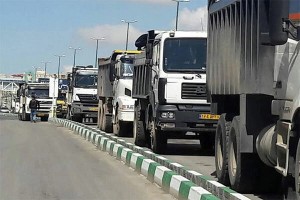
Trucks line in Isfahan, central Iran, during a strike on November 25, 2026.
Iranian truck drivers entered a fifth day of strikes on Thursday, with their union saying drivers in 18 cities were refusing to haul freight at rates that have stayed flat as the cost of keeping a truck on the road has climbed.
The Union of Truck Drivers and Trucking Associations Across Iran named Isfahan, Kermanshah in the west and Kazerun in the southern province of Fars among the cities in a message to drivers on Telegram. Truckers in Shiraz stopped work on Sunday, the day the strike began.
The union urged drivers to hold out for higher rates, saying that when one driver agreed to carry a load for next to nothing, others lost out too.
"Tires are priced in dollars, oil is priced in dollars, diesel is priced in dollars," the union said. "So freight rates have to reflect reality too." The rial fell past 2.8 million to the dollar on the open market this week, a record low.
Drivers also face higher insurance premiums, tolls and repair bills, according to the union. "Until we get what we're owed, we won't haul freight," it said.
Diesel shortages, limited supplies of engine oil and tires, and the rising cost of maintaining an aging fleet threatened freight transport across Iran, the union said in a separate statement.
Factories rely on the same trucks to move their goods as farmers do to get crops to market, it said. If those problems persist, production, distribution and prices would all be affected. Farmers had voiced support for the drivers on Wednesday, the union said.
Most of Iran's goods move by road, so truckers' strikes can quickly be felt in shops and markets. In 2018, a truckers' strike over pay and costs spread to hundreds of cities, and the judiciary threatened strikers with harsh punishment.
B‑1B Lancer bomber at the RAF Fairford airbase, after police declared a major incident at the base after several men were arrested on suspicion of offences under the Explosives Act, in Fairford, Gloucestershire, Britain, September 28, 2026. REUTERS/Toby Shepheard
Britain’s Royal Air Force (RAF) is moving military aircraft into hangars and hardened shelters at night to protect them from potential drone attacks amid growing security threats, including suspected Iranian plots targeting British airbases, Sky News reported on Wednesday.
The RAF is also reportedly considering installing anti-drone netting to protect aircraft that remain exposed at military bases.
Iran is suspected of plotting to target RAF Fairford in Gloucestershire, an airbase used by US bombers during the war with Iran. The threat prompted the Pentagon to evacuate bomber aircraft from the facility.
The United States has also relocated military aircraft from a second British airbase following reports of another suspected Iranian threat.
British and US authorities have brought charges against five men in connection with the suspected IRGC-linked plot targeting RAF Fairford in September.
On November 10, US prosecutors announced charges against three men, including a suspect accused of coordinating activities through coded telephone calls while detained in a New York jail. Two other men have been charged in Britain in connection with the suspected plot.
British authorities assessed the suspected Fairford plot as highly likely to have been coordinated in Iran and almost certainly directed by the IRGC, Parliament was told on October 12.
Iranian Foreign Minister Abbas Araghchi rejected Britain’s accusations in a September 30 post on X, pointing to the release on bail of suspects arrested in connection with the Fairford incident.
“I can confirm Iran's belief that releasing supposed terrorists working for foreign states really says it all,” Araghchi wrote, adding: “You're barking up the wrong tree.”
RAF chief Air Chief Marshal Harv Smyth said on Tuesday that the air force was preparing for a scenario where “there is no sanctuary at home, you are fighting from the UK but you need to get on the move.”
Smyth stressed the importance of dispersing military aircraft across multiple locations and maintaining operational readiness in the event of a conflict.
The measures also come amid concerns over Russian sabotage. Britain’s domestic intelligence agency MI5 and the Ministry of Defence warned British companies supplying military equipment to Ukraine on Tuesday that they faced an increased risk of Russian sabotage.