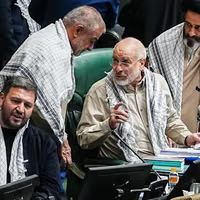
Mohammad Mokhber, an adviser to Supreme Leader Mojtaba Khamenei, said Iran had stood by the Iraqi people during their most difficult days and had proven its friendship.
"This unbreakable bond requires Baghdad to remain vigilant on the issue of borders so that it does not become a tool of the enemies of Islam or give in to the policies of the criminal Trump," Mokhber wrote on X.
The warning followed weeks of border closures, including two more crossings shut on Thursday, after Washington formally asked Baghdad to keep only two crossings with Iran open.
Iraqi Foreign Minister Fuad Hussein disclosed the US request on November 8, saying it would be difficult to implement without damaging Iraq's economy.
Trade between the neighbors is worth $15 billion to $18 billion annually, including about $4 billion in Iranian gas, according to Hussein.
Iraq's national security adviser, Qasim al-Aboudi, arrived in Iran on Saturday, the state-owned Iraqi Media Network reported. An Iraqi official told Al Jazeera that the closure of unofficial border crossings would be discussed during the visit.
The official also said Iraq had reinforced its army's 8th and 11th divisions across large areas of Kirkuk province, including areas bordering Sulaymaniyah, Nineveh and Salahuddin, to prevent smuggling through unofficial routes.
Iraq’s Ministry of Interior also announced the continuation of work to complete comprehensive security fortifications in the Hawizeh Marshes on the border between Iraq and Iran.
Between a rock and a hard place
Baghdad faces competing demands from Washington and Tehran.
The United States has sought to disrupt the movement of weapons, sanctioned goods and illicit revenue across Iran's land borders. For Tehran, the stakes have risen as the US naval blockade has severely restricted its seaborne oil exports.
Iraq is one of Iran's largest export markets and its biggest buyer of gas and electricity. The two countries share a border of roughly 1,600 kilometers, with nine official crossings and numerous unofficial routes.
Baghdad has closed several crossings in recent weeks, including Sheikh Saleh and Bashta on Thursday. About 300 trucks carrying goods and building materials were stranded at Sheikh Saleh, according to Iranian customs officials.
The closures have also stirred opposition within Iraq. Political factions aligned with Tehran have condemned what they describe as American interference, while traders have protested the economic disruption.
Iran-aligned factions retain influence in Iraq's parliament, governing coalition and security establishment, while the country remains financially exposed to Washington.
Iraq's oil revenues pass through an account at the Federal Reserve Bank of New York.
According to Reuters, Washington warned Baghdad earlier this year that it could restrict access to those funds unless it reduced Tehran's influence in its government.