FILE PHOTO: Iranian people shop at the Tehran Bazaar in Tehran, Iran, March 26, 2025. Majid Asgaripour/WANA (West Asia News Agency) via REUTERS
Iranian lawmakers and analysts accuse the Pezeshkian administration of adding to the strain of US sanctions and the naval blockade through currency rules that penalize exporters and bureaucratic hurdles that make it harder for manufacturers to secure raw materials.
They describe a range of domestic measures as “self-sanctions,” pointing to restrictions on foreign currency transactions, banking and customs procedures, and price controls that make it more difficult for businesses to operate.
The criticism has taken on renewed significance as Iran faces restrictions on maritime trade and oil exports. Critics say the government has focused on the consequences of external pressure while doing too little to strengthen domestic production or expand trade through land borders and barter arrangements.
On Wednesday, Hassan Ghashghavi, the spokesman for parliament’s National Security and Foreign Policy Committee, urged the government to support producers during what he described as an “existential war.”
Manufacturers, he said, need access to foreign currency and raw materials to stay in business and avoid bankruptcy.
“Given the existing capacities, the country’s main problem is not a lack of resources but weak management,” Ghashghavi said.
‘Domestic sanctions’ on producers and exporters
Amir Sayyah, an economic advisor to Parliament Speaker Mohammad Bagher Ghalibaf during 2024 presidential debates, told the state TV that the government is making it harder for Iranian entrepreneurs and exporters to operate under already difficult conditions.
“The biggest problem with our economy, apart from foreign sanctions – and I’m not denying foreign sanctions – is domestic sanctions,” Sayyah said on the Be Vaghte Iran (Iran Time) TV debate.
“Whoever can negotiate should go and resolve [the foreign sanctions]. Whoever can find a way around them should do so. But as for domestic sanctions ... if [the enemy] is stabbing us from the front, the government and all these executive agencies should not stab [producers and exporters] in the back.”
Sayyah argued that Iranian businesses could maintain production, trade and financial transactions despite international sanctions if domestic authorities gave them room to operate.
He said currency exchange companies were capable of transferring money from countries such as the United States to destinations in Europe, the Middle East and East Asia, but that the government had failed to make use of their services.
Easing administrative and regulatory restrictions, he argued, would allow businesses to operate more freely without waiting for foreign sanctions to be lifted. He said it would also strengthen Iran’s economic position in any negotiations with Washington.
One of the main obstacles facing exporters, according to Sayyah, is the requirement to bring their foreign currency earnings home at exchange rates set by the central bank. Those rates can put exporters at a financial disadvantage, he said, discouraging them from bringing their earnings back and reducing the supply of foreign currency at home.
“An exporter who earns foreign currency for the country despite sanctions should be regarded as part of the national effort to counter the blockade, rather than being treated as a violator by government agencies,” he said.
Sayyah said the administration of former President Ebrahim Raisi and the parliament at the time had removed some regulations that hampered producers and exporters, but that the work had stalled under Pezeshkian.
Government faces criticism over its economic response
Pezeshkian has repeatedly spoken about the difficulties posed by what he calls economic warfare, arguing that they are more complicated than those of military confrontation.
He has pointed to a shortage of funds and to shortfalls in electricity and natural gas supplies that are expected to lead to scheduled power cuts this winter.
The president has backed diplomacy, arguing that ending the current state of “neither war nor peace” is necessary to ease economic pressure and uncertainty.
His government has drafted next year’s budget around two scenarios, reflecting uncertainty over how long the maritime blockade will last.
The first assumes that current conditions will persist, requiring sharp spending cuts and a halt to new infrastructure projects. Under that scenario, the government would reserve all available foreign currency for essential goods and medicine.
The second envisages the lifting of restrictions and a gradual recovery in the supply of foreign currency, allowing the government to resume reconstruction and infrastructure projects.
Conservative and hardline critics have taken issue with how often the president and his ministers discuss the country’s economic difficulties. They argue that repeated warnings about electricity and gas shortages, scheduled power cuts and limited funds frighten the public and reinforce what they describe as Washington’s psychological warfare.
Hardliners have urged the government to do more to counter the blockade by expanding barter trade and helping domestic producers make fuller use of their capacity.
Imports and non-oil exports fall
The value of Iran’s non-oil exports fell 28.2% between the beginning of April and the end of August compared with the same period a year earlier, according to Foroud Asgari, head of Iran’s Customs Administration. Non-oil exports were down 32.5% from the corresponding period in 2024, before the war.
Imports fell from $23.02 billion to $17 billion, a 26.1% decrease from a year earlier. Compared with the same period in 2024, imports were down 38%, a steeper decline than for non-oil exports.
A substantial share of Iran’s imports consists of raw materials, intermediate goods and machinery used by domestic manufacturers. Economists warn that reduced access to those goods could further undermine production in an economy already under pressure from sanctions and the blockade.
Limits of land routes
Economist Mohammad-Mehdi Behkish has argued that the blockade presents a problem beyond the financial obstacles Iranian businesses faced under previous sanctions.
Even when importers find a way to transfer payments to foreign suppliers, they still face the challenge of getting the goods into the country, he said.
Iran has traditionally conducted a substantial share of its foreign trade by sea. Its land routes have limited capacity and cannot handle the volume of goods previously carried by ship, Behkish argued.
A medical worker attends to a patient at a hospital in Iran.
Weak oversight and financial strain in Iran's healthcare system have left patients facing demands for under-the-table payments, some running to billions of rials for essential treatment, the state news agency IRNA reported on Wednesday.
IRNA called the practice, known in Iran as zirmizi, or "under the table," a possible form of "modern-day extortion" that exploits patients' dependence on their doctors and their fear of losing treatment.
Patients have reported demands for hundreds of millions of rials for routine operations such as removing an appendix or tonsils, and several billion rials for specialized treatment such as bone marrow procedures, IRNA said. One hundred million rials is about $36, and 3 billion rials about $1,070, at a time when the monthly minimum wage is about 166 million rials, or $59.
The payments fall outside insurance and can bypass hospital accounts through cash, personal bank accounts, intermediaries and installments. Patients have told Iran International that some doctors demanded cash or gold coins before performing surgery.
Fear of delayed surgery, retaliation or losing follow-up care keeps many patients from reporting unauthorized charges, which weakens a system of oversight that depends on formal complaints.
Many cases referred to the Government Discretionary Penalties Organization end in acquittal for lack of evidence, such as missing receipts, Deputy Health Minister Sajjad Razavi told local media last month.
There are no reliable figures, said lawmaker Mohammad Jamalian, who heads a parliamentary committee investigating the payments, because so few violations lead to complaints.
In August, the head of the Medical Council, Mohammad Raeeszadeh, cited a survey of more than 60,000 people in which only 5.6 percent said they had paid above approved rates. IRNA questioned the survey's method and whether it counted payments that went unreported.
Patients pay
Iranian patients are paying 55 to 75 percent of their healthcare costs out of pocket this year, and some medicine prices have risen 400 to 500 percent, Hosseinali Shahriari, chairman of parliament's Health Committee, said in September.
Nearly half of those who answered a voluntary Iran International audience survey from October 30 to November 3 said they had postponed treatment or medication because of rising prices. Rising costs have also pushed patients from private hospitals into overstretched public ones.
Much of the strain comes from the state itself. Hospitals and doctors say official tariffs are too low to cover costs, and some state-run basic and supplementary insurers are seven to eight months behind on their payments, Raeeszadeh has said.
None of that justifies unlawful charges, IRNA said, adding that fixing medical pricing and health financing was the job of policymakers, not patients. It called for insurers to pay on time, for transparent hospital billing, for protection for patients who report violations, and for disciplinary cases to be made public.
Mohammad Javad Fazel Lankarani speaks at the “Jurisprudence of Revenge” seminar in Qom on November 25, 2026, where he described revenge for injustices against society as a binding religious obligation to be pursued by the state and citizens.
A senior cleric in the Iranian seminary city of Qom said on Wednesday that avenging attacks on Islam and the Islamic Republic, including the killing of Ali Khamenei, is a religious duty that cannot be forgiven, and that ordinary believers must act if the state does not.
Ayatollah Mohammad Javad Fazel Lankarani set out his case at a seminar titled "The Jurisprudence of Revenge," attended by clerics, university professors and students.
If officials fail to carry out the duty of revenge, he said, responsibility passes to individuals able to act, provided they do not disrupt the Islamic political order.
His argument gives religious grounds for individuals to take revenge into their own hands, at a time when Iran's commanders are vowing revenge for Khamenei, who was killed in US-Israeli strikes on February 28, and Iran-linked plots against people abroad are before courts in Britain, the United States and Europe.
Revenge, not retribution
Fazel Lankarani drew a line between revenge and qisas, the retribution in kind that Islamic law prescribes for murder and bodily harm. Qisas requires the punishment to match the crime. Revenge, he said, covers a much wider range of offenses and requires no such match.
He based the legitimacy of what he called "earthly revenge" on the Quran's depiction of God as an avenger, citing verses that name disbelief, persistent sin, crime and oppression as grounds for divine vengeance against societies.
Ruhollah Khomeini's grandson, Hassan Khomeini, stands next to Iran's slain former Supreme Leader Ali Khamenei.
A duty no one can forgive
Quranic verses that urge patience and forgiveness apply only to personal wrongs, Fazel Lankarani said. When an injustice is done to society, religion or the Islamic political system, the right to revenge belongs to the whole community.
He cited the killing of Khamenei, of military commanders, and children in the southern city of Minab as cases where revenge, not qisas, is a religious duty.
Drawing on Shiite tradition, he also suggested extending the role of vali-ye dam, the heir entitled to demand retribution for a killing, to the entire community of believers. Because religious leaders are spiritual fathers to the faithful, he said, avenging their deaths could become a right all believers share.
Once revenge is religiously required, he said, an Islamic state is bound to pursue it, and cannot waive it by forgiving the offender. That limits the room officials have to choose not to retaliate.
From fatwa to violence
Religious rulings have been used before to sanction violence by individuals far from Iran.
Ruhollah Khomeini, the founder of the Islamic Republic, issued a fatwa in 1989 calling for the killing of the novelist Salman Rushdie, who was stabbed and badly wounded on stage in New York in 2022.
A dynasty of clerics
Fazel Lankarani is the son of the late Grand Ayatollah Mohammad Fazel Lankarani, a marja-e taqlid, or senior religious authority whom Shiite Muslims follow on religious and legal matters. He now heads the jurisprudence research center his father founded in Qom in 1997.
He is part of a pattern of clerical families keeping religious institutions and political influence across generations. The most prominent example is Supreme Leader Mojtaba Khamenei, who succeeded his father this year.
Trucks line in Isfahan, central Iran, during a strike on November 25, 2026.
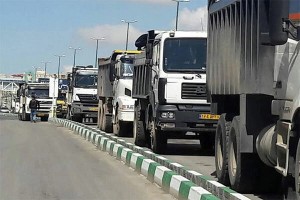
Iranian truck drivers entered a fifth day of strikes on Thursday, with their union saying drivers in 18 cities were refusing to haul freight at rates that have stayed flat as the cost of keeping a truck on the road has climbed.
The Union of Truck Drivers and Trucking Associations Across Iran named Isfahan, Kermanshah in the west and Kazerun in the southern province of Fars among the cities in a message to drivers on Telegram. Truckers in Shiraz stopped work on Sunday, the day the strike began.
The union urged drivers to hold out for higher rates, saying that when one driver agreed to carry a load for next to nothing, others lost out too.
"Tires are priced in dollars, oil is priced in dollars, diesel is priced in dollars," the union said. "So freight rates have to reflect reality too." The rial fell past 2.8 million to the dollar on the open market this week, a record low.
Drivers also face higher insurance premiums, tolls and repair bills, according to the union. "Until we get what we're owed, we won't haul freight," it said.
Diesel shortages, limited supplies of engine oil and tires, and the rising cost of maintaining an aging fleet threatened freight transport across Iran, the union said in a separate statement.
Factories rely on the same trucks to move their goods as farmers do to get crops to market, it said. If those problems persist, production, distribution and prices would all be affected. Farmers had voiced support for the drivers on Wednesday, the union said.
Most of Iran's goods move by road, so truckers' strikes can quickly be felt in shops and markets. In 2018, a truckers' strike over pay and costs spread to hundreds of cities, and the judiciary threatened strikers with harsh punishment.
Russian President Vladimir Putin, Chinese President Xi Jinping and U.S. President Donald Trump arrive for a trilateral meeting at Kylin Villa on November 19, 2026 in Shenzhen, China. The three leaders are meeting on the sidelines of the 33rd Asia-Pacific Economic Cooperation (APEC) Economic Leaders' Meeting hosted by China on November 18-19.
Iranian officials and commentators are divided over whether Donald Trump, Xi Jinping and Vladimir Putin struck a secret deal over Iran in Shenzhen, after a joint statement that never mentioned Tehran and a US claim that Xi and Putin had agreed with Washington on Iran.
Trump had said he would raise Iran with the Chinese and Russian leaders at their summit on November 19. But the final statement made no reference to Iran, the Strait of Hormuz or Tehran's nuclear program.
Two days later, US Treasury Secretary Scott Bessent said otherwise. "It was very interesting in Shenzhen, President Xi, President Putin both agreed they can never have a nuclear weapon and that the Strait of Hormuz should be open to free and open navigation," he said in a television interview.
Foreign Ministry spokesman Esmail Baghaei said on Monday that Tehran had been in contact with Moscow and Beijing, which he called friends of Iran, both before and after the summit. "Decisions about Iran are not made anywhere other than Tehran," he said.
'Didn't take the bait'
The state news agency IRNA argued that neither China nor Russia had reason to back Washington's campaign against Tehran, in an article titled "Trump Took the Iran File to Shenzhen, But Beijing and Moscow Didn't Take the Bait."
Beijing could not endorse US pressure on Iran in an official statement without hurting its own economic interests, IRNA said, while Russia had little reason to help weaken a strategic partner when doing so would strengthen the United States and Israel at Moscow's expense.
"The Shenzhen summit showed that Iran was both a subject of discussion and an issue over which the three powers failed to reach a consensus. This lack of consensus does not indicate that Tehran is unimportant; rather, it reflects the depth of disagreement between Washington, Beijing and Moscow over how to resolve the Iran issue," the article said.
Fears that Iran could be 'sold out'
Before the summit, some Iranian political figures had warned that Trump might win Chinese and Russian help in pressuring Tehran by offering them concessions on Taiwan and Ukraine.
"The three leaders meeting in Shenzhen have no plan to end the war and blockade against Iran. They want to divide the cake of the new world order among themselves ... I believe Iran is not the main issue but part of the deal," Heshmatollah Falahatpisheh, a former chairman of parliament's National Security and Foreign Policy Committee, wrote on X.
Ahmad Salehi, an analyst of Iran-China economic relations, rejected that view on Khat-e Energy, an online talk show run by a hardline outlet, on Sunday. Those who say China and Russia sold Iran out have offered no evidence, he said, and any deal involving Iran would have left some trace in the summit's outcome or in reports of the talks.
Mohammad Mehdi Mazaheri, a former adviser to the late president Akbar Hashemi Rafsanjani, made a similar case in an article for the Khabar Online news site on Sunday.
"It appears that at the Shenzhen summit, Washington did not offer Beijing and Moscow an enticing proposal or a sufficiently convincing strategic incentive to persuade them to sacrifice their regional leverage and put pressure on Iran," he wrote.
Thailand's Prime Minister Anutin Charnvirakul, Malaysia's Prime Minister Anwar Ibrahim, Canada's Prime Minister Mark Carney, Australia's Prime Minister Anthony Albanese, New Zealand's Prime Minister Christopher Luxon, Russia's President Vladimir Putin, China's President Xi Jinping, US President Donald Trump and South Korea's President Lee Jae-myung pose for a group photo during the Asia-Pacific Economic Cooperation (APEC) Summit in Shenzhen, in China's southern Guangdong Province on November 19, 2026.
A deal on the blockade?
Another theory, which spread through hardline media and social media last week, held that China and Russia had agreed with Trump to let Iranian tankers pass more freely through the US naval blockade. Online, it was tied to reports that 14 Iranian tankers had crossed the blockade, claims that Iranian officials later denied.
"Whether a behind-the-scenes deal was made is something we cannot judge because we simply do not know," Salehi said.
Iran should resolve the blockade itself rather than wait for a deal between foreign powers, he said.
Like several hardline figures, he proposed sending a fleet of tankers to their destinations, holding the United States responsible for any attack on them, and retaliating by striking targets Iran had already identified.
China’s President Xi Jinping (C), US President Donald Trump (R) and Russia’s President Vladimir Putin (L) hold a trilateral meeting on the sidelines of the Asia-Pacific Economic Cooperation (APEC) China Summit in Shenzhen, Guangdong province, China, 19 November 2026.
'Shenzhen that did not become Yalta'
Trump drew his own historical parallel. In a Truth Social post, he compared Shenzhen to the Tehran Conference of 1943 and the Yalta Conference of 1945, where Allied leaders shaped the world order after Nazi Germany's defeat, and shared a photo of himself with Xi and Putin that recalled the famous picture of Roosevelt, Churchill and Stalin in Tehran.
When those three met, Iran was under British and Soviet occupation. The Tehran Conference opened on November 28, 1943, so its anniversary falls this week.
"The world has changed; the current world order cannot be restored to the past with old photographs," Mohsen Rezaei, secretary of the Supreme National Security Council, wrote in response.
In an article titled "Shenzhen That Did Not Become Yalta," published on Saturday by the Ettelaat newspaper, Middle East analyst Mohammad-Ali Mohtadi argued that the summit's main lesson for Iran was not to let its future become a bargaining chip between major powers.
Tehran should keep its decisions in its own hands, strengthen its ties with China and Russia, and use their differences with Washington to its advantage, he wrote.
The debate reflects a broader worry in Tehran: whatever its ties to Beijing and Moscow, it cannot assume either will put Iran's interests ahead of its own when dealing with Washington
Members of Iran's Basij paramilitary force, a branch of the Islamic Revolutionary Guard Corps (IRGC), which has played a major role in suppressing anti-government protests across the country.
Iran's military chiefs marked Basij Week by hailing the militia as a global power the United States and Israel cannot neutralize, months after Mojtaba Khamenei set its new commander the goal of making "every Iranian a Basiji."
Iran's military chiefs marked Basij Week by hailing the militia as a global power the United States and Israel cannot neutralize, months after Mojtaba Khamenei set its new commander the goal of making "every Iranian a Basiji."
"None of the strategies of the American and Zionist enemies can predict or neutralize it," Brigadier General Abolfazl Shekarchi, the armed forces' senior spokesman, said in a message for the week, which peaks on Thursday, the 47th anniversary of the Basij's founding. He called it "the most invincible force in the world."
The chief of staff of the armed forces, Major General Ali Abdollahi, said on Wednesday that the Basij had become "more than an organization" and called for its role to be expanded in science and technology, society and defense, as part of Iran's push for "absolute deterrence."
The tributes come as the militia is being rebuilt and expanded. Its commander, Gholamreza Soleimani, was killed in US-Israeli strikes during the war. In August, Khamenei appointed Hossein Taeb, a cleric and former intelligence chief of the Revolutionary Guards, to replace him.
Taeb led the Basij once before, in 2008 and 2009, the year of the crackdown on protests over the disputed presidential election. His appointment decree set the expansion goal of "every Iranian a Basiji," and the Guards have since opened registration for 1,000 new "Janfada" (devotee) national resistance battalions.
Human rights groups know the Basij for something else: its role in crushing every major wave of protest in Iran for decades.
Basij forces take part in an urban military drill in Iran, with a billboard in the background depicting slain IRGC commander Qassem Soleimani saluting the late supreme leader Ali Khamenei.
A force in every neighborhood
Ruhollah Khomeini, the founder of the Islamic Republic, created the Basij, meaning "mobilization," in November 1979. It is formally a volunteer paramilitary force and one of the five branches of the Revolutionary Guards.
Its strength is its reach. The Basij runs "resistance bases," usually housed in mosques, in neighborhoods across the country, under a Guards' rule from 1982 that called for a cell in every neighborhood, working with local clerics and community figures. Student Basij units operate in schools, and Basij branches sit inside universities.
It also extends into the state itself. Government ministries, state companies and public bodies host their own Basij branches, and there are separate Basij organizations for civil servants, workers, merchants, doctors, engineers, lawyers, artists and tribes. Each draws office space, staff time and funding from the institution that hosts it, so much of the militia's real cost never appears under its own name.
That network does more than mobilize volunteers. Basij members have raided private parties where alcohol is served and detained women for breaking the mandatory dress code.
They also gather intelligence. An Iran International investigation in September found that a Basij-affiliated cultural group in the northeastern city of Fariman helped security forces identify people who took part in the January protests, leading to 23 arrests.
The same structure fills the streets for the state. Basij bases have long supplied the crowds for official rallies, from the anniversary of the revolution to Quds Day and the counter-protests staged after the 2009 unrest. Since the war began in February, the state has held nightly rallies that officials say have now passed 260 nights.
Perks and budgets
Membership brings material rewards, which have become a major reason people join: preferential university admission, an edge in government hiring, subsidized loans and shorter compulsory military service.
The state pays for it in many places at once. The Basij has its own line in the national budget, which rose by 45 percent in the budget bill for the year to March 2023, to 30.8 trillion rials.
A study of the following year's budget by Iran Open Data found at least 5.7 trillion tomans, then about $105 million, allocated to the Basij, its industrial arm and affiliated "jihadi" groups, spread across six separate clauses.
They included free bitumen from the oil ministry to pave Basij bases, free land from the roads ministry for Basij centers, and marriage and childbirth loans for members. Because the funding is scattered and its businesses undisclosed, the group said, the full figure could not be calculated.
The militia also has a business empire. In 2018, the US Treasury sanctioned a network of companies built around the Basij Cooperative Foundation, with stakes in banking, manufacturing and mining, saying it helped fund the force's recruitment of child soldiers.
A child soldier holds a rifle during the 1980–1988 Iran-Iraq War. Iran's then-supreme leader Ruhollah Khomeini once called child soldiers the country's “real leaders,” encouraging their participation in the war.
Every crackdown
Basij members, often in plain clothes and working alongside uniformed police, have been implicated in beatings, arbitrary arrests and killings of protesters.
In 2009, Human Rights Watch documented Basij members attacking peaceful demonstrators, raiding university dormitories and beating detainees.
The militia played a leading role in suppressing the November 2019 protests over fuel prices and the 2022 uprising after the death of Mahsa Amini in morality police custody. Amnesty International identified Basij battalions among the forces responsible for the mass killings of protesters in the January massacre.
Child recruits
The militia has a long history of recruiting children. In March 2026, the Revolutionary Guards launched a recruitment drive through mosque-based Basij centers that accepted children as young as 12.
Amnesty International later documented armed children at security checkpoints and said that recruiting children under 15 was a war crime.
The United States has sanctioned the Basij and several of its commanders over serious human rights abuses against Iranians.