• العربية
  • فارسی
BrandBrand
  • Iran Insight
  • Politics
  • Economy
  • Analysis
  • Special Report
  • Opinion
  • Podcast
  • Live TV
  • Iran Insight
  • Politics
  • Economy
  • Analysis
  • Special Report
  • Opinion
  • Podcast
  • Live TV
  • Theme
  • Language
    • العربية
    • فارسی
  • Iran Insight
  • Politics
  • Economy
  • Analysis
  • Special Report
  • Opinion
  • Podcast
  • Live TV
All rights reserved for Volant Media UK Limited
volant media logo

Fidan says Mecca Alliance members discussed US-Iran negotiations

Nov 27, 2026, 22:21 GMT+0
Turkish Foreign Minister Hakan Fidan gestures during the South-East European Cooperation Process (SEECP) summit in Sofia, Bulgaria, June 10, 2026. REUTERS/Spasiyana Sergieva

Turkish Foreign Minister Hakan Fidan said on Friday that Turkey, Saudi Arabia and Pakistan discussed prospects for a positive outcome in negotiations between the United States and Iran during a meeting of the Mecca Alliance for Joint Defense in Islamabad, Turkey’s state-run Anadolu news agency reported.

Most Viewed

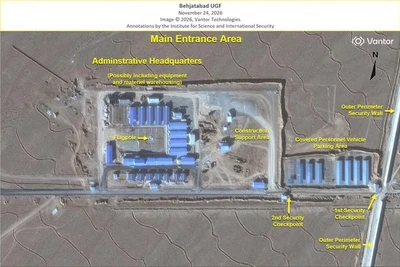
Iran rapidly builds underground complex near nuclear sites – US institute
1

Iran rapidly builds underground complex near nuclear sites – US institute

2
INSIGHT

Iran’s efforts to offset US naval blockade fall short, economists warn

3

Trump deploys extra aircraft carrier, says Iran is making ‘big mistakes’

4

Iran-backed Iraqi militia prepares for renewed US-Iran war, report says

5

Iranian truckers’ strike spreads to more cities on fifth day, union says

Banner

Spotlight

  • Who flogs a singer? The ‘public decency’ case against Parastoo Ahmadi
    PODCAST

    Who flogs a singer? The ‘public decency’ case against Parastoo Ahmadi

  • A dark, cold office: Pezeshkian's austerity gesture backfires

    A dark, cold office: Pezeshkian's austerity gesture backfires

  • Iranian women break silence on a lifetime of violence
    VOICES FROM IRAN

    Iranian women break silence on a lifetime of violence

  • Too poor to marry, young Iranians are offered religious workarounds
    INSIGHT

    Too poor to marry, young Iranians are offered religious workarounds

  • Iran faces year-end cash squeeze if US blockade holds
    INSIGHT

    Iran faces year-end cash squeeze if US blockade holds

  • A broken leg and broken trust: Violence in Iran’s schools
    VOICES FROM IRAN

    A broken leg and broken trust: Violence in Iran’s schools

Banner
Banner
Banner
Banner
Banner
Banner
•
•
•

More Stories

Who flogs a singer? The ‘public decency’ case against Parastoo Ahmadi

Nov 27, 2026, 21:55 GMT+0
•
Negar Mojtahedi
100%
Parastoo Ahmadi is an Iranian artist and singer.

A woman can sing a wordless melody in some settings in Iran. When she sings lyrics, authorities can weigh whether her voice might arouse men. That’s how music researcher Siavash Rokni explains the religious thinking behind restrictions on women’s singing.

Parastoo Ahmadi’s case shows how Iran enforces its rules on public decency. A court deemed her concert video obscene and immoral. Ahmadi and four men who helped stage the concert each received 74 lashes.

Ahmadi performed without a hijab at the historic Deir-e Gachin Caravanserai near Qom in December 2024. There was no audience in the courtyard. The recording drew millions of views online.

In June, a Qom court convicted Ahmadi and eight members of her concert team of “offending public decency” by producing and publishing the video. It sentenced all nine to 74 lashes each and barred them from leaving Iran or pursuing artistic and musical activities for two years.

On November 23, authorities carried out the floggings of Ahmadi and four of the men at the prosecutor’s office in Qom, their lawyer Mostafa Nili said. He identified the men as concert organizer Mohsen Lashkari and musicians Soheil Faghih-Nasiri, Amin Taheri and Amirali Pirnia.

Who decides when a woman’s voice is ‘indecent’?

Iranian authorities generally bar women from singing solo before audiences that include men. Women can sing in a chorus or perform solo for women-only audiences. They have also sung lullabies and children’s songs on television and performed at some regional folk music festivals.

In an interview with Eye for Iran, Rokni traced the distinction to the writings of Ayatollahs Ruhollah Khomeini and Ali Khamenei. “The voice of woman is not haram,” he said, describing their interpretation. “It is when the voice of women incites excitement that it becomes haram.”

A male countertenor can sing in the same range as a woman and be permitted to perform, Rokni said. The distinction he described turns in part on who is singing, whether she is singing words and how authorities judge the effect of her voice on a listener.

Rokni said the definition of public indecency gives judges room to decide what crosses the line. In Ahmadi’s case, the charge concerned the production and publication of the concert video.

The men who stood with her

“When we’re dealing with flogging, this is a form of torture or other cruel, inhuman, or degrading punishment. There is an absolute prohibition,” international human rights lawyer Gissou Nia told Eye for Iran.

Nia pointed to the International Covenant on Civil and Political Rights, which binds Iran. The UN Human Rights Committee has said the treaty’s prohibition on torture and cruel, inhuman or degrading punishment extends to corporal punishment.

The punishment of the four men, Nia said, shows how a system she describes as gender apartheid also harms men who challenge it. They helped put a woman onstage and received the same number of lashes she did.

“It’s really important to remember that men are victims of these gender crimes as well,” Nia said. “The bravery of them in expressing that solidarity with their bodies is quite significant.”

In March 2025, Iranian singer Mehdi Yarrahi also received 74 lashes, his lawyer Zahra Minooei said. He was arrested in 2023 after releasing Rousarieto, or “Take Off Your Headscarf,” a protest song challenging compulsory hijab. After Ahmadi and her team were flogged, Yarrahi shared footage of her concert in solidarity.

The fear a flogging can spread

Azadeh Afsahi, a psychotherapist and founder of Iran House who works with survivors of political violence, said the punishment was meant to instill fear and shame in people who step outside the rules. Flogging can damage a person’s sense of agency, she said, and signal to others what they risk when they speak up or support someone who does.

In Ahmadi’s case, Afsahi saw people rally around the singer. She said the men who helped stage the performance reflected a shift she has seen since the Woman, Life, Freedom movement, with men more willing to take risks in support of women’s freedom.

Afsahi said both trauma and resilience can pass from one generation to the next.

Kiyah Willis, an American fellow at the Objective Standard Institute who made videos about Ahmadi’s case, said she spoke out because Iranian women’s experiences are often overlooked in US conversations about women’s rights. Some viewers had assumed Iranian women broadly supported compulsory hijab, she said. For those viewers, Willis said, the flogging showed how far the state would go to enforce its rules.

“These Iranian stories don’t get told,” Willis said.

Condemnation abroad and a father’s pride

Amnesty International had urged Iran to halt the floggings. After the sentences were carried out, France condemned the punishment, UN human rights chief Volker Türk called it “abhorrent,” and US Ambassador to the UN Mike Waltz called it “pure medieval barbarism.”

Ahmadi’s father, Amir Ahmadi, said he was proud of his daughter’s courage. He described the flogging as a symbol of oppression against art and the women of Iran.

You can watch Eye for Iran on YouTube or listen on any podcast platform.

A dark, cold office: Pezeshkian's austerity gesture backfires

Nov 27, 2026, 20:59 GMT+0
•
Maryam Sinaiee
100%
Iranian President Masoud Pezeshkian, wearing a jacket, reviews documents by the light of a desk lamp in his dimly lit office as part of a publicized effort to conserve energy.

Iranian President Masoud Pezeshkian's attempts to set an example by working in a dimly lit, unheated office have drawn criticism from hardliners who say the gesture projects weakness during the country's confrontation with the United States.

In a televised interview earlier this week, Pezeshkian said he wore a jacket because his office was cold, slept wearing one at home and would move to a smaller room if temperatures fell further to save energy.

What supporters portray as personal austerity and solidarity with the public has become a political controversy, with some critics comparing the president's gestures to the populist style of former president Mahmoud Ahmadinejad.

Tabnak, a news website close to Mohsen Rezaei, secretary of Iran's Supreme National Security Council, published an article titled "Mr. Pezeshkian, Your Dark Room Is a Display of Weakness."

The article acknowledged that the president presumably intended to demonstrate solidarity with Iranians facing difficult conditions and encourage energy conservation.

"But does staging a blackout in the president's workplace, especially when the country remains engaged in a difficult and costly war, really send the right message to society and beyond its borders?" it asked.

The website argued that a country at war and resisting foreign pressure should project effective management and strength.

‘Have a wonderful winter’

The conservative newspaper Farhikhtegan also criticized Pezeshkian in an article titled "The Wrong Signal from the Dark Room," describing the gesture as a staged performance. Instead of communicating "resistance," it argued, the president had conveyed "shortage" and "passivity."

Farhikhtegan also cited Foreign Minister Abbas Araghchi's readiness to reopen the Strait of Hormuz for two days as another example of what it called the government's "message of weakness."

Hardline analyst Ali Abdi questioned the president's public presentation during a roundtable discussion in a video published Friday by Hokmranan Online.

"Have people ever seen pictures of Putin or Zelensky sitting in a dark room after five years of war?" he asked.

US Treasury Secretary Scott Bessent appeared to seize on the images, sharing a Washington Post report about Pezeshkian's dimly lit, unheated office with a mocking message on X.

"Good job, guys. Have a wonderful winter," Bessent wrote.

‘Populist behaviour’

The controversy has revived comparisons with former president Mahmoud Ahmadinejad, who cultivated an image of modest living and informality as part of his populist appeal.

Similar comparisons emerged in November last year after photographs showed Pezeshkian playing soccer alongside members of Iran's national team at the country's National Football Center.

The news website Rouydad24 argued at the time that the episode might appear to be a friendly encounter with players but, viewed alongside the president's other public appearances, revealed a pattern.

"The more critical the country's situation becomes, the more populist President Pezeshkian's behavior becomes," the website wrote.

‘Being honest’

Government officials defended the president's gestures as an appeal for energy conservation during wartime.

Spokeswoman Fatemeh Mohajerani described his conduct as courageous and honest, saying it demonstrated the need to conserve energy under difficult conditions.

Elias Hazrati, head of the government's Information Council, said Pezeshkian had turned off the lights to encourage conservation, strengthen economic resilience and help the country withstand pressure from Trump and the United States.

The president did not need to sit behind a desk in a hall filled with chandeliers to demonstrate Iran's greatness, Hazrati argued.

The reformist newspaper Sazandegi offered a broader defense in a Wednesday editorial titled "The Neorealist President."

It argued that Pezeshkian's behavior reflected honesty and a refusal to mislead the public. His jacket, remarks about energy conservation and dimly lit office challenged a longstanding tradition in Iranian politics of concealing uncomfortable realities while projecting an image of perfection.

"His primary responsibility is to see reality, not conceal it, be honest with the people, and have solutions for overcoming the situation—and to implement those solutions with all his strength and capacity," the editorial said.

US disables first ship since Iran vowed to break blockade

Nov 27, 2026, 19:49 GMT+0
100%
A projectile is headed to impact a vessel, after its crew attempted to run the US blockade of Iran, US Central Command said in a statement, in a location given as the Gulf of Oman, in this frame from a handout video released on November 27, 2026.

The US military said Friday it had disabled a bulk carrier that sailed from the Iranian port city of Bandar Abbas and tried to run the naval blockade, the first ship it has reported disabling since Tehran vowed to break the blockade.

US Central Command (CENTCOM) released video of Thursday’s strike on the Pacific Archer in the Gulf of Oman. It said the Palau-flagged ship ignored repeated warnings after sailing from Bandar Abbas.

A US military aircraft struck the stern, disabling the ship’s propulsion system. The civilian crew was unharmed, CENTCOM said.

The Pacific Archer was the first commercial vessel CENTCOM reported disabling since Iranian officials publicly backed breaking the blockade last week.

The previous strike was on November 7, when US forces disabled the cargo ship Huda, the fifth vessel disabled since the blockade resumed in July.

Thursday’s strike brought that count to six. Another 158 commercial vessels have complied with US orders to change course, CENTCOM said.

Iran’s bid to break the blockade

On November 19, the Revolutionary Guards-affiliated Fars news agency called for a convoy of Iranian oil tankers to sail to China. It argued that the risk of Iranian retaliation against oil terminals in Saudi Arabia, the United Arab Emirates and Qatar could deter Washington from firing on the tankers. Sabereen News, a Guards-linked Telegram channel, carried an unconfirmed report that dozens of tankers were preparing to sail.

Officials were already weighing in that day. Guards spokesman Hossein Mohebbi said Iran would prevent the naval, land and air blockade from continuing. On November 20, Foreign Minister Abbas Araghchi told the ILNA news agency that the naval blockade “must be broken” and that Tehran would pursue both oil exports and negotiations.

The government stopped short of confirming a convoy. On November 23, Foreign Ministry spokesman Esmail Baghaei dismissed reports of tanker loadings and an impending attempt to break through as media speculation, while saying Tehran reserved the right to respond by political, economic or military means.

On November 24, Mohsen Rezaei, secretary of Iran’s Supreme National Security Council, said the armed forces and state institutions were determined to break the blockade.

The Pacific Archer left Bandar Abbas two days later. CENTCOM identified it as a bulk carrier. There is no public indication that Tehran directed its voyage or that it was connected to the proposed tanker convoy.

Tehran vows to keep Hormuz closed

On Friday, the day after the strike, Mohammad Mokhber, an adviser to Supreme Leader Mojtaba Khamenei, told reporters that the Strait of Hormuz would stay closed and that Iran would prevent the US blockade from remaining in place.

The blockade has put pressure on Iran’s oil earnings and its currency. US Treasury Secretary Scott Bessent said Wednesday that Iran had no oil left at sea to sell.

On Friday, when the dollar traded above 2.93 million rials on Iran’s unofficial market, Central Bank Governor Abdolnaser Hemmati acknowledged that the blockade and sanctions had raised trade costs, restricted access to funds and squeezed government revenue, adding to pressure on the rial and on consumer prices.

Iran’s central bank chief admits economic squeeze is hurting families

Nov 27, 2026, 18:20 GMT+0
100%
A woman walks in a local market in Tehran, Iran, September 26, 2026. Majid Asgaripour/WANA (West Asia News Agency)

Iran’s central bank governor acknowledged Friday that access to foreign currency was limited, government revenues were under pressure and soaring prices were eroding families’ purchasing power, with the dollar trading above 2.93 million rials on the unofficial market.

“We know how heavily high prices and instability weigh on your lives,” Abdolnaser Hemmati wrote in an open letter to Iranians. “People have the right to be worried, to ask questions and to demand results from officials.”

Hemmati said sanctions and the US naval blockade had made trade more expensive and restricted Iran’s access to its financial resources. Those pressures, together with the strain on state revenues, were affecting both the exchange rate and the prices Iranians pay, he said.

Two days earlier, Hemmati had credited central bank intervention with keeping the currency market relatively stable over the previous two months. The dollar crossed 2.9 million rials that day, up from about 1.6 million in early April. By Friday, the rial had lost about 45% of its value against the dollar over that period.

“The foreign currency constraints are real,” Hemmati wrote, though he rejected the suggestion that Iran had reached a deadlock. He also dismissed talk of an imminent economic collapse, saying the central bank had supplied more than $32 billion in foreign currency for imports through official channels. He gave no timeframe for the figure.

US Treasury Secretary Scott Bessent, in an interview with Iran International last month, warned Iranians to stock up on gasoline and heating fuel ahead of expected shortages, predicting the economy would shrink by more than a quarter in the year ending March 2027.

“I would predict that from March of '26 until March of '27, the economy would contract more than 25 percent, which is more than the Soviet Union contracted after its collapse,” Bessent said, adding that the campaign was intended to pressure Iran's leadership rather than its population.

Hemmati accused the United States and Israel of seeking to turn economic hardship into social instability. But he also conceded that Tehran’s own policies needed reform and that officials had a responsibility beyond asking people to endure the cost.

“Blaming every problem on sanctions is no substitute for reforming domestic policies,” he wrote. The letter announced no new relief for households or producers.

Iran raised the basic monthly minimum wage by about 60% to 166 million rials for the Iranian year that began in March. At Friday’s exchange rate, that wage was worth about $57.

Even at the time of the wage talks, it covered less than 40% of the estimated 429 million rials a worker’s household needed each month for basic necessities. A promised wage review has yet to produce a decision.

Consumer prices in October were 88.7% higher than a year earlier, according to the Statistical Center of Iran. October was the ninth consecutive month in which food prices were more than double their level a year earlier.

Swedish MPs push to sanction Iranian officials' families and expel Iran's spies

Nov 27, 2026, 14:01 GMT+0
100%
A general view shows the exterior of Sweden’s parliament in Stockholm, Sweden, October 15, 2026.

Lawmakers from the Sweden Democrats have asked Sweden's parliament to back sanctions on Iranian officials and their close relatives, expel people spying for Tehran and cut ties between Swedish and Iranian universities, in a motion submitted on Thursday.

The motion, led by Aron Emilsson of the nationalist party, calls on the government to work for joint EU and US sanctions on Iran and its officials. Where the two cannot agree, it says, Sweden should take a tougher line on its own and press other countries to follow.

Sanctions should not stop at officials, the motion says, but reach their relatives, who "in many cases live well on blood money in the Western world." If adopted and enforced, such measures could include asset freezes, banking restrictions and entry bans.

It also asks the government to review whether people carrying out illegal intelligence work in Sweden can be identified and expelled.

Iran threatens and pressures dissidents abroad and their families inside Iran, the motion says, and because Tehran does not recognize dual nationality or renounced citizenship, Swedish citizens of Iranian origin are especially exposed. More than 100,000 Swedish-Iranians live in Sweden.

Seminaries and universities

The motion asks the government to consider sanctioning Al-Mustafa International University in full, as Canada has done, including any branches or partners in Sweden.

  • Arrests have not stopped Iran's operations in Europe, IISS report finds

    Arrests have not stopped Iran's operations in Europe, IISS report finds

  • Free prisoners first: Jalali's wife challenges Tehran's call for expats to return

    Free prisoners first: Jalali's wife challenges Tehran's call for expats to return

The Iranian-run network, founded in 2007, trains foreign Shiite clerics and missionaries, and the United States has sanctioned it as a recruiting ground for the Revolutionary Guards' Quds Force.

The motion links it to the Imam Ali Center in Järfälla, north of Stockholm, which it describes as an arm of the Islamic Republic in Sweden, with an imam sent by Tehran and close ties to the Iranian embassy.

The center is the leading member of the Islamic Shia Council of Sweden, which received nearly 4 million kronor (about $380,000) in state grants in 2021. Swedish taxpayers should not fund such organizations, the motion says.

It also calls for cooperation between Swedish and Iranian universities to end, arguing that Iranian universities are controlled by the state, lack academic freedom and pose a risk of espionage.

Accountability for abuses

On human rights, the motion asks the government to push for an independent inquiry to document torture and other cruel, inhuman or degrading treatment by Iran's authorities, and to work for those responsible for crimes against humanity to be tried in national or international courts. It also asks the government to look at ways to support peaceful Iranian protesters directly.

Lawmakers from the Christian Democrats, which is in the governing coalition, filed a separate motion calling for tougher EU sanctions on Iran, more support for its democracy movement and a review of diplomatic relations with Tehran. It says further measures should be considered against Iranian diplomats who use their status to threaten dissidents, run influence operations or act against European security.

A target for Tehran

Sweden's security service, Säpo, has named Iran as one of the three countries most active in spying in Sweden, and has said Tehran has moved from gathering intelligence to trying to silence its critics.

In 2024, it said Iran was using Swedish criminal gangs to carry out attacks on Israeli and Jewish targets in the country.

Sweden accounted for 9 percent of the roughly 80 Iran-linked operations in Europe since 2022 identified in a report published on Thursday by the International Institute for Strategic Studies. Tehran has also used detained Swedes and Swedish-Iranians as leverage.

  • Court documents reveal Iranian intelligence contacts in Sweden

    Court documents reveal Iranian intelligence contacts in Sweden

In 2024, Sweden released Hamid Nouri, a former Iranian prison official serving a life sentence for his role in the 1988 mass executions of political prisoners, in exchange for two Swedes held in Iran.

In 2023, Iran executed Habib Chaab, a Swedish-Iranian dissident abducted in Turkey. Ahmadreza Djalali, a Swedish-Iranian doctor, remains on death row in Iran.

The motions have been sent to parliament's Foreign Affairs Committee, which will consider them in December. Such motions are requests to the government rather than laws, and take effect only if parliament adopts them. Neither proposes stripping residency or citizenship from relatives or supporters of Iran's officials, despite claims to that effect on social media.