Free prisoners first: Jalali's wife challenges Tehran's call for expats to return
Vida Mehrannia and her husband Ahmadreza Jalali, who's been imprisoned in Iran since 2016
The wife of imprisoned Swedish-Iranian researcher Ahmadreza Jalali has challenged Tehran's calls for expatriates to return home, urging authorities to first release those jailed after visiting Iran.
"If you're going to invite people, the door must first be open," Vida Mehrannia told Iran International on Tuesday. "Open that door first. Release those who are inside."
Her husband, a specialist in disaster medicine who worked at universities in Sweden, Belgium and Italy, was arrested during a visit to Iran for an academic workshop in April 2016.
He was sentenced to death on espionage charges in October 2017. Jalali denied spying for Israel and said his confession had been obtained under torture.
Mehrannia said her husband had repeatedly faced the threat of imminent execution and endured solitary confinement and prolonged hunger strikes, leaving his physical and psychological health severely damaged.
The imprisonment has also devastated their family. Their 14-year-old son barely remembers living with his father, while their daughter has completed her education during his detention, Mehrannia said.
She said Jalali had been excluded from two prisoner exchanges, including the 2024 agreement that secured the release of two Swedish citizens in exchange for former Iranian prison official Hamid Nouri.
Jalali's case is among several involving academics, dual nationals and foreign residents arrested during visits to Iran, often on espionage or national security charges.
Princeton University doctoral researcher Xiyue Wang was arrested in 2016 while examining historical archives for his dissertation. Sentenced to 10 years for espionage, the American researcher was released in a prisoner exchange in December 2019.
British-Australian academic Kylie Moore-Gilbert was arrested after attending a conference in Iran in 2018. She spent more than two years in prison on espionage charges before being exchanged for three Iranians detained abroad in November 2020.
British-Iranian charity worker Nazanin Zaghari-Ratcliffe was detained in 2016 after visiting family with her young daughter. She was released in March 2022 after nearly six years.
Mehrannia also questioned why Iranian authorities had failed to respond to repeated requests for judicial review, saying her husband had been told his case was an international matter.
She said the authorities had the power to release Jalali, whose health has deteriorated after years of imprisonment, but had repeatedly failed to act.
An Iranian court has sentenced two men arrested during January's anti-government protests to death, a rights group reported Thursday, adding to a growing number of protesters facing execution in the northeastern city of Mashhad.
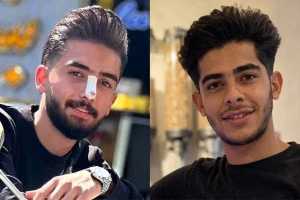
Matin Shabani and Amir Delshad were sentenced by Branch 5 of the Mashhad Revolutionary Court, presided over by Judge Hossein Yazdankhah, according to the US-based Human Rights Activists News Agency (HRANA).
An Iran International review of cases involving political charges found that approximately 220 prisoners are currently under sentence of death across Iran, up from around 194 previously reported.
Shabani was convicted of moharebeh, or "waging war against God", over allegations of arson and destruction of public property during protests in Shandiz, near Mashhad.
His case relates to demonstrations on January 8 and 9, during which a mosque and a Quranic education centre caught fire, according to a source cited by HRANA.
Shabani was arrested during those protests and later transferred to Vakilabad Prison. His death sentence had been communicated to him before Thursday's report, HRANA said.
Delshad was sentenced to death over alleged activities on behalf of an opposition group, as well as arson and destruction of public property during the protests, according to HRANA.
His case has been referred to Iran's Supreme Court following an appeal against the sentence. He remains in Vakilabad Prison.
Other protesters facing execution in Mashhad
In another case, Pouria Hosseini-Mofrad, 23, has appealed his death sentence to Iran's Supreme Court, HRANA reported.
Arrested on January 14, he was sentenced to death in August on national security-related charges. A source cited by HRANA said the allegations against him included breaking the glass of a bus stop and setting fire to shrubs.
HRANA also identified 34-year-old Vahid Khedrikhah as one of three protesters sentenced to death in a separate joint case.
Khedrikhah, Matin Farnian, 23, and a third defendant whose identity remains unknown were convicted of moharebeh by the same court.
Khedrikhah was wounded by gunfire during the January protests, according to a source cited by HRANA.
Five protesters already executed in Mashhad
At least five protesters arrested in connection with January's demonstrations in Mashhad have been executed at Vakilabad Prison this year.
Mehdi Rasouli, 25, Mohammadreza Miri, 21, and Ebrahim Dolatabadinejad were executed on May 3 over their alleged involvement in the protests.
Authorities accused Rasouli and Miri of involvement in the killing of a Basij paramilitary member, while Dolatabadinejad was accused of directing protesters and inciting unrest. Rights groups reported that the men had been subjected to torture and forced confessions.
Two others, Ali Hemmati Sistani and Majid Nikandish, 25, were executed on September 30 after being convicted of moharebeh.
Iran's judiciary accused them of involvement in protests in Mashhad's Tabarsi district on January 8 that allegedly resulted in the deaths of four security personnel.
Amnesty International said the men had been convicted following grossly unfair trials in which televised forced confessions were used as evidence.
According to Norway-based Iran Human Rights, at least 81 people were executed on political charges between January and the end of October, including 32 protesters.
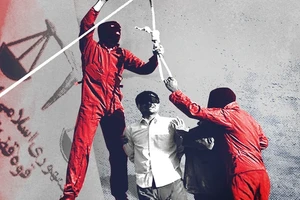
A photo illustration combining images of an execution scene in Iran and graffiti reading “ISIS beheads, the Islamic Republic hangs."
The US State Department on Thursday condemned Iran’s execution of three young men detained over January protests, highlighting their families’ suffering amid a broader campaign of executions that rights monitors say extends far beyond political cases.
In a post on its Persian-language account, USABehFarsi, the department said Iranian authorities had responded to young people’s peaceful demands with violence, closed trials and executions throughout the Islamic Republic’s 47-year rule.
“The Iranian people deserve justice, accountability for those responsible for these crimes, and a future free from terror and fear,” it said.
The post highlighted the suffering of prisoners’ families, citing three young men executed last month over their participation in the January 2026 protests.
“Three young lives unjustly taken. Three families torn apart,” it said.
The men were Alireza Raeisi, 21, and Alireza Sepahi, 24, who were executed on October 5 after what the department described as closed trials based on forced confessions, and taekwondo athlete Siavash Jamshidi Kheirabadi, executed several days earlier.
Raeisi was arrested just hours after his cousin was killed during the demonstrations, according to the post. His father, who remains imprisoned, was taken blindfolded to his son’s secret funeral without being shown where his body was buried.
Sepahi, a university student, married his fiancée, Mahshad, in prison before his execution. She remains behind bars serving a five-year sentence, the department said. His mother was denied a final farewell.
Executions linked to the protests have continued since those cases. On November 3, authorities hanged Amirhossein Maleki and Amirhossein Ebrahimi in connection with the Alikhani Square protest case in Isfahan. The judiciary alleged that the men had been armed and said the Supreme Court had upheld their sentences.
They were among 12 defendants sentenced to death in the case, which stems from January 8 protests. Seven other defendants had already been executed since July 19, according to the Norway-based organization Iran Human Rights. A lawyer representing defendants disputed the official account, saying none had been formally charged with murder and the alleged killings had not been tried.
Human Rights Watch and the Abdorrahman Boroumand Center said in September that authorities were using rushed proceedings, torture-tainted confessions and public executions to instill fear and deter dissent. Their review found that 16 of 29 protest-related execution cases involved no allegation of killing.
An Iran International investigation in October showed Iran had executed nearly two people a week in political and security cases since the January protests, including over protest- and war-related accusations, while another 190 people faced death sentences.
At least 70 people were executed from January 7 to October 5. Human rights organizations and activists say the figures are minimum totals, covering only cases that have been reported and verified.
Of the 70 people executed, 35 were put to death in cases connected to the January protests, nine in cases linked to the 12-day and 40-day wars, and 26 in other political and security cases.
Young Iranians gathering in downtown Tehran on Halloween night, October 31, 2026
Even as Iran grapples with war, economic crisis and the threat of renewed US and Israeli attacks, its security forces are breaking up Halloween celebrations, closing cafes and detaining people for gathering in public.
Analysts say the crackdown on everyday freedoms, alongside the continued execution of protesters, serves several purposes: intimidating a discontented population, reassuring loyalists and demonstrating that the authorities remain firmly in control.
"I think they feel cornered and they feel threatened by the impending military conflict with the US and Israel," Shahin Milani, executive director of the Iran Human Rights Documentation Center, told Iran International.
"They just want to tell the population that we're staying here, we're not going to go anywhere."
On October 30, Basij paramilitary forces and plainclothes security personnel broke up Halloween celebrations on Tehran's Iranshahr Street, beating and detaining people and forcing nearby cafes to close, witnesses told Iran International.
Families spending the evening at nearby Artists Park were also ordered to leave.
The crackdown extended to other cities, where authorities shut down businesses and initiated legal proceedings against organisers of Halloween celebrations.
Social control as a means of survival
Roya Boroumand, executive director of the Abdorrahman Boroumand Center for Human Rights in Iran, said the repression reflects a longstanding feature of the Islamic Republic rather than a new wartime strategy.
She pointed to the years following the 1979 revolution, when authorities targeted cinemas, alcohol sales and women who refused compulsory veiling, even as Iran faced war with Iraq.
"They focused on these issues because this is how they keep people in their place," she told Iran International.
Omid Memarian, an Iran analyst with DAWN, said sweeping social changes in recent years have unsettled the government's conservative base, prompting hardline institutions to enforce restrictions that reassure their supporters.
"These performative acts, which might cost some Iranian citizens their time and their life and their freedoms, [are] designed to satisfy the base, the very hardline base that has been supporting the government over the past seven months," Memarian said.
He distinguished between the civilian government and powerful hardline institutions, including the judiciary, which continue to enforce ideological restrictions.
No respite from executions
The policing of social freedoms comes alongside an escalating campaign of executions following January's nationwide anti-government uprising.
On November 3, Iranian authorities executed Amirhossein Maleki and Amirhossein Ebrahimi, both 19, at Isfahan Central Prison.
Iran Human Rights said the executions brought to nine the number of defendants put to death in the Alikhani Square case, which has been marred by allegations of torture, forced confessions and serious violations of due process.
Three other defendants remain at grave risk of execution.
At least 36 protesters have been executed in connection with the January uprising since March, according to Iran Human Rights.
"They want to intimidate people and just send the message that nothing is going to change and that they're not going to give up an inch," Milani said.
Boroumand argued that international attention to military developments has given the authorities greater room to pursue repression.
"Of course, that's why they are executing so many political prisoners and protesters, because the world is focused on fuel prices and the Strait of Hormuz," she said.
But Boroumand stressed that repression is an existential issue for the Islamic Republic, regardless of whether the country is at war.
A show of strength with limits
Milani cautioned against assuming that every restriction reflects a coordinated national strategy.
"Just because the regime is dictatorial and authoritarian doesn't necessarily mean that it is efficient, even in repression," he said.
Decisions can be arbitrary, he explained, with local officials sometimes imposing restrictions independently of senior authorities.
Memarian said hardline institutions are attempting to demonstrate strength at a time when the government faces unprecedented external pressure.
But he questioned whether they could reverse the social changes that have already taken place, arguing that enforcing restrictions on the scale seen in previous decades has become increasingly difficult.
Milani pointed out that intimidation continues to have devastating consequences for families. Many who have lost children or have loved ones imprisoned may remain silent out of fear that speaking publicly could endanger other loved ones.
Boroumand warned that the consequences of January's crackdown must not disappear from international attention as the war dominates headlines.
"The war is very important, but it should not overshadow the massive and unprecedented killings of January and the repression that Iranians have been experiencing since," she said.
She also pointed to the continuing arrests of lawyers and the difficulties protesters face in securing legal representation.
For the Islamic Republic, repression remains a means of asserting authority. But while it can intimidate citizens into silence, whether it can reverse the social changes that have transformed Iranian society is another matter.
A Revolutionary Court in Tehran has sentenced social media activist Amirhossein Mousavi to death on charges of "corruption on earth" over his activity on X, his lawyer said Wednesday.
In a post on X, Mousavi's lawyer, Reza Shafakhah, said his client had been sentenced over his online activity under the account name "James Bidin."
The sentence was issued by Branch 15 of Tehran's Revolutionary Court, presided over by Judge Abolghasem Salavati, who is under US, British and European Union sanctions over his role in human rights abuses.
Mousavi, 42, who has been detained since December 2024, was also sentenced to five years in prison for "insulting religious sanctities," his sister said on X.
His sister, Saeideh Mousavi, condemned the ruling and called for it to be overturned.
"We condemn this unjust sentence and demand its reversal and that Amirhossein's life be saved," she wrote.
She said her brother had used his online presence to amplify the voices of political prisoners and families of people killed during protests in Iran.
"His only crime was writing about and highlighting the suffering of people whose voices were rarely heard," she wrote, adding: "Writing about people's suffering is not a crime!"
The death sentence also prompted messages of support from other X users, some of whom echoed his sister's appeal.
"He was our voice for years. Now it's our turn to be his," one user wrote.
Another warned that the ruling could have wider implications for Iranians expressing their views online.
"Today, Amirhossein Mousavi was sentenced. Tomorrow, it could be you or me," the user wrote. "We must speak up for him before it's too late."
Mousavi had also received support from families of slain protesters before Wednesday's verdict.
Shabnam Eskandari, whose brother Mohammadreza Eskandari was killed during the 2022 Woman, Life, Freedom protests in Pakdasht, near Tehran, praised Mousavi for helping bereaved families keep the memories of their loved ones alive.
In an October 10 post on X, Eskandari recalled how Mousavi had repeatedly shared posts about her brother and other slain protesters.
"It was James Bidin who constantly shared posts from our families' accounts and repeatedly wrote the names of our loved ones," she wrote.
Solitary confinement, televised confession
Mousavi was arrested on December 18, 2024, at Tehran's Mehrabad Airport while preparing to travel to the southern Iranian island of Kish, according to HRANA.
His lawyer previously said security agencies had monitored Mousavi's X account for nearly six months before identifying him through his activity on the platform.
His prosecution has drawn attention over allegations of prolonged solitary confinement, physical abuse and a televised confession that Mousavi subsequently said had been obtained through threats and coercion.
On October 6, 2025, Iranian state television aired footage of Mousavi during its 20:30 news programme, presenting statements linking him to alleged intelligence activities involving Israel.
Mousavi later rejected the allegations in a letter from Evin Prison, saying interrogators had forced him to participate in the televised interview after months of physical and psychological pressure.
He said he had spent 148 days in solitary confinement, been subjected to beatings and faced threats involving his wife, who had also been arrested.
According to Mousavi, interrogators threatened to detain her again unless he agreed to the interview.
He said his statements had been made under pressure and at the prompting of interrogators, and that state television had selectively edited and distorted his remarks before broadcasting them.
Mousavi also denied supplying Israel with information about sensitive military facilities or maintaining contact with agents of Mossad, Israel's intelligence agency, saying he had never had access to classified information.
Iranian state television has a long history of broadcasting confessions by detainees accused of espionage, national security offences and involvement in anti-government protests.
Human rights organisations have repeatedly criticised the practice, warning that confessions obtained under duress have been used in criminal proceedings, including cases resulting in death sentences.
Hundreds under death sentence
Mousavi's sentence comes amid growing concern over Iran's use of capital punishment against political prisoners and people detained during nationwide anti-government protests in January 2026.
Although Mousavi was arrested before those demonstrations, his case comes as Iranian courts continue to issue death sentences against protesters and other defendants accused of political and national security offences.
An Iran International review of cases involving political charges indicates that approximately 220 prisoners are currently under sentence of death, up from around 194 recorded in early October.
Iran Human Rights, a Norway-based rights organisation, reported Tuesday that at least 691 people had been executed in Iran during the first 10 months of 2026.
Of those, 81 were executed on security-related charges, a category that includes political prisoners, protesters, people accused of espionage and other defendants.
The organisation said 36 protesters were among those executed during the period, including 34 arrested in connection with the January uprising and two associated with the 2022 Woman, Life, Freedom protests.
Iran executed at least 77 people in October, bringing the total recorded this year to 691, including 36 protesters, Norway-based Iran Human Rights (IHRNGO) said on Tuesday.
The group's latest report also documented three cases in which men were executed for deaths it said were caused or provoked by police violence, with evidence of misconduct allegedly ignored or concealed by authorities.
The findings come amid continued executions linked to Iran's December-January nationwide protests, including the hanging of two more men on Tuesday.
Protesters among those executed
According to IHRNGO, 39 people were executed for murder in October, 31 for drug-related offenses, six on national security charges and one for rape.
The six security-related executions included three protesters arrested in connection with January's demonstrations, two political prisoners affiliated with banned opposition groups and an Iraqi national convicted of espionage for Saudi Arabia.
The group said only 13 of October's 77 executions were publicly announced by Iranian authorities. It verified the remaining 64 through independent sources.
From January through October, IHRNGO recorded 691 executions, including 36 protesters, 15 political prisoners affiliated with banned opposition groups and 17 people accused of espionage or collaboration with foreign governments.
The total also included 23 women, 28 foreign nationals and three men who were under 18 at the time of their alleged offenses.
The organization said it had received reports of more than 500 additional executions that remained unverified and were therefore excluded from its figures.
Rights group alleges police violence was concealed
The report identified three men executed between September 30 and October 12 after being convicted of killing police officers, despite evidence that IHRNGO said pointed to police misconduct.
Jaber Khosravi, 43, was executed in Damghan Prison on September 30 following an incident in which a police officer was fatally shot.
According to IHRNGO, Khosravi was experiencing a severe psychiatric episode when officers assaulted him during an emergency hospital response. The group said he discharged a firearm unintentionally, killing an officer, but medical records documenting his condition were disregarded.
Danial Jahanian, 37, was hanged in Bandar Abbas on October 11 over the death of a police officer in a traffic collision.
IHRNGO said forensic evidence and court documents indicated that plainclothes officers shot Jahanian in both legs, causing him to lose consciousness before the collision. The organization also alleged that authorities concealed evidence suggesting another vehicle had fatally injured the officer.
Abolhassan Ranjbar, a 39-year-old Baluch man, was executed in Minab on October 12. The rights group disputed the authorities' account of a deliberate vehicular attack, saying the fatal collision followed a confrontation initiated by police.
"The Islamic Republic uses the death penalty not only to silence dissent, but also to cover up abuses by its own security forces," said Mahmood Amiry-Moghaddam, director of Iran Human Rights.
He accused Iranian authorities of systematically denying defendants fair trials and due process.
Two more men executed over January protests
The report coincided with the executions of Amirhossein Maleki and Amirhossein Ebrahimi, who were hanged on Tuesday in connection with January's protests in Isfahan.
Iran's judiciary-linked Mizan news agency alleged that the men had been armed and said the Supreme Court had upheld their death sentences.
They were among 12 defendants sentenced to death in a case stemming from protests at Alikhani Square on January 8, when authorities accused protesters of involvement in the deaths of four security personnel and other offenses.
Seven other defendants in the case had already been executed since July 19, according to Iran Human Rights.
A lawyer representing defendants has disputed the official account, saying none had been formally charged with murder and the alleged killings had not been tried.
The two executions announced Tuesday were not included in IHRNGO's October figures.
UN raises concerns over mass trials
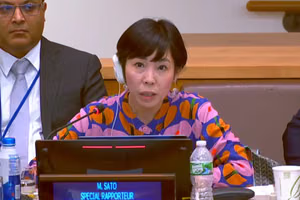
The latest findings follow warnings from UN Special Rapporteur on Iran Mai Sato, who told the UN General Assembly on October 28 that at least 34 people had been executed in connection with January's nationwide protests.
Sato described mass trials in which dozens of defendants faced proceedings lasting only days, raising concerns about whether individual criminal responsibility had been established.
In one case, she said, 34 defendants were tried over five days, with 12 sentenced to death.
The UN's Independent International Fact-Finding Mission concluded that the suppression of January's protests amounted to crimes against humanity.
Iran rejected the UN findings, describing the investigative mechanisms as politically motivated and illegitimate.
Rights groups have repeatedly raised concerns about Iran's use of broadly defined national security offenses, restricted access to lawyers and convictions based on alleged forced confessions.
IHRNGO warned that the true number of executions could be substantially higher than the cases it has independently verified.