• العربية
  • فارسی
BrandBrand
  • Iran Insight
  • Politics
  • Economy
  • Analysis
  • Special Report
  • Opinion
  • Podcast
  • Live TV
  • Iran Insight
  • Politics
  • Economy
  • Analysis
  • Special Report
  • Opinion
  • Podcast
  • Live TV
  • Theme
  • Language
    • العربية
    • فارسی
  • Iran Insight
  • Politics
  • Economy
  • Analysis
  • Special Report
  • Opinion
  • Podcast
  • Live TV
All rights reserved for Volant Media UK Limited
volant media logo

Iran develops new ballistic missile variants, US think tanks say

Nov 25, 2026, 10:04 GMT+0
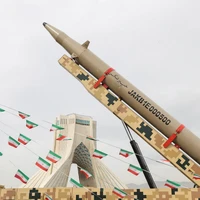
Iranian Fattah missiles are displayed during a military parade marking Sacred Defense Week in Tehran in September 2023.

Iran appears to be developing new ballistic missile variants designed to improve its ability to strike targets and evade air defenses, even as its capacity for mass production remains unclear, two US think tanks said on Tuesday.

The Revolutionary Guards have developed hybrid variants combining components from several existing ballistic missiles, according to a joint report by the Institute for the Study of War (ISW) and the Critical Threats Project (CTP) at the American Enterprise Institute.

Iran has previously used several of the missiles involved in attacks on Israel and US military assets in the region.

Recent footage released by the Revolutionary Guards showing underground missile facilities suggests Iran has continued manufacturing the new variants, the report said.

Satellite imagery showed extensive construction near Iranian missile bases and reconstruction of military facilities damaged by US and Israeli strikes, the BBC reported on November 6.

Russia has also agreed to supply Iran with 90 launchers for advanced guided missiles despite its own military needs in Ukraine, the Financial Times reported on November 5, citing expanding military cooperation between the two countries.

Possible use of cluster munitions

Media affiliated with the Revolutionary Guards suggested on November 23 that Iran could equip one of its new missile variants with cluster munitions, the two think tanks said.

Iran has previously used cluster munition warheads in missile attacks on Israel and US forces in the region, including a September strike on Muwaffaq Salti Air Base in Jordan, added the report.

The extent of Iran's missile stockpiles and its capacity for mass production remain unclear following extensive US and Israeli strikes on missile bases and manufacturing facilities earlier this year, the report said.

Despite extensive damage to its military industry, Iran retains at least 1,700 ballistic missiles and is producing around 50 new missiles a month, Bloomberg reported on November 10.

Any settlement with Iran must address its ballistic missile program and support for regional proxy groups alongside its nuclear program and the Strait of Hormuz, the French foreign ministry said on November 16.

  • Tehran claims its missiles can reach Europe. What has it shown?

    Tehran claims its missiles can reach Europe. What has it shown?

  • Iran's Revolutionary Guards unveil new underground missile site

    Iran's Revolutionary Guards unveil new underground missile site

  • Iran presses ahead with military, nuclear rebuilding despite economic woes

    Iran presses ahead with military, nuclear rebuilding despite economic woes

Most Viewed

Flogging of Iranian singer Parastoo Ahmadi sparks outrage on social media
1

Flogging of Iranian singer Parastoo Ahmadi sparks outrage on social media

2
VOICES FROM IRAN

Deadly poisonings fuel anger over Iran's alcohol ban

3

Iran’s rial falls past 2.85 million to the dollar

4
ANALYSIS

Tehran claims its missiles can reach Europe. What has it shown?

5

Iranian media walk back tanker convoy claims after days of blockade-breaking hype

Banner
Banner
Banner
Banner
Banner
Banner
Banner

Spotlight

  • Persian Gulf oil exports near prewar levels despite Hormuz attacks
    INSIGHT

    Persian Gulf oil exports near prewar levels despite Hormuz attacks

  • Iran faces year-end cash squeeze if US blockade holds
    INSIGHT

    Iran faces year-end cash squeeze if US blockade holds

  • A broken leg and broken trust: Violence in Iran’s schools
    VOICES FROM IRAN

    A broken leg and broken trust: Violence in Iran’s schools

  • Iranian media walk back tanker convoy claims after days of blockade-breaking hype

    Iranian media walk back tanker convoy claims after days of blockade-breaking hype

  • Iraqi forces enter Iran-backed militia stronghold, but who holds power?
    ANALYSIS

    Iraqi forces enter Iran-backed militia stronghold, but who holds power?

  • Tehran claims its missiles can reach Europe. What has it shown?
    ANALYSIS

    Tehran claims its missiles can reach Europe. What has it shown?

  • New video reveals where Iran clerics chose Mojtaba Khamenei as supreme leader
    INSIGHT

    New video reveals where Iran clerics chose Mojtaba Khamenei as supreme leader

  • Iran's housing crisis keeps divorced couples under one roof

    Iran's housing crisis keeps divorced couples under one roof

  • 'Happy Ending' pushes the limits of Iran's underground cinema

    'Happy Ending' pushes the limits of Iran's underground cinema

  • Power cuts return across Iran, threatening over one million jobs
    VOICES FROM IRAN

    Power cuts return across Iran, threatening over one million jobs

  • Inside Iran's online gun market, where a few messages can start a deal

    Inside Iran's online gun market, where a few messages can start a deal

  • ‘The city smelled of blood’: Witness recalls Iran protest crackdown

    ‘The city smelled of blood’: Witness recalls Iran protest crackdown

•
•
•

More Stories

Persian Gulf oil exports near prewar levels despite Hormuz attacks

Nov 24, 2026, 23:04 GMT+0
•
Negar Mojtahedi
100%
Workers aboard the Indian-flagged tanker Desh Garima as it unloads crude oil at a terminal in Mumbai, India, after passing through the Strait of Hormuz, April 30, 2026. (Reuters)

Oil exports from Persian Gulf producers outside Iran have nearly returned to prewar levels despite attacks on shipping in the Strait of Hormuz, with Saudi Arabia and the United Arab Emirates surpassing their prewar crude and condensate export volumes, Kpler data show.

Across the Persian Gulf, producers outside Iran had nearly restored prewar export volumes, helped by the diversion of oil through pipelines.

Their combined exports averaged just under 14 million barrels a day in September and October, compared with 14 million before the war. Kuwait and Qatar remained below their prewar levels, Homayoun Falakshahi, head of crude oil analysis at Kpler, told Iran International.

The recovery contrasts with the sharp decline in Iran’s own oil exports, with the US naval blockade effectively halting its main crude trade with China, according to maritime sanctions expert Charlie Brown.

“We see the market pay more attention to fundamentals now than to headlines,” Falakshahi said.

Why November’s figures could rise

Kpler’s preliminary November estimate fell to about 12 million barrels a day. Falakshahi said tracking data for the most recent seven to 10 days tend to undercount shipments, meaning the November figure could be revised upward.

One reason is that more ships are crossing Hormuz with their tracking signals switched off, said Iman Nasseri, senior vice president for the Middle East and Asia at FGE NexantECA.

“Traffic might not have necessarily dropped but the behavior of the vessels and ship owners have changed,” Nasseri told Iran International.

Tracking firms can identify additional cargoes later, including when oil is loaded onto other vessels outside the strait. Nasseri said estimates for the first half of November had already been revised upward by more than 3 million barrels a day. He said he expected further revisions in December as more cargoes were identified.

Crude is in surplus while fuel supplies remain tight

Energy analysts who spoke to Iran International estimated that the global crude market was already in surplus by roughly 1 million to 2 million barrels a day in the fourth quarter.

Falakshahi said the global crude surplus could average around 2 million barrels a day in 2027 if export flows hold up. Without a fresh escalation, he saw little room for crude prices to rise.

Nasseri estimated that around 12 million barrels a day of oil had continued to flow through Hormuz since September, including roughly 10 million barrels a day of crude.

Refined product exports through the strait were running at about 1.5 million to 2 million barrels a day, down from around 5 million before the war.

Lower product exports and weaker refinery activity have kept diesel and jet fuel prices above prewar levels, he said.

Tehran threatens tighter restrictions

Iranian army chief Amir Hatami ordered tighter restrictions on shipping through Hormuz until Washington meets Tehran’s demands.

He warned that renewed US strikes would draw a more severe response that could extend beyond the region. Parliament Speaker Mohammad Bagher Ghalibaf also said Tehran was prepared to use military means to break the blockade.

Mohsen Rezaei, secretary of Iran’s Supreme National Security Council, said Tuesday that Tehran was determined to break the US naval blockade and would respond with full force to any renewed attack. In a post on X, he called the Trump administration’s blockade plans “delusional and futile.”

The warnings followed remarks by US President Donald Trump on Sunday that strikes could resume after the new year if no deal was reached. Trump also warned that Iranian vessels attempting to breach the blockade would be sunk.

The United Kingdom Maritime Trade Operations (UKMTO) said Tuesday that three vessels had been struck by unidentified projectiles while sailing east through the Strait of Hormuz on Monday. All three continued their journeys, and all crew members were accounted for.

The Islamic Revolutionary Guard Corps (IRGC) separately claimed three tankers caught fire after hitting mines despite US protection. The Joint Maritime Information Center said claims of tankers hitting mines were unconfirmed.

How Gulf exporters kept oil moving

The UAE was among the first countries to coordinate tanker convoys with the United States, Falakshahi said.

Charlie Brown, a senior adviser to United Against Nuclear Iran who focuses on maritime sanctions enforcement and illicit shipping, said Persian Gulf countries found shipowners willing to sail and took on some of the insurance risk themselves. US military support helped vessels get through, he said.

Crews still face the risk of attack. TradeWinds reported at least 64 strikes on ships near Hormuz since the end of September, with vessels operated by Sinokor, ADNOC Logistics & Services and Kuwait Oil Tanker Company among those most frequently targeted.

Iran’s crude exports remain squeezed

Falakshahi said Kpler was seeing no new Iranian crude or condensate exports. Some Iranian oil was already outside the blockade zone, while smaller shipments of refined products, liquefied petroleum gas (LPG) and petrochemicals continued to get through. He estimated those shipments at 120,000 to 150,000 barrels a day in recent months, down from around 800,000 before the war.

Falakshahi also disputed reports that a tanker carrying Iranian oil had breached the blockade, saying the purported ship’s tracking signal had been fabricated. He said satellite imagery showed a group of ships but gave him no evidence that they were moving through the blockade as a flotilla.

Iranian state media and officials later walked back reports of an imminent convoy operation. TankerTrackers said one of the purported vessels, called Line Breaker, did not exist.

Brown said the blockade had halted Iran’s main crude trade from Kharg Island to China. Other Persian Gulf exporters have found ways to keep shipping, he said, and the crews making those voyages are still putting their lives at risk.

“The real unsung heroes, even more so, are the seafarers themselves,” Brown said.

A broken leg and broken trust: Violence in Iran’s schools

Nov 24, 2026, 18:06 GMT+0
•
Farnoosh Faraji, Hooman Abedi
100%
A young schoolboy covers his face as he cries in a classroom in Iran.

His homework was unfinished. His teacher broke his leg and threatened to beat him again if he told his father. The story of an eight-year-old Iranian schoolboy has stirred anguish among parents and revived painful childhood memories.

Siavash Madadi should be spending his days learning to read and write, running around the schoolyard and playing with children his own age. Instead, the second-grade student from a village in Lorestan province, in western Iran, is lying in a hospital bed with a severe fracture to his right leg.

In a video sent to Iran International, the boy explains why his teacher hit him. He simply had not finished his schoolwork.

But the punishment did not end with the blow. The teacher warned him against turning to the very person a child should be able to turn to when someone hurts them: his father, according to information obtained by Iran International.

100%
Eight-year-old Siavash Madadi lies in a hospital bed alongside an X-ray showing the severe fracture to his right leg after his teacher beat him for failing to complete his homework.

Among those who responded to the report, there was disbelief at what the boy had endured.

“How could a child with a broken leg go home without his family noticing that he had been injured?” one person asked.

Some thought of their own children. Others remembered being children themselves, at the mercy of adults they had been taught to respect.

  • Iranian families say rising security pressure is eroding trust in schools

    Iranian families say rising security pressure is eroding trust in schools

“Wasn’t school supposed to be the second-safest place for children?” another person wrote.

Hours after Iran International published the boy’s story, the public prosecutor of Lorestan province announced the teacher’s arrest and the opening of a criminal investigation.

But the announcement could not undo what had happened to the boy or erase the painful memories his story had brought back.

He is only eight

One parent who contacted Iran International had a son in second grade, just like Madadi. Another wondered whether the injured boy would be able to run and play again without difficulty.

For others, the boy’s story opened old wounds.

One person recalled how their younger brother had been beaten by his teacher on his very first day of second grade, leaving half his face bruised.

  • Three Iranian girls hospitalized after alleged beatings by school officials

    Three Iranian girls hospitalized after alleged beatings by school officials

Another remembered a middle school teacher who practiced karate techniques on students.

The children in those classrooms had grown older. The memories had not faded.

Among the messages was one from a high school teacher.

“Even when I am tired and angry, my respect and affection for my students do not diminish,” the teacher wrote.

  • Family source recounts Iranian girl's alleged killing by father

    Family source recounts Iranian girl's alleged killing by father

Iran’s independent teachers’ unions, whose leaders have faced arrest and prison, have long campaigned against violence in schools. Last week their coordinating council condemned a school in Kermanshah for handing 16-year-old Sogand Sayadi over to her father after she warned staff he would kill her.

The wounds no X-ray can show

Doctors can see where Madadi’s bone has broken. The other wounds that violence can leave on a child are harder to see.

  • New eyewitness accounts detail chaos at Tehran girls' school

    New eyewitness accounts detail chaos at Tehran girls' school

“Corporal punishment leads to poor academic performance, undermines children’s self-confidence and may even make them lose the desire to go to school,” Nahid Husseini, a London-based researcher specializing in women’s affairs and education, previously told Iran International.

Teachers opposed to corporal punishment should join parents in widespread protests against physical violence, humiliation and verbal abuse in schools, Husseini said.

“I would warn parents that if they do not take action, it could be their own child who suffers psychological and emotional harm tomorrow,” she added.

The consequences of corporal punishment can persist into adulthood, affecting children’s health, academic performance and social relationships, the World Health Organization said in an August 2025 report.

A protection that existed on paper

Article 81 of Iran’s school regulations, adopted in 2021, prohibits corporal punishment and mistreatment under any circumstances.

In December 2025, the education ministry issued a nationwide directive instructing school administrators to enforce the prohibition.

  • Religious rules and abuse in Iranian schools drive suicides, students say

    Religious rules and abuse in Iranian schools drive suicides, students say

Iran also passed a law in 2020 that makes harming a child a crime, after the killing of 14-year-old Romina Ashrafi by her father caused a national outcry. But Iran’s penal code still allows parents and guardians to physically discipline children within what it calls “customary limits,” a provision critics say leaves the line between discipline and abuse unclear.

Yet an eight-year-old ended up in a hospital bed because he had not finished his homework.

Several people questioned teachers’ psychological suitability and professional competence. Some criticized what they described as the prioritization of religious and political criteria in recruitment.

Applicants for teaching posts in Iran, like all state employees, must pass gozinesh, a vetting process that checks their religious practice and political loyalty to the Islamic Republic.

“Assess teachers’ mental health during recruitment,” one person wrote.

Others demanded the teacher’s dismissal and prosecution.

Madadi’s broken leg is being treated. His teacher is in custody. But an arrest alone cannot restore the trust of parents who send their children to school each morning believing they will be safe.

At eight years old, a child should know that when someone hurts him, he can turn to his parents. That he does not have to hide his pain. That telling his father is not something for which he will be punished.

It was Madadi’s own teacher who told him otherwise.

Flogging of Iranian singer Parastoo Ahmadi sparks outrage on social media

Nov 24, 2026, 03:47 GMT+0
100%
Iranian singer Parastoo Ahmadi performs alongside her band at the historic Deir-e Gachin Caravanserai near Qom, Iran, in December 2024.

The flogging of Iranian singer Parastoo Ahmadi and four members of her concert team on Monday sparked outrage on social media, with artists, activists and other users condemning the punishment and denouncing restrictions on women’s artistic expression in Iran.

Ahmadi, concert organizer Mohsen Lashkari and musicians Soheil Faghih-Nasiri, Amin Taheri and Amirali Pirnia each received 74 lashes at the prosecutor’s office in Qom, their lawyer Mostafa Nili said.

Women have been banned from singing solo in public in Iran since the 1979 Islamic Revolution.

Singer Mehdi Yarrahi, who himself received 74 lashes in March 2025 over a protest song challenging compulsory hijab, shared footage of Ahmadi’s performance on Instagram, expressing solidarity with her and her concert team.

Musician Hana Kamkar also condemned the punishment in an Instagram video, asking Islamic Republic officials what the artists had offered other than humanity, joy and beauty.

Ahmadi’s December 2024 concert was filmed at the historic Deir-e Gachin Caravanserai near Qom, a Shiite holy city and a center of religious conservatism in Iran.

Wearing a long, sleeveless black dress with her hair uncovered, Ahmadi sang alongside male musicians in a performance staged without a live audience. The virtual concert, which defied both mandatory hijab rules and restrictions on women singing publicly, has drawn more than 3.2 million views on YouTube.

Activist Zeinab Zaman highlighted the contrast between the virtual performance and the physical punishment inflicted on the singer.

“Her concert was virtual, but the lash on her body was real,” Zaman wrote on X. “We are recording act after act of courage and shame upon shame in this history. Bodies are eyewitnesses.”

The flogging also reignited accusations of double standards in the Islamic Republic’s treatment of female singers.

In April, as Iran was at war with the United States and Israel, footage of Lebanese singer Julia Boutros was screened at nighttime gatherings of government supporters in Tehran’s Ferdows Garden. Boutros is known for her songs in support of the Lebanese resistance.

Translator Emily Amraee recalled the gatherings in a post on X, noting that the authorities had “enthusiastically” broadcast the Lebanese singer’s performances over several consecutive nights, only to flog an Iranian woman for singing months later.

Others questioned the government’s priorities amid a conflict it has portrayed as a threat to its very existence.

“If possible, in the midst of what you yourselves call an ‘existential’ war, refrain from flogging the daughters of this country. Is that so difficult for you?” Mojtaba Najafi wrote on X.

Mahmood Amiry-Moghaddam, director of Norway-based Iran Human Rights, pointed to the government’s failure to address the country’s economic and infrastructure crises while continuing to punish women for defying its restrictions.

“She sang; the Islamic Republic responded with the lash,” he wrote on X.

“A government that is incapable of resolving the crises of livelihoods, water and electricity, yet does not hesitate to flog a woman for her voice, has reached the end of its life.”

The communications office of Iran’s exiled Crown Prince Reza Pahlavi condemned the flogging in a statement on X, describing it as an attempt to humiliate and suppress the artists and accusing the Islamic Republic of fearing women’s voices.

“The virtual concert staged by Parastoo Ahmadi, a young artist, two years ago and livestreamed on social media remains a lasting symbol of the voices of Iranian women who cannot be silenced,” the statement said.

“Before 1979, Iran was a cradle of art and music and women were pioneers in these fields. Today, however, the regime flogs courage and beauty,” it added.

The statement said the Islamic Republic would soon fall and that women would once again play a prominent role in Iran’s artistic, social, economic and political life.

Ahmadi and the four members of her concert team were convicted of offending public decency by producing and publishing what the court deemed vulgar and immoral content online.

An appeals court upheld their sentences in September, including two-year bans on artistic and musical activities and foreign travel.

Amnesty International had previously called on Iranian authorities to halt the flogging sentences, describing flogging as torture and urging an end to compulsory hijab and corporal punishment.

Tehran claims its missiles can reach Europe. What has it shown?

Nov 24, 2026, 00:59 GMT+0
•
Negar Mojtahedi
100%
Iranian flags hang next to a missile on display during the forty-seventh anniversary of the Islamic Revolution in Tehran, Iran, February 11, 2026. Majid Asgaripour/WANA/Reuters

An Iranian lawmaker’s claim that Tehran’s missiles can now travel 4,500 kilometers and a front-page boast by Tehran daily Hamshahri that all of Europe is within reach have renewed questions about Iran’s ability to strike the continent.

Experts told Iran International the threat should be taken seriously, though Iran has yet to demonstrate that it can reliably hit targets at that distance.

Ahmad Bakhshayesh Ardestani, a member of Iran’s parliamentary National Security and Foreign Policy Committee, made the 4,500-kilometer claim on Monday without offering technical evidence.

Hamshahri, a newspaper run by Tehran’s municipality, touted a range of roughly 5,000 kilometers. The Islamic Revolutionary Guard Corps (IRGC) has said it lifted its self-imposed 2,000-kilometer limit but has given no details about whether longer-range missiles have been deployed.

100%

What the Diego Garcia launches showed

The clearest indication that Iran may have exceeded its old 2,000-kilometer limit came in March, when it reportedly fired two missiles toward Diego Garcia, a joint US-British military base in the Indian Ocean. One was intercepted and the other failed in flight.

Jim Lamson, a senior research associate at the James Martin Center for Nonproliferation Studies at Middlebury College, assessed that both were intermediate-range ballistic missiles, or IRBMs, capable of traveling at least 4,000 kilometers.

“It does show that Iran had developed at least prototypes of IRBMs, but their design and production status remain unclear,” Lamson said.

He said US and Israeli strikes damaged Iran’s missile development and production facilities, leaving it unclear whether Tehran could build more of those missiles in the near term.

Farzin Nadimi, a senior fellow at the Washington Institute for Near East Policy who specializes in Iran’s military capabilities and Persian Gulf security, said Iran could build on its existing missile technology to extend its reach.

He suspects the two missiles fired toward Diego Garcia may have been modified versions of the Khorramshahr-4, a medium-range missile with a declared range of about 2,000 kilometers. Their identity remains unconfirmed.

“So they were technically capable of reaching Diego Garcia,” Nadimi said, citing the flight paths of both missiles.

The reported launches suggest Tehran was willing to attempt a strike well beyond its old limit.

Nadimi said some parts of southeastern Europe are already within reach of Iran’s existing missiles. He estimated that a range of 4,000 to 4,500 kilometers could put much more of Europe within reach, potentially including Britain.

What Europe should prepare for

Simone Ledeen, who oversaw US defense policy for the Middle East as a deputy assistant secretary at the Pentagon, said the threat to Britain and Western Europe is emerging and called on European governments to invest in missile defense now.

“European governments should plan for the capability arriving rather than wait for proof of it,” Ledeen said.

She said the most immediate danger comes from missiles that can already reach US forces and allies in the Middle East.

Reaching the continental United States would require a missile with substantially greater range. Ledeen and Nadimi said Iran’s space program provides some of the technology relevant to developing an intercontinental ballistic missile, a capability that would require further development and testing.

Why Tehran is making the threat now

Tehran’s latest missile claims came a day after US President Donald Trump told Fox News he was inclined to resume strikes on Iran after the new year if no deal was reached.

Kerri Bitsoff, a former senior US Treasury official who helped impose sanctions on networks supplying Iran’s missile and drone programs, said Tehran is using its longer-range missile claims to pressure Washington and its allies to back away from further military action and to turn public opinion against the war.

Bitsoff said Iran’s ability to rebuild and resupply its missile program is under strain. In her view, publicizing a longer range gives Tehran a way to exert pressure while its ability to field those missiles remains uncertain.

“I read it as once again, the regime looking for leverage,” Bitsoff said.

Deadly poisonings fuel anger over Iran's alcohol ban

Nov 23, 2026, 12:30 GMT+0
100%
A healthcare worker tends to a patient receiving respiratory support in an intensive care unit at a hospital in Iran.

The poisoning of around 150 people and deaths of at least five from adulterated drinks have sparked widespread criticism of Iran's alcohol ban, with citizens blaming the policy for unsafe products and some accusing state institutions of distributing them.

At least five people have died after consuming counterfeit alcoholic drinks in Neyshabur, Shiraz and Marvdasht in recent days, according to official figures.

The number of people poisoned in Neyshabur reached 120, with four deaths, Milad Taqdisi Heydarian, acting deputy for treatment at Neyshabur University of Medical Sciences, said on November 22.

One patient was declared brain-dead and 11 others required intubation, according to the official figures.

Health officials in Shiraz also reported around 30 methanol poisoning cases in Shiraz and Marvdasht, leaving one person dead and four in intensive care.

Citizens blame prohibition for unsafe drinks

The poisonings prompted widespread reactions from Iran International's audience, with many arguing that the Islamic Republic's ban on alcohol production, sales and consumption has fueled an unregulated market.

  • Bootleg alcohol identified as top cause of deaths from poisoning in Iran

    Bootleg alcohol identified as top cause of deaths from poisoning in Iran

"Look at the result of prohibition. This is how they end up giving people poison," one citizen wrote.

Another criticized those who blamed the victims for drinking alcohol, questioning why Iran does not permit the sale of alcoholic drinks that meet international safety standards.

Several respondents argued that prohibition had failed to stop consumption while removing safeguards against dangerous products.

"People in our country drink alcohol. At least legalize it and regulate it. That would be better than the current situation," one citizen wrote.

"I don't drink, but its import and sale should be legalized," another said.

Fatal alcohol poisonings have repeatedly occurred in Iran. In December 2025, eight people died and one lost their sight after consuming contaminated drinks in separate cases in Iranshahr and Bampur.

Alcohol poisoning accounted for around five percent of 4,232 poisoning-related deaths during the first five months of the Iranian calendar year, according to a forensic medicine report published in October 2025.

Homemade and counterfeit alcoholic drinks were identified as major causes.

Revolutionary Guards accused of involvement

Some respondents accused institutions linked to the Islamic Republic, including the Revolutionary Guards, of distributing contaminated drinks.

"The Revolutionary Guards themselves distribute these counterfeit products," one citizen wrote.

Another described those supplying adulterated drinks as "system-affiliated sellers."

One respondent said methanol was advertised on Instagram as "90 percent corn alcohol" for 3000,000 rials per liter and accused the Revolutionary Guards of supplying it.

The actual number of alcohol poisoning cases could be [up to 10 times higher than emergency admission figures https, Deputy Health Minister Alireza Raisi said in October 2025, explaining that some victims avoid treatment because of fear or other reasons.

  • Who is behind the sale of lethal bootleg alcohol in Iran?

    Who is behind the sale of lethal bootleg alcohol in Iran?

Methanol poisoning can cause blindness, severe organ damage and death. Health officials in Neyshabur have yet to identify the substance responsible for the latest poisonings.

The deaths have renewed criticism of restrictions that citizens say leave consumers dependent on an unregulated market, with some demanding legalization and quality controls to prevent further fatalities.