Experts told Iran International that the deployment marked a significant step in the government’s efforts to rein in militias, but cautioned that a withdrawal of Kataib Hezbollah fighters would not necessarily end Tehran’s influence.
Mukhlad Hazem, a former security adviser to the Iraqi parliament’s leadership, described the deployment as a step no previous Iraqi prime minister had dared to take, but said it was too early to assess its success.
Ahmed al-Sharif, an Iraqi strategic affairs expert, said even if Kataib Hezbollah withdrew from Jurf al-Sakhar, it could relocate its fighters to another strategically important area.
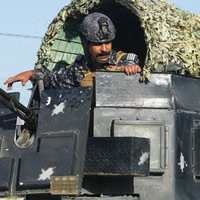
Iraqi Prime Minister Ali al-Zaidi announced on Friday the start of a drive to extend state authority across the country as army and federal police forces entered Jurf al-Sakhar, an area south of Baghdad that had been under the group’s control for 12 years.
“We have not entered a war. Everyone there is your brother,” Zaidi said in a video message to troops deployed in the area, officially known as Jurf al-Nasr.
Zaidi said his government sought to extend its authority throughout Iraq, combat corruption and end the presence of weapons outside state control.
Government forces entered without major clashes despite earlier threats by Kataib Hezbollah and mounting tensions with Baghdad.
However, subsequent reports indicated that Kataib Hezbollah fighters remained in the area even after government forces entered.
A deal to avert confrontation
The standoff escalated earlier this month after details of a confidential 19-page report on suspected oil smuggling in Jurf al-Sakhar appeared in Iraqi media on November 9.
Based on satellite imagery and an examination of oil transportation routes and tanker movements, the report identified suspicious activity near oil pipelines dating back to 2021.
Kataib Hezbollah denied allegations of involvement in illegal oil-related activities.
Zaidi ordered an investigation, but the dispute quickly widened into a confrontation over security control of the area.
Kataib Hezbollah defended its presence, saying it was necessary to prevent the resurgence of Islamic State and protect routes leading to the Shiite holy city of Karbala.
As tensions mounted, Esmail Qaani, commander of the Quds Force of the Islamic Revolutionary Guard Corps (IRGC), traveled to Baghdad for talks with Iraqi political leaders and armed groups.
Kataib Hezbollah confirmed on November 19 that its secretary-general, Abu Hussein al-Hamidawi, had met Qaani alongside Badr Organization leader Hadi al-Amiri and Popular Mobilization Forces (PMF) chairman Falih al-Fayyadh.
Iraqi media reported that Zaidi and Qaani had reached an understanding on the peaceful withdrawal of Kataib Hezbollah and its replacement by a joint security force.
Reuters also reported that Shiite political leaders had mediated a deal to avert an armed confrontation.
Under the arrangement, security responsibilities in Jurf al-Sakhar were divided among the army, federal police, energy police and units of the PMF.
Withdrawal or redeployment?
Sharif described Jurf al-Sakhar as one of Tehran’s key strongholds in its confrontation with the United States.
He said a gradual withdrawal could give Kataib Hezbollah time to await developments in negotiations between Tehran and Washington amid the risk of renewed escalation.
Sharif said Tehran opposed efforts to bring all weapons under Iraqi state control because doing so would deprive Iran of an important source of leverage in its dealings with Washington.
In his assessment, Tehran’s intervention was intended to prevent an armed confrontation between Iraqi government forces and Kataib Hezbollah while securing more time for the group to redeploy its fighters.
The US State Department said on November 18 that Washington expected the Iraqi government to hold Iran-aligned armed groups accountable for their violent and destabilizing activities.
Twelve years of displacement
Located in northern Babil province near the Euphrates River, Jurf al-Sakhar lies close to key routes connecting Baghdad with Anbar and Karbala provinces.
The predominantly Sunni Arab area was recaptured from Islamic State in October 2014 by Iraqi government forces and Shiite armed groups, including Kataib Hezbollah.
The group subsequently took control of security in the area, restricting access for displaced residents, journalists and many government officials.
More than 6,000 families have been displaced from Jurf al-Sakhar since 2014, according to Iraq’s Ministry of Migration and Displacement, with many still living elsewhere.
Hazem said Sunni political factions wanted the issue resolved and displaced families allowed to return.
He said the deployment of government forces and the establishment of an operations center had diminished Jurf al-Sakhar’s status as an area beyond the reach of state authorities.
Completing that process, however, would depend on bringing weapons exclusively under state control and addressing outstanding security and economic issues.
Hazem cautioned that Jurf al-Sakhar’s infrastructure had been severely damaged and that displaced residents would be unable to return without reconstruction.