Houthis threaten Saudi Red Sea ports if Hodeidah is struck
Iran-backed Houthis in Yemen threatened to target Saudi Red Sea ports if the Saudi-led coalition strikes the port of Hodeidah, its spokesman Yahya Saree said on Friday.
The threat followed a coalition warning urging civilians to evacuate the port area in western Yemen.
“If the enemy carries out its threats to bomb Hodeidah port, Jeddah port and all Saudi ports along the Red Sea coast will be targets for our forces,” he said.
He also warned airlines that Saudi airspace was unsafe and would be the scene of Houthi military operations in the coming hours. He said the warning did not include the airspace over Mecca and Medina.
Iran has sentenced Pouya Fakhrabadi, a 25-year-old national taekwondo champion, to death over a fire during January’s protests in the central city of Yazd, and a source told Iran International he was tortured into confessing.
Judge Mohammad Bemani, who heads Branch 2 of Yazd’s Revolutionary Court, issued the sentence in a joint case known as the “Yazd telecommunications” case, according to information received by Iran International and the rights group HRANA.
Three other men in the case, Mehdi Rajabi, Mohammad Kargar and Mohini Makki, were each sentenced to 20 years, to be served in internal exile in the prison of Zahedan, in Sistan and Baluchestan province, more than 800 kilometers away.
The charge announced was “taking part in setting fire to public property.” The details of the accusations against the men are not known, and it is not clear whether Fakhrabadi has appealed.
The case stems from protests on January 8 and 9, the days of the January massacre, when Imam Hossein Square in Yazd was one of the city’s main protest sites. The telecommunications building on the square and other government offices nearby, including one belonging to the Imam Khomeini Relief Committee, a state welfare foundation, caught fire.
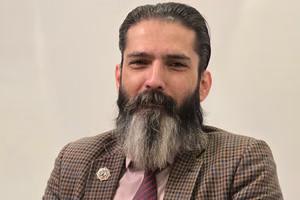
Pouya Fakhrabadi
‘They broke his head with a rifle butt’
Fakhrabadi, who holds a master’s degree in physical education, was arrested at his home in Yazd on February 20, a source familiar with the case told Iran International. Security agents broke his head with a rifle butt during the raid, leaving a wound that needed 20 stitches, the source said.
In solitary confinement he was severely beaten and tortured and lost about 30 kilograms, the source said. Agents forced him to confess by threatening to kill members of his family and to sexually abuse them. He was denied a lawyer throughout the case.
His sister, who saw the violence during his arrest, suffered severe panic attacks and could barely speak for months afterward, the source said.
Fakhrabadi is a champion in hanmadang, the taekwondo discipline of creative and power breaking. He won gold at the international Kukkiwon Cup, organized by the sport’s world headquarters in South Korea, and has won a national title, setting a new record.
The Yazd detainees
Of 28 people from the January protests held in Yazd prison, 15 have been sentenced to between three and 21 years, and 13 are still awaiting a verdict, HRANA reported on Tuesday.
In the months since the protests, Iran’s judiciary has handed down death sentences, prison terms, floggings and asset confiscations to many of those detained and to other political prisoners.
On Wednesday, the UN General Assembly’s human rights committee adopted a draft resolution condemning the crackdown on the January protests and calling for a halt to all executions, with a view to abolishing the death penalty.
A lawyer facing a wartime charge
In Isfahan, prosecutors have extended the detention of human rights lawyer Amirsalar Davoudi by 30 days and added a new charge, his lawyer, Mehdi Karimi Farsi, told the Emtedad news site.
Davoudi, who was sentenced in 2019 to 30 years in prison and 111 lashes over his work defending political prisoners, was arrested again on October 11. He already faced charges of “spreading falsehoods online,” “propaganda against the system” and “inciting people to war and killing each other to disrupt national security.” He now also faces “producing and spreading false news against national security in wartime.”
Moein Khazaeli, a lawyer, wrote on X that prosecutors brought the new charge under Article 4 of a law toughening penalties for espionage, passed after the June 2025 war. It carries 10 to 15 years in prison, he said, or death if the court treats it as “corruption on earth.” He said the law was being used to stop lawyers defending their clients.
Part of the case against Davoudi stems from a recording he posted on Instagram on October 4 of a wedding ceremony conducted by phone between two of his imprisoned clients, Mahshad Keshani and Alireza Sepahi Badjani. Sepahi Badjani was executed the next day.
Davoudi suffered a heart attack in solitary confinement on November 8 and was taken to Isfahan’s Al-Zahra hospital, Iran Human Rights reported. The next morning, he was taken to court to be charged. He has had no contact with his family since his arrest, his lawyer said, despite a court order on November 15 allowing calls.
UN human rights experts said on November 9 that Davoudi’s arrest was part of a campaign of pressure on independent lawyers, at least 135 of whom faced judicial or security action in Iran between September 2025 and September 2026.
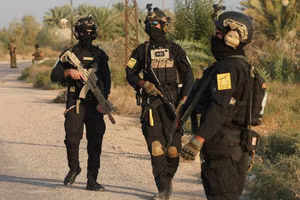
Members of the Iraqi police take part in a security deployment on the outskirts of Jurf al-Sakhar, Babil province, Iraq, November 20, 2026.
Iraqi forces began deploying on Friday in Jurf al-Sakhar, a town south of Baghdad held for more than a decade by Iran’s most powerful militia ally in Iraq, under a deal brokered by Shiite leaders days after the head of Iran’s Quds Force arrived in Baghdad.
A convoy flying Iraqi flags drove toward Jurf al-Sakhar on Friday, and hundreds of soldiers took up positions on the outskirts.
The yellow flags of Kataib Hezbollah were still flying farther inside the town, and none of the group’s fighters were visible. A security headquarters is due to open on Saturday to oversee the handover, with a unit assigned to protect energy facilities.
Under the deal, Kataib Hezbollah fighters are to withdraw to other parts of Iraq, Reuters reported, citing security officials. Al Arabiya, citing sources, said the withdrawal would be phased over a month. A joint command of the army, federal police, energy police and units of the Popular Mobilization Forces is taking over the town.
The standoff began on Monday, when Prime Minister Ali al-Zaidi ordered troops to prepare to enter Jurf al-Sakhar after an investigation accused Kataib Hezbollah of running a network that siphoned off hundreds of millions of dollars’ worth of state oil through tampered pipelines.
Nine senior security and oil officials were dismissed, and arrests linked to the case raised fears of an armed confrontation. The group denies the accusations and had warned it would resist any attempt to enter the town.
The same day, Esmail Qaani, commander of the Revolutionary Guards’ Quds Force, which runs Iran’s network of allied armed groups abroad, arrived in Baghdad to help defuse the crisis, Iraqi Shiite political sources told Reuters. Kataib Hezbollah said its leader, Abu Hussein al-Hamidawi, met Qaani and Hadi al-Amiri, head of the Iran-backed Badr Organization, in the talks that led to the deal.
A town nobody could enter
Jurf al-Sakhar, a Sunni farming town on the Euphrates about 50 kilometers south of Baghdad, was retaken from Islamic State in 2014 by the army and Shiite militias, Kataib Hezbollah among them. Its residents were never allowed back. More than 100,000 people from the town and surrounding villages remain displaced, Shafaq News reported, and even government officials have rarely been let in.
The town sits near the roads linking Baghdad with Karbala and Anbar province, and has served as a financial hub for evading sanctions on Iran, said Omar Mohammed, an Iraqi historian known for documenting life under Islamic State as Mosul Eye. He called the move “a theatrical show.”
“I think maybe the Iranian-backed militias will allow them some cosmetic gains, but there’s no way that Iran is going to allow its footprint in Iraq to disappear,” David Patrikarakos, a journalist and author of a book on Iran’s nuclear program, told Iran International earlier this week.
Iran’s strongest arm in Iraq
Kataib Hezbollah was founded after the 2003 US-led invasion of Iraq by Abu Mahdi al-Muhandis, who was killed alongside Quds Force commander Qassem Soleimani in a US drone strike at Baghdad airport in January 2020. Washington designated it a terrorist organization in 2009 and blamed it for a January 2024 drone attack that killed three US soldiers at a base in Jordan.
It is among the most influential members of the Islamic Resistance in Iraq, an umbrella of Iran-backed factions that has claimed more than 150 attacks on US forces since the Gaza war began in 2023, and more recently on US troops in the Persian Gulf states.
The militias report directly to Iran’s Revolutionary Guards. Their arsenals include anti-tank guided missiles, precision-guided rockets, armed drones and some short-range ballistic and cruise missiles, according to Iraqi security officials.
Kataib Hezbollah has thousands of fighters and no announced leadership structure. It forms several battalions of the Popular Mobilization Forces, an umbrella of mostly Shiite armed factions set up in 2014 to fight Islamic State and later made an official state force.
Its fighters draw state salaries, and some of its members designated as terrorists by the United States hold senior posts in the PMF. It also has a political party, Huquq, with five lawmakers, and business interests in construction, housing, trade and currency exchange, according to an Iraqi official report. The group denies these.
Since the United States and Israel went to war with Iran on February 28, Iraqi militias have struck US troops and facilities in Saudi Arabia and the United Arab Emirates. President Donald Trump has pressed Zaidi to disarm them, and the factions have refused to hand over their weapons.
Members of the Iraqi police take part in a security deployment on the outskirts of Jurf al-Sakhar, Babil province, Iraq, November 20, 2026.
A risky test for Baghdad
Moving against the militias carries a price. In November 2021, after then-Prime Minister Mustafa al-Kadhimi ordered a crackdown, his Baghdad home was hit by an armed drone in what officials called an assassination attempt.
In August, Iraqi special forces arrested the intelligence chief of another Iran-aligned faction, Harakat al-Nujaba, over drone attacks on US targets. He was released 48 hours later after threats of retaliation and the intervention of senior Shiite politicians.
Iraq is also tied to Iran in ways that a single town cannot change. It imports Iranian gas and electricity, and the militias’ access to dollars and to trade has made Iraq one of Iran’s main routes around sanctions. The US Treasury barred 14 Iraqi banks from dollar transactions in 2023 over suspected links to Iran, and in 2025 it sanctioned a businessman accused of smuggling Iranian oil disguised as Iraqi crude.
John Craig, a former US ambassador, called Baghdad’s move “about 10 years overdue.” Whether Zaidi can do more, he said, would show how serious he is.
A screenshot from the debate between Shahram Ettefagh and Jafar Shiralinia, published by Azad on November 18, 2026.
Is Iran’s four-decade confrontation with the United States a product of the Islamic Republic’s ideology, or of an older conflict over Iran’s place in the world? Two Iranian analysts clashed over the question in a debate published online on Wednesday.
Political researcher Shahram Ettefagh, whose views are close to liberalism and free-market economics, argued that the hostility is rooted in the ideology of the state founded after the 1979 revolution.
Historian Jafar Shiralinia, who studies Iran’s contemporary history, said it reflects a longer struggle between Iran and Western powers that began well before 1979. The prerecorded debate was released on the YouTube channel of Azad, a popular online political debate and talk show.
‘A system of beliefs’
Anti-Americanism became inseparable from the Islamic Republic’s political ideology after the revolution, Ettefagh said, first shaped by leftist ideas and then built into the state’s founding paradigm.
He pointed to the attacks on the United States, Israel and Arab governments in the revolution’s first months, the creation of an annual Quds Day for Jerusalem, calls for people across the region to rise against their rulers, and the seizure of the US Embassy in Tehran, where diplomats were held hostage for 444 days.
That framework would block any real change in relations with the West, he said, even if the two sides reached a deal to end the current war.
“Any reflection on the present moment in Iran, or on Iran’s future, is undoubtedly dependent on this paradigm, this system of beliefs and ideas that still governs the Islamic Republic,” he said.
The ideology was also an obstacle to Iran’s development, Ettefagh said. Iran had worked with the West at various points in its history, and its troubles with Western countries should not be blamed on a permanent hostility toward Iran.
‘An issue involving Iran, not the Iranian government’
Shiralinia rejected the idea that the conflict should be read mainly through the events of 1979. “I see this as an issue involving Iran, not the Iranian government,” he said.
Iran’s efforts to industrialize, build national power and develop strategic technologies had long met resistance from major powers, including the United States, he said, rooted in a strategic and civilizational outlook toward non-Western societies rather than in disagreement with any one government’s policies.
He cited moments when Tehran had sought to ease tensions and relations soured anyway: Iran’s cooperation with the United States in Afghanistan after the September 11 attacks, which was followed months later by President George W. Bush naming Iran part of an “axis of evil,” and the outreach of President Mohammad Khatami’s government.
Iran’s own mistakes, including the embassy seizure, should not be defended, Shiralinia said, but they had to be weighed alongside Washington’s military, political and economic policies, which he said many analyses overlook.
The 1953 coup
The sharpest disagreement was over 1953, when Prime Minister Mohammad Mossadegh, who had nationalized Iran’s oil industry, was removed from power.
Shiralinia called the US-backed coup a turning point that turned clerics, leftists and nationalists alike against Washington. “Before the coup, public opinion and even intellectuals did not view America as negatively as they did afterward,” he said.
Ettefagh rejected that account. “I do not accept the idea that America came and carried out a coup in Iran,” he said.
“The coup that took place was Mossadegh’s coup against the Shah, and the Shah, as the higher authority, had the right under the constitutional monarchy to dismiss him.”
The Shah did issue a decree dismissing Mossadegh in August 1953. The operation to remove him was organized by American and British intelligence, a role the CIA acknowledged in documents declassified in 2013.
The debate left the two men divided on whether the confrontation would outlast the Islamic Republic. For Ettefagh, it is the product of the state’s ideological choices. For Shiralinia, it is a conflict involving Iran as a country, one that could survive a change of government.
Britain is carrying out offensive cyber operations against Iran, Russia, China and North Korea, the commander in charge of its military cyber force told Sky News, a rare public admission that comes as Iran-linked plots and hacks hit Britain and its allies.
Asked whether the National Cyber Force was conducting offensive operations, General Sir Rob Magowan said, “Absolutely, and we’ve been clear about that.” Russia, China, Iran and North Korea “are a threat to our way of life and they are conducting operations in the cyber domain,” he said.
“And they need to be really clear that there’s going to be a cost to them conducting operations in the cyber domain and that’s what our cyber force is about.”
British officials almost never discuss the force’s offensive missions in public. Set up in 2020, it brings together the signals intelligence agency GCHQ, the Ministry of Defense, the foreign intelligence service MI6 and the Defense Science and Technology Laboratory. King Charles opened its new headquarters in Samlesbury, in northwest England, on Monday.
‘Threat with threat’
Magowan, a Royal Marines officer who heads the military’s Cyber and Specialist Operations Command, said the force could map an adversary’s networks “and ensure that we can achieve effect inside that network.” Its operations were succeeding, he said, though he gave no details.
“I wouldn’t say we’re at war, but we’re not at peace either,” he said. “We’re in this hybrid zone, this grey zone, below the threshold of conflict.”
His message to adversaries was blunt. “If you’re going to try to operate in the cyber domain, then you’re going to meet us. You’re going to meet that threat with threat,” he said.
Britain’s National Cyber Security Centre, part of GCHQ, tracked 1,831 reported cyber attacks in the past year, 80 of them nationally significant.
From Fairford to Mildenhall
The admission comes after a run of Iran-linked threats against British soil, several of them aimed at the US military presence there.
In September, police arrested five men near RAF Fairford in western England, which US bombers had used to strike Iran. Washington pulled all 12 of its B-1B bombers from the base in early October, and two men were charged in October under the National Security Act, one accused of assisting Iranian intelligence. Prime Minister Andy Burnham said the plot was “almost certainly” directed by the Revolutionary Guards.
Earlier in November, a US indictment and an ITV News investigation tied the Fairford plot to a network run from Baghdad on behalf of Iranian intelligence, which Western officials blame for about 18 attacks across Europe, seven of them in Britain, many aimed at Jewish targets.
The same week, the US military moved tankers and aircraft out of RAF Mildenhall in eastern England over a threat from Iran, and raised the alert level there and at nearby RAF Lakenheath to the second-highest.
Iran’s top security official, Mohsen Rezaei, has since warned that Iran would strike US bases in Europe if attacked again. Last week, two men were convicted in London of spying on Iran International journalists for Iranian intelligence. Iran-linked operations have led to more than 50 arrests in Britain in the past year, according to MI5.
Iran’s hackers across Europe
Iranian hackers have also gone after civilian infrastructure.
In July, Iran-linked hackers took over the controls of a small gas power plant in Britain and forced it offline for about four days, the Telegraph and Guardian reported. British officials confirmed a cyber incident but have not publicly attributed it.
In October, hackers took control of refrigeration systems at about 700 supermarkets in France, letting fridges and freezers warm up. France blamed Shahid Kaveh, an offensive cyber unit of the Revolutionary Guards working behind front groups including one calling itself CyberAveng3rs.
On the night of November 1, supermarkets in at least nine European countries reported similar attacks, and hackers tampered with freezers storing blood for patients at France’s national blood service, which is now under judicial investigation.
The CyberAveng3rs name echoes a group that US authorities linked to the Guards after it hacked control systems at American water utilities in 2023. Iran-linked hackers were also blamed for attacks on US water systems in July.
Members of the Iraqi armed group Kataib Hezbollah patrol a road in Jurf al-Sakhar, Babil province, Iraq, November 17, 2026. REUTERS
Iraqi authorities have reached a deal with Iran-backed Kataib Hezbollah to avert a confrontation over its stronghold south of Baghdad, with government forces expected to enter the area Friday, Reuters reported Thursday, citing three senior security officials.
Under the agreement, brokered by senior Shiite political leaders, Kataib Hezbollah fighters would relocate from Jurf al-Sakhar to other areas, Lieutenant General Saad Maan, head of Iraq's Security Media Cell, told Reuters.
The deal follows days of escalating tensions after Prime Minister Ali al-Zaidi ordered preparations for government forces to take control of Jurf al-Sakhar, a Kataib Hezbollah stronghold in Babil province, about 60 kilometers southwest of Baghdad.
Al Arabiya separately reported, citing sources, that the agreement provides for a phased withdrawal of the militia within a month, alongside the deployment of Iraqi security forces.
The militia warned Tuesday that it would resist any attempt by government forces to enter the area, which it has controlled for more than a decade.
The dispute intensified after Iraqi authorities investigated allegations that Kataib Hezbollah operated an oil-smuggling network that diverted hundreds of millions of dollars' worth of state-owned oil, Reuters reported. The militia denied the allegations.
Esmail Qaani, commander of the Revolutionary Guards' Quds Force, arrived in Baghdad on Monday to help defuse the standoff, according to Iraqi Shiite political sources cited by Reuters.
A Kataib Hezbollah spokesperson said the group's leader, Abu Hussein al-Hamidawi, met Qaani, Badr Organization chief Hadi al-Amiri and other figures in talks aimed at preventing a confrontation. Participants described the outcome as positive Thursday.
Iraq also announced that a joint security command would begin operating in Jurf al-Sakhar on Friday, bringing together army, federal police, energy police and Popular Mobilization Forces units.
Iraqi armed forces were placed on heightened alert Thursday ahead of the deployment, according to the state-run Iraqi News Agency.
Kataib Hezbollah subsequently ordered its fighters to resume normal duties after days of heightened tensions, according to a statement by the group's leader, Abu Hussein al-Hamidawi.
The standoff has tested Zaidi's efforts to bring Iran-backed militias under state authority. Kataib Hezbollah operates within Iraq's officially recognized Popular Mobilization Forces but has frequently challenged government authority.
The United States has designated Kataib Hezbollah a foreign terrorist organization since 2009.