Egypt condemns attacks on Kuwait, expresses full support
Egypt condemned attacks on Kuwait on Wednesday, calling them an unacceptable violation of the country’s sovereignty and international law.
The Egyptian Foreign Ministry said the attacks threatened Kuwait’s security and regional stability amid heightened tensions. It expressed Cairo’s full support for Kuwait and for measures it takes to protect its sovereignty and security.
Egypt also said the security of Kuwait and other Persian Gulf countries was closely linked to its own national security.
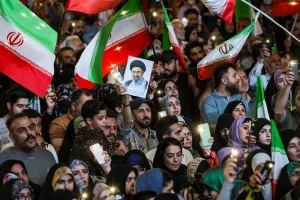
Supporters of the Islamic Republic wave Iranian flags during a nighttime rally.
Iran's nightly rallies by Islamic Republic loyalists have become platforms for opposing negotiations with Washington and targeting senior officials, drawing criticism over their political agenda, use of public resources and disruption to daily life in recent months.
The gatherings began in early March after the announcement that Supreme Leader Ali Khamenei had been killed in US and Israeli strikes. Supporters of the Islamic Republic took to streets and squares across the country and have continued gathering nightly.
Calls for revenge over Khamenei's killing and opposition to an agreement ending the war have become prominent features of the rallies, alongside attacks on officials involved in diplomatic efforts.
“A minority in the streets wants war, but the majority of people, who have no voice, just want to live their lives,” Mohammad-Ali Abtahi, a former first vice president under President Mohammad Khatami, said in an interview with Hamshahri television.
Abtahi's remarks circulated widely on social media and drew a backlash from supporters of the gatherings. Some Iranian media have also reported declining attendance, raising questions about the rallies' appeal beyond their most committed participants.
Khorasan newspaper, which is close to Parliament Speaker Mohammad-Bagher Ghalibaf, accused speakers of exploiting the gatherings for political score-settling.
“Turning an atmosphere of solidarity into an arena for political score-settling has not only reduced public participation but also endangered national cohesion,” the newspaper wrote.
During an online debate on the Azad platform, economist Mousa Ghaninejad challenged philosophy professor Bijan Abdolkarimi, who opposes negotiations with Washington, over the significance of the nightly crowds.
Ghaninejad argued that gathering in the streets did not make participants' positions correct and accused them of presenting themselves as the sole representatives of what was right while dismissing opposing views.
Protesters target senior officials
The rallies have increasingly targeted President Masoud Pezeshkian, Foreign Minister Abbas Araghchi and Ghalibaf, who is Iran's chief negotiator.
Placards have accused the officials of being too accommodating toward the enemy, with some demonstrators demanding their dismissal or resignation.
Organizers have also staged smaller daytime protests outside government and military institutions, extending their pressure beyond the nightly gatherings.
The conservative Jomhouri Eslami newspaper last week described the protests as unjustifiable, arguing that they threatened national interests and prevented Iran from “translating its military achievements into diplomatic gains.”
The newspaper wrote that the United States and Israel had infiltrated the gatherings, turning slogans against Washington and Israel into calls for the deaths of current and former Iranian officials.
It urged the judiciary and security agencies to intervene against those it accused of undermining national unity.
Khorasan also demanded judicial action after women wearing burial shrouds gathered outside the Armed Forces General Staff headquarters and accused military commanders of compromising with the enemy.
Khorasan urged the judiciary to take action against the protesters and organizers, as well as those it said had encouraged accusations of betrayal against military commanders and senior officials.
Public funding faces scrutiny
The rallies have also raised questions about the use of public resources to support political mobilization.
Rouydad24 news website last week described the gatherings as an “electoral campaign for the ultra-hardline faction,” questioning the use of public facilities to advance a particular group's political agenda.
The website highlighted the role of Tehran Mayor Alireza Zakani and his political allies in organizing and promoting the demonstrations.
It said no transparent financial information was available about their costs or the extent of direct funding by Tehran Municipality.
Residents complain of disruption
Beyond political infighting, residents have complained on social media about loudspeakers, traffic congestion and the nightly occupation of streets and public squares.
Some rally supporters have dismissed these objections, portraying participation as a wartime duty and criticism as disloyalty.
“The nightly gatherings are Iran's defensive shield, like air defenses, fighter jets and missiles whose noise we hear and fear, but they are on our side,” Kobra Asoupar, a journalist and defender of the nightly gatherings, wrote on X.
“If someone says during a war that we should not defend ourselves because we are being disturbed, that person is either an idiot or a traitor,” she added.
Lebanon’s Hezbollah, acting under the IRGC Quds Force’s direction, recruited six Thai clerics who had studied in Qom for a plot to attack the Israeli embassy in Bangkok, a Western intelligence source and a source close to the Quds Force told Iran International.
The sources identified the six men as recruits of Unit 910, the overseas operations unit of the Iran-backed Lebanese group. They said the plot was thwarted.
One member of the network said a Lebanese man he knew as Abu Hassan was his direct handler and supplied him with information for the planned attack.
The two sources identified Abu Hassan as Majed Abdullah, also known as Fadi Kassab, and said he began recruiting students at Al-Mustafa International University in Qom around 2020 with help from the Quds Force.
Kassab’s earlier mission in Bangkok
Kassab’s involvement in Thailand dated back to at least 2012, the sources said. That year, he entered the country under an assumed name to plan and oversee attacks on Israeli interests in Bangkok. The sources identified Hussein Atris, a Swedish-Lebanese national arrested at Bangkok airport that year, as one of his operatives.
Atris led Thai police to a warehouse outside the capital where bomb-making materials had been stored. A Thai court convicted him the following year of illegally possessing the materials.
The two sources said Kassab prepared recruits for Unit 910 and had also been linked to operations in Cyprus, Bulgaria, the United States and Canada. They described a division of responsibilities in Iran. A Lebanese national named Mohammad Hassan oversaw Hezbollah’s operations in the country and trained recruits, while Kassab planned attacks on Israeli interests.
From Qom’s seminaries to Bangkok
At the center of the Thai network, the sources said, was Mubarak Hosseini, a cleric who had spent more than three decades in Iran and later became head of Al-Mustafa’s alumni association.
His family’s ties to Iran went back to 1985, when his cousin Salman Hosseini, a Shia cleric, came to the country and was recruited by the Hojjatieh Association, the sources said. Salman subsequently made regular trips to Thailand to recruit others, including Mubarak.
In a 2023 interview with the Iranian publication Ofogh-e Howzeh, Mubarak said he arrived in Iran in 1991 and studied first at Qom’s seminary, then at the International Centre for Islamic Studies. He later pursued a doctorate in political science at Al-Mustafa, which was founded in 2008 on the orders of then-Supreme Leader Ali Khamenei.
The US Treasury sanctioned the university in 2020, saying the Quds Force used it to recruit for intelligence work and overseas operations.
Mubarak went on to head the Association of Thai Clerics and manage the Thai-language website of Khamenei’s office. In Bangkok, he established the Ahl al-Bayt religious center and founded an association called Supporters of Velayat-e Faqih, a reference to the doctrine of clerical rule underpinning the Islamic Republic.
Speaking to Iranian state television, Mubarak said he founded the association to “express affection for the Supreme Leader and the leader of Muslims” and to “prevent British and American Shiites from gaining influence in Thailand, in accordance with the Supreme Leader’s instructions.”
Family ties among the recruits
Mubarak and Salman helped Hezbollah recruit five other men from among Al-Mustafa’s students, the two sources said. Four of the five had family ties to Mubarak or to one of the other recruits.
The sources identified two of Mubarak’s sons-in-law, Mohammad Koim Akbar Syed and Seyyed Abbas Sadarsan, as members of the network. A third recruit, Ismail Pathan, was Mohammad Koim’s brother-in-law. Pathan graduated from Al-Mustafa and is active in the Ahl al-Bayt World Assembly, an Iranian religious organization that operates under the supreme leader’s supervision.
The fourth was Mubarak’s nephew, Ahmad Hossein Prathansakul, also an Al-Mustafa graduate, the sources said.
The sources identified Syedaree Sakkitticha as the only one of the six with no fa
mily connection to the others. They said he organized anti-Israel demonstrations in Bangkok. In 2023, Sakkitticha accompanied Meysam Motiei, an Iranian religious chanter associated with Khamenei’s office, during a visit to Thailand.
Quds Force source names three financial backers
The source close to the Quds Force identified three Iranian institutions affiliated with the supreme leader as financial backers of the network. They were Al-Mustafa International University, the Ahl al-Bayt World Assembly and Astan Quds Razavi, a wealthy Iranian religious foundation with extensive business holdings. The source said the World Assembly helped raise money for the network through seminars.
Motiei spoke publicly about financial support for Thai Shiites after his 2023 trip. He told Iranian state television that he and his companions had received no payment for the visit and had taken money with them for Thai Shiites he described as facing severe hardship. Motiei said Khamenei had encouraged him to spend as much as possible on the young people he met.
Mubarak also has business interests in Iran. He serves on the boards of Mobin Masir Mandegar Apadana and Pishtaz Sanat Mobin Pars, both of which trade in oil and petrochemical products.
After the closure of the Strait of Hormuz, Mubarak addressed rising oil prices in a Facebook post aimed at Thais. He told them Thailand’s Energy Ministry was not responsible, blamed the United States and Israel, and urged people to demonstrate outside their embassies in Bangkok.
On April 26, Mubarak was seen at a nighttime rally in Qom in support of Mojtaba Khamenei, who succeeded his father as supreme leader.
Smoke rises on Iran's Qeshm Island after airstrikes attributed to the US military on Nov. 17, 2026.
US fighter jets struck a Revolutionary Guards missile launch site on Iran’s Qeshm Island on Tuesday after Iranian drones targeted Bahrain, in an exchange that threatened efforts to ease the conflict.
A US military official said American aircraft used precision munitions to hit the site, describing the strike as an act of self-defense.
“The strike was in response to IRGC aggression targeting US personnel and assets,” the official said. “US Central Command remains highly vigilant and fully postured to protect Americans across the region.”
Iranian provincial official Ahmad Nafisi said the attack on Qeshm caused no damage to residential or commercial areas or vital infrastructure.
Iranian media reported that US forces had hit an air defense missile launcher in the island’s Nariman area. The IRGC-affiliated Tasnim news agency reported that several projectiles had struck the island.
The strike came hours after the Guards said they had targeted a US radar system at Bahrain’s Isa Air Base in response to what they described as continued violations of Iranian airspace by US military drones.
The US military said the Iranian drones had been intercepted without damaging American equipment or injuring US personnel.
“Multiple Iranian one-way attack drones launched by the IRGC today towards Bahrain were intercepted without any damage to US equipment or injury to American personnel,” US Central Command said on X, adding that US and partner forces remained highly vigilant.
Iran’s army separately said it had shot down a LUCAS drone over the Strait of Hormuz using domestically developed air defenses. The US has not commented on the army’s claim.
Regional condemnation
US Secretary of State Marco Rubio discussed the Iranian attacks with Bahraini Foreign Minister Abdullatif bin Rashid Al Zayani, Bahrain’s Foreign Ministry said. Rubio condemned the attacks and reaffirmed Washington’s commitment to Bahrain’s security and that of its regional partners.
Saudi Arabia called for an immediate halt to Iranian attacks on countries across the region and urged that diplomacy be given a chance. Qatar also condemned the attacks on Bahrain, warning that their continuation marked a serious escalation that undermined efforts to ease tensions.
The Guards, meanwhile, issued a further warning to Bahrain.
Spokesman Hossein Mohebbi accused its government of cooperating in attacks on Iran and relying on a US “security bubble,” saying those policies would cast doubt on Bahrain’s survival in a new regional security order.
The exchange came as Qatar said it would meet Iranian officials to discuss proposals aimed at narrowing differences between Tehran and Washington.
It also followed Iranian Foreign Minister Abbas Araghchi’s visits to Pakistan and Oman, who have long been acting as mediators in Iran-US tensions.
Shipping under threat
The violence also coincided with further reports of vessels being hit around the Strait of Hormuz.
The UK Maritime Trade Operations agency said a vessel sustained a second strike about seven nautical miles north of Khasab, Oman, causing a fire. Its crew were unaccounted for, and the extent of the damage was unknown, the agency said, citing a maritime security agency.
Iran’s Guards Navy separately claimed that a supertanker carrying more than two million barrels of crude and a liquefied gas carrier had struck sea mines in the strait. Iran’s army also reported a mine strike on a tanker east of the waterway.
It was unclear whether the Iranian statements and the UKMTO alert referred to the same incidents.
The suspected honor killing of a 16-year-old Iranian schoolgirl has raised questions about her school's failure to protect her after she reportedly warned that her life was in danger, with authorities announcing the arrest of her father and school principal on Tuesday.
Sogand Sayadi died after leaving school with her father in Kermanshah, western Iran, prompting calls from teachers' organizations and human rights groups for an investigation into the circumstances surrounding her death.
Her father was detained on suspicion of assault and provisionally murder, while the school principal was arrested on suspicion of negligence, the judiciary-affiliated Mizan news agency reported, citing provincial chief prosecutor Hamidreza Karimi.
Investigators are examining possible murder or suicide, with forensic examinations continuing to determine the cause of death and any criminal responsibility, Karimi said.
Sayadi had reportedly warned school officials that her life would be in danger if she returned home with her father. Her body was discovered the following morning in the courtyard of her residential building.
Photographs published from her funeral also showed her father standing among mourners during the funeral prayer.
Accounts of violence at school and home
Officials at the school summoned Sayadi's father, Kioumars Sayadi, after learning about a matter involving her private life, the Hana Human Rights Organization reported Monday.
Accounts surrounding the case suggest the dispute concerned the teenager's romantic relationship with a boy, although the school principal denied that this prompted the decision to summon her father.
Sayadi's father severely beat her in front of classmates and repeatedly struck her head against a wall outside the school, Hana reported, citing its sources.
The violence continued at home, where her father threw her from the building, according to the organization.
Other accounts suggest the teenager fell from the fifth floor of the building.
Kermanshah's education department offered a different account of her departure from school, saying her father had visited to collect her academic records and arrange her transfer to Gilan-e Gharb, a town in western Iran.
The two left school around 9 a.m., the department said.
Sayadi lived with her stepmother and faced family disagreements, while apparently being pressured to return to her hometown, Jahangir Aghaei, the department's public relations director, said.
Teachers question school's responsibility
The Coordinating Council of Iranian Teachers' Trade Associations accused school officials of disregarding Sayadi's warnings and demanded accountability from the Education Ministry in a statement Monday.
The council called for an end to interference in students' private lives, stronger child protection mechanisms and the removal of laws that shield perpetrators of family violence.
Hana also demanded an independent investigation into the death and the possible responsibility of school staff.
Under Article 301 of Iran's Islamic Penal Code, fathers and paternal grandfathers are exempt from qisas, or retaliatory execution, for killing their children.
Femicide figures highlight wider problem
At least 84 women and girls were killed in Iran between March 21 and October 13, including 12 girls under 18, according to figures compiled from cases documented in media coverage.
Mourners gather for Sogand Sayadi's funeral in western Iran, with her father reportedly among those attending the funeral prayer.
In 75 cases, the perpetrators were known to the victims. Eight of the underage victims were killed by fathers, brothers or other blood relatives.
The figures reflect documented cases rather than the total number of killings.
Legislation intended to protect women against violence remains unapproved after more than 15 years of debate among Iranian government institutions.
Sayadi's death has intensified scrutiny of the responsibilities of schools and state institutions to protect girls facing threats within their families, particularly when warnings of possible violence are raised before a death occurs.
File photo: People queue to buy bread outside a bakery in Iran.
Bread rationing has been introduced without public notice in two Iranian provinces, triggering queues and disputes at bakeries, the hardline daily Kayhan reported, as government officials confirmed a nationwide bread purchase management system on Tuesday, November 17.
Kayhan, published under the supervision of a representative of Iran's Supreme Leader, reported that the restrictions had been introduced in Khuzestan province in southwestern Iran and Zanjan province in the northwest without informing bakers or consumers in advance.
The measures prompted residents to rush to bakeries and led to verbal confrontations, the newspaper reported.
Under the system described by Kayhan, each person receives a monthly allocation equivalent to approximately eight kilograms of subsidized flour, priced at 23,000 rials ($0.009) per kilogram.
Purchases exceeding the allocation are charged at the commercial rate of 126,500 rials ($0.047), more than five times the subsidized price, with the additional payments transferred to government accounts, Kayhan reported.
The newspaper questioned why the measures had been introduced without informing bakers or consumers and accused “elements within the government” of contributing to “public anxiety” through simultaneous changes affecting bread, gasoline and electronic food vouchers.
Local media had previously reported restrictions in Shadegan, Andimeshk, Omidiyeh and Zeydun in Khuzestan province, where daily bread allocations were set at between two and 2.5 loaves per person.
Purchases exceeding those amounts were priced at 131,500 rials ($0.049), according to the local reports.
The bread purchase management system is being implemented across Iran, but ordinary households face no restrictions on their daily purchases, Omid Jahannejadian, director-general of Khuzestan's Grain and Commercial Services Department, told the official IRNA news agency on Tuesday.
The program is intended to regulate subsidized flour consumption, prevent potential misuse and identify purchases exceeding normal household needs, Jahannejadian said.
Consumption thresholds are calculated using purchasing data collected over the past two years, taking account of differences between urban and rural areas.
The system calculates allocations at the household level, with purchases by family members counted toward a combined household allowance, Jahannejadian added.
File photo: A baker prepares traditional bread at a bakery in Iran.
In Zanjan province, Ali Eyvazi, director-general of the provincial Grain and Commercial Services Department, also confirmed that unusually large bread purchases would be charged at commercial rates.
Ordinary household purchases would not face higher prices, Eyvazi told IRNA.
The guidelines were issued on November 15, with the system subsequently updated at bakeries and flour mills.
Although the average monthly flour allocation per Iranian is approximately eight kilograms, applying an identical limit to every person without accounting for household circumstances and regional differences would be inaccurate, Eyvazi said.
The program was initially tested in Markazi province before authorities decided to expand its implementation to other provinces following an evaluation.
In a separate interview with the Mehr news agency, Eyvazi rejected descriptions of the measures as a two-tier bread pricing system, saying ordinary household consumption would remain unrestricted despite the introduction of purchasing thresholds.
Supermarkets must obtain bread from bakeries operating without government subsidies, while commercial purchases from subsidized bakeries must comply with the new rules, Eyvazi added.
Rising food costs put pressure on households
The introduction of bread purchase controls comes as Iranians face increasing difficulties affording basic food products.
Iran's minimum monthly base wage stands at about 166 million rials ($62), following a 60 percent increase in March. The cost of a basic monthly basket of goods for a working-class family had reached approximately 906 million rials ($337) by July, more than five times the minimum base wage, according to calculations cited by Iranian media.
Accounts sent to Iran International describe households turning to installment payments to purchase essential items, including bread, meat, chicken and eggs.
In a video showing a bakery queue in Tehran, one resident described shortages alongside rising prices and shrinking loaf sizes.
"Bread has become scarce, and we have to stand in line to buy it. At the same time, the loaves have become smaller and more expensive. Can someone tell us how we are supposed to feed our children?" the resident said.
Other citizens have described reductions in flour allocations and changes in the taste and color of bread.
Economic hardship is also affecting social relations as more households struggle to meet their basic needs, sociologist Hossein Ghazian told Iran International.
When survival becomes people's primary concern, competition increasingly replaces cooperation, potentially contributing to domestic violence, street confrontations and crime, Ghazian said.
The economic pressures can also contribute to depression, suicide, declining marriage and birth rates, and migration, reflecting diminishing confidence in the future, Ghazian added.
The nationwide bread controls introduce new purchasing thresholds for a staple food even as officials insist that ordinary household consumption will remain unaffected.