Can higher fuel prices curb Iran’s smuggling problem?
Long queues and empty pumps have brought Iran’s fuel shortages into sharper focus, raising a difficult question: how much would charging consumers more change where the country’s subsidized fuel ends up?
Esmail Saghab Esfahani, a vice president who heads the state energy efficiency agency, acknowledged this week that “we really have a supply problem.” He told Iranians they could no longer count on fuel stations to cover their needs and should save part of their monthly ration before traveling.
“All the gasoline the government has, it has given to the people,” he said. “Nothing has been held back to supply more.”
On Thursday night, residents of Bandar Abbas, the main port on the Persian Gulf, blocked a road near a fuel station in the city’s Rajaei district with their cars, protesting long lines and empty pumps. Drivers on the Minab–Bandar Abbas route had protested earlier over the lack of fuel.
The economic argument for higher prices is straightforward. Fuel is inexpensive domestically and costly abroad, making it profitable to move illegally. Narrowing that gap could reduce the incentive to smuggle.
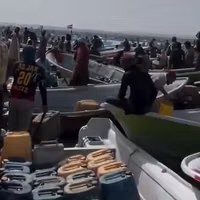
Screengrab from a viral video showing a large gathering of fuel smugglers aboard boats in Iran’s southeastern Sistan and Baluchestan province.
Long queues and empty pumps have brought Iran’s fuel shortages into sharper focus, raising a difficult question: how much would charging consumers more change where the country’s subsidized fuel ends up?
Esmail Saghab Esfahani, a vice president who heads the state energy efficiency agency, acknowledged this week that “we really have a supply problem.” He told Iranians they could no longer count on fuel stations to cover their needs and should save part of their monthly ration before traveling.
“All the gasoline the government has, it has given to the people,” he said. “Nothing has been held back to supply more.”
On Thursday night, residents of Bandar Abbas, the main port on the Persian Gulf, blocked a road near a fuel station in the city’s Rajaei district with their cars, protesting long lines and empty pumps. Drivers on the Minab–Bandar Abbas route had protested earlier over the lack of fuel.
The economic argument for higher prices is straightforward. Fuel is inexpensive domestically and costly abroad, making it profitable to move illegally. Narrowing that gap could reduce the incentive to smuggle.
But the price difference alone does not explain how large volumes leave a state-controlled distribution system, who obtains them or why enforcement so often focuses on those transporting the fuel. Nor should gasoline shortages and diesel diversion be treated as interchangeable problems.
Where fuel leaves the system
Journalist Yashar Soltani, in a recent interview, alleges that approximately 30 million liters of fuel are smuggled out of Iran daily with assistance from people within state institutions. That would represent roughly 11 billion liters annually. His estimates and allegations of official involvement have not been independently verified.
The allegations nevertheless raise a question that deserves investigation. Transporting millions of liters requires more than individual drivers willing to cross a border. It requires access to supplies, storage, vehicles, financing and buyers. The people carrying the fuel are visible; those deciding where it comes from and who receives the proceeds may be much harder to identify.
Soltani’s November 2024 investigation into a southern Iranian smuggling case described the alleged use of forged delivery documents, reused permits and payments to secure passage through checkpoints. If those mechanisms operate as described, the decisive breach occurs before the border, when fuel is released or diverted under false pretenses.
Higher prices could affect the profitability of that trade. They would not, by themselves, repair the controls that allowed the diversion.
The Razzaq scheme requires particular care. It is reportedly an authorized fuel allocation program intended to support border communities. Its existence does not establish that every shipment made through it is illegal. Equally, official authorization does not remove the need to examine who controls allocations, how transactions are recorded and how much income reaches households.
Conflating authorized trade with smuggling would make reform less credible. Authorities should distinguish legal exports, administrative discrepancies and proven diversion, then publish comparable figures. Otherwise, seizure statistics and alarming estimates can obscure the basic question of where public resources go.
Who would pay more?
The incentive created by price differences is substantial. In December 2025, Financial Tribune reported diesel selling domestically for around 300 tomans per liter while fetching nearly 50,000 tomans across the border. These were reported prices at that time, rather than current quotations, but they illustrate the potential margins.
The effect of a price increase depends on its size, currency movements, operating costs and how traders obtain supplies. Someone buying fuel lawfully faces a different calculation from an organizer acquiring it through a fraudulent allocation or an unrecorded transfer.
Small increases may leave lucrative margins intact. Larger increases could reduce them, but would also raise costs for legitimate freight operators and farmers, with consequences for household budgets. A subsequent fall in the rial could widen the international price gap again.
The distinction between fuels is equally important. Evidence of large-scale diesel diversion does not, on its own, establish that higher gasoline prices for motorists would address it. Officials should explain which fuel is disappearing, where losses occur and how each proposed adjustment would tackle that specific problem.
The distinction between participants matters, too. A household carrying fuel because other income is scarce does not exercise the same control as someone managing bulk supplies, financing and distribution. Enforcement should examine responsibility and financial benefit rather than assume that the easiest person to arrest is the most consequential.
Removing a driver’s livelihood may leave an organizer able to recruit somebody else. It can also deepen local dependence on whoever controls access to work. Alternative employment should therefore be part of enforcement policy, rather than postponed until restrictions have made families poorer.
Iran’s earlier subsidy reform provides a practical lesson. An IMF working paper on the 2010 reform describes compensatory payments deposited before higher prices took effect. That experience does not establish a lasting solution to smuggling, but it shows that household protection can be prepared before costs rise.
Following the fuel and the money
Soltani’s allegations of official involvement need independent investigation. Authorities should trace fuel from refineries and depots to its intended customers, comparing deliveries with quotas and transport records. When fuel goes missing, investigators should examine who approved its release, who received it and who benefited.
Tracking devices are useful only if someone acts on the evidence. They cannot prevent diversion on their own if records are altered or officials facilitate it. Any investigation must also be able to scrutinize politically connected operators.
Authorized border programs should make clear what households are entitled to receive, account for the money paid to them and provide a way to challenge unfair deductions. Families need realistic alternatives, including access to legal trade, support for local businesses and training that leads to paid work.
Higher prices can help narrow the margins that make smuggling profitable. But if the opaque allocations and protection arrangements described in these reports persist, households and legitimate businesses could face higher costs while those controlling diverted supplies continue to profit.
The test of reform is therefore more demanding than whether it raises revenue or produces more arrests. It is whether less fuel disappears, investigations reach those organizing its diversion, and vulnerable households receive support before their costs rise. Without those changes, consumers could end up paying more without knowing whether the next station will have fuel.
A government-organized Janfada mobilization gathering held in Iran in October 2026.
Iran’s Revolutionary Guards are expanding a campaign built around sacrifice for the homeland into a route for military training and Basij paramilitary recruitment, giving a force associated with decades of domestic repression a broader patriotic appeal.
The Janfada initiative — roughly meaning someone willing to sacrifice their life — presents participation as service to Iran. Its development raises a question: how far can the authorities use national loyalty to attract recruits who might otherwise hesitate to join the Islamic Republic’s security institutions?
On November 2, Hassan Hassanzadeh, commander of the Guards’ Tehran corps, said the first Janfada brigade had been organized, completed supplementary training and received equipment. Speaking at the opening of a training center in Tehran’s Tajrish Square, he said the unit was preparing for practical exercises and specialist shooting-range training.
The announcement marked a further step toward turning a public mobilization campaign into organized military units.
A new route into the Basij
Launched on March 28 by the Guards-linked Baqiyatallah cultural and social headquarters, Janfada initially invited volunteers to participate in defense, security and relief activities during the war with the United States and Israel.
By September, organizers were announcing plans for 1,000 national resistance battalions. Training programs subsequently included firearms handling, urban defense and rescue skills.
Ali Kowsari, the Basij’s deputy for training, has said participants who complete supplementary courses can join the organization’s combat structure. Esmail Faraji, its deputy for operations, has said the campaign attracted volunteers who had not previously belonged to the Basij, although the scale of that recruitment has not been independently established.
The distinction matters because the Basij, a paramilitary organization subordinate to the Revolutionary Guards, combines military mobilization with ideological organization and domestic security. Its network extends through neighborhoods, universities, schools and workplaces, and its members have participated in successive protest crackdowns.
A campaign emphasizing defense of the country could therefore provide a more accessible entry point than direct recruitment under the Basij name. Joining a course presented as preparation to protect Iran may carry different associations from joining an institution identified with policing dissent.
That remains an interpretation of the campaign’s appeal, rather than proof of its organizers’ intentions or success. Available evidence does not establish how many participants are new recruits, how many were already Basij members, or whether the patriotic message has broadened support beyond existing government loyalists.
National defense and domestic control
The campaign’s public presentation has combined national solidarity with explicit loyalty to the leadership.
At the September 18 Janfada parade in Tehran, participants included Basij members, uniformed volunteers and children. The event began with a declaration of allegiance to Khamenei, while President Masoud Pezeshkian described it as a display of national cohesion.
That combination illustrates how the campaign places defense of Iran alongside support for the political system.
Its activities also extend beyond preparation for an external attack. Campaign spokesman Sassan Zare said in September that Janfada provided training related to urban and public security, while responsibility for deploying volunteers at checkpoints rested with the relevant security bodies.
Those overlapping functions make the campaign relevant to domestic control, although they do not establish that every participant will undertake security duties or be deployed against protesters.
A Syrian parallel, with limits
Syria offers a comparison in how governments organize loyalist forces under the language of national defense.
During Bashar al-Assad’s rule, pro-government militias and neighborhood committees were incorporated into the National Defense Forces. Research by the Institute for the Study of War describes Iranian and Hezbollah assistance in formalizing the force along a model resembling the Basij, including training recruits.
The comparison has limits. Syria involved the consolidation of existing militias during a civil war. Janfada is presented as a recruitment and training campaign connected to institutions that remain in place. There is no evidence here that the Basij has been dissolved or formally renamed.
The more defensible argument is that Janfada offers the existing security structure an additional public identity and recruitment channel. Its language emphasizes sacrifice for the country; its training pathways lead toward institutions whose responsibilities also include preserving the Islamic Republic.
Whether that approach can repair the Basij’s reputation remains unproven. What commanders’ announcements demonstrate is a growing effort to turn patriotic participation into organized manpower.
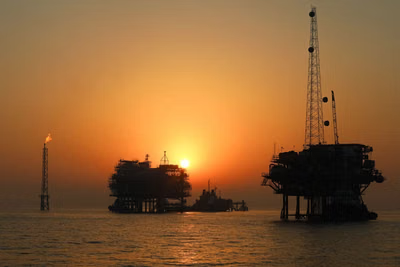
File photo: Iran's Reshadat oil rig in the Persian Gulf
Iran's oil production fell by nearly half from pre-war levels in October, dropping below the amount its refineries consumed before the war, according to new figures from the International Energy Agency (IEA) and Iranian Oil Ministry data reviewed by Iran International.
The IEA estimated in its latest monthly report that Iran produced 1.86 million barrels of crude oil per day in October, down 46% from pre-war levels.
An Iranian Oil Ministry report reviewed by Iran International showed that the country's refineries consumed more than 1.873 million barrels per day in 2024–25, before the war disrupted production and refining operations.
New processing units have since been added to Iranian refineries, potentially increasing their crude oil requirements. However, wartime damage and disruptions mean actual domestic demand may differ from pre-war levels.
The steep production decline comes amid a US naval blockade that has effectively halted Iranian crude exports and severely restricted shipments of petroleum products, leaving Tehran with limited options for maintaining production.
Kpler previously told Iran International that Iranian crude oil loadings had stopped in mid-August, leaving the country with virtually no option but to keep production close to domestic consumption levels.
One possible contributing factor is the damage to Iran's Lavan refinery during the war, although the facility has a relatively small crude oil processing capacity of 35,000 barrels per day.
Threat to refinery operations
Homayoun Falakshahi, a senior analyst at Kpler, told Iran International on November 13 that Iranian naphtha loadings had fallen by 100,000 barrels per day in recent months.
He warned that if Iran cannot export the product, it may be forced to partially shut down some refinery units.
"Iran's fuel oil (mazut) loadings have also fallen to 15% of their pre-war levels. However, some of the surplus refinery products, such as fuel oil, can be sold to countries like Afghanistan and Pakistan, or absorbed through increased domestic consumption. Naphtha is a more complicated issue," he said.
Naphtha is primarily used as a feedstock for petrochemical production, although modern refineries can also process it into higher-value products such as gasoline.
During the war, several units at the major petrochemical complexes in Assaluyeh and Mahshahr, which account for 70% of Iran's total petrochemical production, were also targeted.
The damage, combined with restrictions on exports, has complicated Iran's ability to absorb or sell surplus refinery products.
Kpler data show that while crude oil loadings have come to a complete halt, shipments of some petroleum products, particularly liquefied petroleum gas (LPG), have continued at reduced levels.
United Against Nuclear Iran (UANI) recently reported that Iran had managed to move 11 LPG cargoes past the US naval blockade since it began.
Reuters estimated Iran's LPG exports that evaded the blockade between mid-July and mid-October at 4.1 million barrels. An Iran International analysis based on Kpler data showed that this was less than 14% of Iran's LPG exports over the same period last year.
In its latest assessment, UANI said another 12 small Iranian tankers carrying LPG were anchored in the Gulf of Oman, apparently waiting for an opportunity to cross the blockade.
There have been no confirmed reports of Iranian naphtha cargoes passing through the US blockade.
Region recovers as Iran's output falls
While Iranian oil production has plunged, other major producers in the Persian Gulf have been recovering from disruptions caused by the war.
New OPEC figures show that its members, together with the UAE, which left the organization on May 1, produced a combined 27.16 million barrels per day in October, up 1.96 million barrels from September.
Excluding Iran, daily production by OPEC member countries in October was nearly 900,000 barrels above the 2025 level.
OPEC figures also show that Iran's daily output fell by 1.34 million barrels compared with 2025, while combined production by Iraq and the UAE increased by 1.3 million barrels.
Iraq produced 4.5 million barrels per day in October, although its oil minister recently said production had exceeded five million barrels per day in November.
Saudi Arabia has also reported raising its daily output to 10.5 million barrels, around 1.3 million barrels above its October level.
The IEA said in its latest report that global oil production exceeded worldwide demand in October for the first time since the outbreak of the Middle East war, driven by recovering output among Arab producers in the Persian Gulf.
The agency also reported that global oil stocks held at sea increased by 86 million barrels during the month, underscoring the broader recovery in supply even as Iran's production remained severely constrained.
Trucks queue at the Bazargan border crossing between Iran and Turkey, one of Iran’s main overland trade routes
Tehran has dismissed US plans to restrict Iran’s overland trade routes as ineffective propaganda, but Iranian businesses report sharp increases in transportation costs and insurance premiums.
Some say these costs have multiplied several-fold, though it remains unclear how much of the increase can be attributed to the new operation.
Operation Iron Gate follows two earlier US initiatives, Economic Fury and Economic Outcast, which introduced a naval blockade and expanded secondary sanctions across five sectors: digital assets, technology, gold, aviation and shipping.
Iron Gate, by contrast, is a CENTCOM task force rather than a full-scale operation. Established on November 7 and operating with roughly 20 personnel based in Tampa, Florida, its long-term impact remains difficult to assess.
The economic damage
The International Monetary Fund projects a 5.4% economic contraction and 68.9% inflation for 2026.
CENTCOM asserts its blockade has prevented more than $25 billion in crude exports, although the figure has not been independently verified.
While CENTCOM has not specified the total volume of trade Iron Gate aims to block, its stated targets cover weapons, dual-use technology, sanctioned materials and illicit revenue moving through land and Caspian routes.
Ordinary trade is not explicitly targeted, but the scale of Iran's regional commerce illustrates the challenge of enforcing such restrictions.
Regional trade
Iraq has more land crossings with Iran than any other neighbouring country. On November 9, Washington reportedly requested that Baghdad close all but two crossings.
Iraq's Trade Ministry put bilateral trade at $12.5 billion in 2024, while Iranian customs figures showed Iraq purchased $11.9 billion in Iranian exports during the last Iranian calendar year, making it Iran's second-largest export market after China.
Smaller crossings have also expanded rapidly, with Mehran alone handling $453 million in exports over six months.
Reports by Alhurra, the US-funded Arabic-language broadcaster, have highlighted IRGC-supervised smuggling through militia-controlled routes into Iraq, potentially making these networks a particular target for Iron Gate.
Along the Turkish border, six-month bilateral trade reached $7.04 billion, according to Mehr News. Petrochemicals accounted for 48% of Iranian exports and oil products another 33%.
Bazargan remains a major bottleneck, with Iranian officials reporting that Turkey permits only 200 trucks a day, against the 500 requested by Tehran.
To the north, industry estimates published in Iranian economic media project Russia–Iran Caspian cargo volumes of approximately 10 million tonnes in 2026, nearly double the previous year's level.
Iranian exports to Pakistan and Afghanistan amount to roughly $2.4 billion each, alongside extensive informal fuel smuggling on which an estimated 2.4 million people in Pakistan's Baluchistan depend.
Internal strain
Many observers, including some Iranian officials, argue that additional restrictions are unlikely to bring about economic collapse, pointing to Iran's adaptation to nearly five decades of sanctions.
Assessments reported by Reuters have also suggested that renewed military strikes may be unlikely to change Tehran's negotiating position or destabilize its leadership.
Yet the ability of the Iranian state to withstand pressure does not mean its population can absorb the costs. Iranians contacting foreign-based Persian-language outlets, including Iran International, consistently describe the growing hardship facing ordinary households.
Iron Gate may prove more effective at raising trading costs and disrupting specific networks than at restricting Iran's overall commerce.
Oil-product flows through Iraq and Turkey, along with military-related shipments across the Caspian, could face additional scrutiny. But the task force's limited size and the geographical scale of its mission make its eventual impact uncertain.
Caspian maritime traffic, in particular, remains difficult for Washington to reach directly.
Iran may therefore be able to withstand further restrictions, even at the cost of prolonged economic hardship. Tehran could ultimately prefer what amounts to more pressure on ordinary Iranians over geopolitical concessions.
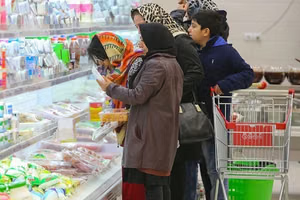
Shoppers walk through a market in Iran, where rising living costs and shrinking purchasing power reflect the economic toll of 47 years of Islamic Republic rule.
Nearly 47 years after Iran's 1979 revolution, a former football chief has asked what Iranians got for its promises, pointing to officials’ children living abroad, oil wealth that never reached wages and a state that answered protests with bullets.
“You haven’t done anything for 47 years. All you talk about is dignity, dignity, dignity. What dignity?” Mohammad Dadkan, former president of Iran’s Football Federation, said in an interview on the Persian-language podcast Tak be Tak.
The cost of confronting US
"What would we have to talk about if it weren't for 'Death to America'? What would we use to keep people occupied?" Dadkan asked.
The slogan has been at the heart of the Islamic Republic’s identity since 1979, when students loyal to Ayatollah Khomeini seized the US embassy and held its diplomats hostage.
Decades of confrontation, and the dispute over the nuclear program, brought broad US sanctions on oil, banking and trade.
They have deterred investment and raised the cost of imports, and the state’s own mismanagement has done the rest. Iranian households live with high inflation, falling purchasing power and few jobs.
Officials call resistance to Washington the measure of national independence. Iranians have paid for it in prices.
Shoppers crowd a bazaar in Iran, where decades of economic hardship, rising prices and declining purchasing power have taken a toll on everyday life.
Privilege at home, children abroad
"What have you done other than fill your own pockets, send your children abroad and take all the privileges for yourselves?" Dadkan said.
The children of senior officials living in the countries their parents denounce have long drawn anger.
Fatemeh Ardeshir Larijani, daughter of Ali Larijani, the former secretary of the Supreme National Security Council killed in an Israeli strike in March, worked as a cancer specialist at Emory University in the United States until January, when Emory said her employment had ended after protests by Iranian Americans. A government spokesman said she had already returned to Iran.
Issa Hashemi is the son of Masoumeh Ebtekar, a former vice president who was spokeswoman for the students who seized the US embassy in 1979.
He lived in Los Angeles with his wife and son until April, when US immigration authorities detained the family and Secretary of State Marco Rubio revoked their permanent residency over their connection to Ebtekar.
For most Iranians, a falling currency and closing visa doors have made studying or settling abroad ever harder.
Oil wealth and shrinking wages
"We have stone, gold, oil, the best resources and an excellent geographical position for attracting tourists. We haven't done anything," Dadkan said.
Iran has some of the world’s largest oil and gas reserves. Its people have not seen the benefit.
Annual inflation reached 76.8 percent in October, according to the Statistical Center of Iran, and prices were 88.7 percent higher than a year earlier.
The dollar traded at about 2.63 million rials in November, against about 1.6 million in early April: the rial lost nearly 40 percent of its value in seven months.
The base minimum wage for the Iranian year that began in March was set at about 166 million rials a month. At today’s rate that is about $63.
'National dignity’
Dadkan also turned the officials’ favorite word back on them, pointing to Iranian women driven into prostitution in neighboring countries.
The US State Department’s 2019 Trafficking in Persons Report cited growing numbers of young Iranian women in prostitution in Dubai, some controlled by networks that took their passports and threatened violence, and possible links between traffickers and members of the police, the Revolutionary Guards and the Basij militia.
Its 2022 report identified Iranian women as vulnerable to sex trafficking in Turkey, especially near the border.
Resilience, salaries and missiles
"They've come up with something new, and apparently they all say the same thing," Dadkan said, criticizing officials' repeated use of the term resilience.
The Persian term tabavari, meaning resilience or the ability to withstand hardship, has increasingly featured in speeches by Iranian officials urging the public to cope with economic and social pressures.
Shoppers browse fresh produce at a market in Iran.
The appeals have come as households struggle with persistent inflation, declining purchasing power, electricity outages and water shortages. Power cuts have disrupted businesses and industrial production, while water shortages have affected daily life in several provinces.
Dadkan's criticism focused on the expectation that citizens should repeatedly adjust to worsening conditions, with officials emphasizing their capacity to endure hardship rather than explaining how the underlying problems would be addressed.
Dadkan also challenged demands for higher parliamentary salaries.
"Why should your salary get increased? What have you done?" he asked.
He contrasted lawmakers' benefits with the struggles of retirees who have repeatedly demonstrated for pensions that keep pace with inflation.
Military priorities drew similar criticism.
"You come on television in the morning and say the missiles' range should be increased. Why is that your concern? Go take care of people's lives, their welfare and their security," Dadkan said.
Iranian officials have made expanding the country's missile capabilities a priority, even as power cuts disrupt homes and factories, water shortages worsen and basic infrastructure falls into disrepair.
The right to protest
"Now tell those who don't agree with your policies to come out. See if you can contain the crowds. Then you'll find out whether people want you," Dadkan said.
His challenge followed years of anti-government demonstrations, including protests in 2017–18 and 2019, the Woman, Life, Freedom uprising of 2022 and the nationwide protests of January 2026.
The January crackdown, particularly the killings on January 8 and 9, became central to questions about the system's treatment of dissent.
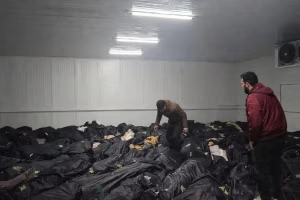
On January 25, Iran International's editorial board announced that more than 36,500 people had been killed during those two days, citing confidential security documents, field reports and testimony from medical workers, witnesses and victims' families.
One generation lived through revolution, war and one economic crisis after another. The next grew up with falling incomes and few prospects, and many left. Others buried relatives killed in the streets.
Forty-seven years is a chapter in a state’s history. For Iranians it is a lifetime of youth spent getting by, futures abandoned and families split by emigration or death. None of it can be given back.