Iran navy threatens ‘heavy damage’ to US ships entering territorial waters
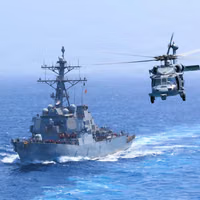
Iran’s navy would inflict very heavy damage on US ships if they tried to enter the country’s territorial waters, a senior naval officer said on Monday.
Farhad Fattahi, the navy’s deputy operations commander, said the response would involve an “impactful and combined” operation.
He cited missile and drone deployments along Iran’s southern coast and other military equipment.
US President Donald Trump dances during a rally, in support of Republican US Senate candidate, former US Representative Mike Rogers, ahead of the midterm elections, at an entertainment complex in Port Huron, Michigan, US, October 25, 2026. REUTERS/Jonathan Ernst
A renewed diplomatic push to avert another round of the US-Iran war gathered pace on Sunday, with Qatari mediators in Tehran as President Donald Trump publicly weighed reaching an agreement with the Islamic Republic against taking further military action.
The Qatari team was in the Iranian capital as part of an effort coordinated with the United States to reduce regional tensions, an official briefed on the matter told Reuters.
The visit puts Doha at the center of an attempt to break a diplomatic deadlock even as the risk of renewed fighting has grown.
The urgency behind that effort was underscored by Trump himself. In an interview with Fox News on Sunday, the US president framed his options in stark terms.
“Do I make a deal with them or do I finish them off? That's the only question,” Trump said.
But Trump also left space for mediators to work. Asked separately on Sunday whether US strikes could resume that day, he said, “There will not be a strike today,” stopping short of ruling out military action later.
Messages continue despite wide gaps
Iran, for its part, is also keeping the diplomatic channel alive without signaling that it is prepared to accept Washington's terms.
Foreign Ministry spokesperson Esmaeil Baghaei said on Sunday that messages were continuing to pass between Iran and the United States through intermediaries and that Tehran had not closed the window on diplomacy.
At the same time, Iranian officials have accused Washington of demanding what Tehran characterizes as its “complete surrender.”
The two sides also remain divided over the terms of a broader settlement. Washington has continued to make Iran's nuclear capabilities central to any settlement. Trump told FOX 2 Detroit on Sunday that the war would not end until the United States was satisfied Tehran did not have nuclear weapons capabilities, while saying he was prepared to take time to reach an agreement.
“I'm going to make a great deal. I'm a longterm person; I'm not a short term person,” he said.
Iran's ambassador to Pakistan said on Saturday that Tehran remained willing to resume negotiations under a Pakistan-brokered interim agreement reached in June. He said Iran had offered through Islamabad to reopen the Strait of Hormuz if Washington lifted its naval blockade.
The June agreement, brokered with Qatar's help, was intended to restore shipping, end the blockade and begin negotiations toward a broader agreement addressing Iran's nuclear program.
The Iranian ambassador accused Trump of undermining the latest diplomatic effort by insisting that the blockade would remain in place.
Regional governments seek an off-ramp
The Qatari intervention follows a broader diplomatic push by regional and European governments concerned that another attack on Iran could expand the war.
Foreign ministers from Turkey, Saudi Arabia, Egypt, Pakistan, Britain, France, Germany and Italy met in Istanbul on Friday, where Turkish Foreign Minister Hakan Fidan warned that renewed attacks on Iran would widen the conflict and said diplomacy remained the only way to end it.
The meetings brought together governments with different relationships with Washington and Tehran but a shared interest in preventing another round of fighting from spreading across the region.
That concern has grown as Iran has threatened retaliation against US and regional interests and attacks on commercial shipping have continued around the Strait of Hormuz.
Seven oil tankers were reported attacked or damaged by Iranian forces or naval mines in and around the strait on Friday. Despite the continuing risks, tankers have been moving oil through a US-protected corridor.
CENTCOM commander Adm. Brad Cooper flew over the Strait of Hormuz on Sunday as the US military said it had supported more than 3,000 commercial vessel transits through the waterway over the past six months and helped Persian Gulf partners export more than 1.5 billion barrels of crude oil since summer.
Cooper said the main shipping routes remained clear of mines laid by Iran's Revolutionary Guards. CENTCOM said more than 95% of vessels had passed safely in recent months despite attacks by the Guards.
The confrontation has also spread to Yemen, where renewed Houthi attacks on Saudi Arabia have added to concerns over regional energy infrastructure and shipping routes.
Diplomacy under military pressure
The diplomatic push is therefore taking place while both sides retain significant means of pressure.
Washington continues its naval blockade of Iran while keeping open the possibility of renewed military action. Tehran, meanwhile, retains its ability to threaten shipping through the Strait of Hormuz and US and regional interests.
Those pressures also form part of the bargaining over a possible settlement. Tehran has linked reopening the Strait of Hormuz to an end to the US blockade, while Washington has continued to press Iran over its nuclear program, with the sequencing of concessions remaining a key obstacle.
The result is a diplomatic effort taking place under the threat of escalation rather than after that threat has receded.
For now, both sides continue to signal that an agreement remains possible. But neither has publicly indicated that it is prepared to bridge the differences that have stalled negotiations, leaving Qatar and other mediators seeking an opening while Washington and Tehran prepare for the consequences of another breakdown.
Iran's judiciary has indicted comedian Saeed Shakiba on charges including supporting Israel and the Pahlavi dynasty, state media reported on Sunday, days after authorities opened a case against him over a video impersonating former Supreme Leader Ali Khamenei.
The judiciary-affiliated Mizan news agency said Tehran prosecutors had issued the indictment following an investigation into what authorities described as insulting and offensive content published by the comedian on Instagram.
According to Mizan, the charges include knowingly expressing support for Israel on social media, insult and engaging in propaganda against the Islamic Republic through negative portrayals of the country and support for the Pahlavi dynasty, which ruled Iran until the 1979 Islamic Revolution.
Mizan said the case had been referred to court for further proceedings.
Shakiba came under scrutiny after publishing a satirical video on October 13 in which he imitated Khamenei's voice, parodying his meetings with poets.
On October 14, Mizan announced that Tehran prosecutors had opened a case against a social media personality identified only by the initials S.Sh., accusing him of publishing insulting and offensive content.
The agency said action had been taken against the individual but provided no details about the measures, the specific charges or his whereabouts.
US-based rights group Human Rights Activists in Iran (HRANA) reported on October 14 that authorities had opened a case against Shakiba following the satirical video, saying the judiciary had not disclosed details about the proceedings or his situation.
Shakiba is known for posting comedy videos and voice impressions of prominent figures on Instagram, where he had around one million followers.
Following the announcement of legal proceedings, posts on his Instagram account were removed. A notice bearing the emblem of Iran's police said the account had been restricted by judicial order over what authorities called criminal content.
The Islamic Revolutionary Guard Corps-affiliated Fars news agency also criticized the video, accusing Shakiba of insulting Khamenei and his family.
Shakiba had previously published satirical impressions of other Islamic Republic officials and expressed support for protestors killed during the January uprising.
Previous arrests and prosecutions of Iranian comedians
Iranian authorities have previously arrested and sentenced comedians and satirists over their work, drawing criticism from human rights groups.
Shaker Bori
Last month, Shaker Bori, a comedian and social media personality from the southwestern city of Abadan, was sentenced to 13 months and 20 days in prison for disseminating false information with the intent to harm others, according to the rights group HRANA.
Bori was also fined 45 million rials (approximately $17) for insulting a member of parliament. The case followed a complaint by lawmaker Mousa Ghazanfarabadi over a video Bori had published.
Bori had previously been arrested on July 31, 2023, after reporting to an Islamic Revolutionary Guard Corps intelligence office in Abadan to seek the return of his confiscated mobile phone, according to the Norway-based rights group Hengaw.
He was released on bail on August 10, 2023, after spending 10 days in detention.
Zeinab Mousavi, known for her online character Empress Kuzco
Another comedian, Zeinab Mousavi, known for her online character Empress Kuzco, was sentenced to six months in prison in November 2025 over a satirical video about Ferdowsi, the celebrated Persian poet.
In February 2026, a Tehran appeals court upheld the sentence, which also included a fine of 160 million rials (approximately $59) and an order to write a research paper about Ferdowsi, according to HRANA.
Mousavi had previously been arrested in October 2022 in the central city of Qom during nationwide protests sparked by the death of Mahsa Amini in morality police custody. She was released on bail in November that year and subsequently sentenced to two years in prison.
Mousavi said she had spent 25 days in solitary confinement during her detention.
She was arrested again in 2023 and released several days later, according to HRANA.
Kioomars Marzban
In another case, satirical writer Kioomars Marzban was arrested at his home on August 26, 2018, by Revolutionary Guard intelligence agents.
Marzban was sentenced in August 2019 to 23 years and nine months in prison on charges including insulting the supreme leader, propaganda against the Islamic Republic and cooperating with a hostile state, according to HRANA.
The sentence, of which 11 years were enforceable under Iranian law, was upheld on appeal in October 2019.
Marzban was released from Tehran's Evin prison in February 2021 after serving approximately two and a half years. His lawyer, Mohammad Hossein Aghasi, said six years of his sentence had been pardoned and the remainder suspended, according to freedom of expression organization ARTICLE 19.
Following his release, ARTICLE 19 condemned his prosecution, saying he should never have been imprisoned for his writing.
"His case is emblematic of the Iranian authorities' zero tolerance for freedom of expression and the Judiciary's lack of independence," said Saloua Ghazouani, then director of ARTICLE 19's Middle East and North Africa program.
PEN America has also criticized Iran's treatment of satirical artists. In June 2023, the organization condemned the arrest of cartoonist Atena Farghadani following the publication of a satirical drawing on Instagram.
"Cartoonists should not be persecuted for their creative expression," said Julie Trébault, then director of PEN America's Artists at Risk Connection.
PEN America said the arrest reflected broader efforts by Iranian authorities to intimidate artists, journalists and activists.
A pedestrian passes as an artist paints a mural on a wall in the Chaharmardan neighborhood of Qom, central Iran.
Iran may be approaching a mental-health emergency as prolonged uncertainty over war, economic pressure and the future takes a growing toll on the public, the head of the country’s Psychology and Counseling Organization said on Sunday.
Asked by ILNA how far Iranian society was from a mental-health emergency, Alireza Agha-Yousefi said: “I don’t think we are very far from it.”
He pointed to marriage, divorce and birth rates as areas of concern and said authorities needed to act before psychological and social problems became more severe.
Uncertainty and prolonged stress
Agha-Yousefi said the prolonged state of neither full-scale war nor peace was itself becoming a major source of pressure.
“The overall condition of society in a situation of neither war nor peace can create significant psychological strain,” he said.
He said people normally try to meet their needs while also responding to threats, but when both are present at the same time, threats tend to dominate.
“Uncertainty about the future is one of the most difficult situations,” he said, adding that it deprives people of the ability to plan their lives.
Agha-Yousefi said prolonged uncertainty could produce severe anxiety and, over time, lead to both physical and psychological exhaustion.
Effects may emerge later
He cautioned that the consequences of intense stress do not always appear immediately.
“The effects may show themselves one or two years later,” he said, citing depression, marital conflict and physical health problems as possible outcomes.
He also pointed to prolonged muscle tension, joint and spinal pain and gastrointestinal problems as conditions that can be associated with chronic stress.
President Masoud Pezeshkian last week also described the current “no war, no peace” situation as the worst position Iran could be in, as tensions with Washington remained unresolved.
Agha-Yousefi said the same economic conditions contributing to psychological strain were also making treatment less accessible.
He said demand for counselling had risen, but inflation and declining purchasing power meant many people could no longer afford psychological services.
“Psychological services are not covered by basic insurance,” he said, adding that official figures on the number of people seeking treatment could therefore give a misleading picture.
He said some people who need help simply do not seek it because of the cost.
A proposal to bring psychological services under insurance coverage had been submitted to the organization’s central council around four months ago but had yet to be approved, he said.
Pressure on families and social stability
Agha-Yousefi also said Iran appeared to be moving toward greater social dislocation.
“It seems our social situation is, to some extent, moving toward anomie or social normlessness,” he said.
He warned that as social stress rises, the effects can spread into family life and wider social behavior, including later marriage, addiction and greater instability within households.
“When problems enter the family, they can be a sign of deeper social damage,” he said.
He added that severe family pressures could, in some cases, contribute to extreme violence, including killings within families.
Agha-Yousefi said delaying preventive measures would make the psychological, physical and social consequences much harder and more expensive to address later.
War fears add to uncertainty
His comments come as speculation grows over possible renewed US and Israeli military action against Iran.
Recent reports have said the US military has prepared options for further strikes after the November 3 midterm elections if President Donald Trump authorizes them.
That uncertainty has added another layer of pressure to an economy already strained by inflation, a weakening currency and declining purchasing power.
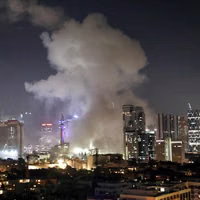
Smoke billows following missile attack from Iran on Israel, at Tel Aviv, Israel, June 13, 2025.
The war with Iran raises a familiar question for Israel: Can battlefield gains produce lasting peace? Its military history offers mixed answers, from unresolved victories to withdrawals and ceasefires that left adversaries armed.
Destroying Iran’s military capabilities and preventing their reconstruction are different objectives, requiring different measures of success.
Since 1948, Israel has fought conventional Arab armies and armed organizations such as Hezbollah and Hamas, and has increasingly confronted Iran directly through missile, drone and air attacks far beyond its borders. These forms of warfare have overlapped, posing different challenges for bringing the fighting to an end.
Their endings show how battlefield outcomes interact with diplomacy, outside pressure and arrangements for security after the fighting.
1948: Survival without peace
Fighting between Jewish and Arab communities followed the UN’s 1947 partition plan. After Israel declared independence in May 1948, neighboring Arab armies entered the conflict. Israel survived and gained territory beyond the boundaries proposed for the Jewish state.
In 1949, it signed separate armistice agreements with Egypt, Lebanon, Jordan and Syria. These established lines separating the forces, rather than permanent political settlements. The Egyptian agreement explicitly envisaged a subsequent peaceful settlement.
Israel’s survival did not resolve the territorial dispute or the displacement of Palestinians. The fighting ended without peace between Israel and its neighbors.
1956: Military gains, withdrawal under pressure
During the Suez crisis, Israel attacked Egypt in coordination with Britain and France, rapidly advancing across Sinai.
Pressure from the United States, the Soviet Union and the United Nations forced a withdrawal, completed in March 1957. Israel could not retain the territory it had captured, despite its battlefield success.
The outcome nevertheless brought security gains: Israel regained access to the Straits of Tiran, while a UN emergency force deployed in Sinai. The US State Department’s historical account distinguishes those gains from the territorial withdrawal.
The episode illustrates why withdrawal is not automatically evidence of military defeat, and why military superiority alone does not determine a war’s political outcome.
1967: Six days of fighting, decades of consequences
Israel’s opening airstrikes devastated Egypt’s air force. Within six days, Israeli forces had captured Sinai, Gaza, the West Bank, East Jerusalem and the Golan Heights. The war ended through ceasefires, without a formal surrender by the defeated Arab states. Israel’s decisive battlefield victory transformed the territorial balance but did not settle the conflict.
UN Security Council Resolution 242 subsequently established a framework linking Israeli withdrawal from occupied territory with an end to belligerency and recognition of states’ right to live within secure, recognized boundaries.
The military result was immediate. Disputes over occupation, borders and Palestinian rights lasted far beyond the fighting.
Egyptian fighter jets are seen after being destroyed by Israel's Air Force. File photo
1973: From surprise attack to a peace treaty
Egypt and Syria attacked Israeli forces in Sinai and the Golan Heights in October 1973, initially making substantial gains. Israel counterattacked and crossed the Suez Canal before US-Soviet diplomacy and UN ceasefire resolutions helped stop the fighting.
The US State Department’s history describes the war as opening the way for Henry Kissinger’s shuttle diplomacy and, ultimately, the Egyptian-Israeli peace treaty. Egypt did not recover all Sinai through military action, but the war helped break the diplomatic stalemate.
The 1978 Camp David accords provided the framework for the 1979 treaty. Israel agreed to withdraw from Sinai in exchange for peace with Egypt. The main withdrawal was completed in 1982; the disputed Taba area was returned in 1989 following arbitration.
Egypt recovered territory through a combination of war and diplomacy. Israel exchanged territorial control for a political agreement with a major adversary.
Israel’s 1982 invasion drove into Beirut, where US-mediated arrangements secured the departure of Palestine Liberation Organization leaders and fighters. This was an evacuation from Beirut, not the elimination of every Palestinian armed presence in Lebanon.
Israel withdrew much of its force in 1985 but retained a southern security zone alongside the allied South Lebanon Army. Its remaining troops left in May 2000, following years of conflict with Hezbollah. UNIFIL’s historical account records both withdrawals.
The withdrawal was unilateral, without a peace treaty or formal Israeli surrender. Hezbollah portrayed it as a victory; Israel ended a prolonged deployment without resolving the underlying confrontation.
The departure of one armed organization’s leadership in 1982 had not produced a lasting end to fighting.
Israeli tanks are positioned near Israel's border with Lebanon, in northern Israel. File Photo
2006: A ceasefire without disarmament
The 2006 war followed Hezbollah’s cross-border attack and capture of two Israeli soldiers. Israel launched extensive air and ground operations, but Hezbollah remained armed and continued firing rockets during the conflict.
Neither side’s survival or military performance alone explains the settlement. The operative mechanism was UN Security Council Resolution 1701, adopted on August 11, followed by a cessation of hostilities on August 14.
It called for Hezbollah to stop attacks, Israel to stop offensive operations, and Israeli forces to withdraw as Lebanese troops and an expanded UNIFIL deployed. It envisaged an area between the Blue Line and Litani River free of armed personnel and weapons other than those of the Lebanese government and UNIFIL.
Hezbollah was not disarmed. Nevertheless, UNIFIL says the arrangements helped sustain almost 17 years of relative calm before the escalation beginning in 2023. An incomplete settlement still had significant practical effects.
A view shows houses and buildings destroyed in Israeli strikes, in Jabalia in the northern Gaza Strip. File Photo
Gaza: Repeated campaigns and rebuilding
The Gaza wars of 2008–09, 2012, 2014 and 2021 ended without Hamas surrendering or losing all its military capabilities.
Scholars Efraim Inbar and Eitan Shamir described Israel’s approach as “mowing the grass”: periodically degrading an adversary’s capabilities and restoring deterrence rather than expecting a permanent political resolution through force. Their study appeared online in 2013 and in the Journal of Strategic Studies in 2014.
After Hamas’s October 7, 2023 attack, Israel set broader objectives, including dismantling its military and governing capabilities and recovering the hostages. Shamir argued that the attack marked a departure from the previous limited-campaign approach. That was his strategic assessment, rather than proof that eliminating Hamas was achievable.
The ensuing war devastated Gaza. The October 2025 ceasefire did not settle its future: a year later, the UN human rights office was still reporting killings despite the agreement.
Lebanon after 2023: Military damage and state authority
Israel’s 2024 campaign killed Hezbollah leader Hassan Nasrallah and other senior commanders, severely damaging its leadership. The fighting nevertheless moved toward a negotiated cessation of hostilities rather than formal surrender.
The US-French-brokered arrangement took effect on November 27, 2024, and again rested on implementing Resolution 1701, Lebanese state authority and Israeli withdrawal.
Disarmament remained contested. In October 2026, The Wall Street Journal reported that Hezbollah demanded the return of explosives seized by Lebanese authorities, illustrating the continuing struggle over weapons outside state control.
Missiles launched from Iran are intercepted as seen from Tel Aviv, Israel, June 13, 2025.
Iran: Ending operations or preventing reconstruction?
The June 2025 war involved Israeli attacks on Iranian military and nuclear targets and direct US strikes on Fordow, Natanz and Isfahan. US involvement therefore preceded the broader war of 2026.
Israel’s Foreign Ministry described the nuclear threat as “existential and imminent” in its account of the operation. That characterization was Israel’s stated justification, not an independently established finding that Iran possessed nuclear weapons. The same document records Israel’s acceptance of a US-proposed ceasefire on June 24. The broader confrontation in 2026 extended to shipping and energy supplies. By October, the US naval blockade and the standoff over reopening the Strait of Hormuz remained unresolved.
Netanyahu has explicitly advocated moving beyond containment. Addressing military cadets in February 2026, he declared there would be “no more containment of threats” and emphasized preemptive action. This supports describing a shift in his stated approach, without assuming a uniform doctrine across every Israeli institution.
Destroying launchers or facilities has measurable immediate effects. Preventing their reconstruction depends on industrial capacity, supply networks, political decisions and whatever monitoring or enforcement follows.
Possible scenarios
Within the approach of seeking to prevent Iran from rebuilding its military threat, two scenarios can be considered. Neither is a prediction or an exhaustive account of how the conflict might end.
The first is a military defeat sufficiently extensive to destroy much of Iran’s offensive capability and substantially constrain its reconstruction. Lasting results would depend on measures that prevent replenishment, rather than destruction alone. The second combines military defeat with the end of the Islamic Republic and its replacement by a political system that abandons hostility toward Israel and support for armed proxies.
That scenario depends on more than a change of leadership. It assumes a successor government both chooses and can enforce a different policy, including ending financial, military and operational support for allied armed groups. A government’s collapse would not itself establish those conditions.
The scenarios may overlap, but neither guarantees stability. Their outcomes would depend on political authority, security arrangements and the capacity to enforce commitments after combat ends.
Other possible outcomes include a negotiated agreement that constrains Iran’s capabilities without changing its government, or a prolonged armed standoff sustained by deterrence. Neither would necessarily eliminate the underlying hostility, though either could bring the current fighting to an end.
Israel’s earlier wars provide different benchmarks: territorial withdrawal under international pressure in 1956, land exchanged for peace with Egypt, unilateral withdrawal from Lebanon, and ceasefire arrangements that reduced fighting without disarming Hezbollah. Each ended a particular phase of conflict; only some produced a broader political settlement.
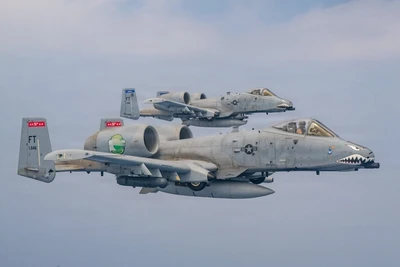
Two US Air Force A-10 aircraft patrol over the Middle East in a photo released by US Central Command.
Tehran has offered to reopen the Strait of Hormuz if Washington lifted its naval blockade, Iran’s envoy to Pakistan said Saturday, while an IRGC-affiliated outlet rejected such an exchange and President Donald Trump raised the possibility of strikes as soon as “tomorrow.”
Iran’s ambassador to Islamabad, Reza Amiri Moghadam, said Tehran had conveyed through Pakistani mediators that it was prepared to reopen the strait if Washington ended its blockade of Iranian ports, the Associated Press reported.
Speaking at a seminar in Islamabad, Moghadam said Iranian officials had communicated that position during visits to Tehran by Pakistan’s army chief, Field Marshal Asim Munir. He accused Trump of rejecting the proposal by insisting the blockade would continue.
Moghadam said Iran remained open to negotiations under a Pakistan-brokered interim agreement reached in June, according to AP’s readout of his remarks.
Pakistan and Qatar helped broker that framework, which envisaged restoring shipping through the strait, lifting the blockade and beginning negotiations on a broader deal covering Iran’s nuclear program.
Al Arabiya separately reported Saturday, citing unnamed sources, that Iran had informed Pakistan it was willing to resume negotiations with Washington and reopen the strait in exchange for the blockade being lifted.
But the IRGC-affiliated Tasnim news agency quoted an informed source rejecting Al Arabiya’s account as “lies and fantasy” and saying Tehran had made no new proposal to Pakistani mediators.
“Iran fundamentally does not accept any equation of the Strait of Hormuz in exchange for the blockade,” the source said, adding that Iran would find ways around the blockade and ultimately break it.
The source said Tehran stood by seven conditions already formally conveyed through mediators. An earlier “seven-day plan” setting out its demands for reopening the strait had been passed to Washington, the source said, adding that insecurity would persist until all Iranian demands were met, including an end to disruption of its ports and shipping.
Tasnim’s denial explicitly targeted Al Arabiya’s report, rather than the ambassador’s remarks reported by AP.
US may attack Iran tomorrow
Trump, meanwhile, kept open the possibility of both military action and an agreement, saying he wanted a permanent solution to prevent Iran from developing a nuclear weapon.
“Do you really think I’m going to tell you if I’m going to do it?” Trump told reporters Saturday. “There’s a possibility I will. There’s also a possibility we’ll have a nice big beautiful agreement.”
He said Iranian leaders wanted a deal but questioned whether they would abide by it.
“They want to make a deal. But the problem is, will they hold the deal?”
Trump argued that ending the military campaign after B-2 bomber strikes in 2025 would have allowed Iran to rebuild its nuclear capabilities and eventually develop a bomb.
“I’ve got to make it permanent. That’s the only reason I’m doing it as long as I’m doing,” he said.
The Hill reported Saturday, citing two sources familiar with the planning, that the US military had prepared options for renewed strikes on Iran after November’s midterm elections.
One source said US Central Command had follow-up strike plans ready pending White House authorization. Another said multiple options were being presented to War Secretary Pete Hegseth and that Trump would keep his options open until a final decision was required.
A Pentagon official told The Hill the department’s “job is to develop and present military options to the President.”
The Wall Street Journal reported earlier in the day that US naval forces are preparing for possible renewed strikes against Iran, with sailors loading munitions and readying aircraft aboard American warships.
The preparations include the USS George Washington aircraft carrier strike group, as Washington considers further military action against the Islamic Republic.