Sri Lanka rescues 40 Iranian sailors from stranded ships
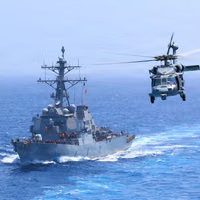
Sri Lanka Navy personnel assist Iranian sailors during a rescue operation after responding to a distress call from their vessel, the Iranian military ship, IRIS Dena, while at sea within Sri Lanka’s maritime search and rescue region, in Indian Ocean, Sri Lanka, March 4, 2026.
Sri Lanka rescued 40 Iranian sailors from commercial ships in international waters off its coast following medical emergencies and helped arrange their return to Iran, foreign ministry spokesman Thushara Rodrigo said on Sunday.
Rodrigo said the operation followed a request from the Iranian embassy through diplomatic channels to assist sailors suffering from unspecified medical emergencies.
The sailors were brought ashore at Galle Harbour, about 126 kilometers (78 miles) from the commercial capital Colombo, where they received medical treatment before returning to Iran.
The ministry did not provide details about the medical emergencies or the circumstances requiring the sailors' evacuation.
Reuters said the sailors came from 19 commercial ships, while local media, including reports citing India's The Hindu newspaper, identified the vessels as US-sanctioned oil tankers.
The Associated Press (AP) separately reported that the Iranian embassy and local shipping agents arranged vessels to transport the sailors ashore, while Sri Lankan authorities handled immigration and other administrative procedures.
AP said the ships were among Iranian vessels stranded near Sri Lanka following the US naval blockade imposed as part of Washington's war against Iran.
Sri Lankan authorities previously acknowledged that 19 ships were positioned about 24 nautical miles off the country's coast, with crews reporting shortages of food, water and fuel.
Earlier this month, Sri Lankan officials said they had no immediate plans to assist the stranded vessels, citing national interests and concerns about potential US secondary sanctions, according to AP.
The latest operation follows an earlier rescue involving Iranian military personnel off Sri Lanka's coast.
On March 4, a US submarine torpedoed and sank the Iranian warship IRIS Dena in international waters near Sri Lanka, killing more than 80 sailors.
The bodies of those killed were returned to Iran in mid-March, while 32 survivors of the sunken warship and 208 crew members from another Iranian vessel were repatriated in April.
Iran's judiciary has indicted comedian Saeed Shakiba on charges including supporting Israel and the Pahlavi dynasty, state media reported on Sunday, days after authorities opened a case against him over a video impersonating former Supreme Leader Ali Khamenei.
The judiciary-affiliated Mizan news agency said Tehran prosecutors had issued the indictment following an investigation into what authorities described as insulting and offensive content published by the comedian on Instagram.
According to Mizan, the charges include knowingly expressing support for Israel on social media, insult and engaging in propaganda against the Islamic Republic through negative portrayals of the country and support for the Pahlavi dynasty, which ruled Iran until the 1979 Islamic Revolution.
Mizan said the case had been referred to court for further proceedings.
Shakiba came under scrutiny after publishing a satirical video on October 13 in which he imitated Khamenei's voice, parodying his meetings with poets.
On October 14, Mizan announced that Tehran prosecutors had opened a case against a social media personality identified only by the initials S.Sh., accusing him of publishing insulting and offensive content.
The agency said action had been taken against the individual but provided no details about the measures, the specific charges or his whereabouts.
US-based rights group Human Rights Activists in Iran (HRANA) reported on October 14 that authorities had opened a case against Shakiba following the satirical video, saying the judiciary had not disclosed details about the proceedings or his situation.
Shakiba is known for posting comedy videos and voice impressions of prominent figures on Instagram, where he had around one million followers.
Following the announcement of legal proceedings, posts on his Instagram account were removed. A notice bearing the emblem of Iran's police said the account had been restricted by judicial order over what authorities called criminal content.
The Islamic Revolutionary Guard Corps-affiliated Fars news agency also criticized the video, accusing Shakiba of insulting Khamenei and his family.
Shakiba had previously published satirical impressions of other Islamic Republic officials and expressed support for protestors killed during the January uprising.
Previous arrests and prosecutions of Iranian comedians
Iranian authorities have previously arrested and sentenced comedians and satirists over their work, drawing criticism from human rights groups.
Shaker Bori
Last month, Shaker Bori, a comedian and social media personality from the southwestern city of Abadan, was sentenced to 13 months and 20 days in prison for disseminating false information with the intent to harm others, according to the rights group HRANA.
Bori was also fined 45 million rials (approximately $17) for insulting a member of parliament. The case followed a complaint by lawmaker Mousa Ghazanfarabadi over a video Bori had published.
Bori had previously been arrested on July 31, 2023, after reporting to an Islamic Revolutionary Guard Corps intelligence office in Abadan to seek the return of his confiscated mobile phone, according to the Norway-based rights group Hengaw.
He was released on bail on August 10, 2023, after spending 10 days in detention.
Zeinab Mousavi, known for her online character Empress Kuzco
Another comedian, Zeinab Mousavi, known for her online character Empress Kuzco, was sentenced to six months in prison in November 2025 over a satirical video about Ferdowsi, the celebrated Persian poet.
In February 2026, a Tehran appeals court upheld the sentence, which also included a fine of 160 million rials (approximately $59) and an order to write a research paper about Ferdowsi, according to HRANA.
Mousavi had previously been arrested in October 2022 in the central city of Qom during nationwide protests sparked by the death of Mahsa Amini in morality police custody. She was released on bail in November that year and subsequently sentenced to two years in prison.
Mousavi said she had spent 25 days in solitary confinement during her detention.
She was arrested again in 2023 and released several days later, according to HRANA.
Kioomars Marzban
In another case, satirical writer Kioomars Marzban was arrested at his home on August 26, 2018, by Revolutionary Guard intelligence agents.
Marzban was sentenced in August 2019 to 23 years and nine months in prison on charges including insulting the supreme leader, propaganda against the Islamic Republic and cooperating with a hostile state, according to HRANA.
The sentence, of which 11 years were enforceable under Iranian law, was upheld on appeal in October 2019.
Marzban was released from Tehran's Evin prison in February 2021 after serving approximately two and a half years. His lawyer, Mohammad Hossein Aghasi, said six years of his sentence had been pardoned and the remainder suspended, according to freedom of expression organization ARTICLE 19.
Following his release, ARTICLE 19 condemned his prosecution, saying he should never have been imprisoned for his writing.
"His case is emblematic of the Iranian authorities' zero tolerance for freedom of expression and the Judiciary's lack of independence," said Saloua Ghazouani, then director of ARTICLE 19's Middle East and North Africa program.
PEN America has also criticized Iran's treatment of satirical artists. In June 2023, the organization condemned the arrest of cartoonist Atena Farghadani following the publication of a satirical drawing on Instagram.
"Cartoonists should not be persecuted for their creative expression," said Julie Trébault, then director of PEN America's Artists at Risk Connection.
PEN America said the arrest reflected broader efforts by Iranian authorities to intimidate artists, journalists and activists.
A pedestrian passes as an artist paints a mural on a wall in the Chaharmardan neighborhood of Qom, central Iran.
Iran may be approaching a mental-health emergency as prolonged uncertainty over war, economic pressure and the future takes a growing toll on the public, the head of the country’s Psychology and Counseling Organization said on Sunday.
Asked by ILNA how far Iranian society was from a mental-health emergency, Alireza Agha-Yousefi said: “I don’t think we are very far from it.”
He pointed to marriage, divorce and birth rates as areas of concern and said authorities needed to act before psychological and social problems became more severe.
Uncertainty and prolonged stress
Agha-Yousefi said the prolonged state of neither full-scale war nor peace was itself becoming a major source of pressure.
“The overall condition of society in a situation of neither war nor peace can create significant psychological strain,” he said.
He said people normally try to meet their needs while also responding to threats, but when both are present at the same time, threats tend to dominate.
“Uncertainty about the future is one of the most difficult situations,” he said, adding that it deprives people of the ability to plan their lives.
Agha-Yousefi said prolonged uncertainty could produce severe anxiety and, over time, lead to both physical and psychological exhaustion.
Effects may emerge later
He cautioned that the consequences of intense stress do not always appear immediately.
“The effects may show themselves one or two years later,” he said, citing depression, marital conflict and physical health problems as possible outcomes.
He also pointed to prolonged muscle tension, joint and spinal pain and gastrointestinal problems as conditions that can be associated with chronic stress.
President Masoud Pezeshkian last week also described the current “no war, no peace” situation as the worst position Iran could be in, as tensions with Washington remained unresolved.
Agha-Yousefi said the same economic conditions contributing to psychological strain were also making treatment less accessible.
He said demand for counselling had risen, but inflation and declining purchasing power meant many people could no longer afford psychological services.
“Psychological services are not covered by basic insurance,” he said, adding that official figures on the number of people seeking treatment could therefore give a misleading picture.
He said some people who need help simply do not seek it because of the cost.
A proposal to bring psychological services under insurance coverage had been submitted to the organization’s central council around four months ago but had yet to be approved, he said.
Pressure on families and social stability
Agha-Yousefi also said Iran appeared to be moving toward greater social dislocation.
“It seems our social situation is, to some extent, moving toward anomie or social normlessness,” he said.
He warned that as social stress rises, the effects can spread into family life and wider social behavior, including later marriage, addiction and greater instability within households.
“When problems enter the family, they can be a sign of deeper social damage,” he said.
He added that severe family pressures could, in some cases, contribute to extreme violence, including killings within families.
Agha-Yousefi said delaying preventive measures would make the psychological, physical and social consequences much harder and more expensive to address later.
War fears add to uncertainty
His comments come as speculation grows over possible renewed US and Israeli military action against Iran.
Recent reports have said the US military has prepared options for further strikes after the November 3 midterm elections if President Donald Trump authorizes them.
That uncertainty has added another layer of pressure to an economy already strained by inflation, a weakening currency and declining purchasing power.
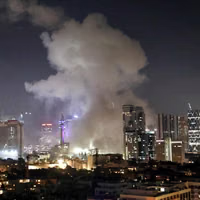
Smoke billows following missile attack from Iran on Israel, at Tel Aviv, Israel, June 13, 2025.
The war with Iran raises a familiar question for Israel: Can battlefield gains produce lasting peace? Its military history offers mixed answers, from unresolved victories to withdrawals and ceasefires that left adversaries armed.
Destroying Iran’s military capabilities and preventing their reconstruction are different objectives, requiring different measures of success.
Since 1948, Israel has fought conventional Arab armies and armed organizations such as Hezbollah and Hamas, and has increasingly confronted Iran directly through missile, drone and air attacks far beyond its borders. These forms of warfare have overlapped, posing different challenges for bringing the fighting to an end.
Their endings show how battlefield outcomes interact with diplomacy, outside pressure and arrangements for security after the fighting.
1948: Survival without peace
Fighting between Jewish and Arab communities followed the UN’s 1947 partition plan. After Israel declared independence in May 1948, neighboring Arab armies entered the conflict. Israel survived and gained territory beyond the boundaries proposed for the Jewish state.
In 1949, it signed separate armistice agreements with Egypt, Lebanon, Jordan and Syria. These established lines separating the forces, rather than permanent political settlements. The Egyptian agreement explicitly envisaged a subsequent peaceful settlement.
Israel’s survival did not resolve the territorial dispute or the displacement of Palestinians. The fighting ended without peace between Israel and its neighbors.
1956: Military gains, withdrawal under pressure
During the Suez crisis, Israel attacked Egypt in coordination with Britain and France, rapidly advancing across Sinai.
Pressure from the United States, the Soviet Union and the United Nations forced a withdrawal, completed in March 1957. Israel could not retain the territory it had captured, despite its battlefield success.
The outcome nevertheless brought security gains: Israel regained access to the Straits of Tiran, while a UN emergency force deployed in Sinai. The US State Department’s historical account distinguishes those gains from the territorial withdrawal.
The episode illustrates why withdrawal is not automatically evidence of military defeat, and why military superiority alone does not determine a war’s political outcome.
1967: Six days of fighting, decades of consequences
Israel’s opening airstrikes devastated Egypt’s air force. Within six days, Israeli forces had captured Sinai, Gaza, the West Bank, East Jerusalem and the Golan Heights. The war ended through ceasefires, without a formal surrender by the defeated Arab states. Israel’s decisive battlefield victory transformed the territorial balance but did not settle the conflict.
UN Security Council Resolution 242 subsequently established a framework linking Israeli withdrawal from occupied territory with an end to belligerency and recognition of states’ right to live within secure, recognized boundaries.
The military result was immediate. Disputes over occupation, borders and Palestinian rights lasted far beyond the fighting.
Egyptian fighter jets are seen after being destroyed by Israel's Air Force. File photo
1973: From surprise attack to a peace treaty
Egypt and Syria attacked Israeli forces in Sinai and the Golan Heights in October 1973, initially making substantial gains. Israel counterattacked and crossed the Suez Canal before US-Soviet diplomacy and UN ceasefire resolutions helped stop the fighting.
The US State Department’s history describes the war as opening the way for Henry Kissinger’s shuttle diplomacy and, ultimately, the Egyptian-Israeli peace treaty. Egypt did not recover all Sinai through military action, but the war helped break the diplomatic stalemate.
The 1978 Camp David accords provided the framework for the 1979 treaty. Israel agreed to withdraw from Sinai in exchange for peace with Egypt. The main withdrawal was completed in 1982; the disputed Taba area was returned in 1989 following arbitration.
Egypt recovered territory through a combination of war and diplomacy. Israel exchanged territorial control for a political agreement with a major adversary.
Israel’s 1982 invasion drove into Beirut, where US-mediated arrangements secured the departure of Palestine Liberation Organization leaders and fighters. This was an evacuation from Beirut, not the elimination of every Palestinian armed presence in Lebanon.
Israel withdrew much of its force in 1985 but retained a southern security zone alongside the allied South Lebanon Army. Its remaining troops left in May 2000, following years of conflict with Hezbollah. UNIFIL’s historical account records both withdrawals.
The withdrawal was unilateral, without a peace treaty or formal Israeli surrender. Hezbollah portrayed it as a victory; Israel ended a prolonged deployment without resolving the underlying confrontation.
The departure of one armed organization’s leadership in 1982 had not produced a lasting end to fighting.
Israeli tanks are positioned near Israel's border with Lebanon, in northern Israel. File Photo
2006: A ceasefire without disarmament
The 2006 war followed Hezbollah’s cross-border attack and capture of two Israeli soldiers. Israel launched extensive air and ground operations, but Hezbollah remained armed and continued firing rockets during the conflict.
Neither side’s survival or military performance alone explains the settlement. The operative mechanism was UN Security Council Resolution 1701, adopted on August 11, followed by a cessation of hostilities on August 14.
It called for Hezbollah to stop attacks, Israel to stop offensive operations, and Israeli forces to withdraw as Lebanese troops and an expanded UNIFIL deployed. It envisaged an area between the Blue Line and Litani River free of armed personnel and weapons other than those of the Lebanese government and UNIFIL.
Hezbollah was not disarmed. Nevertheless, UNIFIL says the arrangements helped sustain almost 17 years of relative calm before the escalation beginning in 2023. An incomplete settlement still had significant practical effects.
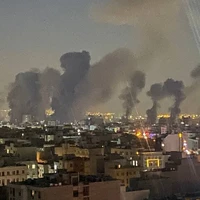
A view shows houses and buildings destroyed in Israeli strikes, in Jabalia in the northern Gaza Strip. File Photo
Gaza: Repeated campaigns and rebuilding
The Gaza wars of 2008–09, 2012, 2014 and 2021 ended without Hamas surrendering or losing all its military capabilities.
Scholars Efraim Inbar and Eitan Shamir described Israel’s approach as “mowing the grass”: periodically degrading an adversary’s capabilities and restoring deterrence rather than expecting a permanent political resolution through force. Their study appeared online in 2013 and in the Journal of Strategic Studies in 2014.
After Hamas’s October 7, 2023 attack, Israel set broader objectives, including dismantling its military and governing capabilities and recovering the hostages. Shamir argued that the attack marked a departure from the previous limited-campaign approach. That was his strategic assessment, rather than proof that eliminating Hamas was achievable.
The ensuing war devastated Gaza. The October 2025 ceasefire did not settle its future: a year later, the UN human rights office was still reporting killings despite the agreement.
Lebanon after 2023: Military damage and state authority
Israel’s 2024 campaign killed Hezbollah leader Hassan Nasrallah and other senior commanders, severely damaging its leadership. The fighting nevertheless moved toward a negotiated cessation of hostilities rather than formal surrender.
The US-French-brokered arrangement took effect on November 27, 2024, and again rested on implementing Resolution 1701, Lebanese state authority and Israeli withdrawal.
Disarmament remained contested. In October 2026, The Wall Street Journal reported that Hezbollah demanded the return of explosives seized by Lebanese authorities, illustrating the continuing struggle over weapons outside state control.
Missiles launched from Iran are intercepted as seen from Tel Aviv, Israel, June 13, 2025.
Iran: Ending operations or preventing reconstruction?
The June 2025 war involved Israeli attacks on Iranian military and nuclear targets and direct US strikes on Fordow, Natanz and Isfahan. US involvement therefore preceded the broader war of 2026.
Israel’s Foreign Ministry described the nuclear threat as “existential and imminent” in its account of the operation. That characterization was Israel’s stated justification, not an independently established finding that Iran possessed nuclear weapons. The same document records Israel’s acceptance of a US-proposed ceasefire on June 24. The broader confrontation in 2026 extended to shipping and energy supplies. By October, the US naval blockade and the standoff over reopening the Strait of Hormuz remained unresolved.
Netanyahu has explicitly advocated moving beyond containment. Addressing military cadets in February 2026, he declared there would be “no more containment of threats” and emphasized preemptive action. This supports describing a shift in his stated approach, without assuming a uniform doctrine across every Israeli institution.
Destroying launchers or facilities has measurable immediate effects. Preventing their reconstruction depends on industrial capacity, supply networks, political decisions and whatever monitoring or enforcement follows.
Possible scenarios
Within the approach of seeking to prevent Iran from rebuilding its military threat, two scenarios can be considered. Neither is a prediction or an exhaustive account of how the conflict might end.
The first is a military defeat sufficiently extensive to destroy much of Iran’s offensive capability and substantially constrain its reconstruction. Lasting results would depend on measures that prevent replenishment, rather than destruction alone. The second combines military defeat with the end of the Islamic Republic and its replacement by a political system that abandons hostility toward Israel and support for armed proxies.
That scenario depends on more than a change of leadership. It assumes a successor government both chooses and can enforce a different policy, including ending financial, military and operational support for allied armed groups. A government’s collapse would not itself establish those conditions.
The scenarios may overlap, but neither guarantees stability. Their outcomes would depend on political authority, security arrangements and the capacity to enforce commitments after combat ends.
Other possible outcomes include a negotiated agreement that constrains Iran’s capabilities without changing its government, or a prolonged armed standoff sustained by deterrence. Neither would necessarily eliminate the underlying hostility, though either could bring the current fighting to an end.
Israel’s earlier wars provide different benchmarks: territorial withdrawal under international pressure in 1956, land exchanged for peace with Egypt, unilateral withdrawal from Lebanon, and ceasefire arrangements that reduced fighting without disarming Hezbollah. Each ended a particular phase of conflict; only some produced a broader political settlement.
Armed Baluch groups in Iran’s southeast are adding one more strain on the Islamic Republic’s security forces just as war has stretched them thinnest, with 18 attacks in the 18 days to October 10, more than in any full month this year.
At least 63 armed incidents were documented across Sistan and Baluchestan and neighboring Kerman province between March 31 and October 10, leaving at least 94 people dead and 33 injured, according to the rights group HRANA. The attacks have grown more complex as well as more frequent: coordinated ambushes, roadside bombs and heavier weapons.
The question is whether a decades-old insurgency, long contained by force, can become a wider problem for a state fighting on other fronts.
A coalition with bigger aims
Several Baluch armed organizations joined forces in December 2025 under the People’s Fighters Front. The coalition includes Jaish al-Adl, which Iran and the United States both list as a terrorist organization.
The front has increasingly framed its goal as ending the Islamic Republic’s rule rather than winning concessions for the Baluch. Whether it can draw support beyond the southeast is unproven.
Its timing is not accidental. Iran’s security services are absorbing the consequences of war with the United States and Israel while still needing the forces they rely on to suppress dissent at home.
Rahim Bandoui, an Iranian-Baluch human rights activist and senior member of the Balochistan People’s Party, said the conflict itself is nothing new.
Speaking on Iran International’s Eye for Iran podcast, he traced it to decades of repression, arguing that Tehran has long treated peaceful political activity and armed resistance in the province as the same security threat.
What has changed, he said, is the state’s position. A government weakened by war presents armed groups with an opening they did not have before.
What the attacks can and cannot do
If the attacks keep growing, Tehran will have to send more personnel and resources to the southeast at a time when its security forces are already stretched. Those forces have contained unrest there before through military operations, mass arrests and lethal force. A sustained insurgency adds a cost on top of the war.
That cost could be felt elsewhere. Every unit tied down in Sistan and Baluchestan is one not available against protests or other opposition in the rest of the country.
The limits are real, though. There is no evidence the coalition can take and hold territory or threaten the central government’s control. Its political ambitions face a further obstacle across the border: Baluch armed groups in Pakistan differ considerably from their Iranian counterparts in ideology and aims, so a unified cross-border movement is unlikely without substantial change on both sides.
The grievances underneath
The insurgency sits on grievances that successive crackdowns have failed to address.
Sistan and Baluchestan, home to a mostly Sunni Baluch population, is among Iran’s poorest provinces despite its position on the Pakistani and Afghan borders and its natural resources. Residents face discrimination, few jobs and poor access to schools, clinics and other basic services.
Tens of thousands of people in the province have no official identity documents, Sabah Baluch, a human rights advocate with Iran House, told the podcast, which shuts them out of basic services and legal rights. For some families that has meant generations without formal schooling or work.
Hardship pushes residents into dangerous informal work, above all carrying fuel across the border, where they risk being shot by security forces or burning to death in vehicle fires.
The province has also seen some of the Islamic Republic’s deadliest violence against dissent. On September 30, 2022, during the nationwide protests that followed the death of Mahsa Amini, security forces killed at least 87 people in Zahedan, the provincial capital, most of them Baluch worshippers, in what became known as Bloody Friday.
Baluch prisoners are also executed out of all proportion to their numbers. According to Iran Human Rights, they accounted for 20 percent of recorded executions in 2023, 11 percent in 2024 and 9 percent in 2025, from a group that is a small fraction of Iran’s population.
The larger question
For now the Islamic Republic retains the military and security capacity to hold the southeast, and nothing suggests the insurgency can change the balance of power on its own.
The larger question is not whether armed groups can defeat government forces in Sistan and Baluchestan. It is whether a state that has relied on lethal force against its opponents for decades can go on containing several challenges at once while war makes new demands on the forces it uses to do so.
For Iran’s wider opposition, the answer will matter well beyond the southeast.
US President Donald Trump boards Air Force One for a trip to Sioux City, Iowa, at Joint Base Andrews, Maryland, US, October 22, 2026.
The United States is tightening economic pressure on Iran to bolster efforts to reach a diplomatic solution and can sustain its naval blockade for the foreseeable future, the US Ambassador to the UN said, as President Donald Trump weighs renewed strikes after midterm elections.
Mike Waltz told the Financial Times that Washington still wanted Tehran to return to negotiations and reach what he called a “meaningful agreement” on its nuclear program, but acknowledged the standoff could continue without a deal or a return to prewar shipping levels through the Strait of Hormuz.
“The president and the US Navy can maintain this blockade for the foreseeable future,” Waltz said, adding that the administration was continuing to tighten economic pressure.
He said the US would not consider its objectives achieved until Iran’s highly enriched nuclear material had been dealt with and an agreement reached over domestic uranium enrichment.
Trump considers renewed strikes after midterms
The comments come as Trump is considering several days of renewed strikes against Iran after the midterms, The Atlantic reported, citing officials and people familiar with the discussions.
Potential targets include Iran’s missile and drone arsenal, energy infrastructure and nuclear facilities, according to the report. One outside adviser told the magazine that US economic pressure was working and that additional strikes could push Iran closer to collapse.
An official and another person familiar with the talks said Trump had initially hoped Tehran would return to negotiations before the election, but that had not happened.
US officials stressed that no decision had been made on whether to resume strikes after November 3. The Atlantic said some officials also saw uncertainty over Washington’s next move as a way of keeping Tehran under pressure.
Israeli Prime Minister Benjamin Netanyahu had pushed for another round of strikes before Israel’s election, according to the report, but Trump has so far declined to authorize a new attack before the US vote.
Washington and Tehran trade competing Hormuz messages
The military pressure is unfolding alongside sharply different accounts from Washington and Tehran over control of the Strait of Hormuz.
Trump said on Thursday that more oil had moved through the strait over the previous week than at any point before the war, attributing the increase to the US blockade.
“More oil came out of the Hormuz Strait over the last week than at any time previous, including before the war,” Trump told a campaign rally in Iowa. “That’s because of the blockade.”
He said the blockade had stopped Iran from exporting its own oil and again argued that US military action had destroyed Tehran’s nuclear enrichment capacity.
IRGC says US pushed away from the strait
Iran, however, presented a very different picture on Friday.
IRGC Navy commander Ali Ozmaei said US forces had been pushed hundreds of kilometers away from the Strait of Hormuz and no longer had a place there.
“Today, the Americans are not present in the Persian Gulf and have moved 600 to 700 kilometers away from the Strait of Hormuz,” Ozmaei said. “America no longer has a place in the Strait of Hormuz.”
The competing statements underscore how control of shipping and access through Hormuz have become central to both sides’ strategy, as Washington seeks to pressure Tehran economically while keeping open the possibility of renewed military action.