From six-day victory to wars of attrition: How has Israel ended its wars?
The current war with Iran raises a question Israel has repeatedly faced: can battlefield gains produce a lasting end to conflict? The Jewish State's military history offers varied answers: victories that left underlying disputes unresolved, withdrawals without formal surrender, and ceasefires that left adversaries armed.
Destroying Iran’s military capabilities and preventing their reconstruction are different objectives, requiring different measures of success.
Since 1948, Israel has fought conventional Arab armies and armed organizations such as Hezbollah and Hamas, and has increasingly confronted Iran directly through missile, drone and air attacks far beyond its borders. These forms of warfare have overlapped, posing different challenges for bringing the fighting to an end.
Their endings show how battlefield outcomes interact with diplomacy, outside pressure and arrangements for security after the fighting.
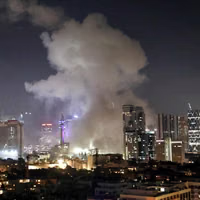
Smoke billows following missile attack from Iran on Israel, at Tel Aviv, Israel, June 13, 2025.
The war with Iran raises a familiar question for Israel: Can battlefield gains produce lasting peace? Its military history offers mixed answers, from unresolved victories to withdrawals and ceasefires that left adversaries armed.
Destroying Iran’s military capabilities and preventing their reconstruction are different objectives, requiring different measures of success.
Since 1948, Israel has fought conventional Arab armies and armed organizations such as Hezbollah and Hamas, and has increasingly confronted Iran directly through missile, drone and air attacks far beyond its borders. These forms of warfare have overlapped, posing different challenges for bringing the fighting to an end.
Their endings show how battlefield outcomes interact with diplomacy, outside pressure and arrangements for security after the fighting.
1948: Survival without peace
Fighting between Jewish and Arab communities followed the UN’s 1947 partition plan. After Israel declared independence in May 1948, neighboring Arab armies entered the conflict. Israel survived and gained territory beyond the boundaries proposed for the Jewish state.
In 1949, it signed separate armistice agreements with Egypt, Lebanon, Jordan and Syria. These established lines separating the forces, rather than permanent political settlements. The Egyptian agreement explicitly envisaged a subsequent peaceful settlement.
Israel’s survival did not resolve the territorial dispute or the displacement of Palestinians. The fighting ended without peace between Israel and its neighbors.
1956: Military gains, withdrawal under pressure
During the Suez crisis, Israel attacked Egypt in coordination with Britain and France, rapidly advancing across Sinai.
Pressure from the United States, the Soviet Union and the United Nations forced a withdrawal, completed in March 1957. Israel could not retain the territory it had captured, despite its battlefield success.
The outcome nevertheless brought security gains: Israel regained access to the Straits of Tiran, while a UN emergency force deployed in Sinai. The US State Department’s historical account distinguishes those gains from the territorial withdrawal.
The episode illustrates why withdrawal is not automatically evidence of military defeat, and why military superiority alone does not determine a war’s political outcome.
1967: Six days of fighting, decades of consequences
Israel’s opening airstrikes devastated Egypt’s air force. Within six days, Israeli forces had captured Sinai, Gaza, the West Bank, East Jerusalem and the Golan Heights. The war ended through ceasefires, without a formal surrender by the defeated Arab states. Israel’s decisive battlefield victory transformed the territorial balance but did not settle the conflict.
UN Security Council Resolution 242 subsequently established a framework linking Israeli withdrawal from occupied territory with an end to belligerency and recognition of states’ right to live within secure, recognized boundaries.
The military result was immediate. Disputes over occupation, borders and Palestinian rights lasted far beyond the fighting.
Egyptian fighter jets are seen after being destroyed by Israel's Air Force. File photo
1973: From surprise attack to a peace treaty
Egypt and Syria attacked Israeli forces in Sinai and the Golan Heights in October 1973, initially making substantial gains. Israel counterattacked and crossed the Suez Canal before US-Soviet diplomacy and UN ceasefire resolutions helped stop the fighting.
The US State Department’s history describes the war as opening the way for Henry Kissinger’s shuttle diplomacy and, ultimately, the Egyptian-Israeli peace treaty. Egypt did not recover all Sinai through military action, but the war helped break the diplomatic stalemate.
The 1978 Camp David accords provided the framework for the 1979 treaty. Israel agreed to withdraw from Sinai in exchange for peace with Egypt. The main withdrawal was completed in 1982; the disputed Taba area was returned in 1989 following arbitration.
Egypt recovered territory through a combination of war and diplomacy. Israel exchanged territorial control for a political agreement with a major adversary.
Israel’s 1982 invasion drove into Beirut, where US-mediated arrangements secured the departure of Palestine Liberation Organization leaders and fighters. This was an evacuation from Beirut, not the elimination of every Palestinian armed presence in Lebanon.
Israel withdrew much of its force in 1985 but retained a southern security zone alongside the allied South Lebanon Army. Its remaining troops left in May 2000, following years of conflict with Hezbollah. UNIFIL’s historical account records both withdrawals.
The withdrawal was unilateral, without a peace treaty or formal Israeli surrender. Hezbollah portrayed it as a victory; Israel ended a prolonged deployment without resolving the underlying confrontation.
The departure of one armed organization’s leadership in 1982 had not produced a lasting end to fighting.
Israeli tanks are positioned near Israel's border with Lebanon, in northern Israel. File Photo
2006: A ceasefire without disarmament
The 2006 war followed Hezbollah’s cross-border attack and capture of two Israeli soldiers. Israel launched extensive air and ground operations, but Hezbollah remained armed and continued firing rockets during the conflict.
Neither side’s survival or military performance alone explains the settlement. The operative mechanism was UN Security Council Resolution 1701, adopted on August 11, followed by a cessation of hostilities on August 14.
It called for Hezbollah to stop attacks, Israel to stop offensive operations, and Israeli forces to withdraw as Lebanese troops and an expanded UNIFIL deployed. It envisaged an area between the Blue Line and Litani River free of armed personnel and weapons other than those of the Lebanese government and UNIFIL.
Hezbollah was not disarmed. Nevertheless, UNIFIL says the arrangements helped sustain almost 17 years of relative calm before the escalation beginning in 2023. An incomplete settlement still had significant practical effects.
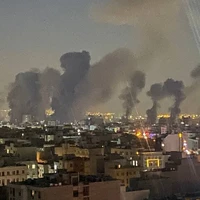
A view shows houses and buildings destroyed in Israeli strikes, in Jabalia in the northern Gaza Strip. File Photo
Gaza: Repeated campaigns and rebuilding
The Gaza wars of 2008–09, 2012, 2014 and 2021 ended without Hamas surrendering or losing all its military capabilities.
Scholars Efraim Inbar and Eitan Shamir described Israel’s approach as “mowing the grass”: periodically degrading an adversary’s capabilities and restoring deterrence rather than expecting a permanent political resolution through force. Their study appeared online in 2013 and in the Journal of Strategic Studies in 2014.
After Hamas’s October 7, 2023 attack, Israel set broader objectives, including dismantling its military and governing capabilities and recovering the hostages. Shamir argued that the attack marked a departure from the previous limited-campaign approach. That was his strategic assessment, rather than proof that eliminating Hamas was achievable.
The ensuing war devastated Gaza. The October 2025 ceasefire did not settle its future: a year later, the UN human rights office was still reporting killings despite the agreement.
Lebanon after 2023: Military damage and state authority
Israel’s 2024 campaign killed Hezbollah leader Hassan Nasrallah and other senior commanders, severely damaging its leadership. The fighting nevertheless moved toward a negotiated cessation of hostilities rather than formal surrender.
The US-French-brokered arrangement took effect on November 27, 2024, and again rested on implementing Resolution 1701, Lebanese state authority and Israeli withdrawal.
Disarmament remained contested. In October 2026, The Wall Street Journal reported that Hezbollah demanded the return of explosives seized by Lebanese authorities, illustrating the continuing struggle over weapons outside state control.
Missiles launched from Iran are intercepted as seen from Tel Aviv, Israel, June 13, 2025.
Iran: Ending operations or preventing reconstruction?
The June 2025 war involved Israeli attacks on Iranian military and nuclear targets and direct US strikes on Fordow, Natanz and Isfahan. US involvement therefore preceded the broader war of 2026.
Israel’s Foreign Ministry described the nuclear threat as “existential and imminent” in its account of the operation. That characterization was Israel’s stated justification, not an independently established finding that Iran possessed nuclear weapons. The same document records Israel’s acceptance of a US-proposed ceasefire on June 24. The broader confrontation in 2026 extended to shipping and energy supplies. By October, the US naval blockade and the standoff over reopening the Strait of Hormuz remained unresolved.
Netanyahu has explicitly advocated moving beyond containment. Addressing military cadets in February 2026, he declared there would be “no more containment of threats” and emphasized preemptive action. This supports describing a shift in his stated approach, without assuming a uniform doctrine across every Israeli institution.
Destroying launchers or facilities has measurable immediate effects. Preventing their reconstruction depends on industrial capacity, supply networks, political decisions and whatever monitoring or enforcement follows.
Possible scenarios
Within the approach of seeking to prevent Iran from rebuilding its military threat, two scenarios can be considered. Neither is a prediction or an exhaustive account of how the conflict might end.
The first is a military defeat sufficiently extensive to destroy much of Iran’s offensive capability and substantially constrain its reconstruction. Lasting results would depend on measures that prevent replenishment, rather than destruction alone. The second combines military defeat with the end of the Islamic Republic and its replacement by a political system that abandons hostility toward Israel and support for armed proxies.
That scenario depends on more than a change of leadership. It assumes a successor government both chooses and can enforce a different policy, including ending financial, military and operational support for allied armed groups. A government’s collapse would not itself establish those conditions.
The scenarios may overlap, but neither guarantees stability. Their outcomes would depend on political authority, security arrangements and the capacity to enforce commitments after combat ends.
Other possible outcomes include a negotiated agreement that constrains Iran’s capabilities without changing its government, or a prolonged armed standoff sustained by deterrence. Neither would necessarily eliminate the underlying hostility, though either could bring the current fighting to an end.
Israel’s earlier wars provide different benchmarks: territorial withdrawal under international pressure in 1956, land exchanged for peace with Egypt, unilateral withdrawal from Lebanon, and ceasefire arrangements that reduced fighting without disarming Hezbollah. Each ended a particular phase of conflict; only some produced a broader political settlement.
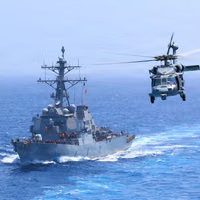
The USS Donald Cook (DDG 75) transits the Arabian Sea as an MH-60S Sea Hawk flies nearby. (CENTCOM/X)
A possible resumption of US strikes on Iran would serve an increasingly economic war, weakening Tehran’s ability to challenge a blockade that Washington appears prepared to maintain for the foreseeable future.
A strike on Iran could "absolutely" come this weekend, the US ambassador to Turkey, Tom Barrack, said Friday, and the administration hasn’t said what it would be for.
The New York Times reports that US and Israeli planners have drawn up a short, intensive campaign for after the November 3 midterms, aimed at Iran’s missile and drone arsenal, nuclear sites and energy infrastructure.
Critics read the reports as proof that there is no strategy anymore. That reads the war through the lens of February, when the economic campaign existed to support the war. Whether the administration designed it this way or simply ended up here, the strikes now serve the economic campaign, which is proving more harmful to the regime than the strikes ever were.
Washington has committed to the blockade and treats the strikes as optional. Speaking to reporters Friday, President Trump said the choice was whether to finish it off or let it wither, and that with oil moving through Hormuz the US was getting everything it wanted. Mike Waltz, the US ambassador to the United Nations, told the Financial Times the same day that the president and the Navy can maintain the blockade for the foreseeable future while the administration keeps tightening economic pressure.
The US is now running a siege. It has sharply restricted Iran’s access to oil buyers, international finance and regional trade. The job of the military is to keep the cordon from being broken. The shift in strategy came in July, when the US restored the blockade after the June memorandum collapsed and the strikes that followed were about the strait.
Central Command said its July strikes were meant to degrade Iran’s ability to attack commercial shipping. The next round of strikes would be the first planned campaign since the blockade and the sanctions began doing real damage to the regime.
Iran’s imports since the war began show its priority — bringing in the supplies it needs to be able to fight its way out of the blockade. It is bringing in truck parts, missile fuel ingredients and missile and drone components to rebuild the launchers and stockpiles. The Wall Street Journal counted about 1,300 shipments of dual-use components from Chinese suppliers to Iran’s defense ministry in the first half of the year.
On October 1 the Treasury sanctioned Iran’s truck and auto makers, which it called an essential part of Iran’s defense industrial base, and the suppliers in Turkey, the Emirates and East Asia feeding them parts. Iran is assembling missiles from stockpiled components in small numbers, the Journal reported in September, and the blockade has made the solid-fuel components it can’t make harder to import.
Iran loaded no crude oil onto tankers in September, according to Bloomberg. CENTCOM says the blockade has stopped $25 billion in oil exports. The United Arab Emirates halted all trade and financial dealings with Iran in August. The regime has no way to persuade its own base or the Persian Gulf states that it has an answer.
That leaves Tehran a short list of cards to play against the blockade and the sanctions.
The first is attacking commercial shipping in the strait. Maritime security sources recorded at least 12 attacks on tankers around the Strait of Hormuz in the week to October 5, the highest weekly total of the war.
The second is pressuring its neighbors. Iran threatens Persian Gulf energy infrastructure, US bases and undersea cables, and it has the Houthis at Bab el-Mandeb, all meant to push the Persian Gulf states to lobby Washington to end the blockade.
The third is to strain US munition supplies. Mohsen Rezaei, Iran’s security chief, said this week that a long war favors Iran because the test is which side can sustain a cycle of production, deployment and response.
The fourth is to keep offering a deal that it likely won’t make. Tehran’s standing offer is to reopen the strait in seven days in exchange for ending the blockade, easing oil sanctions and releasing frozen assets.
The fifth is the nuclear program, which the regime can negotiate to death over enrichment and dangle in front of Washington for the same price.
A strike goes down that list. The missile and drone arsenal the Times describes, and the launchers, mine-layers, naval sites, radars and air defenses CENTCOM has hit since July, are the hardware behind the regime’s threat to the strait and its neighbors.
Fewer launchers means fewer ships hit and a weaker threat to the Persian Gulf. Hitting stockpiles and production sites limits its ability to strain and outlast US munition supplies, and a strike tests Rezaei’s claim directly. Destroying enough of those capabilities would weaken Iran’s offer to stop attacking shipping in exchange for lifting the blockade.
Washington would have less reason to pay for a threat Iran could no longer credibly sustain. Hitting Pickaxe Mountain doesn’t end the nuclear program, but it leaves Tehran less to bargain with when it asks for sanctions relief.
Holding a blockade is expensive. Destroyers are doing work that cheap systems should do, and the Navy is stretched thin. Fewer Iranian launchers firing at the escort mission means the Navy can hold the line longer without forcing a decision in Washington.
The regime has shown it will take the strikes. Ali Khamenei and Ali Larijani are dead, Mojtaba Khamenei succeeded his father, and Tehran still won’t concede on any deal the US could accept. What it can’t take is the economic war.
The blockade turned the clock against Tehran. The regime’s strategy since February has been to wait — for the administration to lose patience, for the midterms, for the next policy swing.
The US can hold a blockade for the foreseeable future at a cost it can carry. A prolonged loss of oil revenue will make Tehran’s strategy of waiting out Washington increasingly difficult to sustain. The strikes exist to keep that clock running.
File photo: Oil and gas tanks are seen at an oil warehouse at a port in Zhuhai, China
China's imports of oil recorded as Malaysian have plunged alongside the collapse of Iranian exports under the US naval blockade, suggesting how heavily Iran relied on relabeling its crude for its biggest customer.
In September, China imported just 276,000 barrels per day of oil recorded as Malaysian, down from an average of nearly 1.3 million barrels per day in 2025.
In some previous months, the figure had reached 2 million barrels per day. That is roughly four times Malaysia's total oil production.
Much of the discrepancy may reflect oil coming from Iran but recorded by China's customs as originating in Malaysia, alongside sanctioned oil from other producers and genuine Malaysian exports.
Chinese customs authorities have consistently reported zero monthly imports of Iranian oil since 2020. Yet tanker-tracking companies estimate that Iran delivered an average of around 1.5 million barrels per day to China last year.
Sanctions and blockade
Kpler previously told Iran International that most Iranian oil exports to China are recorded as Malaysian, while some cargoes are declared as originating from Iraq, Oman and even the United Arab Emirates. TankerTrackers has also documented the practice.
The decline in China's recorded Malaysian imports has accelerated as US sanctions have tightened and the naval blockade has choked off Iranian exports.
Kpler data obtained by Iran International show that Iran delivered more than 1.55 million barrels per day of oil to China between January and May this year. From June through September, the average fell to less than half that level.
By mid-October, the volume of Iranian oil afloat outside the US blockade line had fallen to zero.
If current trends persist, China's imports of oil recorded as Malaysian could fall to their lowest level in years, potentially approaching the 2017 level of just 130,000 barrels per day as early as this month or next.
Alternative suppliers
While Iranian oil exports have collapsed, tanker-tracking data show that overall oil exports from the Middle East have recovered to prewar levels and even surpassed them.
The Wall Street Journal, citing Kpler data, reported that the region's exports of oil and petroleum products have reached 24 million barrels per day, above the level recorded before the war.
Before the war, more than 80% of the oil passing through the Strait of Hormuz was destined for Asian markets, with China the largest buyer.
Chinese customs data show that in September, China imported an average of 2.9 million barrels per day from Oman, the United Arab Emirates, Qatar, Saudi Arabia and Iraq, up from less than 2 million barrels per day in May.
The figure nevertheless remained below February's prewar level, when China's combined imports from those five countries exceeded 3.8 million barrels per day.
The numbers also reflect a broader shift in Chinese oil buying after the outbreak of war. As global prices surged, China at one point cut overall crude imports by around 30% and drew instead on its strategic petroleum reserves.
In that sense, China acted as a significant shock absorber, helping limit an even sharper increase in global oil prices.
Before the war, China imported around 11.5 million barrels per day of crude. Following the US-Israeli war on Iran and disruption of traffic through the Strait of Hormuz, imports fell to around 8 million barrels per day before recovering more recently to above 9 million.
The shift suggests that China is increasingly replacing lost Iranian barrels with oil from other Middle Eastern producers. The disappearance of China's “Malaysian” imports is yet another measure of how sharply the blockade has curtailed Iran's access to its most important oil market.
Turkish Foreign Minister Hakan Fidan poses with Egyptian Foreign Minister Badr Abdelatty, Pakistan's Deputy Prime Minister and Foreign Minister Mohammad Ishaq Dar, Saudi Arabia's Foreign Minister Prince Faisal bin Farhan Al Saud, French Minister for Europe and Foreign Affairs Jean-Noel Barrot, German Foreign Minister Johann Wadephul, British Foreign Secretary Ed Miliband and Italian Minister of Foreign Affairs International Cooperation Antonio Tajani before their meeting in Istanbul, Turkey, October 23, 2026.
Turkey will host the foreign ministers of seven countries on Friday for talks on the Iran-US war, security in the Strait of Hormuz and Bab al-Mandab, developments in Yemen and the Israeli-Palestinian conflict.
For the first time, Turkey, Saudi Arabia, Egypt and Pakistan will meet Britain, France and Germany for security-focused talks. The meeting comes as attacks on ships and regional energy infrastructure continue and oil prices have reached their highest level in five months.
The Istanbul meeting could mark a shift from regional consultations toward broader security coordination. It follows months of efforts by regional states to build cooperation against threats from the Islamic Republic, particularly attacks by the Iran-backed Houthis.
Turkey, Saudi Arabia and Pakistan — the three members of the Mecca defense pact — will all attend and have committed to using their military capabilities to defend Saudi Arabia. Egypt is also considering military support for Riyadh.
The three European powers are now joining the talks with concerns of their own, particularly over energy.
The platform could lead to a form of division of labor in the Iran war, operating in parallel with US and Israeli military pressure on the Islamic Republic and focused primarily on containing the Iran-backed Houthis.
From regional consultations to defense cooperation
Turkey, Egypt, Pakistan and Saudi Arabia have held regular consultations since March following Houthi threats in Bab al-Mandab. The grouping has become known as the R4.
The four countries have emphasized direct regional involvement in resolving crises and in recent months have adopted common positions on the Iran war, Palestine and Saudi security.
Alongside these diplomatic efforts, Turkey, Saudi Arabia and Pakistan have expanded defense cooperation through the Mecca pact. Under the agreement, an external armed attack on one member is considered an attack on all three.
Officials from the three countries agreed on August 31 to establish a joint secretariat and expand defense cooperation. Their defense committee decided on October 5 to make agreed forces and military capabilities available for rapid deployment to Saudi Arabia.
The four R4 countries also condemned Iran-backed Houthi attacks on Saudi Arabia in an October 11 statement and backed Riyadh’s measures to counter the threats.
Turkey is meanwhile pursuing parliamentary approval of the Mecca pact, while Egypt’s parliament is due to decide on Monday, October 26, whether to deploy forces in military support of Saudi Arabia. Egypt is not a member of the pact, but the prospect of it joining is being seriously considered.
Despite these developments, the countries continue to emphasize a diplomatic solution to the Iran-US war, and some remain in contact with Tehran.
While seeking to prevent the war from spreading, they are also moving closer to joint defensive action against Iran-backed Houthi attacks. These parallel efforts could help contain the crisis and pave the way for a new regional security arrangement, but could also draw the countries deeper into the war and create domestic political tensions.
Containing the Iran-backed Houthis on a parallel track
Protecting critical infrastructure is a central priority for Saudi Arabia in its cooperation with Turkey and Pakistan.
Iran-backed Houthi attacks on Saudi economic and military facilities and insecurity in Bab al-Mandab have caused direct damage while putting pressure on the kingdom’s energy exports and investment plans.
Strengthening Saudi Arabia’s defensive capabilities could reduce some of that vulnerability. But the impact of the new cooperation may extend beyond protecting Saudi facilities.
Saudi defenses against such attacks currently depend on direct US support. A greater role for Turkey and Pakistan, combined with coordination among the four regional countries, could reduce that dependence and allow Washington to devote more resources and attention to the Iran war.
From this perspective, two parallel tracks are taking shape. The United States and Israel are pursuing direct military pressure on Iran, while the countries represented in Istanbul are cooperating to contain the regional consequences of the war.
The two tracks, however, do not constitute a single coalition. Despite their political and security ties with the United States, the regional countries have avoided joint arrangements with Israel, preventing the two approaches from becoming fully integrated.
Cooperation with Washington does not necessarily mean participation in Israel’s strategy. These countries can oppose an expansion of the war against Iran while acting to contain threats arising from it, particularly Houthi attacks.
The practical result could be a form of division of labor even without a formal agreement between the US-Israel camp and the R4.
Iran’s leverage and the risk of diminished influence
The emerging arrangement has particular significance for Iran. If the cooperation succeeds and takes on a military dimension, it would amount to action against an ally of Tehran.
For now, Iran is seeking to raise the cost of continuing the war for the United States and regional countries by leveraging its geographic position in the Strait of Hormuz and its support for the Houthis. Tehran has also promised to respond to actions against its interests.
Alongside maintaining these forms of leverage, Tehran is using diplomacy in an effort to turn them into political gains.
Iranian Foreign Minister Abbas Araghchi has said a seven-day proposal for restoring normal shipping through the Strait of Hormuz was conveyed through Qatar, with implementation conditional on Tehran’s demands being met.
On Yemen, he has said Iran is prepared to mediate between Saudi Arabia and Ansarullah while rejecting the assertion that the Houthis take direct orders from Tehran.
The two positions indicate that Tehran wants to preserve its ability to turn regional pressure into political leverage. Continued pressure, however, could produce a different outcome.
Governments facing attacks on infrastructure and disruption to maritime routes are moving toward closer defense cooperation to reduce their vulnerability, potentially increasing their capacity to confront Iran.
Crucially, reducing the impact of regional pressure does not necessarily require the military defeat of Iran-aligned forces.
If Saudi Arabia can better protect its infrastructure with help from new partners and the threat to shipping in Bab al-Mandab diminishes, part of Tehran’s bargaining power would be reduced.
Its leverage in the Strait of Hormuz would not be directly affected by these arrangements and would remain in Tehran’s hands, though it could become more fragile than before. Much will depend on Tehran’s response to actions taken by the countries participating in the platform.
Ansarullah, however, is an actor with demands of its own, and ending the Yemen war would require a separate agreement.
Continued contacts between Turkey, Pakistan and Egypt and Tehran also indicate that these governments still see a role for the Islamic Republic in reducing tensions. Anadolu Agency has reported that Pakistan’s army chief asked Tehran to use its influence to halt Houthi attacks on Saudi infrastructure.
Europe and the future of regional security
The involvement of Britain, France and Germany could broaden the scope of this emerging cooperation.
Their involvement reflects concerns about the wider consequences of the war, disruption to shipping through the Strait of Hormuz and, above all, energy supplies.
The European countries are joining the R4 states in an effort to address those concerns, but their involvement would also increase NATO’s presence in the region and could potentially lead to an expanded military role.
For Turkey, hosting the meeting provides an opportunity to strengthen its position in regional diplomacy. Saudi Arabia can combine the defensive support of regional partners with broader European consultations.
The European countries, meanwhile, are engaging governments that cooperate with the United States while maintaining political access to Tehran, allowing them both to maintain channels with Iran and signal their opposition to its actions.
Continued European engagement with the R4 could produce a multilayered structure linking political cooperation among the four regional countries, the defense commitments of three of them and diplomatic coordination with Europe.
Such a structure would not immediately replace the US presence and would not necessarily align with Israel’s strategy, but it could give regional countries a larger role in managing crises — a role Turkish President Recep Tayyip Erdogan has strongly pursued.
From this perspective, the Istanbul meeting may signal an emerging division of labor between two parallel tracks: US and Israeli military pressure on Iran on one side, and efforts by regional countries, with European participation, to contain Tehran’s regional proxies on the other.
While such cooperation could help reduce tensions, it also carries the risk of widening the war — a shared concern that has made all sides cautious about taking major military action.
Iranian lawmakers and military officials attend a parliamentary session to confirm Mehrdad Akhlaghi as Iran’s new defense minister, October 17, 2026
Iranian leaders raised the conditions for negotiations with the United States and issued fresh warnings of a wider military response on Wednesday, even as signs persisted that Tehran was leaving room for diplomacy.
President Masoud Pezeshkian said threats and sanctions must be lifted in practice before conditions for negotiations could be established, while Revolutionary Guards spokesman Hossein Mohebbi said Iran would launch offensive operations against any country that attacked it as part of a shift toward asymmetric warfare.
An unnamed senior security official also told state-run Press TV that Iran was prepared for an all-out war and would respond “without restraint” to renewed attacks or assassinations.
The rhetoric coincided with high-level discussions in Tehran. Iranian media reported Wednesday that Parliament Speaker Mohammad Bagher Ghalibaf had met Supreme Leader Mojtaba Khamenei to discuss the latest military and economic developments in the confrontation with the United States and Israel.
The meeting also addressed strengthening Iran's national capabilities, maintaining social cohesion, tackling economic difficulties and “advancing relations with strategic partners,” according to the reports.
Yet diplomatic channels remain active. Russian President Vladimir Putin told US envoy Steve Witkoff on Wednesday that there was still room for diplomacy over Iran and that an agreement with Tehran was needed, according to the Kremlin.
The competing signals leave open whether Tehran is raising the price of a negotiated pause or preparing for another phase of confrontation.
Talk of a negotiated pause
The conservative daily Jomhouri Eslami reported, citing “informed sources,” that discussions mediated by Qatar and Pakistan could take place this week around a framework for halting military clashes and securing reciprocal concessions.
The report followed Pakistani Field Marshal Asim Munir's visit to Tehran on Tuesday and came amid a flurry of diplomatic activity involving Russia and other regional powers.
According to Jomhouri Eslami, the framework would seek to halt military clashes, address outstanding disputes and sequence concessions in a way that reduced the risk of fighting resuming.
The newspaper said it expected that “the region will not see an escalation of tensions under current conditions.”
The prominence given to the prospect of an agreement by a conservative establishment newspaper is notable at a time when Iranian officials publicly deny that substantive nuclear negotiations with Washington are under way.
Sobh-e No, a newspaper aligned with Parliament Speaker Ghalibaf, also linked renewed discussion of talks to diplomatic contacts involving Pakistan and Russian Foreign Minister Sergei Lavrov, who visited Tehran on Tuesday.
The newspaper reported on a Russian proposal for a joint Iranian-Russian-Chinese initiative concerning the Strait of Hormuz, although Tehran has continued to insist on maintaining its authority over the waterway.
The Pezeshkian administration's Iran newspaper argued that the country's security depended on exercising sovereignty over the strait rather than sharing responsibility with outside powers.
“To preserve our security, we have no option but to exercise sovereignty over the Strait of Hormuz,” it wrote.
That position points to one of the difficulties facing any potential agreement: Tehran wants the Strait of Hormuz and broader maritime security addressed alongside the conflict, while Washington has continued to prioritize Iran's nuclear program.
Pressure in the other direction
Hardline lawmaker Hassan Nataj called for Supreme Leader Khamenei to reconsider the religious prohibition on nuclear weapons in response to the conflict.
“We should ask the Supreme Leader to revise the fatwa prohibiting nuclear weapons in light of the current situation,” he told the Didban Iran website.
The comments come amid a wider debate among Iranian politicians and commentators over whether the country's nuclear posture still provides sufficient deterrence against further US or Israeli attacks.
The simultaneous emphasis on diplomacy and escalation does not establish which course Tehran ultimately intends to pursue.
But the pattern has become clearer: diplomatic channels remain open while Iranian officials publicly raise the conditions for negotiations and stress that renewed attacks could bring a broader military response.