President Masoud Pezeshkian said threats and sanctions must be lifted in practice before conditions for negotiations could be established, while Revolutionary Guards spokesman Hossein Mohebbi said Iran would launch offensive operations against any country that attacked it as part of a shift toward asymmetric warfare.
An unnamed senior security official also told state-run Press TV that Iran was prepared for an all-out war and would respond “without restraint” to renewed attacks or assassinations.
The rhetoric coincided with high-level discussions in Tehran. Iranian media reported Wednesday that Parliament Speaker Mohammad Bagher Ghalibaf had met Supreme Leader Mojtaba Khamenei to discuss the latest military and economic developments in the confrontation with the United States and Israel.
The meeting also addressed strengthening Iran's national capabilities, maintaining social cohesion, tackling economic difficulties and “advancing relations with strategic partners,” according to the reports.
Yet diplomatic channels remain active. Russian President Vladimir Putin told US envoy Steve Witkoff on Wednesday that there was still room for diplomacy over Iran and that an agreement with Tehran was needed, according to the Kremlin.
The competing signals leave open whether Tehran is raising the price of a negotiated pause or preparing for another phase of confrontation.
Talk of a negotiated pause
The conservative daily Jomhouri Eslami reported, citing “informed sources,” that discussions mediated by Qatar and Pakistan could take place this week around a framework for halting military clashes and securing reciprocal concessions.
The report followed Pakistani Field Marshal Asim Munir's visit to Tehran on Tuesday and came amid a flurry of diplomatic activity involving Russia and other regional powers.
According to Jomhouri Eslami, the framework would seek to halt military clashes, address outstanding disputes and sequence concessions in a way that reduced the risk of fighting resuming.
The newspaper said it expected that “the region will not see an escalation of tensions under current conditions.”
The prominence given to the prospect of an agreement by a conservative establishment newspaper is notable at a time when Iranian officials publicly deny that substantive nuclear negotiations with Washington are under way.
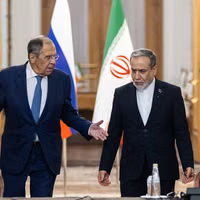
Sobh-e No, a newspaper aligned with Parliament Speaker Ghalibaf, also linked renewed discussion of talks to diplomatic contacts involving Pakistan and Russian Foreign Minister Sergei Lavrov, who visited Tehran on Tuesday.
The newspaper reported on a Russian proposal for a joint Iranian-Russian-Chinese initiative concerning the Strait of Hormuz, although Tehran has continued to insist on maintaining its authority over the waterway.
The Pezeshkian administration's Iran newspaper argued that the country's security depended on exercising sovereignty over the strait rather than sharing responsibility with outside powers.
“To preserve our security, we have no option but to exercise sovereignty over the Strait of Hormuz,” it wrote.
That position points to one of the difficulties facing any potential agreement: Tehran wants the Strait of Hormuz and broader maritime security addressed alongside the conflict, while Washington has continued to prioritize Iran's nuclear program.
Pressure in the other direction
Hardline lawmaker Hassan Nataj called for Supreme Leader Khamenei to reconsider the religious prohibition on nuclear weapons in response to the conflict.
“We should ask the Supreme Leader to revise the fatwa prohibiting nuclear weapons in light of the current situation,” he told the Didban Iran website.
The comments come amid a wider debate among Iranian politicians and commentators over whether the country's nuclear posture still provides sufficient deterrence against further US or Israeli attacks.
The simultaneous emphasis on diplomacy and escalation does not establish which course Tehran ultimately intends to pursue.
But the pattern has become clearer: diplomatic channels remain open while Iranian officials publicly raise the conditions for negotiations and stress that renewed attacks could bring a broader military response.