The meeting adds to signs that Moscow is positioning itself as both an ally of Tehran and a potential intermediary with Washington as diplomatic efforts remain deadlocked over Iran’s nuclear program and the sequencing of commitments.
Earlier this month, Putin said Russia was prepared to do everything it could to help resolve the crisis and subsequently conveyed Tehran’s position to US President Donald Trump. Neither the contents of the message nor Washington’s response was made public.
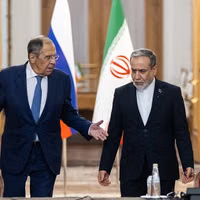
In Tehran on Tuesday, Iranian Foreign Minister Abbas Araghchi said the two countries had “never” worked as closely as they do now, while Lavrov described Iran’s cause as “just” and said Russian specialists who left the Bushehr nuclear power plant during the war were gradually returning.
Yet Iranian media and commentators questioned how much Moscow could achieve as an intermediary given the fundamental differences between Tehran and Washington.
Tabnak, a news website considered close to Supreme National Security Council Secretary Mohsen Rezaei, said Moscow could help by conveying messages, consulting with both capitals and supporting a political solution, but cautioned that no mediator could overcome the underlying disagreements on its own.
“As long as fundamental disagreements over the terms of an agreement persist, no mediator can guarantee success,” it wrote, citing differences over the sequencing of negotiations and the scope of commitments.
The reformist outlet Rouydad24 said there was little evidence Moscow had brought a comprehensive plan capable of breaking the deadlock.
“What has so far been presented by official Iranian and Russian sources points less to a ‘grand peace plan’ than to the continuation of Russia’s traditional role as a facilitator of dialogue,” it wrote.
Uranium emerges as key obstacle
A central obstacle in the diplomatic impasse is Iran’s stockpile of uranium enriched to 60%.
Russian officials, including Deputy Foreign Minister Sergei Ryabkov, have indicated that Moscow is prepared to receive the stockpile, a move that could address one of the central concerns surrounding Iran’s nuclear program.
Tehran, however, has rejected the idea of transferring its enriched uranium abroad and denied that nuclear negotiations with Washington are under way.
The position was reiterated during Pakistani army chief Asim Munir’s visit to Tehran on Tuesday. Rezaei told Munir that none of Iran’s enriched material would leave the country, describing it as a national asset intended for domestic use.
Before Lavrov’s arrival, conservative political activist Ali Gholhaki claimed Russia had been partly persuaded by an Iranian proposal, advanced when Ali Larijani was secretary of the Supreme National Security Council, to establish a framework for transferring uranium enriched to 60%.
But following the visit, Gholhaki said Lavrov had produced no tangible result and had left “without any particular achievement.”
The conservative newspaper Khorasan argued that negotiating over Iran’s enriched uranium could increase rather than reduce the danger of another attack.
It argued that while Iran did not possess a nuclear deterrent, its stockpile of highly enriched uranium itself acted as a form of deterrence by raising the risks of further US escalation.
Mohammad-Sadegh Alizadeh, a journalist interviewed by the conservative Farhikhtegan newspaper, said Tehran’s immediate priority should instead be ending the war on terms acceptable to Iran.
“Whether the Russians have agreed to accept Iran’s 440 kilograms of uranium enriched to 60% is a secondary issue to be addressed later,” he said. “First, the question of ending the war must be settled.”
Doubts over Moscow’s interests
Doubts about Russia’s intentions extend beyond whether it can bridge the divide between Tehran and Washington.
Reformist journalist Ahmad Zeidabadi argued that Iranian decision-makers should nevertheless welcome any Russian initiative capable of stopping another war.
“Russian interference is an evil, of course, but compared with the prospect of another war, it is the lesser evil,” he wrote on Telegram.
Commentator Mehran Tabatabaei argued that Moscow’s approach to Iran remained subordinate to its negotiations with Washington over Ukraine.
“Russia will not take any positive steps until it resolves the Ukraine issue and obtains the concessions it wants from the United States over Ukraine,” he wrote.
Journalist Mohammad Aghazadeh offered a starker assessment, saying failure by Lavrov to make progress would suggest diplomacy itself was approaching a dead end.
“Either the current state of uncertainty will continue, or an intense war will begin,” he wrote, “one that will probably not be as easy to end as it is to start.”