Retirees protest across Iran over economic hardship, repression
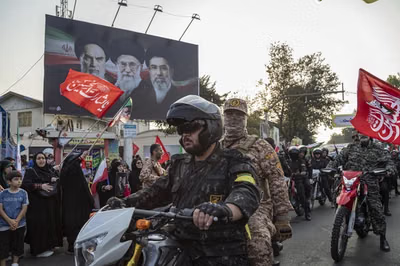
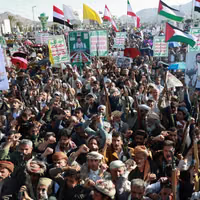
Retirees from Shush and Haft Tappeh hold a protest in southwestern Iran on October 18, 2026.
Retirees staged protests in several Iranian cities on Sunday over soaring living costs, inadequate pensions and healthcare problems, with some demonstrators also chanting against government corruption, repression and executions.
Social Security and steel industry retirees gathered in Tehran, Rasht, Kermanshah, Isfahan, Shush and Ahvaz, demanding higher pensions, payment of overdue benefits and improved access to healthcare.
Videos obtained by Iran International showed protesters chanting slogans including "Our enemy is right here, they lie when they say it's America" and "Cut back on one case of embezzlement and solve our problems."
In Tehran, retirees gathered outside the headquarters of the Social Security Organization, Iran's state pension and social insurance body, chanting "High prices, embezzlement — this is your economy," according to Pezhvak-e Kar Iran, a labor news outlet affiliated with the Iran Labor Confederation Abroad.
In the northern city of Rasht, demonstrators also condemned executions, chanting "We swear by the blood of our comrades, we will stand until the death sentences are overturned."
More than 70 political prisoners have been executed since December 2025, while at least 20 others face execution on politically motivated charges.
The US-based Human Rights Activists in Iran group said in an October 9 report that at least 2,003 people had been executed over the preceding year, a 29% increase from the previous 12-month period.
In the western city of Kermanshah, retirees protested the declining purchasing power of their pensions, chanting "Where are the oil dollars? We bear the inflation" and "War and sanctions are excuses; our lives are the evidence."
Protesters also demanded the release of imprisoned workers, teachers and protesters, including labor activist Nahid Khodajoo, who was arrested at her home by security forces about two weeks ago. Her whereabouts remain unknown.
In the central city of Isfahan, retired steelworkers marched to the provincial governor's office, demanding free and continuous healthcare, payment of overdue benefits and pensions equivalent to 90% of the salaries of comparable active workers.
Iran's semi-official ILNA news agency reported that repeated promises by officials to address the steelworkers' grievances had not been fulfilled.
In the southwestern city of Shush, retired workers from the Haft Tappeh sugarcane complex protested low pensions, inflation, unemployment, housing shortages and the suppression of independent labor organizations, according to the Haft Tappeh Sugarcane Workers' Syndicate.
"We will fight, we will die, we will win our rights," protesters chanted.
In nearby Ahvaz, retirees gathered outside the provincial Social Security headquarters, demanding overdue pension increases and protesting rising prices.
"Our expenses are in dollars, but our salaries are in rials," demonstrators chanted, according to the Iranian Retirees Council. Other slogans included "No to executions" and "Unity against poverty and corruption."
Retirees told ILNA that pensions below the poverty line had made it increasingly difficult to afford basic necessities, including food, medicine and medical care.
Iran's base monthly minimum wage stands at approximately 166.3 million rials ($63 at the October 18 free-market exchange rate), excluding additional allowances.
Years of inflation and the declining value of the rial have eroded purchasing power, fueling recurring demonstrations by retirees and workers demanding higher wages, improved healthcare and payment of outstanding benefits.
Iran's parliament speaker Mohammad Bagher Ghalibaf
Iran's parliament speaker said a "Persian Gulf Data Authority" was coming and urged regional governments and investors to withhold resources from AI companies involved in military operations, amid threats by Iranian hardliners against digital infrastructure across the region.
"The Persian Gulf Data Authority is coming," Mohammad Bagher Ghalibaf wrote on X Sunday.
"To governments, funds, and firms in the region: you are kindly advised to give no resources to any AI or data company aiding invasions or killing children. No finance, equity, land and energy."
Ghalibaf did not explain how the proposed authority would operate, what powers it would have or how Iran could enforce restrictions on companies operating elsewhere in the region.
Hardliners threaten regional digital infrastructure
Last week, Mohsen Rezaei, secretary of Iran's Supreme National Security Council, warned that undersea communications cables, data centers and artificial intelligence facilities could become targets if war with the United States and Israel resumed.
"If war breaks out, many cables, data centers and artificial intelligence facilities, valued at $2 trillion, will be within range," Rezaei said, according to Iranian state media.
He said American technology assets in the United Arab Emirates and around the Strait of Hormuz had not yet been included among Iran's targets but could be struck in a renewed conflict.
The following day, Hossein Shariatmadari, editor-in-chief of the hardline Kayhan newspaper and the supreme leader's representative at the publication, endorsed Rezaei's warning.
In an article titled "Well Done, Brother Mohsen!", Shariatmadari called for using undersea fiber-optic cables running through the Persian Gulf and the Strait of Hormuz to pressure Washington and its allies.
He claimed that damaging the cables could disrupt more than 80 percent of commercial, banking, military and AI-related communications, an estimate that has not been independently verified.
The IRGC-affiliated Tasnim News Agency also backed threats against AI infrastructure, arguing in an article titled "Why Is Artificial Intelligence on the Target List?" that attacks on AI centers could undermine US technological competition with China, deter investment and put pressure on American stock markets.
Shariatmadari had previously urged Iran's military and Islamic Revolutionary Guards on September 3 to disrupt or sever international fiber-optic cables beneath the Persian Gulf and the Strait of Hormuz.
In May, Tasnim proposed imposing licensing and annual renewal fees on foreign operators of undersea internet cables passing through the strait.
It also called for major technology companies, including Meta, Amazon and Microsoft, to operate under Iranian law and proposed granting Iranian companies exclusive control over cable maintenance and repairs.
Previous threats against technology companies
Iran's Revolutionary Guards had already threatened major American technology companies operating in the Middle East during the war earlier this year.
On March 31, the IRGC published a list of 18 companies, including Microsoft, Google, Meta, Apple, Oracle, Nvidia and the UAE-based artificial intelligence company G42, warning that their regional operations could be targeted.
The Guards accused American technology and AI companies of assisting US military operations against Iran and warned employees to leave their workplaces.
The threats followed Iranian drone attacks in early March that damaged Amazon Web Services data centers in the United Arab Emirates and Bahrain.
Amazon said two facilities in the UAE were directly struck, while a nearby drone strike caused physical damage to its infrastructure in Bahrain.
The company reported structural damage, power disruptions and cloud service outages affecting customers across the region.
The Persian Gulf has become an important hub for American technology companies expanding their cloud computing and artificial intelligence operations, with the UAE among the countries hosting major investments in data centers.
Undersea fiber-optic cables are also critical to the region's digital infrastructure, carrying international internet traffic and supporting financial transactions, cloud computing and government communications.
US President Donald Trump speaks next to Israeli Prime Minister Benjamin Netanyahu upon arrival for meetings at Trump's Mar-a-Lago club in Palm Beach, Florida, US, December 29, 2025.
US President Donald Trump on Sunday warned Washington could “soon finish the job” against Iran unless Tehran changed course, as Israeli Prime Minister Benjamin Netanyahu said Israel was prepared to strike Iran without US support and vowed to bring down Tehran’s government.
“Unless they change their ways, rapidly, we will soon finish the job,” Trump wrote in a post on Truth Social, after saying Iran had been “systematically destroyed, both Militarily and Financially.”
Addressing the people of Israel directly, Trump pointed to Tehran’s long-standing slogans of “Death to Israel, Death to America,” saying it had only been a matter of time before Iran sought to act on such threats.
He endorsed Netanyahu for re-election in Israel’s October 27 parliamentary vote, calling him a “Great Warrior Prime Minister” and an “even greater Partner for Peace in combatting the Islamic Republic of Iran.”
He said that if Israel were led by “anyone other than Bibi,” the United States would have to take on the work against Iran itself, adding that he was “not inclined to do so.”
Trump gave Netanyahu his “Complete and Total Endorsement” for re-election and praised him as “Strong, Brave, and Brilliant.”
Netanyahu thanked Trump on X, saying: “Together we will complete the mission!”
Israelis will vote on October 27 in the country’s first national election since the Hamas-led October 7, 2023 attack. The prime minister is not directly elected but emerges through coalition-building in the 120-seat Knesset.
Trump did not say what further action against Iran he had in mind. Earlier this month, he said the United States would not attack Iran before the November 3 US midterm elections and said Washington and Tehran were having “productive discussions.”
His latest comments come after he and Netanyahu discussed the possibility of a new military operation against Iran, according to Axios, which reported last week that the Israeli leader raised concerns about intelligence suggesting Tehran was trying to rebuild its nuclear program.
Netanyahu says Israel can strike Iran without US support
Separately on Sunday, Netanyahu said Israel was prepared to launch a preemptive strike against Iran without US support and that his objectives regarding Tehran did not depend on Washington’s approval.
“The objectives I set do not depend on American approval,” Netanyahu said as he presented an updated national security doctrine, according to Israel Hayom. “To the extent necessary, we will also act independently. We have done so before, and if necessary, we will do so again.”
Netanyahu described confronting Iran as his “life’s mission” and identified a nuclear-armed Iran as Israel’s greatest security threat. “We are prepared to take the initiative,” he said. “We must prevent the enemy from delivering the first blow.”
He said “90% of the job is done,” pointing to Iran’s economic crisis, recent protests and what he described as the government’s weakened position.
“We must bring this regime down once and for all,” Netanyahu said. “That is the directive I have given to all the security agencies.”
Iranian officials raised the possibility of a shift in nuclear policy and threatened retaliation against further US-Israeli attacks, while Tehran outlined its conditions for reopening the Strait of Hormuz on Sunday.
The developments came after Iran's parliament approved a new defense minister with longstanding ties to the Revolutionary Guards' missile program, and Israeli Prime Minister Benjamin Netanyahu called for eliminating what he described as the Iranian threat.
Nuclear doctrine comes under scrutiny
Iran's new supreme leader, Mojtaba Khamenei, may take a different position on nuclear weapons from his late father, Ali Khamenei, whose religious ruling opposed their development, Iranian lawmaker Ahmad Naderi said.
“From Mojtaba Khamenei's conduct, my understanding is that his fatwa will be different,” Naderi told.
Naderi separately expressed his own support for acquiring an atomic bomb, saying he had advocated the move for more than a decade and believed Iran should pursue what he called ultimate military deterrence.
Calls for nuclear deterrence have become more prominent among Friday prayer leaders and representatives of the supreme leader, Naderi added.
The remarks came after US Vice President JD Vance said Washington had achieved a decisive military advantage over Iran but could not consider the conflict finished without a firm commitment that Tehran would not rebuild its nuclear program.
Vance also linked US involvement to energy security, warning that Iranian control over shipping through the Strait of Hormuz could increase gasoline prices.
Hormuz proposal remains unresolved
Iran's seven-day proposal for reopening the Strait of Hormuz remains under consideration, with Tehran reviewing Washington's comments, Foreign Minister Abbas Araghchi said.
“Our conditions are completely clear and were presented to the United States in the form of a seven-day plan,” Araghchi said.
Under the proposal, the strait would reopen on the sixth day if Washington met Iran's conditions, with negotiations resuming on the seventh, Araghchi added.
The conditions were fair and had previously been accepted by the United States, he said.
New defense minister threatens retaliation
Iran's parliament approved Mehrdad Akhlaghi Ketabchi for the post of defense minister with 237 votes in favor and 15 against.
Akhlaghi, a sanctioned veteran of Iran's missile industry, replaces Aziz Nasirzadeh, who was killed during the opening day of US-Israeli strikes in February.
The new minister warned that any further American attack would bring casualties among US personnel stationed in the region.
“If he drops one bomb, he should see how many of his people he will have to carry out horizontally (dead),” Akhlaghi said, referring to President Donald Trump.
Iran's armed forces have also prepared a new operational plan for any renewed attack, Supreme National Security Council Secretary Mohsen Rezaei said.
The plan would be more destructive than those used during the previous wars and would not follow familiar patterns, Rezaei added.
Army commander-in-chief Amir Hatami separately urged the new defense minister to accelerate military modernization, citing the impact of recent wars and international sanctions.
Israel presses for further action
The complete elimination of what Israel considers the Iranian threat remains a central objective for the remainder of Trump's presidency, Netanyahu said in an interview with Life, Liberty & Levin.
Netanyahu argued that military and economic pressure should continue and called for the eventual removal of Iran's current political leadership.
The Israeli prime minister also said Tehran is pursuing intercontinental ballistic missiles capable of reaching the United States and seeking nuclear warheads for them.
Separately, Iran's hardline Kayhan newspaper urged strikes against Israeli nuclear facilities if Washington attacked the underground Pickaxe Mountain complex near Natanz.
The warning followed Trump's suggestion that US forces could target the fortified site.
The statements underscored the competing priorities shaping the confrontation: Washington's demand for guarantees against renewed Iranian nuclear activity, Tehran's conditions for restoring maritime access, and continuing threats of military escalation from both sides.
A wave of deadly attacks on Iranian security forces in the country’s restive southeast has brought renewed attention to a coalition of Baluch militants seeking to broaden their fight against the Islamic Republic, raising questions about how far the insurgency can spread.
The US-based Human Rights Activists News Agency, HRANA, documented 63 armed incidents across southeastern Iran between March 31 and October 10, with at least 94 people killed and 33 wounded, according to local and unofficial reports.
On October 7 and 8, at least five Iranian military and police personnel were killed and several others wounded in four armed attacks within 24 hours, local rights group Haalvsh reported. On October 14, a women’s Basij commander and a police officer were killed in separate attacks in Mehrastan County.
The People’s Fighters Front, known by its Persian initials JMM, has claimed responsibility for at least six attacks. Most of the incidents documented by HRANA remained unattributed or could not reliably be linked to a particular group.
JMM was formed in December 2025 through the merger of several factions, including Jaish al-Adl, a militant group that emerged around 2012 following the dismantling of Jundallah and Iran’s execution of its leader, Abdolmalek Rigi.
The United States designated Jundallah as both a Foreign Terrorist Organization and a Specially Designated Global Terrorist in 2010, amending both designations in 2019 to include Jaish al-Adl as an alias. Iran also designates Jaish al-Adl a terrorist organization.
What is the People’s Fighters Front?
The coalition brings together Jaish al-Adl, the PADA Baluch Movement, Harakat-e Nasr Baluchistan, the Mohammad Rasulullah group and fighters described in its charter as independently organized Baluch combatants.
Jundallah leader Abdolmalek Rigi following his arrest by Iranian authorities on February 23, 2010.
The coalition’s charter describes PADA Baluch as a cultural movement focused on Baluch identity, while other members have explicitly military or religious origins. Harakat-e Nasr, for example, says it was founded to avenge the death of a Sunni cleric.
The front says its formation followed lengthy negotiations to improve coordination and broaden a struggle previously pursued through what its charter calls traditional and rudimentary approaches.
It advocates political, diplomatic, cultural and media activity alongside what it describes as legitimate defense. Its ultimate objective, the charter says, is “deep political changes in Iran.”
Why has the fighting intensified?
Farzin Nadimi, a senior fellow at the Washington Institute, told Iran International that the merger had helped the militants step up their campaign and adopt more destructive tactics, with attacks becoming more frequent particularly in September and October.
The coalition was seeking to build a broader front against Tehran and connect its campaign to the protest movement that emerged in January, exploiting opportunities presented by protests and war, he said.
“We are seeing some more advanced tactics used,” Nadimi said.
Nadimi said the militants had not yet developed the capability to seize territory, though he believed they were moving toward that level of insurgency.
HRANA reported greater use of mines, rocket-propelled grenades and other heavier weapons, alongside the deployment of drones, artillery and armored vehicles by government forces. Attacks on patrols and military convoys were the most common incidents it recorded, followed by targeted shootings.
The region has experienced major attacks for years. Jaish al-Adl claimed a 2019 suicide bombing that killed 27 Revolutionary Guards and a December 2023 attack that killed 11 security personnel in Rask. Coordinated attacks in Rask and Chabahar followed in April 2024.
Baluch activist and journalist Khalilullah Balochi argues that the groups’ capabilities predate their merger and that earlier restraint reflected their assessment of public interests.
“The activities of these groups are not new; what is new is the intensification of attacks,” he told Iran International.
He attributes armed mobilization primarily to economic deprivation, ethnic and religious discrimination and repression, arguing that militarization has deepened the grievances driving recruitment.
The recent fighting also involves armed actors whose affiliations remain unclear.
On October 13, the Revolutionary Guards said five members of an alleged kidnapping cell and one IRGC member were killed during an operation near Zahedan. The Guards said a kidnapped engineer was rescued, without naming the armed group involved.
Separately, Haalvsh reported that more than 20 members of the Fatemiyoun Brigade, an Afghan fighting force operating under the IRGC’s Quds Force, were killed or wounded during prolonged fighting in Taftan County that day.
Can JMM build a nationwide movement?
JMM’s founding documents combine demands for Baluch rights with appeals for nationwide cooperation against Iran’s clerical rulers.
In its founding video, released alongside its charter in December 2025, masked spokesman Mahmoud Baluch appeals to communities across Iran and describes the country’s resources as captive to the system of velayat-e faqih, or rule by an Islamic jurist.
“The People’s Fighters Front wants an Iran for all Iranians,” he says. The charter identifies religious and cultural beliefs as part of the front’s identity, invoking Islamic principles and describing sacrifice for God’s approval.
A recent statement by JMM calls Iran “our dear homeland” and anticipates the “great nation of Iran” uniting against the ruling system.
The coalition describes its operations as defensive. Its charter says they aim to hold the government accountable for repression and remove obstacles to popular demands.
Political analyst Mehdi Nakhl-Ahmadi told Iran International that Jaish al-Adl’s emphasis on ethnic and religious demands and armed struggle had limited its ability to attract wider public support and cooperate with other opposition groups.
The new front’s national objectives and embrace of political, civil and media activity alongside armed struggle could reflect a strategic shift or a tactical effort to overcome those limitations and gain broader acceptance, he said.
However, he cautioned, changing its charter and political language would not necessarily translate into achieving those objectives.
The experience of Iranian Kurdish parties showed that even movements with long political histories and efforts at coalition-building faced a complex, lengthy process in building lasting cooperation and a nationwide support base, he said.
Whether JMM could broaden its reach would depend on other political groups’ willingness to engage and the front’s ability to build trust and cooperation, he said.
Fate of Baluch civilians
Nadimi expects continued counterinsurgency operations, potentially including more forces and Basij personnel, village raids and public executions. He warned that Baluch civilians would continue to face deaths and detentions, while inadequate services would compound anger toward the government.
Balochi argues that armed resistance could restrain the authorities by raising the cost of repression. He believes crackdowns have encouraged recruitment and that the government increasingly recognizes force alone cannot deter the militants.
“In fact, the most effective factor capable of restraining the Islamic Republic’s behavior is the military activities of this very group,” he said.
Are Iran’s neighbors involved?
Tehran has pressed its neighbors to curb armed groups operating along its eastern borders. Ebrahim Azizi, chairman of parliament’s national security and foreign policy commission, accused Pakistan and Afghanistan of leaving their borders unattended and urged stronger diplomatic engagement.
Balochi identifies neighboring governments’ policies as decisive, arguing that the groups could expand if countries hosting them refrain from tightening restrictions.
Iranian authorities also frequently allege foreign involvement in the violence. Tasnim attributed the October 14 killing of the women’s Basij commander to militants linked to the United States and Israel, without providing evidence.
Foreign Ministry spokesman Esmail Baghaei blamed US and Israeli plans for insecurity along Iran’s borders when asked about allegations that regional countries, including the United Arab Emirates, might be assisting armed groups.
Beyond border security, Nadimi warns that the insurgency could become intertwined with the wider war.
“If it continues to increase in intensity and geographical reach, the two could very well intertwine,” he said.
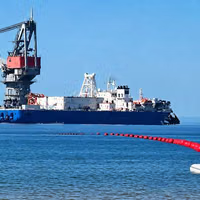
File photo by NEQSOL Holding shows the installation of the Trans-Caspian Fiber-Optic Cable across the seabed of the Caspian Sea as part of the Digital Silk Way initiative.
Investment in trade routes linking Asia and Europe through Central Asia and the Caucasus is putting pressure on Iran’s ambitions to become a major transit hub, with neighboring countries developing transport and digital networks that bypass Iranian territory.
Among them is the Middle Corridor, a network of rail, road and sea links connecting China to Europe through Central Asia and the Caucasus while bypassing Iran.
The corridor is intended not only to connect Chinese and European markets. Countries along the route are also expanding trade among themselves, and the broader connectivity push extends beyond cargo to energy, information technology and data.
On October 15, the presidents of Azerbaijan and Kazakhstan inaugurated a 380-kilometer fiber-optic link across the Caspian seabed with a capacity of more than 400 terabits per second. Part of the Digital Silk Way initiative, the cable complements the Middle Corridor.
Beyond carrying data along the East-West axis, its backers say it will help attract investment in AI data centers, cloud services and high-tech industries.
In its latest report, the World Bank projects that, if the planned investments materialize, freight volumes across the Caspian could rise from 8.8 million tons in 2023 to 32.1 million tons in 2040.
The report also finds that developing the corridor could, in the long term, increase the combined GDP of host countries by about 3.3 percent, equivalent to approximately $58 billion at current levels of economic activity, and raise employment by 2.9 percent.
These gains depend on policy and operational reforms alongside construction. The World Bank identifies at least $25 billion in infrastructure investment needs through 2040, plus an estimated $30 billion for connecting infrastructure, logistics facilities and equipment.
One of the most contentious proposed links is the route through southern Armenia that would connect mainland Azerbaijan to its Nakhchivan exclave, known in Azerbaijan as the Zangezur corridor.
Under agreements reached since August 2025, the US-backed project is being developed as the Trump Route for International Peace and Prosperity, or TRIPP, with Armenia retaining sovereignty and jurisdiction over its territory.
Azerbaijan projects that the route could carry 15 million tons of freight annually. The section through Armenia is roughly 42 to 43 kilometers long.
After several years of fierce opposition to the proposed Zangezur corridor, Iran appears to be taking a more pragmatic approach to Armenia’s inclusion in East-West transport networks, although concerns over American involvement remain.
Iran’s ambassador in Yerevan expressed concern in September about an American presence near the border and proposed a mechanism to address Tehran’s concerns. On October 16, Armenian Foreign Minister Ararat Mirzoyan said Iran had asked about the possible deployment of US military forces on Armenian territory and that Yerevan had assured Tehran this would not happen. He said he believed the Iranian side was satisfied with Armenia’s answers.
The World Bank estimates that developing the Middle Corridor could increase Armenia’s GDP by 3.4 percent, equivalent to $873 million, and raise employment by 3.9 percent in the long term. Armenia, however, is not yet a transit country on the route; the report assumes a direct rail link through the country becomes operational in the early 2030s.
Iran’s transit ambitions face growing competition
Azerbaijan and Iran have also pursued an alternative connection between mainland Azerbaijan and Nakhchivan through Iranian territory, known as the Aras corridor.
That route could preserve a role for Iran in regional transit, but participation in one connecting segment would fall short of Tehran’s broader ambition to become a central hub for trade between Asia and Europe. Western sanctions also complicate efforts to attract European businesses to routes through Iran.
A comparison with Turkey, a key link between the Middle Corridor and European markets, is telling. The World Bank estimates that corridor development could increase Turkey’s GDP by more than $47 billion and employment by about 4.4 percent in the long term.
Iran also faces competition from other regional transport plans. Iraq, with participation from Qatar, the UAE and Turkey, is advancing the Development Road, intended to link the Grand Faw port to the Turkish border at an estimated cost of about $17 billion. Iraqi officials have projected annual revenues of roughly $4 billion, although the project’s returns depend on financing, completion and demand.
The proposed India-Middle East-Europe Economic Corridor and Syria’s Four Seas initiative, linking the Mediterranean, Persian Gulf, Black Sea and Caspian region, likewise reflect efforts to develop alternative networks. These projects remain at different stages of development, and their commercial success is not assured.
More than two decades after Iran, India and Russia agreed to establish the International North-South Transport Corridor, Tehran’s ambition to become a transit hub linking India with Russia and European markets remains only partly realized. Shipments have moved through Iran, but the existence of traffic alone does not demonstrate that the route has fulfilled its wider commercial promise.
Iran’s weak logistics performance adds to the challenge. In the World Bank’s 2023 Logistics Performance Index, it ranked 123rd with a score of 2.3 out of five. Geography gives Iran potential advantages, but converting them into sustained transit business requires reliable infrastructure, efficient border procedures and commercially viable international connections.