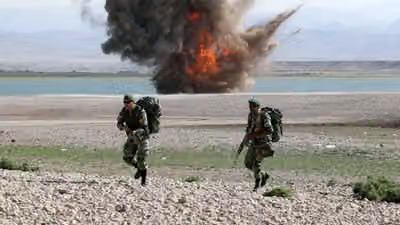
Iranian authorities executed Ali-Sina Mostafavi, a 38-year-old mountaineer from Kerman, the judiciary’s Mizan News reported on Wednesday.
Human rights group Dadban had warned a day earlier that Mostafavi’s execution could be imminent after he was transferred to solitary confinement.
Dadban said prison officials had called his family for a final visit. Human Rights for Sports had also included him on a list of athletes at risk of execution.
Mizan accused Mostafavi of carrying out armed attacks in Kerman, including shootings that it said wounded civilians.
A tanker and a container ship were hit by projectiles of unknown origin in the Strait of Hormuz.
Iran's surge in attacks on commercial shipping in the Strait of Hormuz may be an attempt to exploit US restraint ahead of the midterm elections and undermine a recovery in Persian Gulf oil shipments, experts told Iran International.
Twelve vessels were attacked between October 5 and 11, including six on Sunday alone, and on Tuesday a tanker and a container ship were struck by unknown projectiles, according to UK Maritime Trade Operations (UKMTO), marking one of the most intense periods of attacks since the war began.
Rear Admiral Ali Azmaei of Iran’s Islamic Revolutionary Guard Corps Navy warned Tuesday that Iranian forces would sink US warships approaching the Strait of Hormuz, saying they were “counting down” to a possible confrontation in the strategic waterway.
The escalation comes as the US blockade has effectively halted Iran's crude oil exports, while other Persian Gulf producers have increasingly succeeded in moving their oil through the strategic waterway, threatening to erode one of Tehran's remaining sources of leverage. Brent crude settled at $105.69 per barrel Tuesday, snapping three consecutive sessions of gains, as traders weighed continued Middle Eastern supply disruptions against other market developments.
Charlie Brown, a maritime security expert with United Against Nuclear Iran (UANI), believes the timing may be linked to President Donald Trump's announcement that Washington would not launch new attacks against Iran before the November 3 midterm elections.
"I think Trump signaled it, right? He said he wouldn't attack until the election," Brown told Iran International.
"So, you know, now they're taking that as word, I guess. And testing it and taking advantage of the situation."
Brown said the absence of direct American retaliation for the latest strikes may be encouraging Tehran to push further.
Two senior Iranian officials separately told Reuters that Tehran had changed the type and pace of its attacks, with one goal being to influence the US midterm elections and frustrate efforts to lower global oil prices.
"Every attack that goes without a response probably encourages a follow-on attack," he said.
The calculation extends beyond the military confrontation. Although the United States is less dependent on Persian Gulf oil than many Asian economies, disruptions affect global energy prices and American consumers.
Brown suggested Tehran may be exploiting that vulnerability at a politically sensitive moment, when rising gasoline prices could increase pressure on the White House.
An October surprise?
Shahram Kholdi, a historian of Iran, sees a potentially more ambitious calculation: an attempt to engineer an "October surprise" that could put Trump under pressure ahead of the elections.
Kholdi believes Tehran may have used the relative lull in hostilities to preserve its remaining military capabilities, replenish weapons stockpiles and prepare for a politically advantageous moment to escalate.
"It seems to me that they are headed towards that October surprise moment," he told Iran International.
But Kholdi warned that the strategy could backfire if Tehran moves beyond commercial shipping and attempts to strike American naval assets with advanced missiles.
The danger, in his assessment, is that Tehran may mistake temporary American restraint for an unwillingness to retaliate.
Iran threatens recovery in Persian Gulf oil flows
The latest attacks threaten to reverse a recovery in Persian Gulf oil shipments that had begun to weaken Tehran's ability to disrupt global energy supplies.
Despite the war, producers had managed to increase exports through Hormuz, aided by US protection measures, larger tankers and costly arrangements to move cargo through the threatened waterway.
Oil flows out of the Persian Gulf averaged approximately 15.5 million barrels per day in September, their highest level since the war began, according to recent data by Kpler.
But shipments have since fallen sharply. Just 2.9 million barrels passed through Hormuz on October 11, the lowest daily volume recorded this month, according to Kpler.
The figures underscore the vulnerability of the recovery, although daily flows can fluctuate significantly and do not alone establish how much of the decline resulted directly from the attacks.
Brent crude settled at $104.77 per barrel Tuesday after three consecutive sessions of gains, as traders weighed continued Middle Eastern supply disruptions against other market developments.
Tom Sharpe, a former Royal Navy commander, said the earlier recovery in oil volumes had masked the dangers facing commercial vessels.
"We're at sort of pre-war levels of oil, but in far fewer ships," he told Iran International.
Sharpe described large tankers making high-risk passages with enhanced American protection, sometimes sustaining strikes before reaching safer waters and transferring cargo to other vessels.
In some cases, he said, crews are also transferred after completing the most dangerous part of the journey.
"It's not working. Iran is still striking," Sharpe said of the enhanced protection measures.
According to the Joint Maritime Information Center, US-facilitated vessel movements through Hormuz averaged approximately 29 per day over a recent 72-hour period, compared with a historical average of roughly 138 daily transits.
Undermining confidence in shipping
Brown said Iran does not need to stop every vessel to undermine confidence in the safety of the waterway.
Exceptionally high tanker charter rates have encouraged some operators to continue despite the danger, but others may decide the financial rewards are not worth risking their vessels and crews.
"There will always be some that take the risk because the profits are so big right now," he said.
The threat has also spread beyond the strait, with vessels attacked near Oman's Sohar anchorage and elsewhere in the Persian Gulf.
Brown believes Iran continues to receive Russian and Chinese intelligence assistance, potentially including satellite imagery and vessel-tracking information that does not rely on ships' Automatic Identification System signals.
"I'm confident that that's still happening on a daily basis," he said.
The escalation comes amid renewed diplomatic contacts between Tehran and Washington, with Iranian officials saying the United States has accepted some of Tehran's conditions for de-escalation but that its response remains insufficient.
Trump said Tuesday that Washington would make a decision on Iran “very soon.”
"We'll make a decision on Iran very soon," Trump told reporters, describing Iran as a "failed country" with no economy, inflation of 300 percent and a government unable to pay its troops.
The United States continues enforcing its maritime blockade, while Trump has said Washington will not resume strikes against Iran before the November 3 elections.
Sharpe noted that the surge in attacks on shipping is occurring alongside intensified strikes by the Iran-backed Houthis against Saudi Arabia.
"There's an Iranian and Houthi escalation going on here that's not being matched. How long will that carry on for?" he said.
The simultaneous pressure on Persian Gulf shipping and Saudi infrastructure risks widening the confrontation at a time when diplomatic efforts have yet to produce a settlement.
The stakes for Tehran are particularly high. Kpler data shows no Iranian crude oil or condensate loaded onto tankers throughout September, leaving the Islamic Republic increasingly dependent on its ability to threaten shipments from neighboring producers to maintain leverage over Washington.
But the strategy carries a significant risk: an attack causing substantial casualties or striking US military assets could trigger the kind of direct American retaliation Kholdi warned Tehran may be underestimating.
B‑1B Lancer bomber at the RAF Fairford airbase, which hosts US Air Force personnel, in Fairford, Gloucestershire, Britain, September 27, 2026. According to the police, security measures were increased around the air base after police arrested several men on suspicion of offences under the Explosives Act. REUTERS/Toby Shepheard TPX IMAGES OF THE DAY
Iran on Tuesday summoned Britain’s ambassador and threatened to reconsider diplomatic relations after London blamed the IRGC for a suspected plot targeting a US-used airbase and Britain’s intelligence chief warned of growing Iranian threats to military sites.
The confrontation stems from a September 27 security incident near RAF Fairford in Gloucestershire, southwest England. Five British men were initially arrested after three suspicious vans were stopped near the base. Police found gasoline in the vehicles but no explosives.
Two more men, including a dual British-Iranian national, were subsequently arrested. All seven have been released on bail.
US officials told Reuters that the suspected plot involved a possible Iranian drone attack. Trump later said a threat linked to Iran prompted Washington to withdraw its B-1 bombers from Fairford, adding that the United States knew who had made the threat.
The Trump administration believes the Iranian threats were intended to kill US personnel and destroy American aircraft, AP reported Tuesday, citing a US official. British officials have not confirmed that assessment, and it remains unclear whether those arrested near Fairford were connected to the alleged drone threat.
RAF Fairford has been used by US bombers involved in strikes against Iran. Tehran has previously said bases used to attack its territory could be considered legitimate targets.
Fairford fuels Iran-UK confrontation
British Prime Minister Andy Burnham said Monday the suspected plot was “highly likely” coordinated in Iran and “almost certainly” directed by the Islamic Revolutionary Guard Corps. Home Secretary Shabana Mahmood said investigators believed an individual based in Iran was behind the incident.
Britain summoned Iran's ambassador and sanctioned two Iranian nationals over alleged involvement in hostile operations abroad.
Tehran responded Tuesday by summoning British Ambassador Hugo Shorter. Iranian Foreign Ministry official Alireza Yousefi rejected the accusations, demanded evidence and warned that Tehran would “seriously reconsider” bilateral relations if Britain failed to substantiate its claims.
The diplomatic confrontation came as MI5 Director General Ken McCallum warned Tuesday that Iran was increasingly turning its attention to military sites and other “harder targets” in Britain.
McCallum said the Fairford incident was “not unique” and that more than 50 people had been arrested in Iran-linked operations in Britain over the previous 12 months. He said Iranian activity had increasingly extended beyond traditional targets such as opponents of Tehran to Jewish sites and military installations.
Britain, the United States and 27 other countries also backed London's attribution of Iranian involvement in the Fairford incident, saying it followed a broader pattern of alleged Iranian attacks and hostile activity abroad.
Iran has denied involvement in the Fairford incident and rejected British accusations of directing hostile operations in the country.
U.S. President Donald Trump speaks to reporters on the South Lawn of the White House on October 13, 2026, before departing for Alaska.
US President Donald Trump said Tuesday he would make a decision on Iran “very soon,” as fresh attacks hit commercial shipping in the Strait of Hormuz and the war between Saudi Arabia and Yemen’s Houthis escalated.
Speaking to reporters before departing for Alaska, Trump described Iran as a “failed country” with severe economic problems but did not specify what decision Washington was considering.
"Iran is a failed country. They have no economy. They have 300 percent inflation. They have no money. They're not paying their troops. They're not paying anybody. We'll make a decision on Iran very soon," Trump said.
Trump's remarks came as fighting between Saudi Arabia and Yemen's Iran-backed Houthis intensified.
In a separate Truth Social post, Trump suggested the renewed attacks were carried out “probably at the behest of Iran” and accused the Houthis of deliberately trying to drive up oil prices ahead of the November 3 US midterm elections.
"They’ve been silent for a long time, but now they’ve emerged again, probably at the behest of Iran, which is a Failing Nation, with No Navy, No Airforce, the World’s Worst Economy, and 301% Inflation, in a very nasty way, hitting Saudi Arabia, and purposefully trying to drive up Oil Prices, probably prior to the U.S. Elections — NOT NICE," Trump wrote.
“I’ll be there after the elections, and I will never forget!” he added.
Trump also said he might ask Turkish President Recep Tayyip Erdogan to help Saudi Arabia deal with the Houthis. He said the Houthis were “behaving very badly” and added, “President Erdogan, I think, would do as I ask.”
Trump said Saturday he was considering whether the United States should join Saudi Arabia's military campaign against the Houthis following the deadly attack on Riyadh's King Khalid International Airport.
Saudi Arabia intercepts Houthi missiles and drones
Houthi attacks on Saudi Arabia continued on Tuesday following a deadly strike on Riyadh's King Khalid International Airport on Saturday that killed 13 people and wounded more than 300.
The Saudi-led coalition said its air defenses intercepted and destroyed five drones and six missiles targeting Saudi Arabia on Tuesday, including Riyadh, Dhahran and the country's southern region.
Loud explosions were heard near Saudi Aramco's headquarters in Dhahran, where a fire broke out after a missile attack. A source with direct knowledge told Reuters the headquarters had been struck, though it was unclear whether the building was hit directly or by falling debris. Saudi Arabia's Energy Ministry said the fire was limited to an administrative building and caused no injuries.
As attacks continued on Saudi territory, the Saudi-led coalition carried out strikes in Yemen.
Houthi-run Al-Masirah television said the coalition struck the Yemen Petroleum Company's Al-Sabaha central station on the outskirts of Sanaa after ordering civilians to evacuate the site.
Houthi military spokesperson Yahya Saree said the group's forces were confronting Saudi fighter jets targeting Sanaa and warned that attacks on the Yemeni capital would be met with a “harsh and painful” response in Riyadh.
The fighting prompted a series of diplomatic calls across the region on Tuesday.
Turkish President Recep Tayyip Erdogan told Saudi Crown Prince Mohammed bin Salman that Turkey would continue to stand by the kingdom, strongly condemning the Houthi attacks, according to the Turkish presidency.
Egyptian Foreign Minister Badr Abdelatty called for an immediate halt to attacks on Saudi Arabia during a phone call with his Iranian counterpart Abbas Araghchi, calling the attacks unjustified and unacceptable, Egypt's Foreign Ministry said.
Araghchi also spoke with Turkish Foreign Minister Hakan Fidan on Tuesday about regional developments and efforts to resolve ongoing conflicts, according to Turkish Foreign Ministry sources.
German Chancellor Friedrich Merz urged Iran to engage in serious negotiations and stop destabilizing the region after speaking with Saudi Crown Prince Mohammed bin Salman, according to the German government.
Two more ships struck in Strait of Hormuz
A tanker and a container ship were struck by unidentified projectiles in the Strait of Hormuz on Tuesday, UKMTO said in separate notices. The latest incidents followed a sharp increase in attacks on commercial shipping, with 12 vessels reported attacked in and around the Strait of Hormuz and Persian Gulf between October 5 and 11, according to a tally of UKMTO warnings.
UKMTO said both incidents were under investigation and that details of damage or casualties had not been established.
The incidents came as Iran's Revolutionary Guards renewed threats against US naval forces operating near the strait.
IRGC Navy commander Ali Azmaei said Iranian forces were waiting for American warships to approach the Strait of Hormuz so they could be “sunk.”
Azmaei also claimed the Strait of Hormuz and Persian Gulf were under IRGC Navy control.
US Central Command rejected Azmaei's assertion, saying Tuesday that “American forces and regional partners clearly control the Strait of Hormuz.” CENTCOM said US forces had assisted Persian Gulf partners in shipping more than 19 million barrels of crude oil through the strait on Monday.
Trump weighs next steps on Iran
Trump’s comments about an impending decision on Iran came as Axios reported his administration was weighing whether to maintain pressure on Tehran or resume military action.
Axios reported Tuesday that Trump and Israeli Prime Minister Benjamin Netanyahu discussed a possible new operation against Iran last week, with Netanyahu raising concerns that Tehran was rebuilding parts of its nuclear program.
A US official told Axios that Trump told Netanyahu to prepare for a possible operation but made no commitment on whether or when military action would take place. A White House official disputed that Trump and Netanyahu discussed resuming the war and reiterated that the United States would not attack Iran before the November 3 midterm elections.
Axios said Trump had initially appeared inclined toward renewed strikes but later became more hesitant, while most of his advisers favored maintaining economic and other pressure on Iran for now.
The possibility of renewed military action has also prompted warnings from Tehran. Mohammad Reza Naghdi, a senior adviser to the commander of Iran’s Revolutionary Guards, said a US ground attack would result in large numbers of American troops being captured.
“If the United States launches a ground attack, so many of its troops will be captured that it will be forced to raise the white flag,” Naghdi said.
Director Asghar Farhadi poses during a photocall for the film "Histoires paralleles" (Parallel Tales) in competition at the 79th Cannes Film Festival in Cannes, France, May 15, 2026.
Oscar-winning Iranian filmmaker Asghar Farhadi says his next film will be in Persian and set in Tehran but shot abroad to avoid Iran's mandatory hijab rules and government permit requirements.
In a caption accompanying Instagram video excerpts from a cinema masterclass in Brazil, Farhadi said the screenplay for his next film, a social drama, was nearing completion and filming was planned for 2027.
"My next film, whose screenplay is nearing completion, is a social drama in Persian and has nothing to do with Palestine," he wrote, apparently responding to social media rumors.
"Although the story is set in Tehran, as I have previously stated, I am not willing to make a film under an official permit and with mandatory hijab requirements. For this reason, the film is scheduled to be shot outside Iran next year."
Under Iran's film regulations, filmmakers must obtain production permits from the Ministry of Culture and Islamic Guidance, which oversees the film industry and enforces government censorship requirements.
Directors must submit scripts for approval before filming, while completed productions undergo a separate review before they can be screened publicly. Female performers are also required to wear the hijab on screen, including in scenes depicting private settings.
Farhadi, who won Academy Awards for A Separation and The Salesman, had already announced plans to return to Persian-language filmmaking.
In an August 18 interview with film industry publication Screen Daily, he said his next project would be shot outside Iran and France, citing political and social restrictions as his reason for not filming in his home country.
His latest comments explicitly reaffirmed his refusal to work under Iran's official permit system and mandatory hijab requirements.
Farhadi rejects Tehran’s interpretation of his Hollywood remarks
The filmmaker also addressed controversy surrounding remarks he made about Hollywood cinema and American democracy during a masterclass in Brazil.
Farhadi said some media outlets had incorrectly described his comments as an interview with entertainment publication Variety, when they were made in response to a moderator's question about the Hollywood film Argo during a session attended by students and cinema enthusiasts.
The 2012 film, directed by Ben Affleck, depicts a CIA operation to rescue six Americans from Iran during the 1979 hostage crisis.
"Criticizing parts of Hollywood cinema, the condescending perspective in some films, and discussing American democracy in no way means endorsing the existence of democracy or the way Iran is governed," Farhadi wrote.
He accused media outlets close to Iran's government of exploiting his remarks for political purposes, saying the same outlets had spent years insulting and attacking him.
"The appropriation of my remarks by certain media outlets close to the government is a blatant misuse for their political objectives, which I have never believed in," he wrote.
"Iran, my homeland, has been my red line throughout all these years," Farhadi added. "Everything I have said, and everything I will say from now on, has always been based on this conviction."
The Quds Force of Iran’s Islamic Revolutionary Guard Corps has appointed a new commander to its overseas assassination unit and renamed it to Unit 600 after its personnel and structure were exposed, two sources close to the IRGC-QF told Iran International.
Esmail Qaani, commander of the IRGC’s overseas arm, recently appointed Mojtaba Hagh-Lesan to lead the unit previously known as Unit 840, the sources said.
Hagh-Lesan, 64, previously headed the unit’s intelligence department. He replaces Yazdan Mir, also known as Haj Asghar Bagheri, who was killed in a targeted Israeli strike on April 6.
The unit had been without a commander since Mir’s killing, the sources said. Hagh-Lesan’s appointment puts an existing senior member in charge of a formation linked to plots against Iranian dissidents, journalists, former US officials and Israeli targets abroad.
The sources provided Iran International with the unit’s latest command chart, identifying its leadership and the officials responsible for operations across several regions.
Command structure revealed
According to the chart, Mohammad-Reza Ansari serves as Hagh-Lesan’s deputy and oversees the Israel portfolio.
Mohsen Boroujeni heads special operations for the United States and Europe, while Morteza Babaei leads the department responsible for the Middle East and Africa. Javad Sharfaei oversees special operations in Asia.
The chart identifies Meysam Sahraei as an operative involved in preparing attacks in Africa and India. It also names Gholamhossein Hosseini and Mohammad Hosseinpour as prominent operatives involved in the department’s activities.
The sources said the reliance on existing personnel reflected a crisis in the command structure following the killing of senior IRGC officers. They said it had also raised doubts among Quds Force members about the organization’s effectiveness.
Hagh-Lesan’s published work includes two articles in Strategic Studies, a journal published by the Expediency Council’s Center for Strategic Research.
“Regional Unrest and Domestic Security” appeared in the combined fifth and sixth issues, published on September 23, 1999. “US Intervention in the Bosnian Crisis” was published on November 22, 2004.
From US officials to Israeli businessmen
Unit 840 emerged from Unit 400 in the early 2010s on the orders of then-Quds Force commander Qassem Soleimani. Unit 400 is a covert special operations formation with close ties to Hezbollah.
A photograph of Mir alongside Hezbollah leader Hassan Nasrallah and senior IRGC commanders Mohammad Reza Zahedi and Mohammad Hejazi illustrates those connections.
Yazdan Mir, the former commander of Unit 840, pictured with Hassan Nasrallah, Mohammad Reza Zahedi and Mohammad Hejazi.
Informed sources told Iran International that a Western intelligence service identified and attacked the unit’s headquarters in Damascus in 2020.
The unit subsequently became the focus of investigations into assassination plots abroad.
In August 2022, the US Justice Department charged IRGC member Shahram Poursafi with plotting to assassinate John Bolton, who served as national security adviser during President Donald Trump’s first administration.
Prosecutors said Poursafi offered $300,000 for Bolton’s killing, likely in retaliation for the US strike that killed Soleimani in January 2020.
Iran International’s subsequent investigation, based on information provided by the Black Door hacking group, identified Ansari as the Syria-based Unit 840 commander who led the failed operation against Bolton and former Secretary of State Mike Pompeo.
According to that reporting, Poursafi worked under Ansari, and the network sought to hire non-Iranians to conceal Tehran’s involvement. The person recruited to arrange the killings was an FBI informant.
In June 2023, the US Treasury sanctioned Ansari and Poursafi, saying Ansari, with Poursafi’s support, had planned and attempted to assassinate two former US government officials.
Ansari was also linked to a foiled plot against two Israeli businessmen in Colombia. Iran International reported in December 2022, citing an investigation by Infobae, that he had directed the operation through locally recruited criminals.
The businessmen and their families left Bogota under tight security after Colombian intelligence authorities warned them of the threat, according to that reporting.
Criminal networks and journalist targets
Unit 840 has repeatedly sought to use criminal gangs and traffickers to carry out operations abroad.
In Germany, Iran International previously reported that Ramin Yektaparast, an Iranian-German member of the Hells Angels motorcycle gang, organized attacks against synagogues in Bochum and Essen on behalf of the Quds Force.
The investigation, citing a Western intelligence source and a source within the IRGC, also linked him to a failed plot to assassinate Iranian rapper Shahin Najafi at a concert in Hanover in September 2023.
Yektaparast was shot four times and killed in Tehran on April 28, 2024. Following reports of possible Mossad involvement, the IRGC-linked Tasnim news agency denied he had ties to the Guards and said he was killed in a dispute over “personal matters.”
His funeral notice nevertheless described his death as a “martyr-like ascension,” and he was buried in Section 19 of Tehran’s Behesht-e Zahra cemetery, reserved for fallen IRGC and Basij members.
In Britain, an ITV News investigation exposed a Unit 840 plot, codenamed “the wedding,” to kill Iran International journalists Fardad Farahzad and Sima Sabet.
ITV reported in December 2023 that Iranian operatives had offered a people-smuggler $200,000 to arrange the murders. It identified Ansari as the commander behind the plot.
The plan failed because the smuggler was working as a double agent for a Western intelligence service and passed details to his handler, according to the investigation. Iran’s embassy in London rejected ITV’s findings as baseless.
In Sweden and Denmark, the Quds Force used Rawa Majid, leader of the Foxtrot criminal network, to attack Israeli-linked targets, according to Iran International’s previous reporting.
Swedish investigative journalist Diamant Salihu told the BBC that Majid fled to Tehran in October 2023 and that his links with Iranian authorities developed afterward. Iran International reported in April 2025 that he was living in Iran under IRGC protection.
Britain sanctioned Majid and Foxtrot in 2025. Iran’s embassy in London denied Tehran’s links to the network.
Repeated intelligence setbacks
The unit has suffered a series of blows through the exposure of its personnel and operations.
In May 2022, footage emerged of an interrogation attributed to Mossad in which Mansour Rasouli, a trafficker linked to Unit 840, said he had been tasked with killing an Israeli citizen in Turkey, a senior US general in Germany and a journalist in France.
Later that month, Hassan Sayyad Khodaei, a senior figure in the unit, was shot dead in central Tehran. The New York Times, citing an intelligence official, reported that Israel had told the United States it was responsible.
Those setbacks were followed in June by the removal of Hossein Taeb as head of the IRGC Intelligence Organization.
The following month, Iran International reported that Mossad agents had interrogated Yadollah Khedmati, an IRGC logistics and support commander, near Tehran. Footage of that interrogation was also released.
More recently, Israel announced the disruption of another IRGC network accused of planning attacks on strategic infrastructure and Israeli and Jewish targets abroad.
In a joint statement on April 20, Mossad, the Israeli military and Shin Bet said an operation in Azerbaijan had foiled plans to attack the Baku–Tbilisi–Ceyhan oil pipeline, the Israeli embassy, a synagogue in Baku and Jewish community leaders.
Azerbaijani authorities arrested members of the cell and seized explosive drones and other explosives smuggled from Iran, according to the Israeli account. The suspects had conducted surveillance and photographed targets under orders from handlers in Tehran.
The US, Britain and European Union have imposed sanctions on figures linked to overseas assassination plots. Alongside the US measures against Ansari and Poursafi, Britain sanctioned Unit 840 and Ansari in January 2024. The EU sanctioned Ansari in July 2025, accusing him of ordering the assassination of journalists critical of the Islamic Republic.
Reorganization amid calls for revenge
According to Iran International’s sources, the Quds Force decided to reorganize Unit 840 after its structure and personnel were exposed. Six months after Mir’s killing, Hagh-Lesan’s appointment restores a commander to a unit responsible for covert operations against Iranian government opponents, critical journalists and Israeli targets worldwide.
The reorganization follows public calls for revenge over the killing of former Supreme Leader Ali Khamenei.
In July, Hossein Shariatmadari, the supreme leader’s representative at the hardline Kayhan newspaper, urged authorities to declare Trump and pilots involved in Khamenei’s killing people whose killing was a religious obligation.
Kayhan also said the security of Trump and Israeli Prime Minister Benjamin Netanyahu had been permanently destroyed. Tehran municipal murals threatened both leaders, including one bearing the English words “We will kill Trump.”
Iranian authorities have also expanded efforts to collect information about government opponents abroad.
In September, the IRGC-affiliated Fars news agency announced a system called “Alaj” to identify and track such individuals. It urged government supporters to submit information through the system’s website and the Telegram and Bale messaging platforms.