• العربية
  • فارسی
BrandBrand
  • Iran Insight
  • Politics
  • Economy
  • Analysis
  • Special Report
  • Opinion
  • Podcast
  • Live TV
  • Iran Insight
  • Politics
  • Economy
  • Analysis
  • Special Report
  • Opinion
  • Podcast
  • Live TV
  • Theme
  • Language
    • العربية
    • فارسی
  • Iran Insight
  • Politics
  • Economy
  • Analysis
  • Special Report
  • Opinion
  • Podcast
  • Live TV
All rights reserved for Volant Media UK Limited
volant media logo

Iranian lawmaker says support for reviewing nuclear doctrine is growing

Oct 11, 2026, 08:20 GMT+1

Support for reviewing Iran’s nuclear doctrine is growing among the public, experts and officials, lawmaker Hassan Ghashghavi said on Sunday.

Speaking to police political affairs officials, Ghashghavi said Iran’s control over the Strait of Hormuz was strengthening and that the waterway could not reopen until Tehran’s declared conditions were met.

He also said more than 70% of news and analysis produced by Iran’s adversaries during the war was false or unrealistic, describing it as part of “cognitive or psychological warfare.”

Most Viewed

Iran turns on Pakistan as Saudi defense pact takes effect
1

Iran turns on Pakistan as Saudi defense pact takes effect

2
PODCAST

Iran’s oil lifeline could run dry by mid-December, Kpler says

3

'Three golden weeks': Trump’s no-strike pledge fuels calls in Iran to act first

4

Iran turns to Turkey, Turkmenistan for power as war strains industry

5

'Absolute isolation': US outlines plan to cut off Iran’s economic lifelines

Spotlight

  • Russia fears a pro-Western Iran more than an Iranian atomic bomb
    ONE-ON-ONE

    Russia fears a pro-Western Iran more than an Iranian atomic bomb

  • War puts Iran’s nuclear ambiguity under scrutiny
    INSIGHT

    War puts Iran’s nuclear ambiguity under scrutiny

  • Iran’s oil lifeline could run dry by mid-December, Kpler says
    PODCAST

    Iran’s oil lifeline could run dry by mid-December, Kpler says

  • 'Three golden weeks': Trump’s no-strike pledge fuels calls in Iran to act first

    'Three golden weeks': Trump’s no-strike pledge fuels calls in Iran to act first

  • J’Accuse! Tehran defends French students, silences Iranian youth
    OPINION

    J’Accuse! Tehran defends French students, silences Iranian youth

  • US pressure hits Iranians harder than rulers, 68% in poll say
    VOICES FROM IRAN

    US pressure hits Iranians harder than rulers, 68% in poll say

Banner
Banner
Banner
Banner
•
•
•

More Stories

US weighs strikes on Houthis and Iran after deadly Saudi airport attack

Oct 11, 2026, 05:19 GMT+1
100%
An ambulance is parked outside King Khalid International Airport after an attack on the airport in Riyadh, Saudi Arabia, on October 10, 2026, in this screengrab obtained from social media video.

A deadly Houthi attack on Riyadh’s main airport drew a Saudi vow of retaliation on Saturday, as President Donald Trump raised the possibility of joining strikes on the group and resuming attacks on Iran.

Saudi Arabia’s civil aviation authority said 12 people were killed and 309 injured at King Khalid International Airport, making it the kingdom’s deadliest attack since a 2015 mosque bombing in the eastern city of Qatif. An American citizen was among those killed.

The Saudi-led military coalition blamed Yemen’s Iran-backed Houthis, called the attack a “war crime” and promised a decisive response, without specifying what action it would take. Hours later, it reported that a projectile had landed near King Fahd International Airport in Dammam, eastern Saudi Arabia.

Trump initially said Washington could join Riyadh in striking the Houthis and resume attacks on Iran. Asked later whether Saudi Arabia could defend itself against the group, he praised the kingdom’s capabilities.

“They're able to defend. The Saudis are good fighters. But I think the attack was a terrible thing,” he said.

The United States, Britain, Germany and Spain warned their citizens to avoid the Riyadh airport. The dead included four Saudis, two Bangladeshis, one American, one Egyptian, one Jordanian, one Syrian, one Palestinian and one Sudanese, according to the Saudi aviation authority.

Trump warns Tehran

The prospect of renewed US attacks on Iran also featured in Trump’s remarks in Tennessee on Saturday, where he accused Iranian leaders of potentially seeking to damage him politically before the November 3 midterm elections.

“They'll probably do a little bit extra before the election thinking it's going to hurt us, but we could end it really quick. They don't know how nice I've been to them.”

Trump called Iran a “lunatic country” and mocked its leaders for repeatedly threatening to kill their enemies.

US Ambassador to Israel Mike Huckabee more directly linked the Saudi attacks to Tehran, arguing that curbing Iranian support was essential to stopping the Houthis.

“Why are the Houthis even capable of doing these things? Because they're funded and they're empowered and they're trained by Iran,” Huckabee told Newsmax.

He described Washington’s confrontation with Tehran as an effort to constrain Iran-backed groups, including the Houthis, Hamas and Hezbollah.

“Getting the Iranian regime reined in is the only way to stop some of this aggression that we're seeing through the proxies,” he said.

Huckabee also argued that military and economic pressure under Trump had left Iran in its weakest position since 1979.

Calls to stand behind Saudi Arabia

US Secretary of State Marco Rubio confirmed that an American had been killed in the Riyadh attack and demanded an immediate halt to Houthi strikes. He said Washington stood with Saudi Arabia and offered condolences to the victims’ families.

“These reprehensible attacks demonstrate a blatant disregard for innocent civilian life. They must stop now,” Rubio said.

Pakistan’s Prime Minister Shehbaz Sharif invoked his country’s joint defense pact with Riyadh in underscoring Islamabad’s commitment to Saudi security.

“In accordance with the Makkah Joint Defence Agreement and the enduring bonds of brotherhood between our two countries, we reaffirm our steadfast commitment to Saudi Arabia’s sovereignty, territorial integrity and security.”

Former Qatari Prime Minister Hamad bin Jassim Al Thani urged Persian Gulf states to unite behind Saudi Arabia against threats he said originated in Yemen but were directed from abroad.

“It has now become clear that Iran is our main enemy,” he wrote on X, marking a sharp change from his advocacy in 2023 of negotiations with Tehran and opposition to confrontation.

Freight costs from Turkey to Iran surge fivefold in two months

Oct 11, 2026, 03:00 GMT+1
100%
File photo by Iran's semi-official ISNA shows Iran-Turkey Bazargan (Gurbulak) border crossing.

The cost of transporting goods from Turkish ports to Iran has surged over fivefold in less than two months to about $8,000, Iranian media reported, as Washington pressures Turkey to help cut off Iran's overland trade routes to further isolate Tehran economically.

The US naval blockade of Iranian ports has forced Tehran to rely more heavily on land borders to secure essential imports and maintain trade flows, placing increasing strain on transportation networks already struggling with congestion and limited capacity.

Fars News Agency reported Saturday that freight charges from Turkish ports to Iran had climbed from approximately $1,500 to $8,000 in less than two months, adding to the cost of importing goods into the country.

Ehsan Malekzadeh, chairman of Iran's Association of International Transport Companies, told Mehr News Agency that freight rates had reached $7,900 to $8,000, partly because prolonged border delays had created a shortage of trucks available to transport goods into Iran.

Approximately 8,000 trucks are currently stranded at the Bazargan border crossing with Turkey, while Iranian drivers at the Rimdan crossing with Pakistan face delays of 20 to 25 days, according to Fars.

The closure of the nearby Mirjaveh crossing and inadequate infrastructure at Rimdan have compounded the congestion. Each stranded truck incurs an estimated $175 in daily costs, potentially adding thousands of dollars to transportation expenses.

Malekzadeh warned that the disruption was driving up import costs while undermining Iranian exporters' competitiveness, with some export markets already lost.

He said transportation, insurance and related logistics expenses previously accounted for no more than approximately 10 percent of a shipment's value, but now substantially exceeded that benchmark.

Iranian trade officials have previously warned that overland routes cannot fully replace maritime imports.

In August, Davoud Rangi, vice chairman of the Iran Chamber of Commerce's Import Management Committee, estimated that replacing the cargo of a single ship carrying essential goods would require approximately 2,500 trucks.

He warned that land routes through Turkey and Pakistan lacked the capacity to accommodate the volume of goods previously arriving through Iran's southern ports, while transportation costs would rise sharply.

US Treasury Secretary Scott Bessent told Newsmax on Thursday that Washington was working with Turkey and Pakistan to "cut off all the land routes" into Iran, while describing the United Arab Emirates and Oman as partners in the broader economic pressure campaign.

"We did have a maximum pressure campaign. Now we have an absolute isolation campaign and it's working," Bessent said, referring to Washington's expanding efforts under Operation Economic Outcast.

Russia fears a pro-Western Iran more than an Iranian atomic bomb

Oct 11, 2026, 01:00 GMT+1
•
Kambiz Tavana
100%

Moscow would rather live with an Iranian nuclear weapon than with a change of regime in Tehran, senior Russia scholar Mark Katz told Iran International, arguing that a pro-Western Iran is the outcome Russia actually fears.

Western policy has long treated Iran’s nuclear program as the crisis and the government in Tehran as the address for a deal. Katz, a professor at George Mason University and a nonresident senior fellow at the Atlantic Council, said Moscow has not shared that order of priorities.

Russian President Vladimir Putin reaffirmed Moscow’s support for Tehran during talks with President Masoud Pezeshkian in Turkmenistan on Thursday, offering to help end the war.

But during last year’s 12-day war, which focused mainly on Iranian nuclear facilities, “the Russians weren’t very helpful,” Katz said.

They would prefer that Iran not acquire a bomb, but they are “not hysterical about it” in the way Israel and some other states in the region are.

An Iran with nuclear weapons is the outcome US policy has spent years trying to block. Katz said Moscow does not put it in the same category.

“For them, the worst case is a pro-Western Iran.” Even an anti-Western Iran has pursued interests that clash with Russia’s. A government in Tehran aligned with the West, he said, “would have complete contempt for Russia.”

“But they want the regime to survive, that’s for sure.”

A nuclear partnership with limits

Moscow has nevertheless provided Tehran with diplomatic protection over its nuclear program.

On September 17, Russia and China vetoed a UN Security Council resolution extending independent monitoring of sanctions on Iran. The veto blocked the monitoring mechanism, not the sanctions themselves.

Russia also took part in the Iranian nuclear negotiations, and some diplomats credited it with being useful in the 2000s and 2010s, when Moscow and Tehran still differed on the issue.

Katz said that gap has since closed. Russian pressure on the nuclear issue continued through the end of 2021. Once the war in Ukraine began, “the Russians are simply not focusing on the Iranian nuclear issue.”

“I don’t think that they would be that sad if Iran acquired nuclear weapons,” he added, because those weapons would be aimed at others, not at Russia.

Cooperation stops short of defense

The military relationship between Russia and Iran has deepened considerably since Moscow invaded Ukraine in 2022.

Iran supplied Russia with Shahed drone technology. Western governments have also accused Tehran of supplying short-range ballistic missiles for use against Ukraine.

The two countries formalized their growing cooperation in a strategic partnership treaty signed in January 2025. But the agreement, despite provisions for closer military cooperation, contains no mutual defense obligation.

“Russia’s assistance is to help Iran target US facilities and, of course, the facilities in other Middle Eastern states,” Katz said. “They’re helping Iran make attacks. They’re not defending Iran from attack.”

With Russian forces tied down in Ukraine, a US and Israeli campaign serious enough to threaten the Iranian government would leave Moscow unsure it could help.

Katz said Russia appears to be betting that no such attack will come, drawing confidence from the lesson of earlier this year: strikes on military and nuclear sites do not, by themselves, change who rules in Tehran.

Why Putin will not trade Tehran away

Katz rejected the idea that Iran is expendable, or a gun for hire. Moscow does not control Tehran, and Iran has done things Russia has disliked. For the most part, though, Iran does what Russia wants because of its hostility to the West.

The outcomes Moscow does not want are the fall of the regime or a Trump visit to Tehran “like Nixon in China.” Iranian fears of being traded away, Katz said, misread Putin.

Saudi Arabia tried that bargain in 2015 and 2016, offering more business in the hope Russia would cut back on Iran. Moscow took the business and kept the Iranian relationship.

“I don’t think there’s anything that we could give him that he would be willing to give up relations with Iran for.”

The US-Iran conflict pulls Washington’s attention away from Ukraine and, if Persian Gulf oil shipments are interrupted, lifts the price at which Russia sells its own crude.

Katz said Putin believes he will prevail in Ukraine and feels no need, for now, to give the West anything.

But if Russia prevailed in Ukraine and the United States pulled back from Europe and the Middle East, a more ambitious Iran could clash with Russian interests in Saudi Arabia, the United Arab Emirates and Qatar.

“The weaker America’s position in the Middle East, the more likely we’re going to see clashes of interests between Russia and Iran,” Katz argued.
War puts Iran’s nuclear ambiguity under scrutiny

Oct 10, 2026, 19:54 GMT+1
•
Behrouz Turani
100%
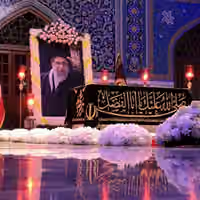
A portrait of slain Supreme Leader Ali Khamenei beside his tomb in Mashhad, Iran.

A revisionist argument is emerging in Tehran over Iran’s nuclear strategy: that its longstanding policy of nuclear ambiguity failed its most important test when it did not deter the United States and Israel from attacking, and should now be reconsidered.

Nezamoddin Mousavi, a former conservative lawmaker with longstanding ties to the Islamic Revolutionary Guard Corps (IRGC), gave unusually explicit expression to that argument this week, declaring that “nuclear ambiguity did not prevent war” and raising the prospect of revisiting Iran’s nuclear doctrine and even its membership in the Nuclear Non-Proliferation Treaty (NPT).

Mousavi, who helped found IRGC-linked media outlets, made the remarks in an interview with Ensaf News, a website close to President Massoud Pezeshkian.

Senior Iranian officials have previously hinted that Tehran could change its nuclear doctrine if sufficiently threatened. But such warnings have generally been directed outward, rather than framed as criticism of an established policy favored by slain Supreme Leader Ali Khamenei.

Mousavi, however, is effectively arguing that a policy intended to preserve strategic uncertainty while stopping short of weaponization failed to provide the deterrence its architects expected.

That diagnosis feeds into a wider debate over what lesson Iran should draw from the war: whether the failure was one of deterrence, requiring greater military leverage, or of escalation management, requiring a different approach to diplomacy.

Iran has long cited Khamenei’s fatwa prohibiting the possession and use of nuclear weapons when confronted with accusations that it might seek a bomb.

Critics, however, have questioned how absolute that prohibition would prove in an existential crisis, especially since Khamenei’s predecessor and founder of the Islamic Republic, Ruhollah Khomeini, held that preserving the state was paramount, taking precedence even over religious obligations.

Against that backdrop, Mousavi said Tehran should reassess its international commitments, the value of NPT membership and its broader deterrence strategy following attacks on Iran’s nuclear facilities.

He stopped short of explicitly advocating the acquisition of nuclear weapons.

His reasoning amounts to three premises and a conclusion: Iran refrained from building a nuclear weapon; ambiguity was supposed to contribute to deterrence; yet Iran was attacked and senior leaders and military commanders were killed. The assumptions underlying Iran’s deterrence strategy, he argues, must therefore be reconsidered.

Beyond Khamenei

Mousavi also ventured into another sensitive subject: whether Khamenei’s death would fundamentally alter Iran’s strategic direction.

He argued that he would not expect dramatic change. Foreign and security policy, he said, is not simply the product of one individual but of institutional thinking and long-term calculations developed over decades.

It reflects a distinctly conservative view of regime continuity: leaders matter, but institutions matter more. Major strategic directions, in this reading, are unlikely to change abruptly regardless of who occupies the highest office.

That also gives the nuclear debate greater significance. If Iran’s strategic direction is fundamentally institutional rather than dependent on one leader, the lessons the establishment draws from the war could outlast the present leadership.

Deterrence or de-escalation?

Not everyone in Tehran is drawing the same lesson.

An article published Wednesday in Etemad newspaper highlighted a competing strand of Iranian political thinking. Where Mousavi sees a failure of deterrence, more moderate voices see a failure to manage escalation.

The hardline argument holds that the United States and Israel seek to weaken Iran regardless of its diplomatic behavior and that negotiations cannot guarantee security while military pressure continues.

The more moderate argument sees the conflict as the product of a broader strategic environment shaped by political, regional, military and economic pressures. For this camp, the lesson is not necessarily that Iran needs greater deterrence, but that it needs more effective crisis management.

The emerging argument in Tehran, then, appears to be shifting from how this war ends to what lesson should be drawn from it: whether greater military and potentially nuclear deterrence offers the best protection against another conflict, or whether security ultimately depends on preventing the next escalation before it begins.

Iran may be restoring activity at nuclear-linked site struck by Israel

Oct 10, 2026, 17:38 GMT+1
100%
Satellite image released by Institute for Science and International Security purporting to show "continued heightened vehicle activity and the cleanup work" at a site in northeast Tehran

New construction and repairs at an Iranian compound previously targeted by Israel suggest Tehran may be moving beyond clearing war damage toward restoring operations at a site linked to nuclear weapons research, according to a Washington-based research institute.

The Institute for Science and International Security (ISIS) said Saturday that satellite imagery showed repairs to what appeared to be a water tank and the addition of a small building nearby at the Minzadayi compound, northeast of Tehran.

The findings add to an assessment published Tuesday in which the institute identified unusually heavy vehicle traffic and earth-moving activity at the heavily secured site, which Israeli aircraft struck on March 3.

The latest observations suggest Iran is seeking “not just to clean up the site” but to resume regular activities there, the institute said in a post on X.

Iran has consistently denied seeking nuclear weapons, maintaining that its nuclear program is intended for peaceful purposes.

The International Atomic Energy Agency has said it has no credible indication of a coordinated Iranian nuclear weapons program, although it has repeatedly raised concerns about Tehran's uranium enrichment and unresolved questions over past nuclear activities.

The original ISIS report, based on high-resolution satellite images taken in September and October, documented passenger vehicles and trucks returning to the compound following extensive work to remove rubble and repair damage from the Israeli attack.

Researchers also identified continued excavation at a section of the compound where the March strikes had left several craters, apparently above underground structures.

The institute said the activity could indicate an attempt to restore capabilities associated with nuclear weapons development. But the images do not establish what work, if any, has resumed inside the compound.

Israel identified Minzadayi as a covert nuclear weapons development facility during the war, saying scientists there had been working on a component of a nuclear weapons system. The institute's assessment of the site's earlier purpose relies partly on those Israeli military claims, which have not been independently verified.

The US and Israel launched their military campaign against Iran on February 28, two days after indirect nuclear negotiations in Geneva that Omani mediators said had made progress. Further technical talks had been planned before the attacks began.

Washington and Tehran remain divided over the future of Iran's nuclear program. The Trump administration is demanding substantial reductions in Iran's enrichment capacity, while Tehran insists it will not surrender its right to enrich uranium.

On Saturday, the Kremlin said Russian President Vladimir Putin had conveyed Tehran's position on a possible settlement of the war to President Donald Trump during a phone call Friday, following consultations with Iranian President Masoud Pezeshkian.

Moscow disclosed neither the details of Iran's position nor Trump's response.

The institute's findings raise the possibility that Iran is rebuilding infrastructure damaged in the war, but leave unanswered the more consequential question of whether any nuclear weapons-related research has resumed.