• العربية
  • فارسی
BrandBrand
  • Iran Insight
  • Politics
  • Economy
  • Analysis
  • Special Report
  • Opinion
  • Podcast
  • Live TV
  • Iran Insight
  • Politics
  • Economy
  • Analysis
  • Special Report
  • Opinion
  • Podcast
  • Live TV
  • Theme
  • Language
    • العربية
    • فارسی
  • Iran Insight
  • Politics
  • Economy
  • Analysis
  • Special Report
  • Opinion
  • Podcast
  • Live TV
All rights reserved for Volant Media UK Limited
volant media logo

Pezeshkian did not send message to Trump after Putin meeting, Kremlin says

Oct 9, 2026, 08:11 GMT+1

Iranian President Masoud Pezeshkian did not deliver a message to US President Donald Trump after meeting Russian President Vladimir Putin in Turkmenistan on Thursday, Kremlin spokesman Dmitry Peskov told TASS on Friday.

Most Viewed

Iran looks for escape routes as US sanctions close in
1
INSIGHT

Iran looks for escape routes as US sanctions close in

2

Tehran divided over $2 billion plan to prop up rial

3
ANALYSIS

China shifts to Iraqi oil: is Iran using old workaround to beat US blockade?

4
ANALYSIS

From talks to war: Tehran sees the gap narrowing

5

Kayhan attacks Ghalibaf’s role in talks. Didn’t Khamenei approve it?

Banner
Banner

Spotlight

  • US pressure hits Iranians harder than rulers, 68% in poll say
    VOICES FROM IRAN

    US pressure hits Iranians harder than rulers, 68% in poll say

  • Saudi Aramco hires US firm to upgrade shared oil field as Iran lags behind

    Saudi Aramco hires US firm to upgrade shared oil field as Iran lags behind

  • Iran's reported $200 million Hezbollah aid angers cash-strapped citizens
    VOICES FROM IRAN

    Iran's reported $200 million Hezbollah aid angers cash-strapped citizens

  • From talks to war: Tehran sees the gap narrowing
    ANALYSIS

    From talks to war: Tehran sees the gap narrowing

  • Iran looks for escape routes as US sanctions close in
    INSIGHT

    Iran looks for escape routes as US sanctions close in

  • China shifts to Iraqi oil: is Iran using old workaround to beat US blockade?
    ANALYSIS

    China shifts to Iraqi oil: is Iran using old workaround to beat US blockade?

  • Parsian Exchange transferred millions of dollars for Iran despite sanctions
    EXCLUSIVE

    Parsian Exchange transferred millions of dollars for Iran despite sanctions

Banner
Banner
•
•
•

More Stories

Taliban-run Afghanistan could get ‘land of its own’ on Iran’s coast, MP says

Oct 9, 2026, 04:48 GMT+1
100%
Chabahar port in southeastern Iran.

Iran has reached a preliminary understanding to allocate land at Chabahar to Taliban-run Afghanistan to build infrastructure for moving its goods to the sea, an Iranian lawmaker said.

Mohsen Zangeneh told Sahar TV during a visit to Afghanistan that the arrangement envisaged about 10 hectares along the waterfront inside Chabahar port and more than 100 hectares in the special zone in an initial phase. The Afghan government would invest in developing the facilities, he said.

“He proposed that we set aside an area in Chabahar for Afghanistan—in other words, that Afghanistan could have land of its own in the free zone at Chabahar port,” Zangeneh said, referring to Afghanistan’s industry minister.

Zangeneh did not specify whether the land would be leased or transferred into Afghan ownership. He said the Afghan side had requested more space within the port itself, but limited coastal land made that difficult.

“We reached this preliminary understanding during this visit and, God willing, we will follow up on it,” he said.

The discussions also covered wider industrial cooperation, a joint industrial park and a goal of increasing bilateral trade to $10 billion, according to Iranian media reports. Zangeneh described the land proposal as a way for Afghanistan to develop the infrastructure needed to transport its goods through Chabahar.

Baloch activists questioned how local residents would benefit, pointing to longstanding problems with housing, employment, infrastructure and access to basic services. They said arrangements for Afghan economic activity in Chabahar dated back to 2012, but questions about the share of development going to Baloch communities remained unanswered.

The Balochistan Human Rights Documentation Network said more than half of Chabahar’s population had at one point lived in informal settlements, with their expansion becoming a major problem for the area.

Against that backdrop, the group said, allocating land for foreign economic activity without disclosing its precise location, ownership arrangements, contract terms or duration of use had heightened concerns. It also questioned the lack of detail about local participation and employment.

Activists called on authorities to identify who would receive the land, disclose investment commitments and explain what obligations would apply to hiring local workers. They also sought clarity on how local communities would share in the revenue and business opportunities generated by the project.

US pressure hits Iranians harder than rulers, 68% in poll say

Oct 9, 2026, 01:10 GMT+1
•
Saba Heidarkhani
100%
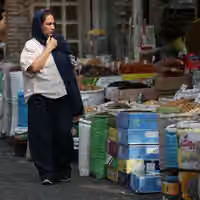
A woman walks past sacks of nuts, dried fruits and other goods at a market in Iran.

More than two-thirds of respondents to an Iran International Instagram poll said the Trump administration’s pressure on the Islamic Republic is hurting ordinary Iranians more than the authorities.

More than 56,000 people took part in the October 8 poll, with 68% saying ordinary people bear the greatest burden of US pressure. Another 23% said both the public and the government suffer, while 9% said the authorities are affected most.

Men accounted for approximately 76% of respondents and women for 24%.

The largest age group was 25 to 34, representing about 38% of participants, followed by those aged 35 to 44 at 29%. Respondents aged 18 to 24 and 45 to 54 each accounted for 12%.

Thousands of comments accompanying the poll reflected differing views on the economic consequences of US pressure, the Islamic Republic's responsibility for worsening living conditions and whether external pressure could bring political change.

Rising prices dominate concerns

The most common concern among respondents who believed ordinary Iranians were suffering most was the deterioration in daily living conditions.

Many cited rising prices, declining purchasing power, shrinking incomes and the growing financial burden on low-income households.

Others pointed to difficulties accessing medicine and medical treatment, arguing that people with fewer financial resources were particularly vulnerable to economic restrictions.

  • Officials trade blame as Iran’s economy sinks deeper

    Officials trade blame as Iran’s economy sinks deeper

"Only ordinary people are being crushed under the pressure," one respondent wrote.

Several participants argued that even when US measures target the Islamic Republic, their economic consequences ultimately reach households through higher prices and reduced access to essential goods.

Officials seen as insulated from hardship

Another recurring theme was the perceived gap between the living standards of ordinary Iranians and those of government officials.

Some respondents argued that access to wealth, foreign currency, privileged positions and state resources allowed officials and their associates to avoid some of the hardships experienced by the wider population.

"The main burden falls on the people. The government would even be happy to see people becoming poorer every day," one respondent wrote.

  • Iran drug shortages hit 800 medicines as costs could triple

    Iran drug shortages hit 800 medicines as costs could triple

Other participants said the Islamic Republic also suffers from economic restrictions through reduced revenues and limited access to financial resources, but can pass some of those costs on to the public.

For these respondents, the issue was not simply whether sanctions hurt the government or the public, but how the economic burden was distributed.

Economic hardship versus hopes for political change

The sharpest disagreement concerned whether the immediate economic costs of US pressure could be justified by the prospect of political change.

Some respondents acknowledged that ordinary Iranians were suffering but considered the hardship acceptable if it weakened the Islamic Republic or helped bring about a different political system.

"People will endure it because this suffering is worth it for a free Iran tomorrow," one wrote.

Others questioned whether worsening economic conditions would produce meaningful political change.

They argued that household finances could deteriorate far more quickly than external pressure could affect the country's political leadership.

100%
A woman shops at a market selling nuts, dried fruits and spices in Iran.

Several respondents held both US policies and the Islamic Republic's economic management responsible for the hardships facing Iranians.

Some likened sanctions to a painful medical treatment, reflecting a willingness among certain supporters of external pressure to accept short-term suffering in pursuit of longer-term political goals.

Others rejected that calculation, arguing that the prospect of political change remained uncertain while the immediate costs to families were already evident.

A divided view of US pressure

Although 68% of respondents believed ordinary Iranians were bearing the greatest burden, their answers did not necessarily show opposition to all forms of US pressure.

  • Iran says economy holding up as pressure mounts on oil, rial

    Iran says economy holding up as pressure mounts on oil, rial

Some viewed the economic consequences as unacceptable, while others regarded them as a painful but potentially necessary means of weakening the Islamic Republic.

Likewise, respondents who believed the government was suffering most did not necessarily dismiss the economic difficulties facing households.

Trump rules out Iran attack before midterms, Tehran says ready for prolonged war

Oct 8, 2026, 22:57 GMT+1
100%
US President Donald Trump in Sparrows Point, Maryland, October 6, 2026. White House

US President Donald Trump said Thursday the United States would not attack Iran before the November 3 midterm elections and that "productive" talks were underway, after reports of US preparations for possible large-scale strikes.

Trump said on Truth Social that Washington was having “productive discussions” with Iran and would not attack the country before the November 3 elections. He said, however, that the US blockade of Iranian ports would remain in place.

Trump had made similar remarks ahead of previous military action against Iran. In June 2025, he said he would decide within two weeks whether the United States would join Israel’s war against Iran, citing a “substantial chance” of negotiations. US forces struck Iranian nuclear sites days later.

Also days before the 2026 war, Trump said he preferred a diplomatic solution with Iran while also laying out the case for possible military action.

The remarks offered the clearest timeline yet for a pause in renewed US strikes, while leaving open the possibility of military action after the elections.

On the Iranian side, President Masoud Pezeshkian said during a meeting with Russian President Vladimir Putin that Tehran had not left the negotiating table and was working on its response to the latest US proposal.

Foreign Minister Abbas Araghchi provided further detail Thursday, saying Iran had received Washington’s response to Tehran’s “seven-day plan” and was reviewing it.

Araghchi said Tehran would deliver its response within the next few days and that messages continued to pass between Iran and the United States through mediators.

Reports of US military preparations

The talks are continuing as Washington prepares for the possibility of renewed military action.

Senior US officials told Israeli military chief Eyal Zamir earlier this week that the White House and Pentagon had instructed US forces to prepare for a possible large-scale attack on Iran within the next three weeks, Israel’s Channel 12 reported Thursday.

The network cited a senior US official and another source briefed on the conversation. Zamir warned that an attack within that timeframe could lead to the postponement of Israel’s October 27 election, based on an assessment that Iran would respond with heavy missile fire against Israel.

Trump’s pledge not to strike Iran before the US midterms appears to rule out that timeline, but does not remove the prospect of renewed military action after the November 3 vote.

No boots on the ground

Defense Secretary Pete Hegseth said Thursday Washington was not seeking to “nation build” in Iran or deploy large numbers of ground troops to control territory, framing the US objective as preventing Tehran from obtaining a nuclear weapon.

Hegseth said Iran could achieve that outcome “the easy way or the hard way,” but that Trump would ultimately decide how to proceed. If military action became necessary, he said, it would be “swift and decisive.”

Mediators are also seeking more room for diplomacy. They have asked Trump to give them additional time for negotiations before any potential attack on Iran, Al Hadath reported Thursday, citing a US source.

In his meeting with Putin, Iran’s Pezeshkian said there was no end to the war in sight as long as the United States continued what he described as unilateralism.

Iranian Defense Ministry spokesperson Reza Talaei-Nik also told the state TV that the country’s arms-production capacity was sufficient to sustain a prolonged war.

“We currently have the production capacity needed for a sustained and prolonged war within our production system,” Talaei-Nik added.

He said Defense Ministry personnel were working alongside missile launch crews, drone units and Revolutionary Guards and army naval and air forces to use battlefield experience to upgrade weapons and equipment based on emerging threats.

Hormuz remains a flashpoint

Iran’s warnings also focused on the Strait of Hormuz, a key issue in negotiations with Washington.

Revolutionary Guards commander-in-chief Ahmad Vahidi said Thursday that the United States and other “extra-regional” powers had no right to interfere in the strait or the Persian Gulf, warning that threats or unauthorized naval movements would face a forceful response.

Vahidi described the Strait of Hormuz as a strategic “red line” for the Islamic Republic and said the Guards’ naval forces were equipped with precision-guided missiles, attack drones, fast boats, electronic warfare capabilities and coastal defenses.

His warning came as tensions over shipping intensified. Reuters reported Thursday that vessel traffic through the strait had fallen to its lowest level in more than two months following a surge in attacks on tankers, while Tehran warned regional countries against attempts to establish oil-export routes it had not authorized.

Saudi Aramco hires US firm to upgrade shared oil field as Iran lags behind

Oct 8, 2026, 20:00 GMT+1
•
Dalga Khatinoglu
100%
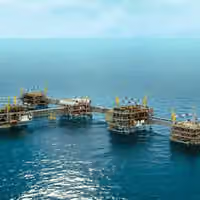
File photo from Saudi Aramco website shows Marjan offshore field

Saudi Aramco has hired a US engineering firm to upgrade an offshore oil field it shares with Iran, which has fallen far behind several neighbors in developing shared energy reserves.

KBR said on October 6 that it would provide engineering and project execution services for offshore processing facilities, gas compression and power systems at Marjan in the Persian Gulf. The work is intended to maintain production capacity and improve associated-gas processing. The company did not disclose the contract’s value.

The award follows a wider expansion of Marjan, whose total budget was put at $21 billion by industry publication Oil & Gas Middle East in a 2023 report.

Aramco said the Marjan project added 300,000 barrels a day of production capacity at the end of 2025. The expansion was designed to bring the field’s capacity to 800,000 barrels a day.

Iran calls its side of the reservoir Forouzan. Iran Open Data estimated Iranian production at about 35,000 barrels a day in a January 21 assessment, attributing the country’s wider difficulties developing shared fields to underinvestment and management constraints.

Saudi Arabia has also expanded its gas-processing infrastructure. Aramco said the Tanajib plant began operations in December 2025 and was expected to reach a raw-gas processing capacity of 2.6 billion cubic feet a day in 2026, handling supplies from both Marjan and Zuluf.

On the Iranian side, the Oil Ministry’s SHANA news agency reported in February that a project to collect gas otherwise burned off at Forouzan and other offshore fields was 76% complete. It said operations were expected to begin in 2028, subject to financing.

Saudi Arabia and Kuwait advance disputed gas project

Saudi Arabia and Kuwait are also moving ahead with development of the Durra offshore gas field, which Iran calls Arash and claims a share of.

Industry publication MEED reported in August that Al-Khafji Joint Operations had awarded contracts for two offshore packages and one onshore package worth an estimated $6.7 billion. The venture is jointly owned by Aramco Gulf Operations Company and Kuwait Gulf Oil Company, subsidiaries of the two countries’ state energy companies.

Iran says part of the field extends into its waters and that it should participate in development. Saudi Arabia and Kuwait reject that claim and maintain that rights to the field belong exclusively to them.

Iran’s wider production gap

The disparity extends to fields Iran shares with other neighbors. In its January assessment, Iran Open Data estimated UAE production from shared oil fields at 130,000 barrels a day, against 58,000 for Iran.

It put Iraq’s extraction from shared oil fields at roughly twice Iran’s and Qatar’s oil-layer output from the South Pars/North Field reservoir at 13 times Iran’s.

Oman was an exception: the assessment put each country’s production from the Hengam field, known as West Bukha in Oman, at about 10,000 barrels a day.

Iran’s national crude production has since fallen sharply during the war. The International Energy Agency estimated output at 2.16 million barrels a day in August, down from 3.59 million in February—a decline of about 40%.

US sanctions 17 ships in push to shut down Iran’s shadow fleet

Oct 8, 2026, 18:25 GMT+1
100%
FILE PHOTO: Tankers sail in the Persian Gulf, near the Strait of Hormuz, as seen from northern Ras al-Khaimah, near the border with Oman’s Musandam governance, amid the U.S.-Israeli conflict with Iran, in United Arab Emirates, March 11, 2026.

The US Treasury sanctioned 17 vessels and their owners Thursday under Operation Economic Outcast, saying the action effectively neutralizes most of Iran’s remaining shadow fleet.

In a statement, Treasury said the ships had carried millions of barrels of Iranian crude, petroleum products and petrochemicals to markets in South and East Asia. The network spanned more than a dozen jurisdictions and relied on international front companies.

Thursday’s broader Iran-related sanctions targeted six individuals, 27 entities and 22 vessels in total, including the 17 ships highlighted by Treasury. The additional targets included five Indian nationals and a Turkish national, along with companies including India’s Samudra Marine Services and SSPL Solutions and the UAE’s Hessonite Ship Management.

“Treasury is starving the tyrannical regime in Tehran of the money it uses to wage war in the region, and we will continue exposing those who enable the regime’s oil sales,” said Secretary of the Treasury Scott Bessent. “No enabler of Iranian sanctions evasion is safe from the full force of Treasury’s authorities.”

Among the targets were the Cameroon-flagged Shenzhen, which Treasury said had transported more than 3.5 million barrels of Iranian crude since November 2025, and the Vanuatu-flagged Tina 5, which carried more than 1.5 million barrels in August. Designated companies include firms in China, Hong Kong, the Marshall Islands and the British Virgin Islands.

Treasury said vessels regularly enter and leave the network, and pledged to continue monitoring attempts to evade sanctions.

Thursday’s measures, issued under Executive Order 13902, freeze the targets’ assets under US jurisdiction and generally prohibit US persons from dealing with them. Foreign financial institutions risk secondary sanctions for knowingly facilitating significant transactions for designated parties.

Treasury also removed the Hakuna Matata and Pinocchio from its sanctions list after they left Iran’s shadow fleet and were sold to non-sanctioned, US-aligned operators. Both vessels had been listed in June 2025.

Launched on August 24 and dubbed Economic D-Day, Operation Economic Outcast seeks to isolate Iran’s revenue and financial networks by increasing pressure on foreign companies and governments that sustain trade with Tehran.

The campaign expanded sanctions exposure across digital assets, technology, gold, aviation and shipping, threatening foreign businesses with exclusion from the US financial system. The broader authorities do not automatically sanction every foreign business in those sectors, but allow Washington to designate additional targets.

On October 1, Washington widened the campaign to Iran’s automotive and rail industries, sanctioning major manufacturers including Iran Khodro and SAIPA.

Treasury said the US military blockade, dwindling oil shipments outside it and widening sanctions were leaving Tehran with fewer options to stabilize its economy.

Iran’s central bank governor, Abdolnaser Hemmati, said Tuesday that the economy was still functioning and rejected what he described as US predictions of collapse.