CENTCOM says Iran naval blockade firm, Hormuz remains open - Al Arabiya
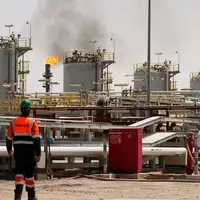
US Central Command said the naval blockade on Iran was “firm and effective” and that no vessel could bypass it without its permission, Al Arabiya reported on Thursday.
CENTCOM said commercial shipping continued through the Strait of Hormuz and that it had removed naval mines planted by Iran there, according to Al Arabiya.
More than 1.1 billion barrels of oil had passed through the strait, CENTCOM said, according to Al Arabiya, which also cited the command as rejecting IRGC statements that the waterway had been closed and saying Iran did not control the Strait of Hormuz.
CENTCOM also said Iran was deliberately targeting sailors and that it had escorted thousands of commercial vessels to protect them, according to Al Arabiya.
Reports that the Islamic Republic sent $200 million to Lebanon's Hezbollah have drawn anger from Iranians struggling with rising living costs, low wages and medicine shortages, according to messages sent to Iran International.
Citizens accused the authorities of prioritizing financial support for regional allies over the needs of Iranians, contrasting the reported payment with their own incomes, government subsidies and mounting household expenses.
In messages, several people described struggling to afford basic necessities, while others questioned why the Islamic Republic was directing resources abroad during Iran's economic crisis.
Hezbollah payments dwarf Iranian wages
"You give each Hezbollah family 8 billion rials, but deposit a 5000,000-rial food allowance for each Iranian and then take even that back a few hours later. This country's money belongs to its people, not Hezbollah," one citizen said.
Another compared the payments with compensation given to Iranian soldiers.
"A soldier who spent eight months under missile fire with no way to escape received seventy million rials in combat pay. Then you gave Hezbollah 8 billion rials from our money," the citizen said.
Reuters reported on October 7, citing two people with direct knowledge, that Hezbollah received $200 million from Iran in September and planned initial payments of $3,000 per family, prioritizing approximately 50,000 families displaced by the war.
At an exchange rate of approximately 2.67 million rials per dollar on Iran's open market, $3,000 amounts to roughly 8 billion rials.
A teacher in Tehran with 18 years of experience compared the payments with his annual salary.
"My salary for an entire year is about 3 billion rials, yet you gave 8 billion rials of our money to the Lebanese," the teacher said.
A local government employee with 29 years of service and a master's degree said his total monthly income was 350 million rials.
Citizens in Neyshabur and Malard also criticized the reported payments, saying the Islamic Republic was directing national resources toward allied groups abroad while Iranians faced poverty and declining purchasing power.
Islamic Republic officials have not formally confirmed the reported $200 million transfer, and the US government has rejected the account.
"Hezbollah has been decimated and caused misery for hundreds of thousands of innocent Lebanese. It is now trying to save face with fake stories about cash influxes from Iran," US State Department spokesperson Tommy Pigott said in a statement. "It can claim whatever it wants, but the money is not there."
Families sell belongings to afford basic necessities
Several citizens described the financial pressures facing their families, including difficulties paying for medicine, food and other essentials.
One person said her husband and son had been forced to sell their mobile phones to cover household expenses, contrasting the family's financial difficulties with the reported funding for Hezbollah.
Another described the rising cost of medication for her father.
"I bought just three blood pressure and heart medications for my father, and they cost 85 million rials. I didn't have enough money to buy the rest of his medicines. Insulin is also unavailable. Previously, these medicines did not even cost 5 million rials," the citizen said.
Other citizens described struggling to afford food and household expenses despite receiving government subsidies and food vouchers.
One person said the authorities treated modest increases in food assistance as a financial burden while continuing to spend substantial sums supporting allied groups in Lebanon.
Anger over Islamic Republic's spending priorities
Some calculated how many Iranian households could benefit from the reported $200 million payment, arguing that the money could help tens of thousands of families struggling with living expenses.
One person directed criticism at Supreme Leader Mojtaba Khamenei over the allocation of national resources.
"You have abandoned your own nation and are giving the Iranian people's money to the Lebanese. It is not your father's inheritance. Charity begins at home," the citizen said.
Another questioned the priorities of President Masoud Pezeshkian and his deputy, saying their public emphasis on serving Iranians conflicted with the financial support directed toward Hezbollah.
The citizen also expressed concern that such funding could contribute to continued armed conflict and civilian deaths.
Several others described the reported payment as part of the Islamic Republic's longstanding policy of financing allied armed groups across the Middle East.
Reuters reported in June that Hezbollah was awaiting additional financial support from Iran after suffering heavy losses in its war with Israel.
The US Treasury Department previously said Iran had transferred over $1 billion to Hezbollah during the first 10 months of 2025.
An Iranian police officer was killed on Thursday when gunmen attacked a patrol near Zahedan in Sistan-Baluchestan, the latest in a series of deadly attacks and clashes involving security forces in southeastern Iran.
Zahedan governor Jamshid Rakhshani-Nasab said a vehicle belonging to a police commando unit came under fire in the Nosratabad area and that officers returned fire.
Sistan-Baluchestan police said the patrol was attacked on the main road in the Lakhshak area while carrying out a security mission. The officer killed was identified as Vahid Enayat.
Police said several attackers were wounded and fled the scene. Security forces were searching the area for those responsible, according to the statement.
Army minibus attacked on Makran coast
In a separate incident on Thursday, gunmen attacked a minibus carrying personnel from the Iranian Army’s 88th Armored Division stationed along the Makran coast, Mehr news agency reported.
The division said the personnel were traveling for a shift change when the vehicle came under fire. One person, identified as Mohammadreza Okati, was killed and three others were wounded.
Series of attacks in Sistan-Baluchestan
No group immediately took responsibility for Thursday’s attack.
The incident came three days after gunmen attacked two military vehicles in Bampur, also in Sistan-Baluchestan. Rights group Haalvsh reported at least three people killed in that attack, while Iranian state media reported lower casualty figures.
Last week, another roadside attack near Zahedan killed several people, according to differing accounts from Iranian authorities and Haalvsh. The IRGC confirmed that one of its fighters was killed in a bombing, while Haalvsh reported a higher toll and said those killed were members of the Iran-backed Fatemiyoun militia.
Repeated clashes in the southeast
The province has also seen recent fighting in Rask, Saravan and other areas, including attacks on police positions and security facilities.
Iranian authorities regularly describe armed groups operating in Sistan-Baluchestan as terrorist organizations. The province has seen repeated armed attacks, insurgent activity and clashes between security forces and gunmen in recent weeks.
Hezbollah supporters attend a ceremony held by Hezbollah to commemorate the first anniversary of their late leader Hassan Nasrallah's killing by Israel, on the outskirts of Beirut, Lebanon, September 27, 2025. REUTERS/Mohamed Azakir
Hezbollah’s external operations unit has been recruiting foreign nationals in Iran and using safe houses in Qom and Tehran to train and shelter recruits, according to information obtained by Iran International.
Information provided to Iran International by an international intelligence agency shows that Hezbollah began contacting foreign students at Al-Mustafa International University five years ago. Those recruited have received training in weapons handling, sabotage, cyberattacks and espionage.
The recruitment operation is conducted in coordination with the Revolutionary Guards’ Quds Force and targets students at Al-Mustafa. The state-run institution was established 18 years ago on the orders of former Supreme Leader Ali Khamenei and has branches in more than 60 countries.
Iran International’s sources identified Mohammad Hassan, an Indonesian national and Al-Mustafa graduate, as the person overseeing Hezbollah’s operation in Iran. Under the supervision of Quds Force commanders, Hassan works for Talal Hamiyah, head of Hezbollah’s Unit 910, the group’s external operations unit.
Under Hassan’s direction, Hezbollah’s recruits maintain numerous safe houses, known as “operations houses,” across Iran. Iran International obtained the locations of four such properties in Qom and Tehran.
Hassan uses an apartment in Kashaneh 2 Tower in Qom’s Velayat district, near Hakim and Payambar-e Azam boulevards, as a safe house for recruitment and training. In Tehran, the network uses properties on Seventh Kish Street in the Naft neighborhood, Third West Sarvestan Street in Rah Ahan and Sarv Alley off Alborz Street in Pounak.
The Quds Force and Hezbollah use the properties as cover to shelter newly recruited members, who also receive training there.
The US Treasury designated Hamiyah a Specially Designated Global Terrorist in 2012 for supporting Hezbollah’s terrorist activities in the Middle East and around the world. The State Department’s Rewards for Justice program offers up to $7 million for information on him.
The unit’s first commander was Imad Mughniyeh, a senior Hezbollah figure who was killed in 2008. Hezbollah’s external operations unit initially included four prominent figures: Mughniyeh, Mustafa Badreddine, Talal Hamiyah and Ahmad Vahidi, then commander of the Quds Force and now commander-in-chief of the IRGC.
After Badreddine was killed, Hamiyah took command of the unit. Mohammad Hassan is now recruiting for him in Qom.
Iran International’s sources identified cleric Habib Mustafa Zaatar as another participant in the recruitment operation. Born in Lebanon’s Jabal Amel region, he lives in Qom. The sources said Zaatar is a US citizen and travels to the United States several times a year. Zaatar teaches Sharh al-Lum‘ah and its section on hudud punishments at Qom’s religious seminary.
Serving as an adviser at the Noor Islamic Center and Hikmat International Academy in Qom, he teaches Shia religious subjects in English. Tuition for his course at Hikmat Academy is 835,000 tomans per month.
Habib Mustafa Zaatar also has close ties to the Najaf religious seminary. He is a lecturer and researcher at the Al-Abbas shrine in Iraq and has translated several well-known Shia religious books. His command of English gives him a key role in recruiting foreign nationals studying at Al-Mustafa and Qom seminaries.
Iran International also identified four people recruited by Hezbollah who have been training for years as members of a sleeper cell in Iran.
One is Mohammad Zaki Fathoni. He heads the regional leadership council of Indonesia’s Ahlul Bayt Foundation and is a member of the Al-Mustafa alumni association. He represented Indonesia at the Fourth International Congress on Nahj al-Balagha and Alawi Governance, held at Iran’s presidential complex in Tehran in fall 2025, with President Masoud Pezeshkian in attendance.
Another recruit is Ahmad Dzilal Mukhlis. He is also a member of the Al-Mustafa alumni association.
Ali al-Attas attends a government-organized Quds Day march in Qom.
Another Indonesian national in Qom, Seyyed Mohammad Mahdi Ali al-Attas, has also been recruited by Hezbollah. He heads the association of Indonesian students studying in Iran and is a member of Indonesia’s Ahlul Bayt Council. Al-Attas hosts a podcast in which he strongly supports the Islamic Republic and speaks against Israel and Zionism.
A photograph reviewed by Iran International shows al-Attas attending a government-organized Quds Day march in Qom.
The fourth Hezbollah recruit in Iran is Mohammad Saleh. He is an Al-Mustafa student and a member of a religious seminary students’ association. On January 29, 2026, Saleh met Reza Ramazani, secretary-general of the Ahlul Bayt World Assembly, as a member of the Indonesian, Thai and Malaysian religious students’ associations.
According to a photograph published by media outlets inside Iran, Saleh attended a pro-government march in September 2022, days before the protests that followed Mahsa Amini’s death, and called for compulsory hijab for Iranian women. He is active in Qom’s religious circles.
Mohammad Saleh attends a pro-government rally calling for mandatory hijab in September 2022, days before the protests that followed Mahsa Amini’s death.
All these activities take place under the cover of Al-Mustafa, which received 1.8 trillion tomans in state funding for the Iranian year that began in March 2026.
Al-Mustafa describes its mission as educating Muslim students in other countries. The United States sanctioned the institution over alleged links to the Quds Force’s military and intelligence activities.
People carry Iranian and religious flags during a state-organized rally in Mashhad, October 6, 2026
Fears of renewed war with the United States, Israel or both are growing in Iran, as military officials talk openly about pre-emptive action and analysts warn that the distance between diplomacy and another round of fighting is becoming dangerously short.
The warnings come as Tehran and Washington continue indirect discussions, mediated by Qatar and others, over a framework for reopening the Strait of Hormuz and ending the conflict, while military preparations and explicit threats complicate the diplomatic track.
Morteza Maki, a senior international relations analyst, wrote in Etemad newspaper that another war was not inevitable, but pressure had reached a point where “the boundary between the threat of war and the start of war has become more fragile than before.”
Ruydad24 similarly warned Wednesday that the most important message from recent developments may not be that Washington has decided to go to war, but that “the distance between the path of negotiations and the path of military escalation has once again become very short.”
Fararu described “strategic ambiguity” as one of the defining features of the current crisis, warning that contradictory claims and uncertainty over the rules of engagement could lead to miscalculation.
The Strait of Hormuz, it said, “has now reached a point where every action there is not merely a tactical move, but a strategic statement.”
Iran signals readiness to strike first
The concerns have taken on greater significance as Iranian military officials increasingly describe pre-emption as part of Tehran’s strategy.
Brig. Gen. Mohammad Akrami-Nia, an army spokesman, told Fars that Iran had carried out pre-emptive operations in the past and would do so again under the framework of self-defense if necessary.
If Iran concludes that an enemy attack is imminent, he said, it will “definitely” launch a pre-emptive operation.
Akrami-Nia described an Iranian attack on a US base in Jordan as pre-emptive and said last week that Iran had shifted its strategy toward pre-emptive warfare following the 12-day war.
The statements have added to concerns that confrontation could escalate not only through a deliberate decision to start a war, but through either side acting on the assumption that an enemy attack is imminent.
Israeli preparations draw scrutiny
Iranian media have also focused on Israeli preparations for a possible new operation against Tehran.
Ruydad24 cited warnings by Israeli Prime Minister Benjamin Netanyahu about a possible Iranian attack alongside reports of Israeli military preparations as reasons the prospect of renewed conflict was being taken more seriously.
The outlet argued, however, that Iran’s ability to launch a pre-emptive attack should not be confused with an intention to do so, saying such an operation would carry significant costs for Tehran.
Fears of a trigger
The possibility of an incident providing the trigger for a wider conflict has become a recurring theme in Iranian commentary.
Journalist Ahmad Zeidabadi warned that Israel could stage a false-flag operation and attribute it to Iran, or conduct such an operation through infiltrators inside the country. He urged Iranian decision-makers not to fall into what he described as Netanyahu’s trap.
Foreign Ministry spokesman Esmail Baghaei raised similar concerns Wednesday in a video about alleged false-flag operations by the United States and Israel.
“False flags are an old craft: manufacture the incident, assign the blame, and harvest the consequences,” Baghaei wrote on X.
Ruydad24 warned that the greatest danger may be an ambiguous incident that sets off a wider escalation.
“The biggest danger for Tehran is not merely a direct attack; it is becoming trapped in a scenario in which a limited action, an ambiguous incident or an operation attributed to Iran becomes the pretext for another round of war,” it wrote.
War or pressure for a deal?
Despite the increasingly alarmed tone, some Iranian analysts believe a direct confrontation before the US elections remains unlikely.
Jafar Ghanadbashi, an international affairs analyst, told ILNA that “one should not expect a war before the US elections.”
He argued that the approaching elections and recent Israeli moves could instead produce efforts to create the impression that war was imminent in order to extract concessions from Iran.
That assessment offers a different reading of the military signaling: the threat of war may itself be a tool of pressure, without either side necessarily having decided to initiate another conflict.
The central concern running through Iranian commentary is not that either side has necessarily decided to start another war, but that pre-emptive military doctrines, strategic ambiguity and fears of a triggering incident have left little distance between confrontation and full-scale conflict.
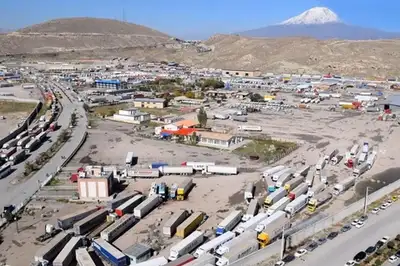
File photo: Trucks at the Bazargan border crossing between Iran and Turkey, with Mount Ararat in the background.
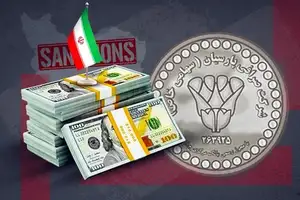
The widening reach of US sanctions across Iran’s transport and industrial networks has raised alarms in Tehran that Washington is seeking to close off the alternative trade routes the country has relied on to circumvent years of economic pressure.
Recent US measures have targeted Iran’s national railway system and major automakers including Iran Khodro and SAIPA, alongside foreign facilitators involved in their supply chains, while pressure has also expanded across aviation, maritime transport and financial networks.
The pattern has prompted some Iranian commentators to warn of what they describe as “network encirclement”: rather than trying to stop Iranian trade at a single chokepoint, sanctions raise the cost of moving money and goods across multiple routes simultaneously.
But Iranian economists and industry analysts are divided over how much additional pressure that can produce after years in which businesses have adapted to sanctions, and whether domestic dysfunction now poses a greater threat to industry than new US designations.
Closing alternative routes
Moderate outlet Khabar Online described the emerging strategy as “network encirclement,” arguing that modern economic blockades do not require borders to be physically sealed.
Instead, pressure can be applied simultaneously through financial sanctions, transport restrictions, higher insurance and compliance costs, and measures targeting companies and intermediaries that facilitate trade.
The importance of alternative routes was illustrated in a recent report by Mehr News Agency examining how Iran has sought to compensate for restrictions on maritime trade and rising insurance costs in the Persian Gulf.
The report highlighted truck traffic through northwestern crossings including Bazargan, Astara and Jolfa, connecting Iran with Turkey, the Caucasus and Russia. It argued that expanding land and rail corridors could reduce dependence on maritime shipping.
But Washington is increasingly targeting some of those alternatives as well.
Recent US sanctions have included Iran’s national railway system and major automakers, while also targeting facilitators in the UAE, Turkey, Hong Kong and India involved in supply chains.
Donya-e-Eghtesad described the measures as an expansion of pressure from maritime routes to overland trade, including networks used to obtain automotive parts.
An economy that has learned to adapt
Whether that approach can substantially increase pressure on Iran is less clear.
Industry analysts cited by Donya-e-Eghtesad said major Iranian automakers have developed extensive domestic sourcing after years of sanctions and reduced dependence on direct relationships with foreign manufacturers.
Eqtesad News went further, arguing that the latest measures against automakers and rail companies may carry greater political and psychological significance than immediate economic consequences.
Iran’s automotive industry has operated without direct partnerships with major international manufacturers for more than eight years and already relies heavily on intermediaries to obtain foreign components, it said.
The outlet argued that sanctions may therefore be producing diminishing returns, while domestic problems including price controls, supply-chain mismanagement and regulatory bottlenecks increasingly constrain production.
Economist Rasoul Safarahang made a similar argument in Khabar Online, saying an economy that has spent years adapting to sanctions is likely to respond to additional pressure by developing informal workarounds rather than immediately altering government policy.
Pressure extends to aviation
Aviation represents another potential pressure point because of its dependence on international maintenance, insurance, fuel and other services.
Iranian media have reported that US restrictions now cover 27 Iranian airlines, potentially affecting not only passenger travel but also time-sensitive cargo and the movement of industrial equipment and other goods.
Khabar Online estimated that restrictions on commercial aviation could cause between $3.5 billion and $5.2 billion in losses through reduced trade, tourism and supply-chain disruption, although the report did not provide sufficient detail to independently assess that estimate.
The outlet argued that longer transport times and more expensive alternative routes could ultimately feed through into higher domestic prices.
The debate in Iranian media therefore reflects two competing assessments of Washington’s strategy.
One sees sanctions as closing the routes Iran has used to adapt to earlier restrictions. The other sees an economy already so accustomed to sanctions that additional designations produces less leverage, while Iran’s own structural economic problems pose the greater threat.