• العربية
  • فارسی
BrandBrand
  • Iran Insight
  • Politics
  • Economy
  • Analysis
  • Special Report
  • Opinion
  • Podcast
  • Live TV
  • Iran Insight
  • Politics
  • Economy
  • Analysis
  • Special Report
  • Opinion
  • Podcast
  • Live TV
  • Theme
  • Language
    • العربية
    • فارسی
  • Iran Insight
  • Politics
  • Economy
  • Analysis
  • Special Report
  • Opinion
  • Podcast
  • Live TV
All rights reserved for Volant Media UK Limited
volant media logo
INSIGHT

Iran looks for escape routes as US sanctions close in

Oct 8, 2026, 00:08 GMT+1

The widening reach of US sanctions across Iran’s transport and industrial networks has raised alarms in Tehran that Washington is seeking to close off the alternative trade routes the country has relied on to circumvent years of economic pressure.

Recent US measures have targeted Iran’s national railway system and major automakers including Iran Khodro and SAIPA, alongside foreign facilitators involved in their supply chains, while pressure has also expanded across aviation, maritime transport and financial networks.

Continue reading

Most Viewed

Iran looks for escape routes as US sanctions close in
1
INSIGHT

Iran looks for escape routes as US sanctions close in

2

Iran’s own surveys reveal demand for 'fundamental change'

3

Tehran divided over $2 billion plan to prop up rial

4
INSIGHT

Iran, US back to ‘square one’ as diplomacy stalls

5
ANALYSIS

China's turn to Iraqi crude shows growing impact of Iran oil blockade

Banner
Banner

Spotlight

  • Hezbollah recruitment network in Iran exposed, four safe houses identified
    EXCLUSIVE

    Hezbollah recruitment network in Iran exposed, four safe houses identified

  • From talks to war: Tehran sees the gap narrowing
    ANALYSIS

    From talks to war: Tehran sees the gap narrowing

  • Iran looks for escape routes as US sanctions close in
    INSIGHT

    Iran looks for escape routes as US sanctions close in

  • China's turn to Iraqi crude shows growing impact of Iran oil blockade
    ANALYSIS

    China's turn to Iraqi crude shows growing impact of Iran oil blockade

  • Tehran divided over $2 billion plan to prop up rial

    Tehran divided over $2 billion plan to prop up rial

  • Parsian Exchange transferred millions of dollars for Iran despite sanctions
    EXCLUSIVE

    Parsian Exchange transferred millions of dollars for Iran despite sanctions

  • Iran protester recounts torture, mock execution after January arrest

    Iran protester recounts torture, mock execution after January arrest

  • Iran’s own surveys reveal demand for 'fundamental change'

    Iran’s own surveys reveal demand for 'fundamental change'

  • Iran executes nearly two people a week since January protests

    Iran executes nearly two people a week since January protests

  • Iran, US back to ‘square one’ as diplomacy stalls
    INSIGHT

    Iran, US back to ‘square one’ as diplomacy stalls

Banner
Banner
•
•
•

More Stories

Iran looks for escape routes as US sanctions close in

Oct 8, 2026, 00:00 GMT+1
•
Behrouz Turani
100%
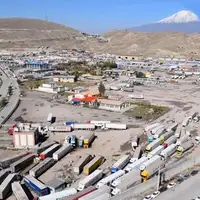
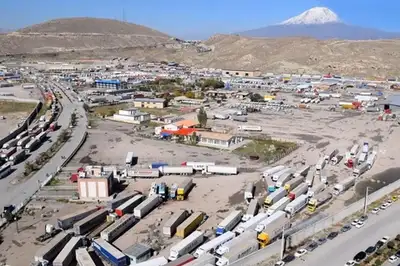
File photo: Trucks at the Bazargan border crossing between Iran and Turkey, with Mount Ararat in the background.

The widening reach of US sanctions across Iran’s transport and industrial networks has raised alarms in Tehran that Washington is seeking to close off the alternative trade routes the country has relied on to circumvent years of economic pressure.

Recent US measures have targeted Iran’s national railway system and major automakers including Iran Khodro and SAIPA, alongside foreign facilitators involved in their supply chains, while pressure has also expanded across aviation, maritime transport and financial networks.

The pattern has prompted some Iranian commentators to warn of what they describe as “network encirclement”: rather than trying to stop Iranian trade at a single chokepoint, sanctions raise the cost of moving money and goods across multiple routes simultaneously.

But Iranian economists and industry analysts are divided over how much additional pressure that can produce after years in which businesses have adapted to sanctions, and whether domestic dysfunction now poses a greater threat to industry than new US designations.

Closing alternative routes

Moderate outlet Khabar Online described the emerging strategy as “network encirclement,” arguing that modern economic blockades do not require borders to be physically sealed.

Instead, pressure can be applied simultaneously through financial sanctions, transport restrictions, higher insurance and compliance costs, and measures targeting companies and intermediaries that facilitate trade.

The importance of alternative routes was illustrated in a recent report by Mehr News Agency examining how Iran has sought to compensate for restrictions on maritime trade and rising insurance costs in the Persian Gulf.

The report highlighted truck traffic through northwestern crossings including Bazargan, Astara and Jolfa, connecting Iran with Turkey, the Caucasus and Russia. It argued that expanding land and rail corridors could reduce dependence on maritime shipping.

But Washington is increasingly targeting some of those alternatives as well.

Recent US sanctions have included Iran’s national railway system and major automakers, while also targeting facilitators in the UAE, Turkey, Hong Kong and India involved in supply chains.

Donya-e-Eghtesad described the measures as an expansion of pressure from maritime routes to overland trade, including networks used to obtain automotive parts.

An economy that has learned to adapt

Whether that approach can substantially increase pressure on Iran is less clear.

Industry analysts cited by Donya-e-Eghtesad said major Iranian automakers have developed extensive domestic sourcing after years of sanctions and reduced dependence on direct relationships with foreign manufacturers.

Eqtesad News went further, arguing that the latest measures against automakers and rail companies may carry greater political and psychological significance than immediate economic consequences.

Iran’s automotive industry has operated without direct partnerships with major international manufacturers for more than eight years and already relies heavily on intermediaries to obtain foreign components, it said.

The outlet argued that sanctions may therefore be producing diminishing returns, while domestic problems including price controls, supply-chain mismanagement and regulatory bottlenecks increasingly constrain production.

Economist Rasoul Safarahang made a similar argument in Khabar Online, saying an economy that has spent years adapting to sanctions is likely to respond to additional pressure by developing informal workarounds rather than immediately altering government policy.

Pressure extends to aviation

Aviation represents another potential pressure point because of its dependence on international maintenance, insurance, fuel and other services.

Iranian media have reported that US restrictions now cover 27 Iranian airlines, potentially affecting not only passenger travel but also time-sensitive cargo and the movement of industrial equipment and other goods.

Khabar Online estimated that restrictions on commercial aviation could cause between $3.5 billion and $5.2 billion in losses through reduced trade, tourism and supply-chain disruption, although the report did not provide sufficient detail to independently assess that estimate.

The outlet argued that longer transport times and more expensive alternative routes could ultimately feed through into higher domestic prices.

The debate in Iranian media therefore reflects two competing assessments of Washington’s strategy.

One sees sanctions as closing the routes Iran has used to adapt to earlier restrictions. The other sees an economy already so accustomed to sanctions that additional designations produces less leverage, while Iran’s own structural economic problems pose the greater threat.

Iran, US back to ‘square one’ as diplomacy stalls

Oct 6, 2026, 17:31 GMT+1
•
Behrouz Turani
100%
A portrait of Iran's slain Supreme Leader Ali Khamenei is displayed during a Janfada rally in Mashhad, October 6, 2026

Rhetoric is hardening on both sides of the Iran-US standoff, with even Iranian analysts traditionally optimistic about diplomacy warning that relations are slipping back to “square one” as military and economic pressure intensifies.

President Masoud Pezeshkian added to that sense of a narrowing diplomatic opening this week, declaring that “talks are meaningless” while Washington maintains what he described as a naval siege and fails to honor its existing commitments.

Pezeshkian said Tehran would not negotiate under military pressure or abandon its seven conditions for de-escalation, a position that leaves little obvious room for compromise as the US builds up forces in the region and tensions around the Strait of Hormuz continue.

Veteran foreign policy analyst Ali Bigdeli, who has traditionally taken a relatively optimistic view of diplomacy with Washington, told Fararu on Tuesday that Iran-US relations had effectively returned to “square one,” with deep mistrust and uncertainty prevailing in both capitals.

He also warned that the increased US military presence in the region, combined with mounting economic pressure on Iran, raised the risk of miscalculation.

Hardline newspaper Kayhan seized on Pezeshkian’s remarks, calling for an immediate and complete withdrawal from Qatar-mediated diplomatic channels.

The English-language Tehran Times portrayed his refusal to negotiate under naval pressure as “a principled rejection” of unilateral Western coercion.

On Monday night, international maritime security agencies issued four attack warnings within four hours following new projectile strikes on commercial oil tankers transiting the Strait of Hormuz.

Seven attacks on commercial vessels have been reported in the strait in the past week, according to maritime intelligence reports, which also describe direct radio warnings from the Revolutionary Guards Navy ordering some tankers to turn around.

IRGC-linked daily Javan highlighted the rapid succession of attack advisories and radio interdictions as evidence that CENTCOM’s naval presence has failed to guarantee freedom of navigation through the waterway.

But the same confrontation that hardliners portray as evidence of Iranian leverage is also generating warnings about its economic cost.

Economic daily Donya-ye Eghtesad argued that shadow fleets and off-radar transfers may allow crude oil to continue moving, but cannot reliably provide the raw materials needed by Iranian industry.

Once existing stocks of industrial inputs are exhausted, the newspaper warned, the combination of disrupted shipping and severed formal banking channels could push domestic industry into deeper decline.

Some Iranian outlets have increasingly focused on the possibility that a single security incident could upset the fragile balance altogether.

Moderate outlet Rouydad24 pointed to reports that American bombers were moved from RAF Fairford in Britain amid concerns about a possible Iranian or IRGC drone threat, as well as a US national security meeting last week with Iran and Yemen on the agenda.

The outlet warned that a single security incident could become a political trigger for escalation, sharply narrowing the distance between negotiation and confrontation.

Diplomatic channels have not disappeared, but harder positions in Tehran and Washington, an expanding US military presence, repeated incidents around Hormuz and growing economic pressure leave increasingly little room for error.

The emerging message from Iranian commentary is that a prolonged stalemate carries risks in either direction: deeper economic deterioration if it continues, and potentially rapid military escalation if it breaks.

Why Iran’s oil minister quit at a critical moment for exports

Oct 6, 2026, 08:34 GMT+1
•
Maryam Sinaiee
100%
Iranian Oil Minister Mohsen Paknejad

Iran’s oil minister left office as exports fell sharply and questions mounted over billions of dollars in sanctioned crude sales, bringing disputes over oil intermediaries, corporate management and political pressure into focus.

President Masoud Pezeshkian initially rejected Paknejad’s resignation, submitted some time earlier because of “personal issues,” but accepted it after the minister again pressed to step down, deputy presidential communications chief Mehdi Tabatabaei said.

Paknejad’s departure, the first by a minister from Pezeshkian’s cabinet, followed weeks of Iranian media reports linking his position to disputes over sanctioned oil sales, major energy projects and management of Persian Gulf Petrochemical Industries Company (PGPIC).

  • What can Iran’s new oil chief change under the US blockade?

    What can Iran’s new oil chief change under the US blockade?

Pezeshkian appointed National Iranian Oil Company (NIOC) managing director Hamid Bovard as acting oil minister. The government has not indicated whether Bovard will remain a caretaker or be nominated for the post.

Export crisis raises questions

Several Iranian outlets had linked Paknejad’s resignation to disagreements with Pezeshkian during cabinet meetings over the oil ministry’s handling of sanctioned crude sales.

Other reported disputes concerned delays to major projects, including development of the South Pars gas field, and the network of intermediaries entrusted with selling Iranian oil and returning the proceeds while circumventing sanctions.

Paknejad left as Iran’s floating oil inventories were approaching exhaustion and questions mounted over around 80 million barrels handed to intermediaries, Rouydad24 wrote.

The website questioned whether “personal reasons” adequately explained the timing, arguing that replacing the official overseeing the sector would not resolve falling exports, foreign currency shortages, unpaid oil revenues and the opaque structure of sanctioned sales.

Eghtesad Online website similarly questioned why Pezeshkian accepted a resignation that had been pending for some time when Iranian oil exports had approached zero.

Billions at stake in trustee system

The use of trusted intermediaries to sell crude under sanctions has become a central controversy surrounding the oil ministry, with lawmakers and media raising questions over unpaid revenues and the allocation of oil.

One intermediary, Hassan Aghayari, owed several billion dollars, ILNA reported on September 13, citing a letter Bovard sent to a senior supervisory body while serving as NIOC chief.

  • Iran oil exports vanish as regional flows surpass prewar levels

    Iran oil exports vanish as regional flows surpass prewar levels

The contract allowing Aghayari to sell oil was concluded on the minister’s order without approval from the sanctions-countering task force, Bovard wrote, according to ILNA. The oil ministry denied the report.

Around 80 million barrels were separately handed to four intermediaries following the Islamabad agreement, lawmaker Valiollah Bayati told Hamshahri newspaper. Hossein Shamkhani, son of former Supreme National Security Council secretary Ali Shamkhani, was among them, Bayati said.

More than 86 million barrels were allocated to trustees without guarantees, lawmaker Hossein Samsami said. Around 30 million barrels reached final buyers, leaving the status of more than 56 million barrels unclear, according to Samsami.

The accounts have raised questions over how intermediaries were selected, what guarantees were required and why further allocations went to people who allegedly owed money from previous oil sales.

Battle over petrochemical giant

Paknejad’s departure has also been linked to a dispute with Mohammad Shariatmadari, head of PGPIC, Iran’s largest petrochemical holding company.

The oil ministry sought to replace Shariatmadari with Hassan Abbaszadeh in July 2026. PGPIC rejected the move, saying it lacked the procedures required under stock-market regulations and board approval. Shariatmadari remained with support from the presidential office.

Paknejad was unwilling to remain as minister if Shariatmadari kept his position, Iranian media reported. Meetings ordered by Pezeshkian failed to settle the dispute, according to those reports.

Shortly before the resignation was accepted, editor of the oil-focused outlet Miz-e Naft Vahid Hajipourwrote on X that Paknejad had been given an ultimatum at a cabinet meeting over Shariatmadari’s continued tenure.

“Paknejad did not accept,” Hajipour wrote, adding that Pezeshkian consequently decided to end cooperation with the minister.

Political pressure

Political pressure offers another explanation. Parliament speaker Mohammad Bagher Ghalibaf was angered by the removal of his ally Hossein Ghorbanzadeh from PGPIC’s board and Paknejad’s refusal to reinstate him, journalist Hatef Salehi wrote on X on October 1.

Ghalibaf subsequently pressed Pezeshkian to remove Paknejad, Salehi said.

  • Islamic Republic's 'slow meltdown' leaves it fewer ways out, analysts say

    Islamic Republic's 'slow meltdown' leaves it fewer ways out, analysts say

“If the oil minister is replaced in the coming days, the roots of the decision should be sought in Ghorbanzadeh’s longstanding friendship and relationship with Ghalibaf, not in the government’s strategy,” Salehi wrote.

The competing accounts leave no single explanation for Paknejad’s departure, placing it instead at the intersection of an export crisis, disputed sanctioned oil sales, a battle over one of Iran’s biggest companies and reported political pressure over control of key posts.

As the rial sinks, Iranians seek shelter in almost anything else

Oct 2, 2026, 17:59 GMT+1
•
Behrouz Turani
100%
Visitors look at vehicles on display at the seventh Tehran Auto Show in the Iranian capital, September 2026

Iran’s stock market is breaking records even as the dollar and gold hit new highs, an apparent contradiction that may point to the same dynamic: households and investors scrambling to protect their wealth as the rial weakens and the economic toll of the Iran-US war grows.

Before trading closed on Wednesday, the final working day of the week in Iran, the Tehran Stock Exchange reached a record 7,766,000 points.

The market has risen 109 percent since the start of the Iranian year, while small investors poured roughly 4.7 trillion tomans, or about $19 million, into shares in a single day.

Iran’s prominent economic daily Donya-ye Eghtesad argues that the surge is not necessarily a sign of confidence. People are buying shares as political and economic risks rise, it says, while savers are also moving into gold, coins and dollars, all of which hit record highs on the same day.

The open-market dollar has passed 250,000 tomans, while measured in dollars, the stock market remains well below previous peaks.

At least part of the rally therefore appears to reflect a search for protection against the falling rial rather than confidence in the underlying economy.

Similar pressures are visible in consumer markets, where prices for cheaper mobile phones rose 33 to 42 percent in a month, outpacing the currency’s decline as import quotas, registration rules and fees hit lower-priced devices particularly hard.

Earlier this week, the government announced that the central bank would sell up to $2 billion in cash. The first $1 billion tranche is being sold through banks, with adults holding a national ID card allowed to buy up to $10,000.

The government’s own newspaper, Iran, warned that selling cash may slow the dollar’s rise but cannot reverse the underlying trend while inflation, budget pressures and political uncertainty remain unresolved.

Tehran’s prosecutor also ordered action against “market disruptors,” including online channels publishing exchange rates. Eyewitnesses on Ferdowsi Avenue, the capital’s main currency-trading hub, reported shorter queues and more sellers than buyers on September 30.

The respite was brief. On October 1, the open-market dollar rose 1.49 percent to 2,593,000 rials, its highest level in a year.

The central bank has been steadily raising the official exchange rate, from about 137,000 to more than 174,000 tomans this year, to encourage exporters to repatriate their foreign-currency earnings. Even so, the open-market rate remains much higher.

Because official imports are priced at the exchange-center rate, increases can feed through into the cost of imported goods. They also reduce the real value of the government’s electronic food-voucher scheme unless the state spends more rials to maintain it.

Hardline outlets including Kayhan and the IRGC-linked Javan portray the rial’s fall as part of Washington’s economic war. But their criticism is also directed at Iranian policymakers.

Kayhan calls currency sales a repeatedly failed policy and a waste of resources in wartime. It wants the government to reverse its economic liberalization and use judicial and security pressure to force exporters to repatriate their foreign-currency earnings.

The criticism exposes an argument within the establishment over how Tehran should respond: spend scarce foreign currency trying to contain demand, or preserve it while tightening controls over exporters and the domestic market.

That argument is becoming more urgent as the US blockade curtails Iranian oil exports, depriving Tehran of a major source of foreign currency.

Diplomacy could provide some relief, with Iran seeking access to frozen assets and an easing of sanctions and the blockade as part of negotiations with Washington.

For now, however, the clearest signal comes from the markets themselves. Stocks, gold and the dollar are all setting records. The simultaneous rush into them suggests that for many Iranians, almost anything that might preserve its value increasingly looks preferable to holding rials.

Iranian press sees diplomacy alive but narrowing after US response

Oct 2, 2026, 03:34 GMT+1
•
Behrouz Turani
100%
Iranian Foreign Minister Abbas Araghchi and other delegates attend the 81st United Nations General Assembly (UNGA) at UN headquarters in New York City, US, September 23, 2026.

Tehran media see diplomacy with Washington as increasingly precarious but not yet dead, with the two sides far apart over the sequencing of any deal and the window for compromise appearing to narrow.

Iran has disputed US accounts that Secretary of State Marco Rubio ordered Foreign Minister Abbas Araghchi and his delegation to leave the country after indirect negotiations in New York reached a stalemate.

Iran’s UN mission said the delegation left according to a schedule communicated to the State Department on September 17 and dismissed reports of a US-mandated departure as “baseless and worthless.”

Two US officials told the Associated Press that Rubio ordered the delegation to leave after little progress in indirect talks mediated by Qatar.

The dispute follows Washington’s response to Iran’s seven-point proposal for de-escalation and reopening the Strait of Hormuz. Araghchi has said Tehran has made no changes to the proposal, which calls for lifting the blockade and unfreezing Iranian assets as steps toward reopening maritime transit and resuming nuclear negotiations.

Iranian media have nevertheless stopped short of declaring the diplomatic process dead.

Across outlets ranging from the government’s Iran Newspaper and state broadcaster-affiliated Jam-e Jam to the moderate business daily Donya-ye Eghtesad, the negotiations are portrayed as a stalled bargaining process rather than a complete collapse.

Washington’s response, delivered through Qatar, is seen as keeping the diplomatic channel open even as the two sides remain far apart.

Across the three outlets, four broad conclusions emerge.

First, no comprehensive settlement appears close. Even the more optimistic assessments envisage, at best, a phased arrangement focused initially on crisis management rather than a broader breakthrough.

Second, trust remains a central constraint. Iran Newspaper and Jam-e Jam cite the US withdrawal from the JCPOA in 2018 and subsequent American policy, while Donya-ye Eghtesad frames the problem more neutrally as the enduring question of which side should move first.

Third, the central dispute is increasingly about sequencing. Tehran wants an end to hostilities, sanctions and blockade relief before reopening Hormuz within seven days and moving to nuclear talks. Washington wants nuclear concessions and movement on Hormuz before easing pressure.

Fourth, from Tehran’s perspective, the Islamabad Memorandum of Understanding remains the principal reference point. The Iranian press portrays the seven-day plan as an accelerated version of the June framework rather than a departure from it.

As the government’s voice, Iran Newspaper presents the seven-point proposal as a reasonable sequence that Washington is obstructing.

It also turns its attention to actors it sees as working against diplomacy, linking Benjamin Netanyahu’s visit to the UAE and his reported intelligence briefing there to efforts to build regional opposition to Iran.

Jam-e Jam similarly rejects accusations that Tehran is seeking to avoid the nuclear issue, arguing that the proposal would bring forward the start of nuclear negotiations from roughly 60 days to seven.

Donya-ye Eghtesad, however, focuses more heavily on the costs of prolonged deadlock. It treats the US response as a test of Iran’s willingness to show nuclear flexibility and argues that verifiable limits on its program would improve the prospects for an agreement.

Despite their different political orientations, the three outlets broadly treat the seven-point plan as the basis for further negotiations rather than something Tehran should abandon.

The remaining debate is largely about timing.

Iran Newspaper and Jam-e Jam argue that leverage over Hormuz, combined with US pre-election concerns about energy prices, favors Tehran holding firm. Donya-ye Eghtesad warns instead that the diplomatic window could close within weeks and that the risks of waiting until after the election may outweigh the benefits.

Trump’s rejection of key Iranian demands, Israeli intelligence activity and the UAE’s acknowledgement of Netanyahu’s visit also provide ammunition to voices in Tehran arguing against early concessions.

Jam-e Jam compared the diplomatic process to a game of Snakes and Ladders, in which every advance is followed by a setback. For now, it sees the US midterm elections as the next major variable that could alter the calculations of either side.