Qatar says US-Iran talks and message exchanges are ongoing
Mediation between the United States and Iran is continuing without interruption, with the two sides still holding talks and exchanging messages, the director of media and communications at Qatar’s Foreign Ministry said Tuesday.
“The talks are continuing, there is an exchange of messages between Washington and Tehran, and Qatar is a mediator between the parties,” Ibrahim bin Sultan Ibrahim Al Hashmi said during the ministry’s weekly briefing.
He said Doha is trying to create conditions for solutions that take into account the concerns of both sides.
Mostafa Sepahvand, 39, Shapoor Noori, 55, and Farhad Javadi-Manesh, 44, in a court sketch from Westminster magistrates’ court / Credit: SWNS
Three Iranian men spied on Iran International journalists to assist Iranian intelligence services and prepare for serious violence against at least one target, prosecutors told a London court Tuesday.
Iran International journalists Mojtaba Pourmohsen and Kambiz Hosseini were among the targets of the alleged surveillance operation, prosecutors told Woolwich Crown Court.
“Together, the defendants were engaged in what is very obviously a form of spying,” prosecutor William Emlyn Jones KC told jurors.
Mostafa Sepahvand, 41, Farhad Javadi Manesh, 46, and Shapoor Qalehali Khani Noori, 57, are accused of conducting months of surveillance and reconnaissance, including photographing and filming locations connected to their targets.
All three are charged with assisting a foreign intelligence service under Britain’s National Security Act 2023. Prosecutors say the foreign intelligence service was Iranian.
Sepahvand is also accused of conducting surveillance, reconnaissance and open-source research intending to carry out serious violence against a person in Britain. Javadi Manesh and Noori are accused of conducting surveillance and reconnaissance intending that serious violence would be carried out by someone else.
“It is the prosecution case that their ultimate objective was that one or more of their targets would be subjected to serious violence,” Jones told the jury.
The prosecution says Sepahvand was intended to carry out the violence himself, with Javadi Manesh and Noori gathering information to assist the planning of an attack.
The three men were arrested in May 2025 and are the first Iranian nationals charged under the National Security Act, which came into force in 2023.
Phones reveal surveillance operation
Prosecutors presented on Tuesday an outline of the evidence regarding the surveillance of Pourmohsen and Hosseini.
“These three defendants were carrying out surveillance and reconnaissance to locate and target at least two journalists associated with news agency Iran International,” Jones said.
The surveillance was intended to establish where targets lived and worked, their routines, the people they spent time with and the layouts of buildings connected to them, according to the prosecution.
Material recovered from Sepahvand’s phone included searches seeking Pourmohsen’s address. One search asked ChatGPT for “Mojtaba Pour Mohsen’s address,” according to evidence presented in court.
ChatGPT did not provide a home address but returned information about his career and social media contacts and suggested contacting him through Iran International, jurors were told.
Investigators also recovered from Sepahvand’s phone what prosecutors described as a briefing document or “targeting package” containing Pourmohsen’s photograph and information about locations associated with him.
The material included the address of Volant Media, Iran International’s parent company, and information about the Clayton Hotel on Chiswick High Road.
Pourmohsen had stayed at the hotel around Christmas 2024 after developing security concerns about his home address, Jones told jurors.
Prosecutors also presented photographs and videos of Malthouse Court, where Pourmohsen had lived between 2019 and 2023.
The defendants appeared not to know that Pourmohsen had already moved away, according to the prosecution.
Location data and videos
Cell-site data placed Sepahvand and Javadi Manesh in the Malthouse Court area on December 10, 2024, prosecutors said.
Data from a SIM card installed in Sepahvand’s Mercedes A200 also placed the vehicle in the area, according to evidence presented to the jury.
Javadi Manesh later sent Sepahvand photographs and videos of Malthouse Court that prosecutors say were recorded during the visit.
One video played to jurors began with a view of the river before moving toward the block of flats and zooming in.
Location data also placed Sepahvand and Noori in the Malthouse Court area on December 16, prosecutors said.
The prosecution had begun addressing the surveillance of Hosseini by the latest court update.
Sepahvand says he acted under pressure
The defendants contest crucial elements of the prosecution case in different ways.
Sepahvand accepts carrying out surveillance and reconnaissance and that he was doing so for the benefit of Iran, according to the prosecution’s account of his defence.
His position is that he did not want to carry out the activity and acted because he feared the consequences of refusing. Sepahvand also maintains that he deliberately did a poor job so the Iranian intelligence service would not receive the assistance it wanted, Jones told jurors.
The prosecution disputes that account.
“We suggest you will find nothing in any of these messages that is, or looks or even feels like, a threat to Sepahvand,” Jones said.
Javadi Manesh and Noori accept visiting relevant locations and taking photographs and videos but maintain that they did not know they were doing so to assist Iranian intelligence services, according to the prosecution’s description of their cases.
Jurors will have to consider whether they knew what the activity was intended to achieve or whether the circumstances meant they reasonably ought to have known, Jones said.
Messages presented to jury
The prosecution also took jurors through communications recovered from Sepahvand’s phone involving two Iranian telephone numbers.
One belonged to a man identified as Mostafa Ghorbani. Another was saved in Sepahvand’s phone as “Amin Mostafa’s friend.”
Both contacts appeared repeatedly in Sepahvand’s phone activity, prosecutors said.
In a December 8 exchange with Ghorbani presented in court, Sepahvand discussed information he had been sent about a person and location.
“It’s a tourist area, look. They got these [from] Iran, someone said he/she/it is here. They also sent me these few pictures from the Internet. I said ‘okay, I’ll go’, if he/she/it wasn’t there it’s their own problem,” Sepahvand wrote in a translated message read to the jury.
The following day, Sepahvand discussed plans to visit a location with the contact saved as Amin, according to the prosecution.
“I’ll definitely go tomorrow,” Sepahvand wrote.
Prosecutors say “tomorrow” referred to December 10, when location data subsequently placed Sepahvand and Manesh near Malthouse Court.
Amin responded with messages including “God willing you’ll see him/her/it” and “it’ll be sorted,” according to translations presented in court.
The prosecution argues the exchanges undermine Sepahvand’s position that he carried out the work because he had been threatened.
Jones also told jurors that some communications referred to Sepahvand being paid for his work.
Prosecutors say Sepahvand also wanted help resolving a criminal conviction in Iran. The jury was told that the conviction itself was not evidence against him and should not be held against him, but prosecutors consider his efforts to resolve it relevant to his motivation.
Another target
The surveillance outlined by prosecutors extended beyond Iran International.
Material exchanged between Sepahvand and Javadi Manesh included information about Jonathan Turner, a founder of UK Lawyers for Israel, the court heard.
Two aerial images sent by Sepahvand to Javadi Manesh in August 2024 showed addresses connected to UK Lawyers for Israel and Turner’s barristers’ chambers, prosecutors said.
The prosecution says the material relates to another person who had attracted the attention of Iranian intelligence services for reasons different from the journalists.
The majority of the evidence on which prosecutors will rely comes from material obtained from the defendants’ mobile phones following their arrests, Jones told jurors.
The indictment accuses Sepahvand, Javadi Manesh and Noori of engaging between August 14, 2024 and February 16, 2025 in conduct likely to assist a foreign intelligence service carrying out UK-related activities, knowing or reasonably being expected to know that their conduct was likely to provide material assistance.
The case is being heard by Mrs Justice Cheema-Grubb and is expected to last six to eight weeks, with the prosecution expected to spend about two weeks presenting its case.
The prosecution’s opening has begun laying out the digital trail at the center of its case, including searches for a journalist’s address, photographs and videos of locations connected to him, location records and messages discussing visits to those locations.
The jury will ultimately decide what the three men knew about the purpose of the surveillance and whether prosecutors prove it was intended to assist Iranian intelligence services and prepare for serious violence against journalists in Britain.
Economic crisis is driving some Iranians across the border to Armenia for construction, taxi and delivery work, turning a longtime holiday destination into a source of income for families struggling to make ends meet at home.
For years, Armenia meant something very different for many Iranian visitors.
Travel agencies sold packages for the country’s water festival, wine festivals and concerts. The images returning from Yerevan were largely of Iranians who had crossed the border for a few days of music, celebrations and leisure.
Those trips continue, and Iranians remain one of the largest groups of foreign visitors to Armenia.
But as economic pressures have deepened in Iran, another Iranian presence has become increasingly visible in Yerevan.
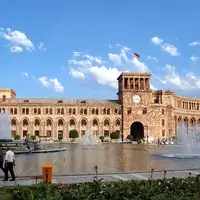
Around Republic Square, tourists stroll past fountains and the square’s distinctive stone buildings. Among them, Iranian men of different ages sit on benches speaking Persian.
Listen to some of their conversations and the subject is not where to eat or what to see.
It is work: wages, employers, rent and who is still hiring.
For some Iranians, Armenia is no longer somewhere to spend money on a few days away. It is a nearby country where they hope to earn enough to cover their own expenses and send what remains to their families in Iran.
‘Job placement’ signs in Persian
A few streets away, around Tigran Mets Avenue and the Firdusi neighborhood, the change is even more visible.
A job placement advertisement near Tigran Mets Avenue in Yerevan.
Sheets of paper attached to some walls carry a single word in Persian: job placement.
The reasons Iranians travel to Armenia vary widely. Many still come as tourists. Others choose Yerevan as a place to meet relatives who have emigrated to Western countries.
War and concerns about security have also prompted some to leave Iran temporarily.
But another group has been pushed out by the struggle to make a living.
High inflation, falling purchasing power, the declining value of the rial and the growing difficulty of covering everyday expenses have changed the calculation for some Iranian workers.
Even casual work in a neighboring country can make financial sense when the income is earned in Armenian drams and can be converted before some of it is sent back to Iran.
For these workers, a wage that is modest by Armenian standards can carry considerably more weight at home.
Working in Armenia, supporting a family in Iran
Ahmad, a 47-year-old from Sanandaj who asked to be identified by a pseudonym, left his wife and children in Iran and traveled alone to Armenia about four months ago.
He spent his first three months doing construction work in towns around Yerevan, earning about 7,000 drams a day, roughly $19.
Iran’s economic crisis has driven some citizens to Armenia in search of work.
A substantial share of that money went to the contractor.
The size of the wage was not Ahmad’s only concern. He had no written contract and worried that he might finish the job without receiving the money he was owed.
About a month ago, he switched jobs and began driving for Yandex in Yerevan.
Ahmad does not speak Armenian. He has learned only a few basic words useful for navigating the city: left, right and straight.
“From morning until the afternoon, I make enough to cover the car and my expenses. Whatever I earn after that, I can save,” Ahmad said.
That money is sent to his family in Sanandaj.
Reza, another Iranian in his 30s, arrived in Armenia from Karaj two months ago.
Friends who had traveled there before him suggested he come to Yerevan for work.
Concerns about war played a role in his decision to leave Iran, but economic pressure became the main reason for staying.
“The economic situation was so bad that I couldn’t cover my own expenses, let alone help my retired father. Now I work construction here. At least I can convert my wages into foreign currency and send money to them,” Reza said.
Reza also works without a formal written contract.
He has heard about workers whose employers failed to pay them, although he has not had problems with his own employer so far.
Construction, taxis and deliveries
The jobs newly arrived Iranians find are often in sectors where fluency in Armenian or advanced professional qualifications are not required.
Iranians were among the nationalities that filed the most employment-based residence applications in Armenia in the first half of 2026.
Construction is one of the main options, with Iranians working in jobs ranging from steel reinforcement and block laying to electrical work.
Others drive taxis through ride-hailing platforms. Some work as couriers, delivering food and other goods by bicycle, electric scooter or even on foot.
Others have found jobs in online casinos or entertainment and nightlife businesses.
Armenia’s expanding construction sector has helped create demand for workers. Official figures show construction activity increased 24.5% in the first six months of 2026 compared with the same period a year earlier.
But the attraction of these jobs for Iranian workers is not simply that Armenia pays higher wages.
The difference between the value of money earned in the two countries matters just as much.
As the rial has lost value and purchasing power has declined in Iran, earnings that may not stretch far in Yerevan can take on a different value once converted and sent home.
For some, working in Armenia is therefore not the beginning of an attempt to settle there permanently.
It is a way of keeping a household in Iran afloat.
Tourist on paper, worker in Yerevan
Official statistics provide only a partial picture of the Iranian presence in Armenia because not everyone who crosses the border and finds work appears in employment-based residency figures.
The number of Iranian tourists visiting Armenia increased from 176,453 in 2024 to 182,364 in 2025, a rise of about 3.3%.
Iranians accounted for around 8.1% of all foreign tourists in Armenia in 2025, making them the third-largest group after Russians and Georgians.
But being recorded as a tourist does not necessarily mean a visitor spends the entire trip sightseeing or on holiday.
Iranian citizens do not need visas for short-term travel to Armenia. Some who enter under those arrangements find jobs after arriving and enter the informal labor market without obtaining a work permit or employment-based residency.
That leaves open the possibility that some Iranians appearing in tourism and arrival statistics are, in practice, looking for work or returning to jobs they have already found.
High housing costs, unfamiliarity with the Armenian language and banking restrictions are among the main challenges facing newly arrived Iranians in Yerevan.
Available figures do not show how many Iranian visitors begin working after arrival, meaning the share of such workers in the overall increase in Iranian visitors cannot be calculated.
Temporary residency figures offer a clearer view of the formal side of labor migration.
A total of 8,181 foreign nationals received temporary residency in Armenia during the first half of 2026, with citizens of Russia, India and Iran making up the three leading nationalities, according to Armenia’s Interior Ministry Migration and Citizenship Service.
Of those temporary residency permits, 6,085 were issued on the basis of employment.
Citizens of Vietnam, Iran, China and India were among the nationalities filing the largest numbers of applications for employment-based residency.
The figures put Iranians among the main groups receiving temporary residency and among the leading applicants for employment-based status.
The exact number of Iranians granted employment-based residency in the first half of 2026 has not been published.
Those figures also cover only people who went through the formal process. Iranians working without permits in construction, taxis, delivery services and other sectors do not appear in that part of the data.
Tourism and residency figures therefore offer signs of a growing Iranian presence but cannot establish the actual size of the Iranian workforce in Armenia.
Earning abroad, sending money home
Employment brings its own difficulties.
Housing is among the first challenges facing new arrivals. Many Iranians stay in hostels or share rooms and apartments with several other people to keep costs down.
Access to banking services can also be difficult.
Sanctions and banks’ risk-management policies mean opening an Armenian bank account does not necessarily give Iranian nationals full access to cards and international financial services.
But workers such as Ahmad and Reza are not comparing Yerevan with wealthy European cities.
Their calculation is more immediate: what they could earn in Iran versus what they can save in Armenia and send to the people waiting for them at home.
That calculation is giving Armenia a different meaning for some Iranians.
A country associated for years with tours, concerts, festivals and short holidays is now also a place where Iranians lay blocks on construction sites, drive taxis and deliver food to earn money for households across the border.
For those families, Iran’s economic crisis is measured not only in inflation, the exchange rate or lost purchasing power. It is measured in the distance between home and the nearest place where one member of the family can still earn enough to send something back.
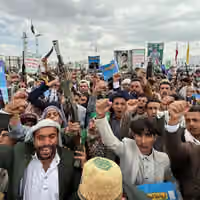
Houthi supporters rally to celebrate advances by Houthi forces along the Red Sea coastline in Sanaa, Yemen, Sept. 18, 2026. (Adel Al Khader/Reuters)
Saudi-backed Yemeni forces on Monday reversed weeks of Houthi gains around Bab al-Mandab, the strategic strait linking the Red Sea to the Gulf of Aden, exposing vulnerabilities in the Iran-backed group even as fighting elsewhere showed how far Yemen remains from a decisive shift.
As government-aligned forces advanced along Yemen’s southwestern coast, the Houthis stepped up pressure around Taiz, one of the country’s largest cities, leaving a battlefield moving in two directions at once.
The reversal came as Saudi Arabia, Turkey and Pakistan activated their Mecca Joint Defense Agreement following an emergency meeting in Riyadh, saying they would accelerate the deployment of agreed military forces and capabilities to Saudi Arabia.
Together, the developments point to a potentially consequential new phase of the Yemen war. But whether the counteroffensive can be sustained, and what any lasting reversal would mean for Iran’s position in Yemen, remains unclear.
“I think it’s too early to talk about sustainable gains against the Houthis at this point,” Thomas Juneau, a Yemen expert and non-resident fellow at the Sana’a Center for Strategic Studies, told Iran International.
“I think we need more time to see the dust settle.”
Iran watches a critical coastline
The importance Tehran attaches to Yemen’s western coast was apparent even as the latest Houthi gains were being reversed.
An IRGC-aligned Iranian newspaper led its coverage Monday with the headline “Ansarullah’s Upper Hand in Regional Equations,” arguing that Houthi positions around Bab al-Mandab translate into deterrence and regional leverage extending far beyond Yemen.
But the territory captured during the Houthis’ September advance was always going to be difficult to defend.
Juneau described southwestern Yemen as flat and exposed, with few natural defensive advantages and increasingly stretched Houthi supply lines.
“If it turns out that the losses are limited to the southwest corner of Yemen, that is not surprising in the sense that that was difficult for the Houthis to hold,” he said.
Even if pushed farther from Bab al-Mandab, the Houthis remain close enough to threaten Red Sea shipping with missiles and drones.
“So that would not be a strategic setback for them,” Juneau said.
Fatima Abo Alasrar, a Yemeni scholar, senior policy analyst and founder of Ideology Machine, said the Houthis’ September push had IRGC backing and caught Saudi-backed Yemeni forces poorly coordinated to respond.
Monday’s counteroffensive, however, demonstrated how quickly those gains could be reversed.
“The biggest takeaway is that this myth of Houthi invincibility is no longer there,” she said.
Hodeidah and Taiz complicate the picture
The more consequential test may now lie elsewhere.
The Houthis still control Hodeidah farther north on the Red Sea coast, preserving their ability to threaten maritime traffic even without holding territory immediately around Bab al-Mandab.
“Bab al-Mandab was just the icing on the cake,” Abo Alasrar said.
The possibility of attacks can itself increase shipping and insurance costs, meaning the Houthis do not need to physically control the strait to retain leverage over maritime traffic.
A loss of Hodeidah would represent a much more significant change to their strategic position. Late on Monday, the Saudi-led coalition said its naval forces struck Houthi military infrastructure in Yemen’s Hodeidah governorate, including weapons storage sites, facilities housing explosive-laden boats and stockpiles of sea mines.
At the same time, the Houthis are increasing pressure around Taiz, one of Yemen’s largest and most densely populated cities.
The geography presents a very different battlefield from the exposed southwestern coast and raises the prospect of a costly war of attrition.
“What I’m watching right now is the population centers,” Abo Alasrar said. “It’s in the cities, it’s in the population centers that the Houthis can inflict real damage.”
Iranian media has also shown growing interest in the fighting around Taiz, with Tasnim closely tracking Houthi advances there.
The simultaneous movement on the two fronts is one reason Juneau cautioned against drawing broad conclusions from the coastal counteroffensive.
“I don’t think we’re in a position to say yet that the Houthis are sustaining losses,” he said.
Two wars increasingly intertwined
The fighting is unfolding against the backdrop of the wider confrontation involving Iran, but Yemen cannot be understood solely through that lens.
“The war in Yemen is unlikely to end without a broader resolution to the war with Iran,” Mohammed al-Basha, a Yemeni-American analyst and founder of the Basha Report, told Iran International.
“But ending the confrontation in the Strait of Hormuz will not, by itself, end the war in Yemen.”
“The two conflicts are interconnected, but they are also distinct, with their own actors, grievances, battlefields, and political dynamics,” he added.
That distinction is important in assessing what the latest Houthi setbacks mean for Tehran.
Iran’s support has helped the Houthis develop into a powerful regional actor, but the group also operates within a distinctly Yemeni conflict shaped by domestic political, tribal and territorial dynamics.
A battlefield setback for the Houthis therefore does not translate automatically into an equivalent strategic loss for Iran.
Saudi Arabia signals it can absorb the risk
The activation of the Mecca Joint Defense Agreement adds another dimension to the confrontation.
Following an emergency meeting in Riyadh, Saudi Arabia, Turkey and Pakistan said they would move immediately to implement their joint-defense commitments and take measures to provide agreed military forces and capabilities and expedite their deployment in Saudi Arabia.
The three countries said the security of each member state was an integral part of their collective security and that implementing the agreement would strengthen deterrence.
“This is an important signal. It is a deterrent signal,” Abo Alasrar told Iran International following the announcement.
Saudi Arabia entered the counteroffensive knowing that supporting Yemeni government forces could expose the kingdom to retaliation from Houthi drones and ballistic missiles.
In Abo Alasrar’s assessment, the agreement signals that Riyadh is preparing to absorb that risk rather than allow the threat of retaliation to constrain the campaign.
It also sends a message about time.
The Houthis had hoped they could pressure Saudi Arabia and eventually emerge with concessions, she said. A Saudi signal that it is prepared for a prolonged confrontation potentially changes that calculation.
“This changes the rules of the game because Saudi Arabia is basically signaling that it’s going to play their game,” Abo Alasrar said. “It’s going to stay at this war as long as they want to, and that they’re ready to absorb the costs until they deal with this problem.”
Whether that deters the Houthis or leads to further escalation remains to be seen.
Limits to a broader government advance
Saudi-backed forces face another obstacle if they try to turn Monday’s counteroffensive into a broader campaign: divisions within the anti-Houthi camp.
Juneau said Iranian assistance explains only part of the Houthis’ resilience.
“Anti-Houthi forces remain fragmented and disunited,” he said.
The Houthis, by comparison, remain a considerably more coherent force, while rivalries among their opponents have repeatedly undermined efforts to establish a united front.
That is one reason Juneau remains skeptical of increasingly confident statements from Yemen’s government about eventually retaking Sana’a.
“When I hear the president of the Presidential Leadership Council, Rashad al-Alimi, talk about getting Sana’a back, as of now, I think that’s wishful thinking,” he said.
The contrast captures one of the central uncertainties surrounding the latest offensive: demonstrating that Houthi territorial gains can be reversed is one thing; translating that success into a sustained campaign against the group is another.
Tehran’s longer game
For Iran, the strategic calculation extends well beyond the movement of individual frontlines.
The Houthis have become an increasingly important part of Tehran’s regional network, particularly as other members of the so-called Axis of Resistance have come under intense pressure.
In Juneau’s formulation, small territorial losses along Yemen’s western coast are “the tree.” The durability of Houthi power is “the forest.”
“The forest, from Iran’s perspective, is the long game of seeing Houthi power in Yemen becoming institutionalized, becoming legitimated,” he said.
Juneau pointed to what appears to be an understanding under which the Houthis refrain from attacking US vessels in the Red Sea while Washington refrains from directly attacking the group.
The precise nature of any understanding remains unclear. But Washington dealing with the Houthis as an entrenched power is itself significant, he said.
“The US is making deals with the Houthis, you know, de facto a mutual non-aggression pact, which in practice legitimizes Houthi rule in large parts of Yemen, which is exactly Iran’s objective,” Juneau said.
Monday’s counteroffensive showed that recent Houthi territorial gains can be rapidly reversed. It has not yet shown that those reversals can be sustained or translated into a broader weakening of Houthi power.
Nor is the battle confined to Bab al-Mandab. The Houthis remain in control of Hodeidah, are applying pressure around Taiz and face opponents whose internal divisions have repeatedly worked to their advantage.
For Tehran, that leaves the picture similarly unsettled: one of its most important regional partners has shown itself vulnerable on the battlefield, but the foundations of the leverage Iran has built through the Houthis remain, for now, largely intact.
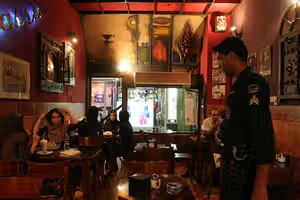
A DJ performs as people gather for drinks at a café in Iran.
Police in Tehran have warned cafes that they could face closure or lose their licenses for hosting live music, using DJs or serving hookah, extending a broader campaign of enforcement against businesses over entertainment, mandatory hijab rules and support for protests.
Ali Rafiei, head of Tehran's police department responsible for monitoring businesses and public venues, said cafes must operate strictly within the activities covered by their licenses.
“Cafes must operate only within their licensed line of business,” Rafiei said. “Serving hookah, hosting live music or DJs, and gambling-related activities are among the violations that will be dealt with.”
He said police would take action as soon as such activities were identified. Businesses could first receive warnings and be required to provide written assurances, while repeated violations could result in their licenses being revoked.
Cafes face wider scrutiny
The warning follows a series of closures targeting cafes, restaurants, shops, gyms and cultural venues across Iran in recent months.
People gather at a café in Iran.
At least 42 businesses were reported sealed between late July and mid-August in different cities.
Authorities in Ardabil also announced the closure of three coffee shops and the arrest of 16 people during the same period.
Closures have not been limited to entertainment or licensing violations. Businesses have also been sealed over the enforcement of Iran's mandatory hijab rules and over support for nationwide protests.
Rafiei said police monitoring of cafes extended beyond activities inside the establishments.
He pointed to Tehran's Sanai and Iranshahr streets, saying cars cruising through the area, sidewalk setups by cafes and groups of young people gathering without what he described as a clear purpose had contributed to congestion and complaints.
Women gather at a café in Iran.
He said blocking sidewalks or public space could also lead to enforcement action. Police generally issue a warning and seek a written commitment from the operator before sealing a business, he added.
Continued violations could ultimately result in the cancellation of a business license, according to Rafiei.
The pressure on cafe operators has also extended to owners who supported the January protests.
In one case, Iran's Supreme Court in September upheld the prison sentence and confiscation of assets imposed on Sadegh Saedinia, the head of Saedinia Properties and Industries and a supporter of the protests.
Women gather at a café in Iran.
Saedinia was sentenced to 12 years, six months and one day in prison and barred from working in the cafe industry for two years after completing his sentence. All branches of his cafe business were sealed following his arrest.
The judiciary said the case involved social media posts, participation in gatherings, closing cafes and shops, and encouraging employees to take part in protests.
Young men and women gather for drinks and food at a café in Iran.
The latest police warning adds live music, DJs and hookah service to a growing list of activities that can expose cafe operators to sanctions, alongside mandatory hijab enforcement, use of public space and support for demonstrations.
The mother of Mani Safarpour, who was killed during protests in Tehran in January 2026.
Clothes, diaries, books and childhood dolls are being taken from the bedrooms of protesters killed in Iran, as security forces extend pressure on families seeking accountability into the most private spaces of their grief nearly nine months after the January 2026 killings.
“Seven plainclothes men entered our home and began searching different parts of it,” the father of a slain teenage girl told Iran International.
“They went into our daughter’s room and put some of her personal belongings, including clothes, diaries, books and even two of her dolls, into a bag and took them away.”
Security forces have raided the homes of at least five families in the past two weeks and removed belongings of their slain relatives, informed sources told Iran International. Three of those killed were under 18.
The raids, sources said, targeted families active on social media and were intended to stop them keeping the memory of their children publicly alive.
The mother of the teenage girl had previously posted videos showing objects left behind in her daughter’s room as she mourned her death.
The latest raids take the pressure on bereaved families beyond summonses, arrests and restrictions on memorials. They reach into rooms left behind by the dead and the objects through which their parents continue to remember them.
‘Nothing will remain in your child’s room’
For another family, the message was explicit.
Security forces searched their home and took a watch and clothes their child was wearing when killed, the mother told. The officers then warned the parents against publishing more photographs or videos online.
“They threatened us that if we published another photo or video on the internet, nothing would remain in our child’s room,” she said.
The officers followed that warning with another, according to the mother.
“They told us, ‘A thief might come to your home one night, and in the morning you might find an empty room.’”
For months, families seeking accountability have faced restrictions on funerals, memorial ceremonies and birthday commemorations, according to information provided to Iran International.
Gravestones have been damaged at night, mobile phone SIM cards blocked and families pressured to remove posts from Instagram.
When a doll becomes something to confiscate
Personal belongings have assumed a wider role in the families’ efforts to preserve the memory of those killed.
A bedroom can be photographed. Clothes can be shown in a video. A diary can preserve someone’s words. A childhood toy can become an intimate reminder that the person killed was a son or daughter with a life beyond the circumstances of their death.
For parents who share those objects online, private grief can become a public record.
That has made the belongings themselves part of the pressure described by the families.
Authorities have previously sought to restrict the public activities of relatives seeking accountability.
Mahmonir Molaei-Rad, the mother of Kian Pirfalak, and other families connected to those killed during the 2022 Woman, Life, Freedom protests have faced similar efforts to restrict their public activity.
But the latest accounts describe security forces crossing another boundary: moving from controlling what families publish to taking away some of the objects they publish about.
The fight over who gets remembered
The bedrooms of those killed have become more than spaces of mourning for some families.
Photographs of their possessions circulate online alongside images of graves, birthdays and family gatherings, allowing parents to preserve details of lives that might otherwise become reduced to names and death tolls.
The sources who spoke to Iran International said stopping that process was a purpose of the recent raids.
The confiscations therefore bring together two strands of pressure on families seeking accountability – attempts to restrict what they say publicly and interference with how they remember privately.
Nearly nine months after the January killings, that struggle has reached objects of little material importance but immense personal value.
For families refusing to let their children disappear from public memory, a dress, a watch, a diary or a pair of dolls can preserve a fragment of the person who once occupied an empty room, but even those fragments are now being taken away.