IRGC says military action against US will continue until Iran’s conditions are met
IRGC spokesman Hossein Mohebbi said Friday that Iran’s Revolutionary Guards would continue military action against the United States until Tehran’s seven conditions were met, the semi-official ISNA news agency reported.
“Our missiles are capable of destroying US multilayered air defense systems,” he said.
Mohebbi added that the United States was portraying the Strait of Hormuz as open to prevent oil prices from rising, but had been unable to keep the waterway open even for a few hours despite having the world’s largest navy.
“Before the war, more than 100 vessels passed through the strait daily,” he said.
The IRGC-affiliated Fars News criticized Iran’s executive vice-president on Friday for joining Saudi officials in a cake-cutting ceremony marking the kingdom’s National Day in Tehran, which it said created an overly “friendly” image at a time of heightened regional tensions.
“Jafar has done it again,” Fars wrote, referring sarcastically to Mohammad Jafar Ghaempanah.
The issue, it said, was not Ghaempanah’s attendance at the event but what it described as the creation of an overly “friendly” image at a time of heightened tensions involving Iran, Saudi Arabia and the United States.
Ghaempanah later told state television that he had not been personally eager to attend the ceremony and had done so on instructions from officials responsible for Iran’s foreign policy.
“I had no motivation to attend the Saudi National Day ceremony, but I was instructed by the relevant foreign policy authorities to take part,” he said.
Ghaempanah added that during the event he condemned what he described as US attacks on Iran carried out from Saudi territory.
Fars said Iran and Saudi Arabia have diplomatic relations and that officials attending each other’s formal ceremonies was consistent with Tehran’s neighborhood policy.
But the outlet objected to images showing Ghaempanah standing alongside Saudi officials and holding hands with a Saudi representative during the cake-cutting ceremony, saying there was a distinction between “diplomatic presence” and producing “a friendly frame” under current conditions.
It pointed to the US naval blockade of Iran and reports of military cooperation between Washington and Riyadh against Iran-aligned groups in the region, arguing that symbolic gestures by senior Iranian officials would therefore face greater scrutiny.
Fars also linked the episode to earlier controversies surrounding Ghaempanah, saying a pattern had emerged in which remarks or actions by the vice president triggered criticism before he later explained that they had been misunderstood.
Ghaempanah previously drew criticism from hardliners after questioning the costs associated with Iran’s uranium enrichment program and arguing that policy should be assessed partly on a cost-benefit basis.
He later said those remarks were intended to argue for minimizing the costs of pursuing national objectives, rather than opposing uranium enrichment itself.
Iran will not make concessions over its nuclear program even if the United States accepts Tehran’s proposal for reopening the Strait of Hormuz, Reuters reported Friday citing a senior Iranian official.
The official, who spoke on condition of anonymity, said Hormuz would remain closed until Washington met all of Iran’s conditions, including lifting its naval blockade of Iranian ports.
The position adds a significant caveat to a proposal outlined by Foreign Minister Abbas Araghchi in New York this week, under which Iran has offered to reopen the strait within seven days if the United States meets a series of demands.
Those include ending the blockade of Iranian ports, waiving sanctions on Iranian oil sales, releasing frozen Iranian funds and ending hostilities on other fronts, including Lebanon. Nuclear negotiations could then resume as part of efforts toward a broader settlement.
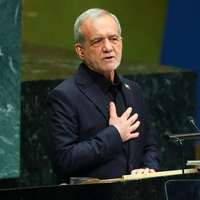
President Masoud Pezeshkian said Thursday that Iran was prepared to relinquish its stockpile of uranium enriched to 60% within the framework of international law and its obligations under the Nuclear Non-Proliferation Treaty.
The distinction could reflect the different questions being addressed: Pezeshkian spoke about Iran’s existing highly enriched uranium stockpile, while the senior official ruled out broader flexibility over the nuclear program.
Iran has long maintained that its nuclear program is entirely peaceful and that it does not seek an atomic weapon.
But senior officials have recently signalled that the attacks on Iran could prompt a reassessment, with Supreme National Security Council Secretary Mohsen Rezaei asking publicly why Iran should not pursue nuclear weapons itself.
The United States and Israel struck the Natanz and Fordow enrichment facilities and the Isfahan nuclear complex during the 2025 conflict, while the fate of Iran’s stockpile of uranium enriched to 60% has remained uncertain.
Natanz was targeted again after the current war began on Feb. 28.
The confrontation follows the collapse of the 2015 nuclear agreement, known as the JCPOA, under which Iran accepted restrictions on its nuclear activities in return for sanctions relief.
Trump withdrew the United States from the agreement in 2018 and reimposed sanctions.
President Donald Trump has made preventing Iran from obtaining a nuclear weapon a central US objective in the current conflict.
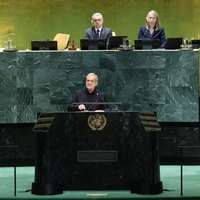
In his UN General Assembly address this week, he threatened further military action if an agreement was not reached while predicting that a deal could come after November’s US midterm elections.
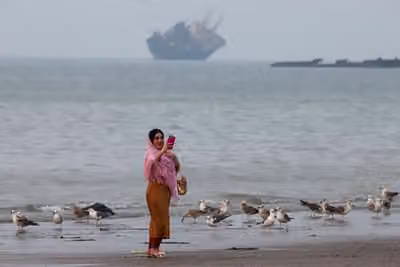
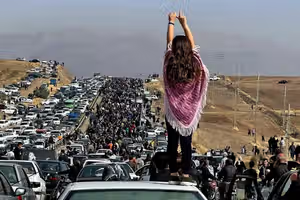
Participants ride motorcycles during a Janfada mobilisation rally in Tehran, beneath a billboard depicting a warrior emerging from the sea and confronting a burning ship, September 25, 2026
Talks between Iranian and US diplomats have continued in New York despite increasingly harsh rhetoric from both capitals, but the emerging dispute is less over whether to negotiate than over who must move first.
The discussions have increasingly focused on sequencing: Iran wants the United States to lift its economic blockade before Tehran reopens the Strait of Hormuz, while Washington is seeking movement on the strait before surrendering its principal source of leverage.
Neither side appears willing to go first despite the mounting economic and political costs of the deadlock.
On the sidelines of the UN General Assembly, Iranian President Masoud Pezeshkian said in an interview with Fox News that Tehran was willing to relinquish its stockpile of uranium enriched to 60% within the framework of international law and its obligations under the Nuclear Non-Proliferation Treaty.
The choice of Fox News may also have reflected an effort to reach President Donald Trump and his political audience more directly, given the network’s close relationship with the president.
Pezeshkian also said Tehran hoped to revive its June ceasefire understanding with Washington before the US midterm elections in November.
“We don't want it to get to the midterm elections,” he told reporters.
Trump has suggested the opposite timetable, saying in his UN General Assembly address that an agreement with Iran would likely be reached after the elections.
Who moves first?
Although both sides insist they seek peace, they remain divided over how an agreement would be implemented and in what order each should make concessions.
Tehran insists that no agreement can be reached before the United States lifts its economic blockade, while Washington and its European allies favour the opposite approach.
The disagreement is compounded by the collapse of the Islamabad Memorandum of Understanding.
From Tehran’s perspective, returning to an agreement that Washington previously failed to honour requires guarantees upfront. From Washington’s perspective, reviving the June arrangement risks appearing to reward Iran for using the Strait of Hormuz as leverage.
Supporters of diplomacy on both sides, along with mediators including Pakistan and Qatar, continue to urge the replacement of military rhetoric with political dialogue.
The problem is that each side is making a different calculation about timing and sequencing, while political considerations discourage either from moving first.
Iran’s demand that “all fronts” be addressed further complicates the equation, linking any agreement to Israel’s actions in Lebanon and elsewhere, while the widening confrontation in the Red Sea and around Bab el-Mandeb has added another layer of uncertainty to negotiations.
The midterms
The competing timetables reveal another dimension of the deadlock: both capitals have now openly linked a potential agreement to the November elections, but appear to be drawing opposite conclusions about who benefits from waiting.
It remains unclear whether Pezeshkian’s remarks will materially alter the course of negotiations. For now, each side appears to calculate that time is placing greater pressure on the other.
Trump’s threat to “annihilate Iran” raises the domestic political cost for Tehran of making concessions and increases the risk that any flexibility will be portrayed by Pezeshkian’s hardline opponents as capitulation.
Washington has political constraints of its own, with congressional hawks and influential regional lobbying groups likely to raise the political cost of concessions to Tehran ahead of the midterm elections.
The view from Tehran
The reformist daily Sharq argued on Thursday that the resumption of contacts offered an opportunity to prevent further escalation, but that significant differences between the two governments and political opposition at home made an immediate breakthrough unlikely.
“The mere continuation of mediation, or even a direct meeting between the presidents of Iran and the United States, lacks the capacity to overcome the current deadlock,” it said. “Changing this situation requires practical and reciprocal decisions from both Tehran and Washington that go beyond diplomatic messaging.”
That assessment points to the constraints facing Pezeshkian, including opposition from hardline parliamentary factions and Iran’s powerful security establishment.
For Iran’s leadership, the principal risk of an agreement is surrendering strategic leverage without guaranteed sanctions relief. For the Trump administration, moving first could expose it to accusations of appeasement ahead of the midterm elections.
The contacts in New York therefore suggest that diplomacy itself is not the missing ingredient. The harder question is whether either side is prepared to move first — and accept the political cost of doing so.
Salman Rushdie writes in a notebook in a frame from Alex Gibney’s documentary Knife: The Attempted Murder of Salman Rushdie.
Salman Rushdie says he never intended The Satanic Verses to provoke the reaction that followed its publication, in a new documentary revisiting Ayatollah Ruhollah Khomeini’s 1989 fatwa calling for his death and the attempt on his life 33 years later.
Rushdie argues that fiction should not be treated as a literal statement of reality. If a novelist writes that a horse can fly, he says, it is an act of imagination and does not mean that a horse is actually flying.
The documentary traces the decades-long consequences of the fatwa, from the controversy surrounding The Satanic Verses and the years Rushdie spent in hiding to the 2022 knife attack that nearly killed him.
Directed by Alex Gibney and based on Rushdie’s bestselling memoir Knife, Knife: The Attempted Murder of Salman Rushdie includes previously unseen footage of his recovery and reflections on a threat that appeared to have receded after Iran publicly distanced itself from efforts to kill him in 1998.
Among the most affecting images are those filmed by Rushdie’s wife, poet and writer Rachel Eliza Griffiths, as he lies in hospital after the attack. When he regains consciousness, despite his condition, Rushdie gives permission for the filming to continue.
“This isn’t just about me; it’s about freedom,” he says.
The documentary returns repeatedly to Iran, showing archival footage of Khomeini’s fatwa being announced on Iranian radio and demonstrations in London where protesters carried photographs of the Iranian leader.
It also recalls the multimillion-dollar reward offered for Rushdie’s killing. The man who attacked him in 2022 later told a court that he admired Khomeini.
Rushdie reflects on people who condemned a book they had barely read and remarks that many devils pretend to believe in God.
He also places the fatwa in the political circumstances of Iran at the time, saying the revolution had not gone well and that the war with Iraq had left the government in a difficult position. He says he ultimately became a casualty of that situation.
For years, Rushdie lived under protection and in hiding. That appeared to change in 1998, when Iran and Britain reached an understanding that paved the way for improved relations.
Iran’s foreign minister publicly declared that the government would neither threaten Rushdie’s life nor encourage others to do so. Two years later, Rushdie moved to the United States and gradually began leaving behind the security arrangements that had defined much of his life.
Looking back after the attack, he asks: “Did I make a mistake?”
The documentary also shows how the 2022 stabbing was received in Iran, including a front page of the newspaper Jam-e Jam depicting Rushdie in the form of the Devil.
The attack itself is initially reconstructed, with the actual footage appearing only near the end. Rushdie was repeatedly stabbed while preparing to speak at an event in New York state, leaving him blind in one eye and with severe injuries.
Rushdie later returns with Griffiths to the site of the attack and stands where he was nearly killed.
“Now I am standing in the place where I once fell,” he says, adding that he does not believe in miracles but describes his survival as “miraculous.”
The contrast with his attacker is one Rushdie also reflects on: he has continued to live and write, while the man who attacked him at the age of 24 is now in prison.
More than three decades after Khomeini’s fatwa transformed his life, the documentary finds Rushdie still defending the freedom at the heart of the original controversy: the freedom of a novelist to imagine.
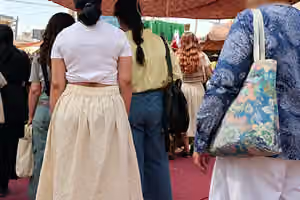
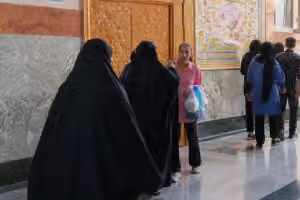
Iranian mothers accompany their daughters on the first day of school in Tehran in September. The image was reframed using AI to extend the background horizontally.
Mothers without headscarves walked daughters in regulation hoods to school in Iran this week. Women who remember 1980 describe the same scene from the year the state began imposing hijab. The picture is identical. What has changed is the society around it.
Among the images of the first day of the school year on September 23 were mothers who had dropped their daughters at the gate with their own hair uncovered, beside girls wearing the maghnaeh, the fitted hood that covers the hair, neck and shoulders and has been part of the girls' uniform in Iranian schools for four decades.
The scene is not new to the Islamic Republic. In the oral histories of women who remember the first years after the 1979 revolution, the same picture appears: mothers who still left the house without a headscarf, walking daughters who had to cover for school, because school was where the new state was making the rule stick first.
In the Islamic Republic's early years, compulsory hijab was established first in the spaces the state controlled most directly, government offices and schools, and only afterward extended to the street and the whole of public life.
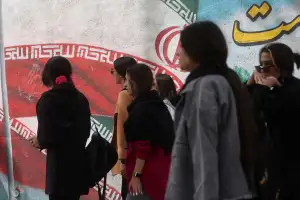
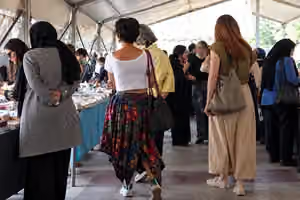
Today the rules in schools and offices remain, and the law on compulsory hijab has not been repealed or even amended. But outside those spaces, part of the female population has been living differently for some time. This time, society has moved ahead of the rules.
Before the hood became the uniform
This summer an image of two designs for girls' school uniforms from 1979, first published by the popular weekly Javanan-e Emrooz, circulated again. Neither design includes the maghnaeh that later became a fixed part of the girls' uniform.
That interval did not last. In 1980, as the new state Islamized government offices and institutions, the dress code for schoolgirls changed too. For the 1980-81 school year, the requirement became a long-sleeved smock, loose trousers and a headscarf. In 1983, appearing in public without what the state called "sharia hijab" was made a crime.
The note to Article 638 of the Islamic Penal Code later became the legal basis for action against women who appear in public without the hijab the state requires.
So the history of compulsory hijab cannot be read from the street alone. School and office were among the first places it was enforced, and only later did the requirement settle across public space.
The regulation and the mandatory hood
In schools, much of that structure still stands. Article 85 of the schools' executive regulation, adopted in 2021, says students' clothing should be "simple, beautiful, varied, neat and cheerful," appropriate to Islamic-Iranian culture and identity, social custom, the student's age and the climate. The choice of style and color is left to each school's council, with the participation of the student council.
But the note to the same article fixes the range for girls. A female student's dress is either "chador, manteau, trousers and maghnaeh" or "manteau, trousers and maghnaeh," the chador being the full-length cloak and the manteau the long coat worn over trousers.
The chador is not compulsory. The maghnaeh is. The regulation provides no option for a girl to attend school with her hair uncovered.
The requirement begins in primary school. A girl of six or seven may walk to the gate hand in hand with a mother whose hair is uncovered, and must then cover her own to go in.
The distance between society and the rules can hardly be seen more clearly than in those few meters.
The fight reaches the uniform itself
This year the argument over girls' dress did not stop at the hood. The uniform itself made news.
On the eve of the new term, a message circulated about a girls' primary school in Saadat Abad, an affluent district in northwest Tehran, saying pupils would wear a shirt or blouse with trousers in place of the usual smock or manteau. Because the school is state-run, the message spread widely and reached state television.
The education office for Tehran's District 2 denied it, saying the images being shared had nothing to do with that school's uniform.
So the case cannot be treated as a confirmed change to a state school's uniform. But that such a report could circulate about a state school, and that the ministry felt obliged to answer it, shows the argument over girls' dress has reached the definition of the uniform itself.
Official policy has not moved. This year's directives asked schools to avoid unnecessary changes to the design and color of uniforms.
The result is a split. Outside school, the way women dress has changed quickly in recent years. Inside it, the manteau, trousers and maghnaeh of the official regulation remain exactly where they were.
Today's girls are not the girls of 1980
The most important difference between the two identical pictures may be the girls themselves.
The dress rules of 1980 were imposed on a society in which the Islamic Republic was still building its political, educational and cultural institutions. Today the same rules have to be enforced on a generation whose experience of how women around them dress is entirely different.
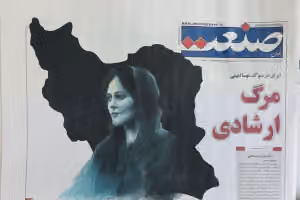
The protests of 2022 carried that difference into the schools. Among the most repeated images of the Woman, Life, Freedom uprising were teenage girls in school uniform who had taken off their hoods, in the schoolyard, the classroom and the street.
Reports of action against students over hijab followed. Amnesty International recorded the account of a 17-year-old who, after being seen with her hair uncovered on the school's cameras, was suspended and threatened with being reported to the security agencies.
That is a different experience from 1980. A student today may see bareheaded women on her way to school in the morning, be dropped off by a bareheaded mother, put on the hood to enter, and take it off again when school lets out.
For part of this generation, the maghnaeh is no longer a continuation of how they dress outside. It is a rule that applies on entering a controlled space, and stops applying on leaving it.
The law has not moved
None of this social change has become legal change.
The note to Article 638 still makes it a crime for a woman to appear in public without sharia hijab. Article 85 still lists the maghnaeh as part of a girl's dress.
The law known as Protection of the Family through the Promotion of the Culture of Chastity and Hijab, passed in December 2024, which would have widened the punishments and the means of enforcing compulsory hijab considerably, is not being implemented for now. Its suspension did not repeal the laws that came before it.
So what has happened in Iran's streets is not, in law, hijab becoming optional. The law has not recognized a right to choose. Part of society has made a different choice in practice.
A woman without a headscarf in Iran today is not uncovered because the law gave her that right. The law can still treat what she is doing as a crime, even if it is not enforced at every time and in every place.
The administrative structure behind hijab policy has not gone either. The budget for the Iranian year that began in March 2025 set aside 2.592 trillion rials, about $1.1 million at market rates, for the Headquarters for Enjoining Good and Forbidding Evil, the state body charged with policing public morality, for which hijab has been a principal concern. That is roughly the annual minimum wage of 1,300 workers.
In the budget for the year that began this March, the line was written differently: 6.284 trillion rials, about $2.7 million, in a single shared allocation for three bodies, the headquarters, Soureh University, which is run by the state's Islamic propaganda organization, and the Islamic Propagation Coordination Council, which organizes official rallies. Because the shares are not separated, the full figure cannot be described as the headquarters' budget, still less as a hijab budget.
The education ministry and other state bodies also retain duties under the existing law on dress. The retreat of enforcement in parts of public space has not removed the law, the institutions or the money behind it.
In 1980, the bareheaded mother was walking her daughter toward a rule that would soon reach her too. In 2026 she walks her daughter toward the last place the rule still holds. The picture has not changed. Its direction has. The few meters between her uncovered hair and her daughter's hood are no longer the distance between two generations, but between a society that has changed and a law that still says it hasn't.