Iran says Tehran-Dushanbe flight turned back after Turkmenistan denied overflight permit


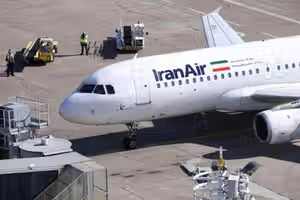
A Tehran-Dushanbe flight was forced to return to Imam Khomeini International Airport after Turkmenistan did not grant Iranian airlines permission to cross its airspace, Iran's Civil Aviation Organization said on Thursday.
Spokesman Majid Akhavan told ISNA the aircraft could not reach its destination because it was denied transit through Turkmen airspace.
ISNA also reported that all flights by Iranian airlines to the United Arab Emirates had been canceled from midnight.


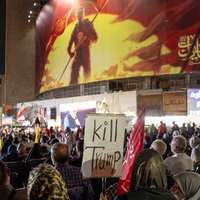
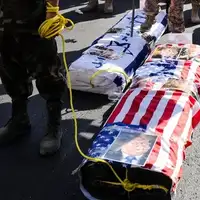

Iranians writing to Iran International this week did not see a diplomatic visit. They saw the men they hold responsible for January's massacre walking free in New York, and they asked the city's mayor, who once promised to arrest Netanyahu, why.
As President Masoud Pezeshkian and Foreign Minister Abbas Araghchi arrived for the UN General Assembly, the messages came in with a phrase that recurred until it became the story's own name: the "killers in suits." The demand attached to it was the same almost every time. Arrest them.
Voices from Iran draws on messages sent to Iran International by people inside the country. Names are withheld for their safety.
The demand
A writer from Fardis, on the western edge of Karaj, pointed to the latest human rights reports and asked why officials responsible for crushing 40,000 protesters in January were not being detained in New York.
Another wrote simply that now they were there, this was a good chance to arrest Pezeshkian and Araghchi.
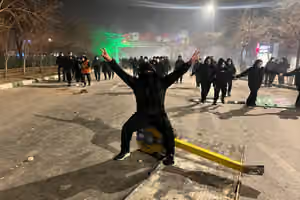
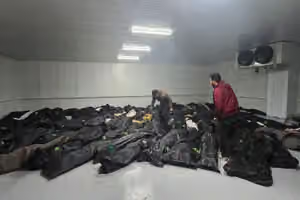
The UN fact-finding mission on Iran said in its new report that many of the violations committed in the crackdown on the January 2026 protests, including murder, imprisonment and severe deprivation of liberty, amounted to crimes against humanity. Its chair, Sara Hossain, said the true number of victims could be "significantly" higher than the government's own figure.
One writer suggested that while the officials were at the United Nations, footage and documents of the killings should be handed to the same body. Others addressed Donald Trump directly, asking him to act on the crackdown rather than host or negotiate with the delegation.
And several turned to Zohran Mamdani, who as a candidate for mayor of New York said he would have Benjamin Netanyahu arrested if the Israeli prime minister set foot in the city, citing the International Criminal Court warrant against him.
"The mayor of New York who wanted to arrest Netanyahu," one wrote, "does he by any chance not intend to arrest the criminals in suits who sit on the Supreme National Security Council and whose signatures are on the massacre of January 8 and 9?"
The visas
A second thread was anger at what writers called the West's double standard: condemning the repression while receiving the men accused of it.
"My question is this," one wrote. "Didn't Mr. Trump always talk about the January massacre? So why has he given visas to the ringleaders of the killers of Iran's children?"
The State Department has said that admitting the core members of the Iranian delegation was an obligation Washington carries as host of the United Nations, and that the delegation's movements were restricted. The US government also agreed to Araghchi's request for a security detail during his stay.
"Bodies attached to the United Nations say the leaders of the Islamic Republic have committed crimes against humanity," another writer addressed the president. "Why are they now freely, and even under your escort, in America and at the UN?"
Not everyone expected an arrest. One writer said it was probably beyond the West to detain the officials, and proposed instead that Iranians abroad gather outside UN headquarters.
'A puppet'
The other constant in the messages was that Pezeshkian does not decide anything, and that his presence at the UN is a performance of the system that does.
Writers called him a marionette, a wind-up doll, and the tea boy of the power mafia, and called the trip a circus staged for legitimacy.
Some pointed to how little it achieved. One wrote that for years the Islamic Republic's only gain from attending the UN had been shopping in New York, and that Trump had taken even that away.
Last September the State Department restricted the Iranian delegation's access to wholesale and luxury stores during its stay.
Beneath the mockery ran a fear. Several writers worried that a deal might be struck, and that the file on the killings would be pushed aside for it.
Chinese suppliers sent around 1,300 shipments of dual-use components to Iran’s defense ministry in the first half of 2026, helping sustain its weapons programs, The Wall Street Journal reported.
Iranian customs records showed one delivery arriving on June 17, when Washington and Tehran signed a 60-day truce and China promoted its peacemaking role. More than a dozen shipments followed two days later, carrying over $6 million in parts usable in drones.
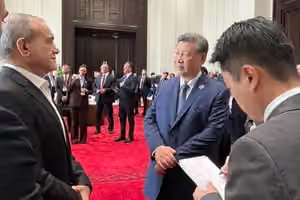
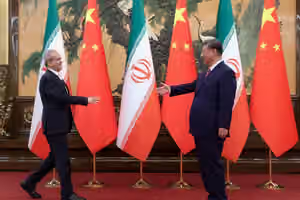
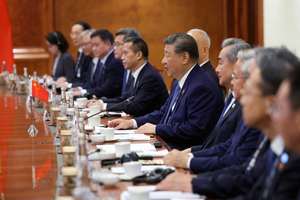
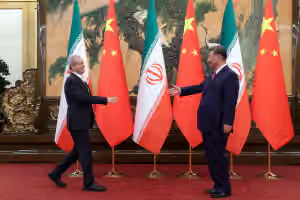
The findings put Chinese support for Tehran at the center of Xi Jinping’s Washington visit this week, alongside trade, artificial-intelligence safety and Taiwan. Trump told aides that preserving relations with Xi was a priority, the Journal reported.
Records supplied by ImportGenius, covering January 2025 through June 2026, listed thousands of shipments to Iranian companies and the defense ministry, including GPS devices, motors and aircraft engine parts. Many cited Article 119, which exempts defense imports from tariffs.
Days before war began on February 28, China delivered 300 tons of chemical compounds to the ministry. Trade initially collapsed, and April’s US naval blockade restricted supplies further. Iran responded by expanding air connections.
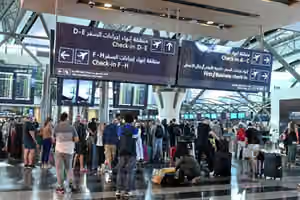
US-sanctioned Mahan Air increased flights from Beijing, Shanghai and Guangzhou to Tehran from four weekly in early March to about 27 by late April, FlightRadar24 data showed. It operated 39 China–Iran flights in September’s first week, twice its prewar level. Several were unavailable for passenger bookings. China services continued despite announced suspensions to Oman and Turkey.
CSIS researcher Kate Koren identified Chinese companies advertising sensitive electronics used in Shahed drones. Suppliers cultivated Iranian customers through trade fairs and Persian-language marketing.
Chinese chemical supplies also helped replenish missile production damaged by Israeli attacks in 2024. After reports of those exports in 2025, US forces raided a ship carrying dual-use components from China to Iran.
In a December letter, sanctioned Chinese company Haokun Energy said it had coordinated confidential export licensing for sodium perchlorate, used in missile propellant, and created a Beijing shell company for the transaction. The Journal verified the company’s registration but could not establish whether the deal proceeded.
Washington also targeted networks seeking newer Chinese shoulder-fired missile systems for Iran, which manufactures versions based on older Chinese designs. One unsuccessful effort sought delivery through Belarus to conceal Iran’s Center for Innovation and Technology Cooperation as the recipient. Tasnim separately published footage of IRGC personnel training with portable launchers.
Iran's biggest buyer
China became Iran’s dominant oil buyer after Trump’s 2018 “maximum pressure” campaign; the countries signed a 25-year pact in 2021. US lawmakers put China’s share above 80% of Iranian crude exports. Banks and shell companies have facilitated payments, including in yuan, US officials and other sources told the Journal.
One arrangement involved Iranian petrochemical sales to Egypt through Banque Misr’s UAE branch. After US objections to dollar payments, proposed transactions shifted to yuan through China’s Cross-Border Interbank Payment System. Washington intervened, stopping the plan, and later moved to restrict the branch’s dollar access.
Egypt and the bank said they were engaging US authorities; the bank affirmed regulatory compliance. Beijing suspected Egyptian officials had shared information with Washington, and Xi raised the matter in Cairo on September 1, the Journal reported.
US officials also linked Chinese satellite imagery obtained before and after a July 17 Iranian strike to the attack, which killed three American troops in Jordan. Washington had sanctioned three Chinese imagery companies in May.
Despite hundreds of sanctions, disagreements persisted inside Trump’s administration. Hegseth said China and Russia enabled Iran; Trump cited Xi’s assurances against weapons deliveries, saying: “I trust them.” Rubio said Chinese assistance had not changed the war’s trajectory.
July measures targeted Mahan-linked entities, including a Chinese sales agent. Late-August Operation Economic Outcast targeted a Chinese-owned tanker and procurement networks, but no major Chinese companies. Kpler recorded roughly four million barrels reaching China the following week.
Lawmakers from both parties urged tougher action; Senator Elissa Slotkin called for Iran to become central to the summit. Rubio promised frank talks, while Treasury and the White House defended their enforcement efforts.
China rejected accusations of improper support, citing export controls and opposition to unilateral sanctions. Hong Kong said it implements UN sanctions only.
Iran and the United States ended Wednesday divided over how to end their war despite renewed UN talks, as Tehran rejected US pressure and Washington maintained its blockade of Iranian ports while oil shipments continued through Hormuz.
The first indirect talks between the two countries in months took place Tuesday on the sidelines of the UN General Assembly, between speeches in which US President Donald Trump threatened further military action and Iranian President Masoud Pezeshkian rejected the use of force to secure a deal.
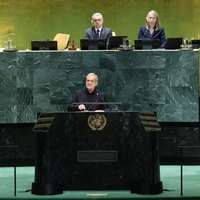
Pezeshkian told the assembly Wednesday that Iran would not surrender to American pressure but remained willing to negotiate. He accused Trump of displaying a “bullying mentality” and argued that diplomacy could not succeed under military threats.
His address left the central dispute unresolved. A senior Iranian official told Reuters that Tehran was reviewing Washington’s response to its proposal for ending hostilities but that the sides remained far apart. The proposal prioritizes lifting the US blockade of Iranian ports and reopening Hormuz.
Trump had described Tuesday’s discussions as productive. Iranian officials confirmed that Foreign Minister Abbas Araqchi communicated with US envoys Steve Witkoff and Jared Kushner through Qatari mediation but disputed suggestions that Tehran had abandoned its conditions for reopening the strait.
Hormuz remains at the center of the dispute
The disagreement over the waterway links the diplomatic exchanges to the continuing confrontation at sea.
Pezeshkian argued in his UN speech that Iran could not be denied access to Hormuz while other countries benefited from shipping through it. Tehran has linked reopening the strait to an easing of US military pressure and the lifting of the blockade. Washington has rejected Iran’s efforts to exert greater control over navigation and collect fees from passing vessels.
While those terms remained unsettled, US Treasury Secretary Scott Bessent said American forces were helping move between 10 million and 17 million barrels of oil a day through Hormuz despite attacks on tankers.
He compared that volume with about 20 million barrels a day before the war and said roughly 3 million barrels were moving through alternative routes.
“The tankers, they may get hit. Many of them just sail on,” Bessent told Fox News.
US Central Command separately said it had redirected 115 commercial vessels as of September 23 while enforcing the blockade of Iranian ports. The figures describe two distinct parts of Washington’s maritime campaign: maintaining oil flows through the strait and restricting trade with Iran.
Continued shipments have not restored safe passage for commercial crews. A vessel was struck in Hormuz on Wednesday, killing one crew member and forcing the evacuation of more than 20 others, according to Oman’s navy. The origin of the projectile was not immediately established.
The danger also prompted India’s Forward Seamen’s Union to seek naval escorts for merchant ships after Indian sailor Suraj Yadav, 26, was killed aboard the MV Cape Dao off Oman.
European Council President António Costa raised the shipping dispute with Pezeshkian, urging Iran to halt strikes on neighboring countries, restore freedom of navigation through Hormuz and resume cooperation with the International Atomic Energy Agency.
Economic pressure continues alongside diplomacy
Washington also pressed ahead with restrictions beyond the maritime blockade.
Bessent said US sanctions had shut down more than 80% to 90% of Iran’s international flights and questioned how Tehran’s delegation to the UN would return home. The measures expose foreign companies servicing Iranian airlines to potential secondary sanctions.
The restrictions disrupted routes to neighboring countries, although some international flights continued after the US deadline. The Guardian reported that Iranian officials were seeking to preserve air links as the new measures took effect.
The diplomatic opening did not produce an announced shift in the military positions of Iran or Israel. Iran’s Armed Forces Chief of Staff Ali Abdollahi vowed retaliation for the killing of the country’s former supreme leader and children in Minab. Israel’s UN ambassador Danny Danon said Israel had not finished its mission against Iran and called for further sanctions.
By the close of Wednesday, the talks had restored a channel between Washington and Tehran but left the terms of a settlement unresolved. The US blockade remained in place, oil continued to move through a dangerous waterway, and neither side had announced an agreement on how unrestricted navigation through Hormuz would resume.
Iran’s economy contracted sharply in the spring as war hit its oil and gas sectors, with new data pointing to an energy crunch that could force Tehran to balance gas exports against rising domestic demand as winter approaches.
Iran’s Statistical Center reported that gross domestic product contracted 10.1% year on year in the spring, with almost every major sector shrinking except agriculture.
The value added of the oil and gas extraction sector, measured at constant 2021 prices, fell 26.4%. Its share of Iran’s economy also declined from 26% in the spring of last year to 21% in the same period this year.
International Energy Agency data show that Iran produced an average of about 2.6 million barrels of crude oil per day between April and June, roughly corresponding to the spring quarter. That was more than 20% below the same period last year.
Average daily oil production fell further to around 2.3 million barrels in the summer. With the United States imposing a naval blockade on Iran from mid-July, the contraction in GDP is expected to be significantly sharper in the summer than in the spring.
Gas distribution
Statistical Center data show that the value added of the gas distribution sector, measured at constant 2021 prices, fell by more than 21% in the spring from a year earlier.
Israel targeted gas-processing facilities at South Pars, the field that accounts for around 70% of Iran’s gas production, on March 18. Since then, Iranian officials have given varying estimates of the decline in gas production, ranging from 100 million to 230 million cubic meters per day.
The International Energy Agency’s initial estimates, published in May, suggested that Iran’s daily gas production may have fallen by around 100 million cubic meters.
The Statistical Center did not specify the exact daily volume of gas distributed during the spring. However, an earlier report showed that Iran produced and injected around 726 million cubic meters per day of processed gas into the distribution network in the spring of last year.
Given the 21% decline in the sector’s value added at constant prices, this suggests that gas supplied to the domestic network fell by roughly 152 million cubic meters per day this spring, to around 573 million cubic meters.
The decline is particularly significant ahead of winter. Iran faces a severe natural gas deficit during the cold months, with the daily shortfall reaching as much as 250 million cubic meters during periods of peak demand.
The government has consequently been forced to restrict supplies to industries, power plants and the petrochemical sector to meet rising residential demand.
The gas export puzzle
Despite the decline in gas supplied to the domestic network, Iran increased exports to one of its two gas customers.
Data from Turkey’s energy market regulator (EMRA) show that Iranian gas exports to Turkey increased 27% between April and June to 30 million cubic meters per day. Iran also exports gas to Iraq, although comparable data for the same period have not been published.
The increase in exports to Turkey may have two main explanations.
First, domestic gas demand is lower during the warmer months than in autumn and winter. Second, Iran’s industrial and petrochemical sectors may have experienced a significant decline in gas consumption because of the war.
According to earlier Statistical Center data, Iran’s petrochemical sector and industries consumed about 82 million and 397 million cubic meters of gas per day, respectively, in the spring of last year.
Combined, that represented roughly 75% of domestic gas sales, excluding exports, transmission and distribution losses, and gas used to operate the network itself. The combined figure was equivalent to about 66% of the total processed gas injected into the network that spring.
Israel targeted parts of Iran’s petrochemical complexes in Asaluyeh and Mahshahr during the spring. Together, those facilities account for around 70% of Iran’s petrochemical production. Israel also targeted the Mobarakeh and Khuzestan steel complexes, which together account for about half of Iran’s steel production.
It is therefore likely that gas consumption by these industries fell sharply during and after the attacks, freeing up some gas for exports.
But the situation could change rapidly as temperatures fall.
Household gas consumption rises to roughly twice its spring and summer levels in autumn and more than three times the warm-season level in winter. Households accounted for 49% of Iran’s total gas consumption last winter, according to the Statistical Center.
It remains unclear whether Iran will be able to maintain gas exports to Turkey and Iraq once domestic demand surges in the coming months.
Iran warned Wednesday that any renewed US attack would draw a stronger military response, even as officials from the two countries pursued a new diplomatic opening in New York that has triggered a backlash among hardliners in Tehran.
The warnings followed President Donald Trump's threat at the United Nations to “annihilate” Iran, while Tehran has said further negotiations depend on Washington accepting seven conditions it has put forward for ending the conflict.
Mohsen Rezaei, secretary of Iran's Supreme National Security Council, sharply criticized Trump in remarks broadcast on state television, saying Iran would not return to what he described as the previous model of diplomacy.
He said the United States would first have to meet Iran's seven conditions before Tehran would agree to reopen the Strait of Hormuz and begin negotiations.
Rezaei said it had been agreed at a meeting with President Masoud Pezeshkian that Foreign Minister Abbas Araghchi would communicate the conditions to intermediaries during his visit to New York.
That account has become significant amid a growing dispute in Tehran over Araghchi's contact with US special envoy Steve Witkoff on Tuesday and whether the foreign minister had authorization to meet him directly.
US officials have described the latest contact between the two sides as face-to-face, while Iranian accounts have emphasized the role of mediators and said the purpose was to convey Tehran's conditions to Washington.
‘Childish and vile’
Iran's state broadcaster reported Tuesday evening that Araghchi had met Witkoff at the insistence of the American side and that the purpose of the meeting was to communicate Iran's conditions for reopening the Strait of Hormuz.
Foreign Ministry spokesman Esmail Baghaei said contact with the US side took place through Qatari mediators and was intended to communicate conditions including an end to the war on all fronts, a halt to US military operations, an end to the naval blockade and economic war, and the release of Iranian assets.
The contact prompted strong criticism of Araghchi from hardline and IRGC-affiliated media.
Tasnim News Agency, which is affiliated with the IRGC, described Araghchi's explanation as “childish and vile” and demanded an apology, questioning why he needed to meet Witkoff if Iran's conditions had already been communicated through intermediaries.
Ebrahim Rezaei, spokesman for parliament's National Security and Foreign Policy Committee, also questioned the meeting and asked Araghchi to explain what authorization he had received.
But parliament member Mojtaba Zarei defended Araghchi, saying his own review indicated that the foreign minister had been authorized to meet Witkoff.
“There was and is no negotiation,” Zarei wrote, saying Iran's seven conditions, including the lifting of the blockade of Yemen, had been communicated directly to Trump's representative.
Pezeshkian’s revised speech
The dispute unfolded as Pezeshkian and Trump publicly exchanged warnings while leaving open the possibility of diplomacy.
Pezeshkian said during his address to the General Assembly on Wednesday that he had changed his prepared remarks after hearing Trump's speech.
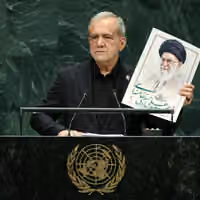
Holding up photographs of children killed in the attack on a primary school in Minab alongside an image of late Supreme Leader Ali Khamenei, Pezeshkian accused the United States and Israel of imposing the war on Iran and said the Islamic Republic had “powerfully” defended itself.
But he also said Iran remained open to negotiations in pursuit of peace and would not accept what he called “the language of coercion.”
Trump, meanwhile, issued a fresh warning against Iran while also expressing optimism that the dispute between Washington and Tehran could be resolved.
Speaking Wednesday at a meeting with Gulf Cooperation Council leaders in New York, Trump said the United States would “immediately” attack Iran if it carried out activities at the Kolang underground facilities.
Later Wednesday, after meeting British Prime Minister Andy Burnham, Trump said negotiations were continuing and that he believed the two sides would ultimately reach an agreement.
Iran's General Staff of the Armed Forces and the Khatam al-Anbiya Central Headquarters accused Trump of using the UN podium to justify military action and said Iran was prepared to deliver “stronger, crushing and unpredictable blows” in response to any renewed attack.
The simultaneous threats and diplomatic contacts have left the two sides pursuing negotiations while publicly warning that renewed military action remains possible.