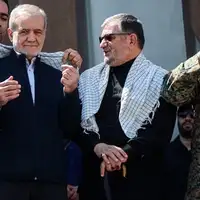
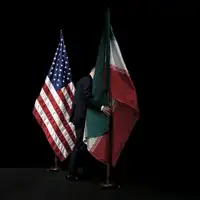
Iranian President Masoud Pezeshkian devoted both the opening and closing sections of his address to the United Nations General Assembly on Wednesday to rejecting President Donald Trump's accusations against Tehran.
He also made clear that while Iran welcomed negotiations, it would not yield to coercion or what he described as Trump's “bullying.”
The tension between those two messages reflects the difficult political terrain surrounding the latest diplomatic opening. Pezeshkian and Foreign Minister Abbas Araghchi have signaled a willingness to pursue talks, but criticism from hardliners has raised questions about how much room they have to negotiate.
Those divisions surfaced after Araghchi's contact with US envoy Steve Witkoff in New York on Tuesday.
The IRGC-affiliated Tasnim News Agency reported Wednesday that the contact had taken place without authorization from Iran's policymaking bodies, including the Supreme National Security Council.
Citing Mohsen Rezaei, secretary of the council, Tasnim said the approved plan had been limited to conveying Iran's seven conditions through mediators. It described Araghchi's reported interaction with Witkoff as a “major error” and called on the foreign minister to explain his actions.
The criticism points to a potentially important fault line in Tehran: not necessarily over whether diplomacy should continue, but over how direct that diplomacy is permitted to become.
Accounts of Tuesday's discussions have themselves differed. US officials have described a three-hour diplomatic exchange positively, while Iranian accounts have emphasized the role of mediators and said Tehran's conditions were conveyed to Washington.
An Iranian diplomat told Reuters before Pezeshkian's speech that discussions on ending hostilities could continue in New York and described the General Assembly as “a golden opportunity for America to return to diplomacy.”
US Secretary of State Marco Rubio said any agreement would require sustained work over time and that Trump retained military options.
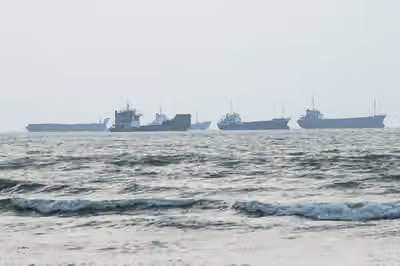
Rubio also pointed to divisions within Tehran, saying potential agreements had repeatedly faltered after being referred back to the country's revolutionary establishment. He blamed the IRGC for the collapse of an earlier US-Iran understanding after it attacked ships in the Strait of Hormuz.
Hardliners test the limits
Despite Tasnim's criticism of Araghchi, some hardline messaging immediately before and during the New York talks appeared to leave room for diplomacy.
Before opposition to the talks became more vocal, even the hardline Kayhan newspaper sounded unusually supportive of Pezeshkian on Wednesday morning.
IRGC spokesman Hossein Mohebbi also delivered a dual message following reports of the talks.
“We don't reject diplomacy, but we impose our own conditions. Our defensive power will be proven in the field,” he was quoted as saying.
The formulation suggested that the IRGC was not rejecting negotiations outright, even while insisting that diplomacy take place on Tehran's terms and alongside continued military pressure.
The dispute over Araghchi's contact with Witkoff suggests the argument may therefore be less about whether Iran should negotiate than about the format, limits and authorization of those negotiations.
Pezeshkian's own language at the United Nations appeared designed to preserve that room while demonstrating that negotiations would not amount to capitulation.
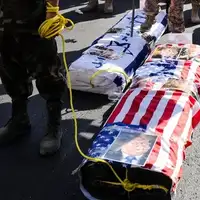
Responding to Trump's rhetoric, he warned the United States, Israel and regional actors that Iran would respond forcefully to threats, while insisting that Tehran still believed in diplomacy.
Major General Ali Abdollahi, chief of staff of Iran's Armed Forces, similarly argued that “rhetoric doesn't change the power calculus” and described Trump's remarks as “a sign of desperation” on the US side.
The sequencing problem
The mediation channel has so far allowed the two sides to exchange complex proposals without requiring the politically riskier spectacle of a meeting between Trump and Pezeshkian.
But even if Tehran's internal disagreements can be contained, substantial differences remain over what each side must do first.
Washington is reportedly insisting on the clearance of maritime choke points and assurances related to Iran's nuclear program before easing its naval blockade.
Tehran, by contrast, is demanding an immediate end to US interdictions and the release of $24 billion in frozen foreign assets as conditions for further progress, according to a source close to the Iranian diplomatic team.
Iran has also linked progress in negotiations to reopening the Strait of Hormuz.
The diplomatic opening in New York therefore leaves two related questions unresolved: whether Washington and Tehran can agree on the sequence of steps needed to end the conflict, and whether Iran's diplomats have sufficient authority at home to deliver whatever they negotiate.
The reaction from the IRGC and other hardline institutions in the coming days may provide an early indication of the answer.