The developments come as President Masoud Pezeshkian is preparing to travel to New York for the UN General Assembly, creating another potential diplomatic opening as tensions remained high around the Strait of Hormuz.
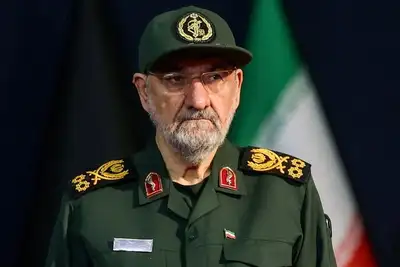
Revolutionary Guards spokesperson Hossein Mohebbi said Monday a renewed attack on Iran would change both the scale of Tehran’s response and the geographical reach of the conflict.
“We will introduce new weapons with new capabilities into the battle, and the world will be astonished,” Mohebbi said, adding that Iran had identified targets that had not previously come under attack.
He said the Revolutionary Guards had prepared for a prolonged conflict and would change the “geography of the war” if Iran came under renewed attack.
Iran’s armed forces separately pledged in a joint statement to make the United States, Israel and their allies “taste the bitterness of further defeats,” while Army Commander Amir Hatami said the military remained on full alert.
The warnings came as the risks of the conflict remained visible at sea.
Two tankers were struck in separate incidents while transiting the Strait of Hormuz on Monday, according to the United Kingdom Maritime Trade Operations.
One tanker entering the waterway was hit by an unknown projectile, leaving two crew members with minor injuries. The vessel remained under its own power and continued toward its next port, with no environmental damage reported.
Hours later, the master of an LPG tanker traveling out of the strait reported that the vessel had been hit by debris from unknown projectiles. Its crew was safe and the tanker continued toward its destination.
The incidents came amid a sharp decline in commercial shipping through the strategic waterway. Seventeen commodity vessels crossed the strait over the weekend, compared with 37 a week earlier, according to shipping data cited by Reuters.
Before the war began on February 28, about 125 large commercial vessels typically passed through the Strait of Hormuz each day.
The Revolutionary Guards also said Monday that they had shot down another US MQ-1 drone over the strait. The force has announced several drone interceptions over the waterway in recent days but has provided limited supporting evidence.
Mediators push for return to talks
Against that backdrop, regional governments were intensifying efforts to prevent another round of fighting and restart negotiations between Iran and the United States.
Qatar has been exchanging proposals with Washington and Tehran for nearly two weeks, Foreign Ministry spokesperson Majed Al-Ansari said, adding that mediators were traveling between capitals in search of common ground.
Pakistan has also been involved in the diplomatic push. Interior Minister Mohsin Naqvi met his Iranian counterpart Eskandar Momeni in Tehran on Monday, weeks after taking part in Pakistani mediation efforts aimed at ending the Iran-US conflict.
Iran’s Foreign Ministry said before the visit that it was not aware of any specific US message or proposal being carried by Naqvi.
Neither Washington nor Tehran has publicly indicated that an agreement is close.
Pezeshkian, meanwhile, was due to leave for New York on Tuesday to attend the UN General Assembly, bringing Iran’s president to the United States at a time of heightened diplomatic activity.
US pressure continues alongside diplomacy
The mediation effort has not brought an easing of US economic pressure.
Treasury Secretary Scott Bessent said Monday that Washington intends from September 23 to use secondary sanctions to effectively shut Iranian airlines out of international operations by targeting companies that provide them with fuel, landing services and ticketing.
“When Iranian airlines land at an airport, you cannot provide them with fuel, you cannot provide them with landing services, you cannot sell them tickets, or you will be knocked out of the dollar system,” Bessent told CNBC.
Bessent said the United States was also discussing enforcement of sanctions on Iran with Chinese officials, following talks with Vice Premier He Lifeng and financial authorities.
The combination leaves diplomacy unfolding under growing pressure rather than replacing it: regional mediators are trying to reopen negotiations while Washington tightens Iran’s economic isolation and Tehran warns that renewed military action would bring a broader response.
With attacks continuing around Hormuz and neither side signaling that a deal is near, the mediation effort is increasingly focused on preventing the current confrontation from opening into another, wider phase.