• العربية
  • فارسی
Brand
  • Iran Insight
  • Politics
  • Economy
  • Analysis
  • Special Report
  • Opinion
  • Podcast
  • Live TV
  • Iran Insight
  • Politics
  • Economy
  • Analysis
  • Special Report
  • Opinion
  • Podcast
  • Live TV
  • Theme
  • Language
    • العربية
    • فارسی
  • Iran Insight
  • Politics
  • Economy
  • Analysis
  • Special Report
  • Opinion
  • Podcast
  • Live TV
All rights reserved for Volant Media UK Limited
volant media logo

Vance says US in direct talks with Houthis amid Saudi escalation

Sep 14, 2026, 16:20 GMT+1

US Vice President JD Vance said Monday that Washington has been holding direct talks with Yemen’s Houthis as the Iran-aligned group escalates attacks on Saudi Arabia and expands its control near the Bab el-Mandeb Strait.

“We’ve also been engaged in direct conversations with the Houthis themselves,” Vance told reporters, adding that the administration was also in contact with Saudi Arabia and other countries affected by the fighting.

“We actually feel like we are on top of the situation,” he said. “It’s a very fluid and dynamic thing, but we’re going to keep on monitoring it and making sure that Americans’ best interests are represented.”

The remarks come after Saudi Crown Prince Mohammed bin Salman sought direct US military help against the Houthis last week. President Donald Trump declined to authorize US strikes, while Washington offered Riyadh intelligence sharing and targeting support.

Most Viewed

Mideast oil flows recover while Iran exports vanish, tracker says
1

Mideast oil flows recover while Iran exports vanish, tracker says

2

Iranians buy bread on credit, queue for chicken scraps

3

Deadly ship strike deepens crisis over Strait of Hormuz

4

Hormuz diplomacy stalls as attacks deepen pressure on Persian Gulf oil routes

5
VOICES FROM IRAN

Iran students go without as elite schools charge billions

Banner
Banner
Banner

Spotlight

  • Rushed trials, public hangings: Iran courts race to crush dissent
    INSIGHT

    Rushed trials, public hangings: Iran courts race to crush dissent

  • Israeli envoy says no victory until Islamic Republic falls

    Israeli envoy says no victory until Islamic Republic falls

  • Russia may fill Iran gap if support for Yemen Houthis falters
    ANALYSIS

    Russia may fill Iran gap if support for Yemen Houthis falters

  • Bid to oust Pezeshkian exposes rift among Iran conservatives
    INSIGHT

    Bid to oust Pezeshkian exposes rift among Iran conservatives

  • Iran’s hardliners bet on escalation as options narrow
    ANALYSIS

    Iran’s hardliners bet on escalation as options narrow

•
•
•

More Stories

Iran blocks restaurant page over ‘Bibi cutlet’ post

Sep 14, 2026, 14:55 GMT+1
100%

Iranian authorities blocked the Instagram account of a Tehran restaurant after it posted an apparent play on two terms that have become politically charged for the Islamic Republic: “Bibi” and “cutlet.”

The restaurant, Dastpokht-e Bibi (Bibi’s Cooking), posted an Instagram story reading “Nothing beats Bibi’s cutlet” alongside Iranian pop star Moein’s song Bibi Gol.

Shortly after the post went viral, the restaurant’s account was blocked by judicial order for what authorities described as “publishing criminal content.”

100%
The restaurant's page on Instagram was shut down by the Iranian authorities

On its face, the post advertised one of the restaurant’s dishes. But both words carry meanings in Iran’s increasingly coded political vocabulary.

“Bibi” is an old-fashioned Persian term for one’s grandmother. But it is also the widely used nickname of Israeli Prime Minister Benjamin Netanyahu and has become politically charged in Iran, particularly after the wars with Israel and the United States, as the nickname appeared in anti-government memes and expressions of support for Israeli attacks on the Islamic Republic.

  • Israeli Killings Of IRGC Generals Unleash Mockery Among Iranians

    Israeli Killings Of IRGC Generals Unleash Mockery Among Iranians

“Cutlet,” meanwhile, has been a political taunt since Qasem Soleimani was killed in a US drone strike in Baghdad in January 2020. Opponents of the Islamic Republic began referring to the former Quds Force commander as “cutlet” or “kotlet”, mocking the condition of his body after the strike.

The term subsequently became a broader euphemism on Persian social media for senior regime figures killed in military attacks.

The combination of the two words therefore allowed the restaurant’s slogan — “Nothing beats Bibi’s cutlet” — to be read as a reference to Netanyahu and Iranian officials killed by Israel, although the restaurant did not explicitly make such a political statement.

Authorities have acted over similar wordplay before. Celebrity chef Navab Ebrahimi was arrested in January 2023 after posting a recipe for cutlets on Instagram on the anniversary of Soleimani’s killing. His restaurant was also sealed and his Instagram account taken offline.

  • Iranian Professor Arrested For Mocking IRGC Commander's Death

    Iranian Professor Arrested For Mocking IRGC Commander's Death

In January 2024, an Iranian doctor and university professor from the city of Bojnourd in the northeast was detained after posting a picture of "cutlet" on the night of the death of IRGC commander Razi Mousavi.

In June 2024, the Iranian judiciary initiated a legal case against Hossein Pakdel, a playwright and theater director, for allegedly "disrupting the psychological security of society". Pakdel's Instagram post suggested that politics transform "stupid men into special diet cutlets".

The sensitivity surrounding references to Israel has intensified further during the current war.

Iranian authorities said in March that more than 1,000 people had been arrested over accusations including sharing anti-government material online or cooperating with Israel and the United States, while the judiciary warned that some forms of assistance to hostile states could carry the death penalty.

  • Khamenei ‘rat’ taunt spills from social media onto Iran’s campuses

    Khamenei ‘rat’ taunt spills from social media onto Iran’s campuses

IAEA raises alarm over Iran access as Hormuz tensions mount

Sep 14, 2026, 13:23 GMT+1
100%
Pedestrians walk past a billboard promoting Iran’s nuclear program in Tehran.

Concern over Iran’s nuclear program intensified on Monday as the UN nuclear watchdog said it had conducted almost no inspections in the country for more than six months, while tensions surrounding Hormuz deepened and Yemen’s Iran-backed Houthis claimed another attack on Saudi.

The developments centered on the loss of international oversight of Iran’s nuclear material, mounting restrictions and threats involving shipping through Hormuz, and a new round of regional military activity that prompted Saudi emergency alerts and high-level talks with the head of US Central Command.

IAEA warns of serious proliferation concern

The International Atomic Energy Agency has carried out no in-field verification activities in Iran for more than six months, except for an inspection of the Bushehr nuclear power plant in June, Director General Rafael Grossi said at the agency’s General Conference in Vienna.

Grossi said the IAEA withdrew its inspectors after renewed attacks on Iran in late February, worsening a decline in oversight of Tehran’s nuclear program during 2026.

The agency has also lacked continuity of knowledge for more than a year regarding Iran’s previously declared inventories of low- and highly enriched uranium, including material enriched to 60% purity, at nuclear facilities affected by attacks in June 2025.

“The Agency’s lack of information about this nuclear material and access to facilities to verify it is a matter of serious proliferation concern and needs to be addressed with the utmost urgency,” Grossi said.

He called a return to diplomacy and negotiations over Iran’s nuclear program “imperative,” warning that the situation had consequences for the wider global non-proliferation system.

The remarks came as Iran summoned Austria’s chargé d’affaires over Vienna’s failure to issue a visa to Mohammad Eslami, the head of the Atomic Energy Organization of Iran. Foreign Ministry spokesperson Esmail Baghaei called the decision “completely unjustified” and said Tehran had formally protested.

Bloomberg reported earlier that Austria denied Eslami entry after pressure from the Trump administration, preventing him from addressing the IAEA conference. A US official cited by Bloomberg said Washington had urged Austria not to grant a UN-requested sanctions waiver that would have permitted the visit.

Iran threatens restrictions against 77 vessels

Maritime tensions also escalated as Iran’s Persian Gulf Strait Authority published an updated list of 77 vessels it accused of violating Iranian protocols governing passage through the Strait of Hormuz.

The authority warned that the vessels could face restrictions on future passage, including fines, detention or confiscation. Ships cooperating with vessels on the list would also be added, it said, while companies and other entities were warned not to provide services to them.

  • Hormuz diplomacy stalls as attacks deepen pressure on Persian Gulf oil routes

    Hormuz diplomacy stalls as attacks deepen pressure on Persian Gulf oil routes

Iran’s Foreign Ministry said Tehran would continue taking what it considered necessary measures for as long as the United States maintained its maritime blockade.

Baghaei said security in the Strait of Hormuz was a matter for Iran and Oman as the two coastal states and blamed US actions for instability in the waterway. He said an understanding between Tehran and Muscat establishing safe shipping routes had been reached after weeks of negotiations while preserving the sovereign rights of both countries.

But a wider regional meeting planned in Oman had been postponed. Baghaei said it could have provided even a small step toward dialogue between Tehran and Persian Gulf countries, describing its postponement as a missed opportunity.

“Israel is the only beneficiary of tensions between Iran and Persian Gulf countries,” he said, calling on neighboring states to set aside past disputes and pursue regional dialogue.

Saudi Arabia had sought amendments to the Omani-Iranian proposal over concerns that its language could establish an unacceptable new status quo in the strait, Axios reported, citing a senior regional official.

The United States, meanwhile, said its forces had redirected 101 commercial vessels while enforcing the blockade against Iran as of September 13.

Shipping traffic through Hormuz remained sharply reduced over the weekend. Only four commodity vessels exited the Persian Gulf and 10 entered, Reuters reported, citing preliminary tracking data. Daily traffic fell to single digits, compared with a 10-day average of 14 vessels, although the figures excluded ships operating with their tracking transponders switched off.

The IRGC also said that it had detected and destroyed an advanced MQ-1 drone over the Strait of Hormuz using a new Aerospace Force air-defense system. It did not identify the drone’s operator, and the statement was not independently verified.

Houthis claim Saudi air-base attack

Yemen’s Iran-backed Houthis said they attacked an air base in Khamis Mushait in southwestern Saudi Arabia on Monday. Saudi authorities did not immediately confirm that a strike had occurred.

Saudi Arabia’s Civil Defense initially issued emergency alerts warning of potential danger in Khamis Mushait and nearby Abha, but announced shortly afterward that the danger had passed in both locations.

Saudi Crown Prince Mohammed bin Salman met US Central Command chief Admiral Brad Cooper to discuss the latest regional developments.

Elsewhere, missiles struck three camps belonging to Iranian Kurdish opposition groups east of Sulaimaniya in Iraq’s Kurdistan region early Monday, two security sources told Reuters. No casualties were reported, and the sources did not identify who carried out the attacks.

The latest round of tensions has added to pressure on energy markets and regional shipping. Brent crude rose more than $3 to above $108 a barrel at the opening on Monday following fresh strikes on Saudi Arabia and vessels in the Persian Gulf over the weekend.

Pressure was also evident in Iran’s currency market with the US dollar trading at 2.34 million rials, the euro at about 2.7 million rials and the British pound at 3.16 million rials by around midday Monday.

US pilot rescue inside Iran draws mockery of Guards

Sep 14, 2026, 12:06 GMT+1
•
Hooman Abedi
100%
A US Air Force F-15E Strike Eagle flies over mountainous terrain.

A newly disclosed US operation that sent more than 90 American troops into Iran to rescue an airman shot down during the war drew ridicule from Iranians online over the Revolutionary Guards’ failure to find him before his extraction in April.

The operation, detailed by CBS News’ 60 Minutes on Sunday, involved two separate rescue missions after an F-15E was brought down by an Iranian shoulder-fired missile near Isfahan, forcing its two-man crew to eject.

“With this video, maybe the Revolutionary Guards can finally figure out where the pilot was,” one Iranian wrote sarcastically on X after footage and details of the operation were released.

Another user addressed supporters of the Islamic Republic after learning of the scale of the US deployment.

“More than 90 American personnel entered Iranian territory to rescue him,” the user wrote. “Come and tell us we’re a regional power.”

The reactions followed the first extensive public account of the operation, which US commanders described as one of the most complex combat search-and-rescue missions undertaken by the American military.

Two airmen down inside Iran

The F-15E was flying a mission near a mountainous area south of Isfahan on April 2 when it was struck by an Iranian shoulder-fired missile, according to the US account.

The aircraft had been assigned to strike industrial facilities connected to Iran’s drone and missile programs, US Central Command chief Admiral Brad Cooper told 60 Minutes.

The two crew members, identified for security reasons by the call signs Alpha and Bravo, ejected after determining that they could not save the aircraft.

Alpha landed safely, but Bravo’s parachute was damaged. Bravo estimated that he hit the ground at between 70 and 100 miles per hour, breaking his back, an arm and a shoulder.

The two men landed about five miles apart.

Iranian media published images of the wreckage, while videos circulating online showed armed men searching the area for the airmen. Iranian forces at one point came within several hundred meters of Bravo, according to US military sources cited by CBS.

American forces recovered Alpha about six hours after the aircraft went down in a daytime operation during which US helicopters came under fire.

The first rescue force could not locate Bravo and withdrew.

Bravo, despite his injuries, moved away from his landing site and climbed toward a roughly 7,000-foot ridgeline, where he remained hidden as Iranian forces searched for him.

“Never let a lack of motivation put you on Iranian TV,” Bravo told 60 Minutes, describing what drove him to keep moving despite his injuries.

More than 90 US troops enter Iran

Bravo remained inside Iran for roughly two days with little food or water before the United States launched another operation to retrieve him.

The CIA played a central role in the second rescue, using a deception campaign to confuse Iranian forces searching for the airman and classified technology to locate him, according to the CBS account.

US bombers and drones then struck Revolutionary Guard forces near the area where Bravo was hiding to clear the way for the rescue force.

More than 90 US service members entered Iran on the ground during the operation, the first American troops to do so in 46 years, Cooper said.

Several hundred personnel were involved in the air and several thousand others supported the operation, according to the US account.

The rescue force arrived aboard two large search-and-rescue aircraft that landed on a makeshift desert airstrip inside Iran. Smaller Little Bird helicopters were then launched to reach Bravo several miles away on the ridgeline.

Bravo was recovered around 50 hours after being shot down.

But the US personnel encountered another problem before they could leave. The landing gear of the two larger aircraft became stuck in the desert sand, leaving more than 90 US troops stranded on the ground.

A clandestine US Air Force unit was brought in to extract them. American forces destroyed the two stranded aircraft, each worth about $100 million, along with the Little Bird helicopters to prevent the technology from falling into Iranian hands, according to CBS.

Iranians mock security failure

The disclosure that such a large American force had operated on Iranian territory without the airmen being captured prompted a stream of sarcastic reactions from Iranian social-media users.

One user mocked Iranian authorities for apparently failing to detect the scale of the rescue operation.

“To rescue the second F-15 pilot who crashed in Iran, two C-17 aircraft landed in Iran and around 100 military personnel disembarked,” the user wrote. “The sacred system didn’t even realize where they were, when they arrived or when they left.”

Another joked that Revolutionary Guard personnel were still searching the mountains for the American airman.

“In the Islamic Republic’s legends, the clerics and their friends, wearing plastic slippers and carrying chips and yogurt, are still searching the mountains for the American pilot,” the user wrote.

Other reactions contrasted the US military’s ability to locate and extract its injured airmen inside Iran with the hours-long search for the helicopter carrying President Ebrahim Raisi and other senior officials after it crashed in mountainous terrain in May 2024.

“Did you see the documentary about the rescue of the American pilots?” one user wrote, mocking the search for Raisi’s helicopter.

Iran sought international assistance after its own teams struggled to locate the wreckage in heavy fog and difficult terrain. Turkey dispatched an Akinci drone, which detected a suspected heat source and relayed coordinates to Iranian authorities before rescue teams reached the wreckage, where Raisi, Foreign Minister Hossein Amir-Abdollahian and six others were found dead.

Iran’s armed forces later disputed the extent of the Turkish drone’s role, saying its coordinates were several kilometers off and that Iranian teams ultimately located the crash site.

Another reaction distilled the operation into a more direct criticism of the Islamic Republic’s military capabilities.

“They came right into Iran, picked up their pilot and took him away,” the user wrote.
Iranians say basic food slipping beyond reach as bread prices soar

Sep 14, 2026, 10:06 GMT+1
100%
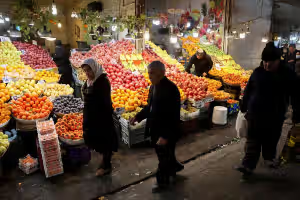
Shoppers walk through a crowded bazaar in Iran.

Iranians are struggling to afford basic food as bread prices rise sharply and citizens describe soaring costs for vegetables, snacks and other everyday purchases, according to an local media report and messages sent to Iran International on Monday.

Bread prices in the Iranian capital have risen sharply without official authorization, putting even bread and cheese beyond the means of some workers, labor-focused ILNA news agency reported.

“Things are very bad with bread, and the unofficial increase in bread prices has become staggering. There was a time when a worker could at least count on bread and cheese, but today they can no longer afford even that,” Ali Torkashvand, executive secretary of the Workers’ House, told ILNA.

The pressure comes as Iran’s official minimum wage stands at about 166.3 million rials per month, equivalent to roughly $72 at the open-market exchange rate.

  • Iran is living through America’s 2022 inflation shock almost every month

    Iran is living through America’s 2022 inflation shock almost every month

Messages sent separately to Iran International describe sharp increases across basic food and household purchases. One citizen said several kilograms of vegetables had cost 25 million rials, equivalent to about 15% of the monthly minimum wage.

“Damn the Islamic Republic for making people suffer this much. We really can’t afford to buy anything anymore,” the citizen said.

A packet of meat-flavored instant noodles cost 900,000 rials, another citizen said.

“I bought a few food and hygiene products and it came to 20 million rials,” another citizen told Iran International, a sum equivalent to about 12% of the monthly minimum wage.

Bread moves beyond reach

ILNA linked the rising cost of essentials to repeated currency depreciation and increases in energy prices, saying shocks to fuel and foreign-exchange costs feed through to food, medicine, housing and other necessities.

Wages and pension payments had failed to keep pace with rising prices, leaving workers struggling to meet basic household expenses, Torkashvand said.

The latest pressure follows the government’s decision to double Iran’s third-tier gasoline price to 100,000 rials per liter from September 8.

Higher gasoline prices could drive up the cost of other goods and services through increased transportation and production expenses, Torkashvand said.

Iran’s economy has come under mounting pressure from international sanctions and restrictions on trade and finance, the economic fallout from war and US efforts to block Iranian oil exports and other revenue streams, alongside declining investment and domestic economic mismanagement.

Workers were struggling with rising prices even before the latest gasoline increase, Ali Zamiri, a labor activist, told ILNA.

“Under the present circumstances, there is no longer any clear order or pattern to prices, while workers’ incomes have not changed in line with these rising costs,” Zamiri said.

Food prices outpace wages

Prices for some staples have risen far faster than overall inflation, with rice increasing by more than 200% and cooking oil by more than 300%, Majid Rahmati, a member of Tehran province’s Islamic Labor Councils board, told ILNA.

Rahmati called for increased food subsidies and higher wages and benefits during the second half of the Iranian year to offset some of the loss in purchasing power.

  • Iranians buy bread on credit, queue for chicken scraps

    Iranians buy bread on credit, queue for chicken scraps

The strain has also forced some families to seek credit for basic food. ILNA reported on Sunday that people in poorer areas of Tehran were asking neighborhood stores to let them buy groceries, meat, prepared meals and even bread on credit.

Shopkeepers themselves were finding it increasingly difficult to continue extending credit as their own costs rose, according to ILNA.

Hormuz diplomacy stalls as attacks deepen pressure on Persian Gulf oil routes

Sep 14, 2026, 00:40 GMT+1
100%
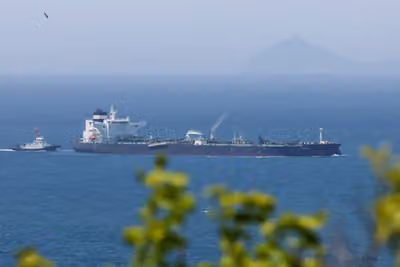
Vessels transit the Strait of Hormuz in an image published by ISNA on September 9, 2026.

Hormuz diplomacy hit a fresh setback Sunday as Oman postponed talks between Iran and Persian Gulf states, while attacks on shipping and Saudi energy infrastructure raised pressure on key regional oil routes.

The postponement came as Washington and Tehran hardened their positions over what any future negotiations should cover. The Trump administration wants talks with Iran focused on Tehran’s nuclear program rather than reopening the Strait of Hormuz, CNN reported, citing three sources familiar with the matter.

Iran, meanwhile, has signaled that it would consider nuclear negotiations only after the dispute over the strait is resolved, including the lifting of the US naval blockade.

Omani Foreign Minister Badr Albusaidi said the meeting planned for Monday in Salalah had been postponed “in the interests of consensus.” Iran’s IRGC-affiliated Fars News later reported that Tehran and Muscat had jointly agreed to the delay at the request of some regional countries.

Saudi Arabia had submitted amendments to the Omani-Iranian proposal over concerns that its wording could establish a new status quo in the strait unacceptable to Riyadh and other GCC states, Axios reported Sunday, citing a senior regional official.

The disagreements have emerged despite a flurry of regional diplomacy. Qatar’s prime minister and Oman’s foreign minister discussed efforts toward a solution guaranteeing freedom of maritime navigation, while the foreign ministers of Kuwait and Saudi Arabia also discussed ensuring the safety and freedom of shipping through Hormuz.

US blockade remains in force

The United States has continued to tighten its maritime pressure on Iran even as regional states search for a diplomatic arrangement.

US Central Command said Sunday that American forces had redirected 101 commercial vessels to ensure compliance with the blockade against Iran, up from 100 a day earlier.

US officials told CNN they believe American forces currently have the military upper hand in the strait, but questions remain over how long Washington can sustain the large-scale escort and naval operation.

Iranian Foreign Minister Abbas Araghchi has said an agreement with Oman on shipping arrangements would not itself reopen the strait, insisting that reopening depends on Washington meeting Tehran’s demands.

President Donald Trump, meanwhile, said Sunday that Iran “wants to make a deal so badly” and suggested the war could end before or shortly after the US midterm elections.

Vessel strike adds to Hormuz risks

Security risks around the strait also intensified on Sunday after an Iranian commercial container ship was struck by an unidentified projectile near Hengam Island, off Qeshm.

Iranian authorities said one crew member was killed and four others wounded. UK Maritime Trade Operations separately reported a vessel struck by an unknown projectile in the Strait of Hormuz, followed by a fire and crew evacuation, though it was not officially confirmed that the two reports concerned the same vessel.

Several explosions of unknown origin were also reported later Sunday in Sirik, in southern Hormozgan province, according to Iranian state media.

Saudi oil route under pressure

The pressure on Hormuz has become more acute for Saudi Arabia after drone attacks forced it to shut its East-West oil pipeline, a critical route carrying crude from the kingdom’s eastern oilfields to the Red Sea.

The pipeline had been transporting around 4 million barrels per day and allowed Riyadh to bypass the disruption in Hormuz. Reuters reported that stocks at the Red Sea port of Yanbu may be sufficient to sustain exports for only five to seven days if the pipeline remains shut, after which as much as 4% of global oil supply could be at risk.

Oil prices rose sharply as markets reopened, with Brent climbing above $108 a barrel after fresh attacks on Saudi Arabia and shipping in the Persian Gulf.

The Iraqi government has meanwhile stepped up security measures after Saudi Arabia said drones used in the pipeline attack were launched from Iraqi territory. Baghdad has begun reopening several border crossings with Iran after temporary closures and security reviews, with commercial traffic through Shalamcheh expected to resume Monday.

Houthis tighten pressure at Bab el-Mandeb

Saudi Arabia is also facing growing pressure on its western flank as Yemen’s Iran-aligned Houthis expand their position around Bab el-Mandeb, the narrow waterway linking the Red Sea to the Gulf of Aden.

The Houthi advance along Yemen’s Red Sea coast has raised fears that Saudi oil exports diverted away from Hormuz could face disruption at a second chokepoint. The US Navy has remained on high alert as the Houthis move closer to Bab el-Mandeb.

The Houthis said Sunday that four commanders of Saudi-backed Yemeni forces were killed and five others wounded in operations near Bab al-Mandab, according to the group-run Saba news agency.

The combination of pressure at Hormuz, attacks on Saudi infrastructure and Houthi gains near Bab el-Mandeb is narrowing the region’s alternatives at a time when diplomatic efforts remain divided over the terms of any maritime settlement.

With the Oman meeting now postponed and Washington and Tehran publicly at odds over the agenda for negotiations, there is no clear timetable for a diplomatic breakthrough even as the economic and military costs of the conflict continue to rise.

Tweet unavailable