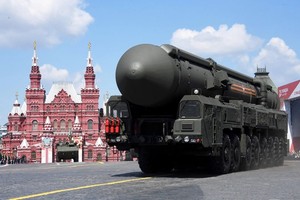
Russia has secretly helped Iran develop supersonic cruise missile technology that experts say could give Tehran a new way to threaten US Navy vessels in the Middle East, the Financial Times reported, citing leaked Russian correspondence, travel records and military patents.
The program, codenamed C430L, began in 2023 and continued during this year's war with the United States and Israel, the FT said.
Its main focus is a ramjet propulsion system that would allow a cruise missile to sustain flight at several times the speed of sound, reducing the time available for US and allied defenses to detect and intercept it.
“For the Iranians, this would give them a qualitatively new strategic weapon system that could threaten US Navy vessels,” Jim Lamson, a former CIA military analyst focused on Iran, told the FT.
Iran has built and flight-tested the propulsion system, but there is no evidence that a Russian-assisted supersonic cruise missile has entered service, the newspaper said.
Russian technical support
The FT said Russia's state arms exporter Rosoboronexport arranged the program with missile developer NPO Mashinostroyenia.
Russian engineers made repeated trips to Iran before a contract was signed with Iran's Ministry of Defense and Armed Forces Logistics in November 2023, according to records reviewed by the newspaper.
By 2025, Russian specialists were analyzing Iranian flight-test data and advising Tehran on the ramjet's fuel system, combustion stability, air intake and engine nozzle.
“This is the transfer of a highly strategically sensitive military technology from Russia that the Iranians have wanted to acquire for decades,” Fabian Hinz, a senior analyst with Conflict Armament Research, told the FT.
“A programme like this would require political clearance from the very top in Russia,” he said.
The Kremlin, Rosoboronexport, NPO Mashinostroyenia and the Iranian government did not respond to requests for comment from the FT.
Potential naval impact
Supersonic cruise missiles combine high speed with low-altitude flight, making them harder for air and missile defenses to detect and engage quickly.
That could be particularly significant in the Persian Gulf, where the United States and its regional allies operate advanced land- and sea-based defenses.
Hinz said Russian engineering support could be especially valuable because it would help Iran solve technical problems rather than simply provide finished weapons.
“Getting a 60-year-old engineer to fly over and problem-solve, using their experience, is hugely valuable,” he said.
The FT said the program continued into 2026, with Russia preparing technical reports and both sides discussing a further phase of development.
A June 2026 Rosoboronexport letter showed talks were still under way over that next stage, though it was unclear whether it had begun.
Deeper military ties
The program points to a deeper form of military cooperation between Moscow and Tehran, with Russia helping Iran acquire the know-how to develop an advanced weapon system of its own.
Iran previously supplied Russia with Shahed attack drones used in Ukraine and helped Moscow establish domestic production.
The FT has also reported that Russia agreed to supply Iran with Verba shoulder-fired air defense systems, while Tehran acquired a high-resolution Chinese satellite later used to monitor US military facilities in the region.
“If the Russians are able to help the Iranians fix their technical problems, I think this would be one of the more impactful areas of Russian military-technical assistance to Iran in recent years,” Lamson said.
Iran's president spent Tuesday assuring Xi Jinping, Vladimir Putin and Narendra Modi that Tehran would return to the Islamabad framework if Washington did. As he spoke, news broke that two Saudi tankers had been hit in the Strait of Hormuz.
Masoud Pezeshkian was at the Shanghai Cooperation Organization summit in Bishkek when the news came in.
Two supertankers, each carrying 2 million barrels of Saudi crude loaded at the Juaymah terminal, were struck within minutes of each other as they sailed out of the strait off Khasab, Oman, according to the shipping intelligence firms Marisks and Kpler.
The timing was, at minimum, unhelpful to Pezeshkian, and it fits a pattern in which his intermittent push for de-escalation is contradicted within hours by events in the strait. Whether by design or coincidence, escalation in Hormuz has repeatedly arrived at the moments his diplomatic track needed quiet.
It did not stay at tankers. By Tuesday night the most significant exchange of fire in weeks was under way. US Central Command said it had struck Revolutionary Guards air defenses, radar, maritime assets, mine-laying capabilities and communications sites, with Iranian media reporting hits near the strait.
Iran said it struck American assets in Bahrain, Jordan, Kuwait and Iraq; Jordan reported intercepting 10 of 13 ballistic missiles, and a drone set a residential block alight in Kuwait City. The Guards claimed heavy American casualties in Jordan and Erbil. Two US officials told Reuters initial assessments found none.
The civilian toll was not in dispute. Five people were killed and dozens wounded near Sirik on the Hormuz coast, according to the Iranian Red Crescent, with the Mehr news agency reporting a four-year-old among the dead. Seven more were killed in strikes on Khuzestan province.
Pezeshkian, it should be said, was not offering peace. He paired his appeal for a mutual return to the Islamabad framework with a declaration that Iran remains prepared to fight, which is the standard formula and the reason his diplomacy has never been the alternative to the war camp that outsiders sometimes take it for.
Inside Iran the coverage and the anxiety pointed in different directions. Newspapers led on the fight over Hormuz and the arguments over the war and the nuclear file; the public was watching the exchange rate.
And when Pezeshkian's de-escalation push was defended at all, it was defended by his own side: outlets close to the administration were the only ones to amplify his son Yousuf and Vice President Jafar Ghaempanah, who spoke up for him.
Both sides want the same thing
What makes the collapse of the past week strange is that the two governments are asking for the same outcome.
At the G20 finance ministers' meeting in Asheville, North Carolina, US Treasury Secretary Scott Bessent set out a dual-track strategy of financial pressure and calibrated military action, emphasizing economic isolation under Operation Economic Outcast over any broad expansion of the war.
Secondary sanctions and banking blockades, he said, are meant to force Tehran back to negotiations without committing ground forces.
That is, in substance, what Pezeshkian was asking for in Bishkek. Both capitals want a route back to talks. Neither can stop shooting long enough to find one.
A controlled cycle, for now
The shape of the conflict supports that reading. What is visible is a tit-for-tat pattern: targeted American strikes on Iran's mine-laying and air defense assets, localized Iranian missile and drone retaliation, both sides using maximum leverage without opening a sustained strategic bombing campaign.
Constraint is part of the explanation. Iran's war-damaged economy and degraded conventional forces have left it stretched, while the US Army has burned through much of its global stockpile of precision long-range missiles, as Reuters reported last month. Trump's own position is complicated by fuel prices rising ahead of November's congressional elections, and this week's strikes pushed oil to a five-week high and sent Asian stocks down.
The rhetoric has not adjusted. "I like our position now much better, with almost total control of the Hormuz Strait, and their economy totally collapsing," Trump said, asking when Iranians would "rise up and fight." Iran's joint military command warned that any country aiding American action in the region would face "heavier, more widespread, and devastating responses."
Washington's attempt to assemble an economic coalition is meeting resistance from partners wary of further disruption to energy and trade, particularly amid tariff disputes. Major importers in Europe and Asia want maritime stability restored rather than prolonged hostilities.
In Bishkek, Xi urged all parties to end the conflict at Hormuz, warning that continued instability threatens energy routes for everyone, which is Iran's largest customer asking it, in public, to stop.
Qatar, which mediated the June ceasefire that swiftly unraveled, went further, holding Iran "fully legally responsible" for this week's attacks and their consequences.
Both sides are pursuing leverage rather than victory. The trouble with leverage is that it only works if the other side can concede, and nobody in Tehran has shown any sign of conceding on the strait.
Peru severed diplomatic relations with Iran on Tuesday, accusing Tehran of escalating conflicts in the Middle East, restricting shipping through the Strait of Hormuz and obstructing nuclear inspections.
“The government of the Republic of Peru has decided to sever diplomatic relations with the Islamic Republic of Iran,” the Foreign Ministry said.
Lima cited what it described as Iran’s repression of peaceful protests, restrictions on press freedom, discrimination against women and girls, and persecution of political opponents.
“Within the framework of its firm commitment to defending democracy, a fundamental principle of its foreign policy, Peru has observed with growing concern the deterioration of democracy in Iran, as documented by various United Nations mechanisms, particularly regarding the repression of peaceful protests, violations of press freedom, discrimination against women and girls, and the persecution of political opponents,” read the statement.
The ministry said Iranian restrictions and disruptions to international trade through Hormuz since March violated freedom of navigation, harmed energy markets and threatened global supply chains.
“The government of Peru views with deep concern the severe restrictions imposed by the Iranian regime, as well as the disruption of international trade through the Strait of Hormuz since March 2026, because they contravene principles such as freedom of navigation and the right of passage through straits used for international maritime transit, which cannot be subject to unilateral conditions, while also affecting navigational safety, the protection of human life at sea and the preservation of the marine environment, in addition to their repercussions for energy prices and the stability of global supply chains,” the foreign ministry said.
Lima also linked the diplomatic rupture to broader security concerns, accusing Tehran of fueling regional violence and denying UN nuclear inspectors’ access to facilities needed to verify that Iran was not developing nuclear weapons.
“The government of Peru also strongly rejects Iran’s incitement to violence and the escalation of conflicts in the Middle East, as well as its obstruction of the work of the International Atomic Energy Agency,” it said.
Peru will maintain consular relations to protect the two countries’ citizens and interests. The decision was communicated to Tehran through Iran’s embassy in Ecuador, which also covers Peru.
Iranian authorities did not immediately respond to Peru’s decision.
Calls for preemptive strikes on US forces are growing in Iran after renewed US attacks, intensifying debate over whether Tehran should shift away from a mainly retaliatory strategy.
The latest cycle began with a US strike on Revolutionary Guards targets on Larak Island in Hormozgan province Sunday night, after a period in which Washington had increasingly emphasized economic pressure, a naval blockade and additional sanctions on Iran.
Iranian authorities initially reported two deaths, but the toll later rose to three after one of the wounded died in hospital, according to the IRGC-affiliated Tasnim news agency.
US Central Command said the Larak strike targeted an “imminent threat,” alleging Revolutionary Guards forces were preparing to launch rockets carrying sea mines toward the Strait of Hormuz. Tehran rejected that account.
Iran responded early Monday with missile and drone attacks on two US bases in Jordan, according to the Revolutionary Guards, which said it had targeted technical and maintenance infrastructure and areas where fighter jets were stationed. Iran’s army separately said it had launched dozens of explosive drones at US personnel and helicopters at Al Minhad Air Base in the United Arab Emirates.
Iran also said after the Larak strike that its forces had shot down US MQ-9 drones over and east of the Strait of Hormuz. There was no immediate US confirmation of those claims.
The confrontation escalated further Tuesday when President Donald Trump announced “large and powerful” US strikes on Iranian targets near the Strait of Hormuz, warning Tehran that retaliation would trigger attacks at a “much harder and higher level.”
CENTCOM later said it had completed a new wave of strikes against Iranian military targets including air defenses, radar systems, maritime assets, mine-laying capabilities and communications sites. US officials told Axios that around 100 targets were struck.
Trump later told Fox News that Iranian radar systems were among the targets.
“They tried to rebuild their radar because they can’t see anything,” he said. “We waited until it was almost built and then we hit it.”
Iran responded with another round of missile and drone attacks on US positions across the region. The Revolutionary Guards said it targeted US facilities in Jordan and Erbil, while Iran’s army said it launched a large-scale drone attack on Sheikh Isa Air Base in Bahrain. Bahrain said its air defenses intercepted and destroyed Iranian drones over the kingdom.
The IRGC also said it had begun responding to the latest US strikes and claimed its air defenses had shot down what it called the 50th US MQ-9 drone. The claim has not been independently confirmed.
Calls for a change in strategy
The widening exchange has unfolded alongside an increasingly explicit debate inside Iran over whether its armed forces should move from retaliating after attacks toward acting when they detect signs that an attack is imminent.
Iran’s leadership has not formally announced any shift toward a preemptive doctrine.
But even before Trump announced Tuesday’s new strikes, political figures close to the establishment were arguing that the confrontation had exposed the limits of diplomacy and of waiting to respond after US military action.
Ali Gholhaki, a political activist close to parliament speaker Mohammad Bagher Ghalibaf, argued Tuesday that the Larak strike had demonstrated the “audacity of the United States” and showed that Washington was prepared to resume significant military action after a period of relative restraint.
He also said expectations of reviving the Islamabad understanding had been disappointed.
“It seems that resolving the issues in the ‘military field’ — given the conditions inside and outside Iran — will be more feasible than ‘diplomacy,’” he wrote.
The argument contrasts with President Masoud Pezeshkian’s continued insistence Tuesday that Iran was prepared to return to the Islamabad memorandum if the United States resumed compliance with its commitments.
Nour News, a website close to Iran’s Supreme National Security Council, said Tuesday that the Larak attack and Iran’s response should not be viewed simply as another cycle of “attack and retaliation,” but as a “sign of a change in the battlefield.”
The website linked Mohsen Rezaei’s appointment as secretary of the Supreme National Security Council to an approach aimed at raising the costs of US military decisions and shifting some of the war’s pressure toward the US economy and domestic politics.
“In the previous model, the United States attacked and Iran responded to maintain deterrence. But in the new model, the response is not only to punish the aggressor; rather, the action must be designed in a way that makes the next US decision more difficult and costly,” Nour News wrote.
It argued that Iran was seeking to confront Washington with a dilemma: restraint by the United States could be interpreted in Tehran as evidence that the threat of force had lost some of its deterrent value, while further US attacks could raise risks to energy supplies and economic stability.
Tasnim, which is affiliated with the Revolutionary Guards, similarly portrayed the speed of Iran’s response to the Larak strike as evidence that the gap between political decision-making and military action was narrowing.
The agency argued that Iran should move from an “immediate response after an attack” toward readiness for “action at the first serious signs of an attack,” while acknowledging the political and strategic risks of such a shift.
Hardline lawmaker Mahmoud Nabavian went further, openly calling for a preemptive attack on US interests across the Middle East.
“Given the enemy’s depleted war reserves, rising fuel prices and the proximity of the US congressional elections, the enemy is seeking to reduce tensions,” Nabavian wrote on X. “So now is the best time for a preemptive attack on US interests in the region, forcing the enemy to retreat and breaking the blockade.”
He described failing to act as “wasting the opportunity.”
The calls do not amount to an announced change in Iranian military doctrine. But they show a growing argument among hardline and security-linked voices that waiting for each US strike before responding leaves Washington with too much control over the pace of escalation.
Hormuz becomes central to military calculus
The debate is closely tied to the struggle over the Strait of Hormuz, where both sides increasingly portray military pressure and control of commercial shipping as part of the same confrontation.
Iranian officials continue to insist that ships cannot transit the strategic waterway without coordination with Tehran. Lawmaker Esmail Kosari said Tuesday that vessels attempting to cross without coordination would be confronted by the Revolutionary Guards.
In a video interview Tuesday, Ghalibaf said: “The Americans falsely assure ships that they can pass through the Strait, but those ships come under attack.”
Iranian military-linked outlets have also reported attacks or threats against vessels Tehran considers noncompliant. The IRGC said one supertanker caught fire after striking two naval mines, but CENTCOM rejected that account and said no vessel had struck mines in the Strait.
Fars separately reported that a Saudi tanker, Cedar, had stopped while transiting the southern corridor of the Strait, but did not establish that Iranian forces had detained the vessel.
The maritime confrontation widened further Tuesday when the US military struck two Iranian government tankers. Axios reported that the attack was carried out under a new “tanker for tanker” policy approved by Trump in response to Iranian attacks on shipping.
US officials said the two tankers were anchored off Iran’s coast north of the US naval blockade line when drones launched missiles into their engine rooms. Axios said it was the first time the US military had struck Iranian tankers in retaliation for attacks on shipping rather than to enforce the blockade.
The escalation leaves the debate inside Iran no longer centered solely on how to answer individual US attacks. Increasingly, the argument is over whether Tehran should try to anticipate them — and whether doing so would strengthen deterrence or instead accelerate an already widening regional war.
An Iranian court has sentenced Ali Zarei Doozdarresi, a protester shot by security forces and blinded in one eye during the 2022 protests, to death after he returned from Germany and was arrested upon arrival in Iran, US-based rights outlet HRANA reported.
Branch 23 of the Tehran Revolutionary Court convicted Zarei of “corruption on Earth,” based on alleged acts including extensive political activity, producing false news, propaganda against the establishment, disrupting security and unauthorized entry into and exit from the country, according to HRANA.
The death sentence was communicated to him on August 23, HRANA said.
Zarei, around 27 and from Tehran, was arrested by Intelligence Ministry agents on April 28 after returning to Iran. His case was initially handled by Branch 3 of Tehran Prosecutor’s Office District 33, known as the Security Prosecutor’s Office, before he was transferred to Qezel Hesar Prison in Karaj on June 30.
He is currently being held in Unit 3, Ward 37 of the prison, according to HRANA.
Zarei lost sight in his right eye after being shot during the 2022 Woman, Life, Freedom protests. He was later detained in December 2023 while visiting the graves of protesters killed in the crackdown at Tehran’s Behesht-e Zahra cemetery and spent 33 days in solitary confinement in Evin Prison.
He subsequently left Iran and reached Germany on a humanitarian visa.
While in Germany, Zarei appeared on stage at a February 14 rally in Munich held on the sidelines of the Munich Security Conference alongside exiled Prince Reza Pahlavi who had called for the gathering.
Iranian authorities have increasingly used the death penalty against protesters and political dissidents. Amnesty International has accused authorities of continuing to “weaponize the death penalty to repress dissent,” saying politically motivated death sentences have followed grossly unfair trials.
Last month, Norway-based Iran Human Rights said 29 people arrested in connection with the January 2026 protests had been executed since March 19, in addition to two protesters from the 2022 Woman, Life, Freedom movement. The group said hundreds of protesters were facing the death penalty and warned of an escalation in executions of political prisoners.
The US-based Center for Human Rights in Iran has also said authorities are increasingly using fast-tracked group prosecutions to sentence protesters to death, describing the practice as part of a strategy to punish those who joined protests and deter future dissent.